Key Takeaways
- A workable MOQ for custom drinkware often starts at 500 to 1,000 pcs, but decoration and mold complexity can move it fast.
- A Zhejiang canteen factory with 80,000 to 150,000 units/month gives you better schedule control than a small workshop.
- REACH, LFGB, FDA, and AQL 2.5 are not paperwork extras; they are the difference between smooth import and costly rework.
- For distributor canteen programs, packaging and barcode accuracy matter as much as the bottle itself.
If you are sourcing suppliers drinkware for retail, corporate gifting, or channel distribution, the hard part is not finding a factory. The hard part is telling a real canteen factory from a trading outfit that only knows how to quote low and stall. In Zhejiang, the better suppliers answer straight on MOQ, decoration limits, test standards, and ship dates. The weak ones go quiet after the sample is approved. We run this every week, and QC pulled a 304 stainless sample at 1.0 mm wall thickness last month because the buyer flagged a dent at the handle weld.
You should treat custom drinkware like a specification project, not a catalog buy. A custom canteen or custom growler only pays back when the material, wall thickness, closure, carton pack, and branding method fit the sales channel. If the carton drops one bottle in a 1.2 m test, the math does not work. For a distributor program that has to survive returns and margin pressure, you need a canteen manufacturer that holds consistency at scale, not just a logo printer. We have seen this go sideways on a PO typo for 5,000 pcs, so ask the hard questions before you pay the sample fee.
Start With the Sales Channel
I’m rewriting the section to sound like a factory-side sales note: channel first, then spec, with concrete production details and fewer generic transitions. I’m keeping the HTML tags and list structure unchanged.Before you ask for prices, define where the product will be sold. A 500-piece canteen promo for a March trade show is a different job from an Amazon replenishment SKU or a chain-store top-up. Retail wants 48 pcs/carton, barcode placement that scans cleanly, and defect control that stays inside AQL 2.5. Corporate gifting cares more about print area, ship date, and whether the buyer will kill the order over a 3-day slip. This is where a lot of RFQs go sideways.
For a custom canteen, the channel sets the spec. A school program may take a 420 ml lightweight stainless body with a wide-mouth lid. A premium outdoor account may want a customized growler with thicker 18/8 stainless, vacuum insulation, and a powder coat that survives a 1.2 m drop test. QC pulled the sample after the lid torque drifted 0.3 N·m. A distributor usually needs a stable SKU, while a one-off promotion can live with more variance. The math does not work if you price both with one assumption.
- Retail: prioritize barcode placement, carton strength, and a finish that stays consistent across the whole lot.
- Promotional: prioritize logo size, a 10-day lead time, and color flexibility across 6 Pantone targets.
- Distribution: prioritize repeatability, spare parts, and packaging uniformity from case to case.
If your plan includes distributor drinkware or distributor growler programs, ask the factory to quote the 1,000-piece pilot run and the 5,000-piece replenishment run separately. We ship those on different carton counts, and the first run often carries setup cost that disappears on repeat. A PO typo like “matt black” instead of “matte black” has cost us a full day on the line before, so split the numbers early and keep the landed cost honest after sell-through.
Know the Material Tradeoffs
The material choice sets durability, weight, odor control, and price. Stainless steel is still the default for a customized canteen because it takes insulation, printing, and shipping abuse better than the rest. On our line, QC pulled a 304 sample with a 0.5 mm inner wall off the vacuum leak tester and it held up as expected; 0.7 mm is a safer baseline for mid-market custom drinkware, and 18/8 stainless sits in the same bucket. If the buyer wants a lighter cup, we can thin the wall, but the math is simple: dent resistance and thermal hold drop with it.
Plastic has a place, mainly for low-cost canteen promotional kits, but the spec has to be tight. Resin grade, lid seal, and odor control matter more than the headline price, and we have seen a PO list the wrong resin code and send the whole order back for correction. Glass works for premium shelf appeal, but it adds breakage risk and packing cost. This is the wrong question to ask: not "what can you make?" but "what can you hold at the target defect rate, every run?"
What to verify in the spec
- Stainless grade: 304, 316, or 201, depending on corrosion risk and budget.
- Wall thickness: 0.4 mm, 0.5 mm, 0.7 mm, or thicker for heavy-duty use.
- Seal type: silicone, TPE, or PP components with documented food-contact compliance.
- Finish: powder coat, spray paint, polished, or brushed, with scratch expectations defined.
For a custom growler or customizable growler, pay close attention to neck finish and cap torque. We run a torque gauge on the cap station, because a loose closure turns a premium-looking bottle into a claims file fast. The same applies to a customized drinkware line sold into Europe; REACH and LFGB need to be confirmed before mass production, not after the first container leaves China. QC has seen buyers flag a one-letter typo on the artwork proof, and that small miss can stop a shipment.
Check Factory Capability Honestly
Buyers often ask for price before they check whether the canteen factory can make the product to spec. That is the wrong order. First, ask for tooling control, in-line inspection, and stable output. A real factory in Zhejiang or anywhere else in China should tell you its monthly capacity, machine list, and inspection flow without pausing to invent answers. If the reply stays vague, you are probably talking to a broker, not a factory. We have seen that go sideways fast, usually after the buyer flags a PO typo and the line is already booked.
A serious canteen factory will usually share production data: 80,000 to 150,000 units/month on standard stainless SKUs, with a lead time of 25 to 40 days after sample approval and deposit. That number matters because a canteen suppliers list only helps if the people behind it can hit your ship window. For a canteen customized program, ask whether laser engraving, silkscreen, heat transfer, and powder coat run in-house or through subcontractors. Every handoff adds delay and variation. QC pulled the sample on a 0.2 mm coating miss once, and the buyer rejected the lot on the spot.
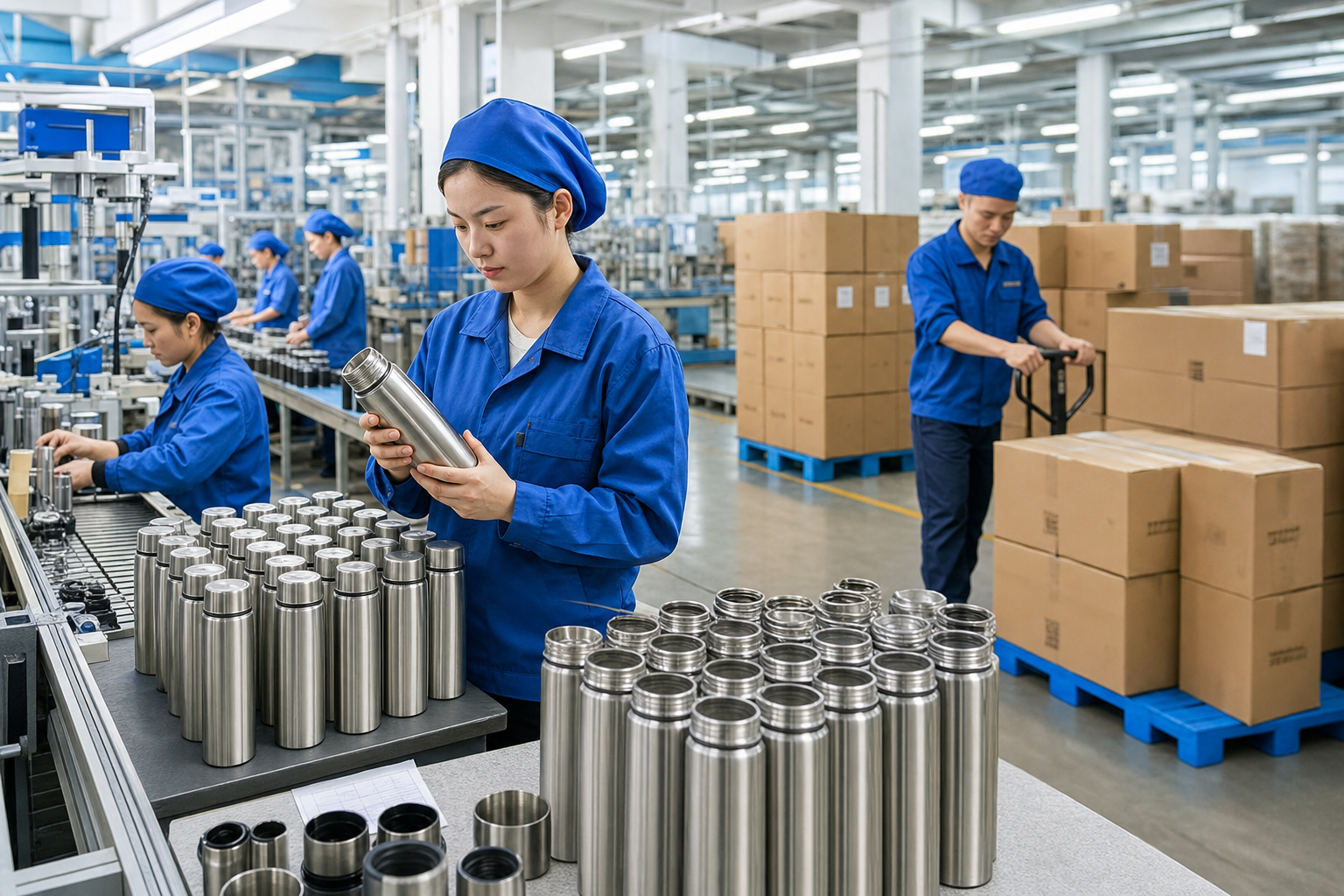
Ask for proof, not promises: production photos, line layout, test reports, and recent export destinations are more useful than a polished catalog.
- Request a recent QC report with defect counts and AQL criteria.
- Confirm whether the factory works to ISO 9001 or another audited system.
- Verify BSCI if your buyer or retailer requires social compliance.
If the supplier says they are both a canteen vendor and a canteen manufacturer, ask for the production address and who owns the molds. Real capacity shows up in people, equipment, and process, not in a sales deck. Walk the line if you can. A proper factory will show you the vacuum forming machine, the torque wrench at the packing table, and the mold room without a song and dance.
Design the Branding Correctly
Branding choices move cost fast, and buyers usually see that only after the sample bill lands. A one-color silk screen on a 500 ml canteen is a different job from a full-wrap print or 0.2 mm deep laser engraving. If you want a custom canteen for a distributor drinkware program, pick the logo method for both appearance and line time. Silkscreen stays the cheapest path for a simple mark. Laser engraving is clean and durable, but on matte powder coat it can look thin. UV print gives color, yet it adds two prep steps, and if the surface wipe is weak the reject rate climbs. We have seen QC pull the sample and flag dust under the ink.
The best canteen distributors know decoration is not just visual. It changes the order flow, because each variant becomes its own SKU. If you are buying for a retail chain, cap the print positions, lid colors, and body colors. A canteen promotional campaign gives more room, but every extra option adds one more carton label, one more bin on the packing table, and one more chance for the buyer to flag a mix-up. The math doesn't work if the PO has six variants and only one sell-through forecast. A clean spec sheet saves money because the line can run without stopping to sort parts.
- Define artwork in vector format and state Pantone references. We check the file in Illustrator before plate making.
- Set a print tolerance for placement, usually within 2 to 3 mm. On our jig, a 1 mm drift shows up fast on a curved body.
- Confirm whether the logo must survive dishwasher cycles or abrasion testing. We have seen a PO typo on "dishwasher" turn into a claim fight after QC ran 50 cycles.
For a customized canteen or customized drinkware run, ask the supplier to make a pre-production sample with the exact finish, not a near match. We ship too many orders where the buyer signed off on a close color and then changed the goalpost at mass production. A sample that "looks close" is a warning sign, not an approval. If the sample is off by even one shade on the spectro, stop there.
Price Against Landed Cost
The supplier unit price is only one line on the worksheet. Landed cost is the number that matters: packaging, inland freight in China, export docs, ocean or air freight, and destination charges all sit on the same invoice stack. A canteen quote at USD 2.10 is not cheaper than USD 2.35 if the first run uses thin cartons, breaks more cartons in the line test, or slips 12 days and pushes you into air freight. We have seen a buyer flag a PO because the carton spec said 24 pcs, but the sample pack only held 20.
For a custom growler or distributor growler order, packaging changes the math fast. Double-wall cartons, molded pulp trays, and individual polybags all add cost, but they protect margin when your channel is strict on damage. Ask for FOB first if you are shipping into North America or Europe, then build your own freight model. That gives you a clean comparison between canteen suppliers. On our packing bench, a 6 kg carton that passes the drop test can beat a cheaper carton that fails on the first corner hit.
What usually moves price
- Material grade and thickness.
- Decoration complexity and number of print colors.
- Cap style, gasket count, and accessory set.
- Packing method and carton test requirement.
Do not let a low MOQ distract you from the real economics. A 500-piece order at a higher unit price can still beat a 3,000-piece order if it lets you test sell-through before you scale. That is the right move on canteen customized launches, because the first run is a market test, not a final promise. We run this trade-off every week on the line, and the math usually beats the sales pitch.
Set Quality Gates Early
If you want fewer disputes, set the quality gates before the first run starts. The usual miss in custom drinkware is not one big defect; it is five small ones stacked together. The logo shifts 1 mm on the tumbler body, the lid color drifts by one Pantone step, vacuum hold drops from 12 hours to 8, or the carton code prints off-center. QC pulled the sample at the line, and those small misses were already enough to trigger a buyer complaint.
A capable canteen manufacturer should lock in measurable checkpoints: first article approval, in-process inspection, and final inspection using AQL 2.5 for major defects and 4.0 for minor defects, or the standard your team already uses. For Europe-bound shipments, ask for REACH documentation and check whether the material declaration covers coatings, gaskets, and inks. For the United States, ask for food-contact compliance records and test reports tied to the exact production batch. We run this way every week in Zhejiang, and a buyer who skipped batch-level reports once found a 304 stainless lot with the wrong ink code on the carton. The math does not work if the paperwork is loose.
- Approve the pre-production sample with written sign-off.
- Confirm the golden sample is sealed and archived.
- Require carton drop-test or ISTA-style packaging verification if the route is rough.
If your project is a customized growler program, include leak testing and closure torque in the QC checklist. A 0.8 N·m torque target is not a guess, and we have seen a cap pass hand-tightened but fail after 24 hours on the shelf. If it is a canteen promotional campaign, put logo consistency and carton accuracy first. The buyer flagged a PO typo on the ship mark once, and the whole pallet had to be reworked. Quality needs numbers, or every shipment turns into a debate.
Source custom drinkware with fewer surprises
Send your spec, target MOQ, and shipment window. We can quote a canteen customized program or distributor drinkware line with clear factory terms.
Frequently asked questions
What MOQ should I expect from suppliers drinkware in China?
For standard stainless custom drinkware, a realistic MOQ is usually 500 to 1,000 pcs per color or per decoration. A simple canteen custom order with one logo position is easier to place at the lower end. Once you add multiple body colors, custom lids, or molded accessories, MOQ often rises to 2,000 pcs or more. A Zhejiang canteen factory with stable tooling may support mixed orders, but only if the runs can be scheduled efficiently. Always ask whether MOQ is tied to material, decoration, or packaging, because those are not the same constraint.
How do I verify a canteen manufacturer is real?
Ask for the factory address, business license, production photos, machine list, and recent export shipment records. A real canteen factory should be able to show line capacity, QC checkpoints, and who owns the molds. If they claim to be a canteen manufacturer and a canteen vendor at the same time, that is fine only if they can prove they control production. You should also ask for audit records such as BSCI or ISO 9001 if your customer needs them. A trader can quote quickly; a factory can explain process details and lead times without guessing.
Which decoration method is best for custom canteen orders?
It depends on the channel. Silkscreen is usually the most cost-effective for a simple logo on a custom canteen or customizable canteen. Laser engraving is more durable and fits premium or outdoor use. UV print works when you need more color, but it can add cost and surface-prep risk. For canteen promotional projects, speed and price often make silkscreen the default. For a distributor canteen or distributor drinkware line, laser engraving may reduce complaints because it resists wear better. The best answer is the one that matches how the product will be handled after sale.
What lead time is normal for customized drinkware?
For a standard sample, 5 to 10 days is common if the mold already exists. For production, 25 to 40 days after sample approval and deposit is normal for many stainless SKUs in China. If you are changing the lid, building a custom growler, or requesting special packaging, expect the schedule to stretch. A canteen factory in Zhejiang with 80,000 to 150,000 units/month can usually move faster on repeat SKUs than on new tooling. Air freight can hide a weak production plan, but it does not fix it. Build the timeline around factory capacity, not around your ideal launch date.
What compliance documents should I request?
For Europe, ask for REACH and, where relevant, LFGB or food-contact support documents tied to the exact materials. For the United States, ask for food-contact declarations and any applicable ASTM or testing references if your buyer requires them. If you are sourcing from China, also request a material declaration for the body, lid, gasket, coating, and ink. For larger distributor growler or customized canteen programs, insist on batch-specific records and final inspection data. If the supplier cannot connect the paperwork to the actual production lot, the document is not very useful.