Key Takeaways
- A real bulk thermos order usually starts at 500-1,000 pcs, not 50 pcs, if you want stable unit pricing.
- 304 stainless is the common baseline; 316 is worth the extra cost only for specific corrosive use cases.
- For Europe and North America, ask for REACH, LFGB, FDA-related materials declarations, and an AQL plan before deposit.
- A good thermos supplier should quote print method, packaging, and lead time separately, not hide them in one lump sum.
If you are sourcing suppliers thermos for outdoor retail or promo runs, the mistake shows up fast: every factory claims custom thermos, but only a real manufacturer thermos keeps heat, passes compliance, and ships on the date you booked. We run into this all the time. A trading layer can hide two weeks of delay and add 8% to the landed cost, while the real plant has a vacuum leak test, a salt spray bench, and QC pulling the sample before the cartons leave the line.
For buyers in Europe and North America, the question is simple. What is the bulk price, what proof of quality is on file, what lead time is real, and how much customization fits before the MOQ bites? In Zhejiang, the stronger supplier thermos teams answer with numbers, not sales talk: 80,000 units per month, 500-piece MOQ on selected models, and 25-35 days once artwork is signed off. We have seen buyers push a 12-color print onto a 300-piece order; the math does not work, and the PO typo usually shows up before sampling is done.
What buyers mean by suppliers thermos
When buyers search for suppliers thermos, they are not hunting a catalog. They want a factory partner that can run repeat orders, protect the logo, and clear export paperwork without surprises. That matters. A distributor can sell stock, but a thermos manufacturer should be able to explain 304 stainless, vacuum test results, coating options, and why one lid adds USD 0.35 on the line. QC pulled the sample after a 6-hour heat test, and that is the sort of detail buyers remember.
For outdoor retailers and promotional brands, the real question is not whether they can make it. The question is whether they can hold the same cap torque, print color, and leak rate across 5,000 units without the buyer flagging the second carton. In Zhejiang, the better thermos suppliers already run fixed molds, a foil printer, and carton packing on the same shift. They can support a custom thermos run, a thermos promotional order, or a retail thermos build without tearing down the whole bottle each time. That is the line between manufacturers thermos buyers can work with and a vendor that only moves what is sitting on the shelf.
Ask three things up front: monthly output, MOQ by model, and whether the vacuum line is in-house or outsourced. If they dodge that, the risk is usually lead time, finish variation, or thin after-sales support. We saw a PO typo on the carton mark cost two days, so this is the wrong question to ask softly. A solid supplier thermos team answers in numbers, not adjectives.
Stainless steel that holds heat
For a stainless thermos, the steel spec sets the baseline. Most custom thermos jobs use 304 stainless on both the inner and outer wall because it keeps cost in line, resists corrosion, and we can source it without drama. If the buyer wants better resistance to salty air, sports-drink acids, or a tougher wash cycle, 316 is the safer call, but the unit price goes up and the mill schedule can stretch by 7 to 14 days. That is normal on our side, not a warning sign.
Do not judge the bottle by steel grade alone. Wall thickness, vacuum level, neck geometry, and lid seal design all move the needle on heat retention. We have seen a 0.4 mm wall with a clean vacuum and a tight screw cap beat a thicker body with a lazy seal. The math does not work any other way. For bulk thermos orders, ask for a measured heat-retention curve, not a line like "keeps hot for 12 hours." A real factory thermos supplier should show test data at fixed conditions, usually with hot-fill and ambient starting points. QC pulled the sample last week and found a 3 degree drop from a bad gasket fit, which is the kind of issue that actually matters.
What to verify
- Inner liner and outer shell grade, usually 304 or 316
- Vacuum integrity and leak test method
- Lid gasket material, often silicone
- Finish type: powder coat, spray paint, or bare steel
If your thermos custom project is for retail, the finish matters as much as the steel. Scratch resistance, color consistency, and fingerprint marks are easy to see on shelf. If it is for distributors thermos programs or factory giveaways, durability and cost usually matter more than a premium hand feel. We run this decision by channel, not by taste. A buyer once pushed for matte black on a giveaway order, then flagged the PO because the first sample showed scuffs after a 50 cm drop test. That is the wrong question to ask. Match the build to the channel, or you will pay for it later.
Customization that changes price
Customization is where buyers lose margin if they do not pin down the spec early. A thermos can look standard on paper, but one logo change can mean a new jig, another 20 to 40 minutes of setup, and a higher reject rate on the line. Laser engraving stays clean and durable, silkscreen works for flat colors, and heat transfer or UV print fits artwork with more than two tones. For a thermos promotional program, we tell buyers to lock the decoration method first, then check the carton size and freight weight, because a 1,000-piece run can move from 860 kg to 1,020 kg with packaging alone.
The biggest cost drivers are lid structure, color matching, and packaging. A custom lid can mean a mold fee of USD 800 to 3,000, depending on the insert and whether the cap uses a new thread pitch. A Pantone finish can trigger two or three extra coating trials before QC signs off. Even a small change, like a printed gift box instead of a brown carton, can add USD 0.20-0.60 per unit at scale. On bulk orders, that is real money. We have seen buyers push for a premium look, then ask why the landed cost jumped. The math does not work that way.
Use a simple rule. If the order is for a seasonal promotion, keep the bottle structure standard and customize only the logo, color, and packaging. If the line is for retail, then push deeper into thermos customized details such as lid shape, silicone ring color, and anti-slip base. A manufacturer thermos team should tell you where the cost curve turns ugly for the expected sell-through. We ran one job where the buyer wanted a new lid and a matte navy body, but the PO typo changed the Pantone code by one digit and the first sample came out off by 2 mm in cap alignment. That is the kind of thing a real thermos factory catches before production, not after shipment.
For branded programs, confirm the artwork file standard, print tolerance, and the number of pieces lost during startup. A serious supplier thermos quote should state these points before you send a deposit. If they cannot tell you whether the first 30 to 50 pieces will be held for QC or packed into the order, you are buying blind. We ship cleaner when the buyer sends vector art, a clear color target, and the carton spec in one pack. Anything less usually slows the line.
MOQ, pricing, and bulk logic
Buyers often ask for a custom thermos price before they define volume, but the math does not work that way. A 500-piece order and a 10,000-piece order are different jobs on the line. On a standard stainless steel bottle, the unit price can drop 12-25% as you move from low MOQ to true bulk thermos volume, because setup, packaging, and overhead get spread across more pieces. We see that every week at the packing bench.
For China sourcing, a common range is 500 pcs MOQ for a simple model, 1,000 pcs for a more involved thermos custom order, and 3,000 pcs or more if you want a special lid or a unique body shape. If a thermos supplier advertises very low MOQ with complex customization, check whether they are just printing stock goods instead of running real production. Sometimes that is fine. Sometimes it means the product is not truly customizable thermos work. QC pulled a sample with the wrong cap color last month, and the buyer flagged it before we loaded the carton.
Price should be split into clean line items: bottle, lid, decoration, packaging, testing, and inland freight to port if you need FOB. Ask for separate quotes at 1,000 pcs, 3,000 pcs, and 5,000 pcs. That gives you the real break point. For distributors thermos programs, this matters because reorders often move faster than the first launch. A thermos distributor needs stable replacement pricing, not a teaser number that only works on paper. The wrong question to ask is, "What is your lowest price?"
Check the payment terms too. In this category, 30% deposit and 70% before shipment is standard, but the exact terms depend on order size and your buyer history. A thermos vendor that cannot explain the pricing logic is usually not the partner you want for repeat business. We once caught a PO typo on the lid spec, and that small mistake would have thrown the whole shipment off by 2,000 pcs if the buyer had not sent the revision in time.
Compliance for Europe and North America
Compliance is not a box to tick at the end. We build it into sourcing from the first sample, because a 5,000-piece order can stall on one missing declaration. For Europe, ask for food-contact paperwork, REACH material declarations, and LFGB test coverage where it applies. For North America, buyers often ask for FDA-related material support letters, but the real job is material suitability, traceability, and buyer-side due diligence. A proper thermos manufacturer should have that packet ready, with the test report tied to the SKU and not a hand-wavy substitute.
Testing has to go past the steel. If the lid uses plastic, silicone, or coating, each part needs its own check. We have seen the line pass the bottle and fail on a bad gasket that smelled off at 60°C. The usual trouble spots are odor, paint adhesion, and leaking at the seal. Ask for a quality plan that covers incoming inspection, in-process checks, final inspection, and export carton drop testing. A realistic AQL is often 1.5 for critical defects and 4.0 for major defects, but the standard should be written down before production starts. The math does not work after the run starts.
For a China-based factory thermos supplier, export discipline matters as much as production skill. You want batch traceability, lot codes, and the ability to pull a production record when a retailer asks a question six months later. On our side, that means the QC sheet matches the lot number on the master carton and the PO typo gets caught before packing. That matters even more for Europe, where a documentation gap can hold customs clearance or create trouble in a distributor thermos program.
Ask for test reports tied to the exact SKU you are buying, not a similar sample from last season.
In Zhejiang, the better suppliers understand this. They run export orders every day, and they know a 3-day compliance delay costs more than a slightly higher unit price. One missing stamp can stop a container. We have seen it go sideways enough times to treat this as a sourcing rule, not paperwork.
Choosing a factory thermos partner
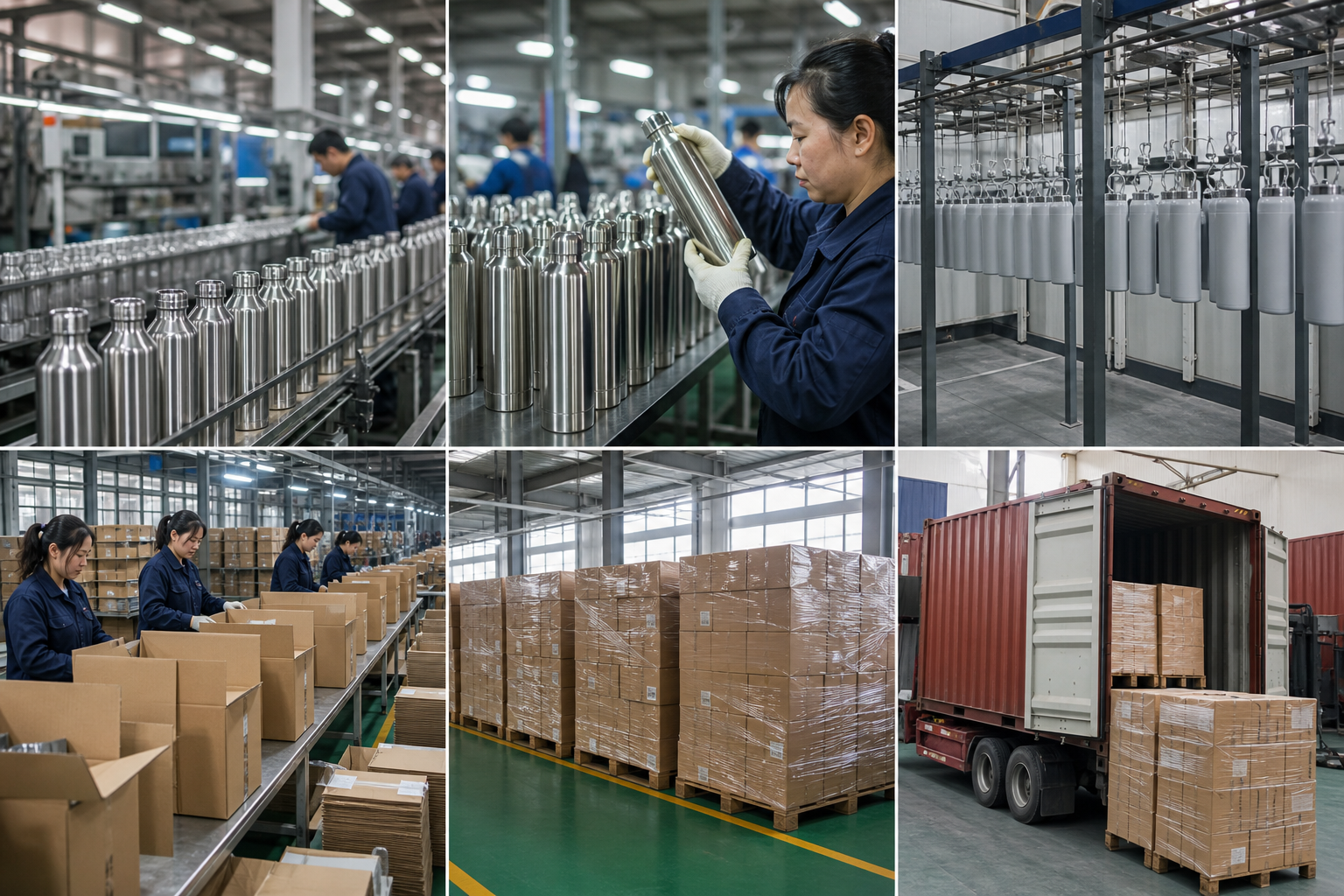
I’m rewriting the section to keep the same HTML structure while making the prose sound like a factory-side sales engineer: concrete numbers, fewer filler phrases, and more direct buyer language.Pick a thermos supplier the way a buyer who has to protect margin and keep the line moving would. Price matters, but so does whether the factory can hold a schedule. Check the real in-house steps: tube forming, vacuum sealing, surface finishing, and packing. If the tube rolls in one shop, the sealing in another, and packing in a third, lead time starts drifting the minute one workshop slips.
Ask for production numbers, not a sales pitch. A credible manufacturer thermos operation should give you monthly capacity, line count, and the months when output drops. A plant in Zhejiang may run 80,000 units per month on a straight SKU, but that can fall fast if you add special powder coating, mixed lids, or custom gift boxes. We have seen it go from 80,000 to 55,000 once the buyer changed the lid spec and the carton art on the same order. The right answer is the number before you place the PO.
Then look at how they communicate. A strong supplier thermos team sends pre-production samples that match the order, confirms Pantone codes with a colorimeter, and flags risk early. They do not wait until the container is booked to mention a 2 mm logo shift or a carton mismatch. QC pulled the sample, checked the print, and found the issue in 10 minutes. That is the kind of boring precision you want. The buyer flagged it, we fixed it, and the line kept moving.
Before signing off, check these points:
- Sample matches mass production intent
- Clear defect definition and AQL agreement
- Export carton strength and label format
- Lead time under realistic load, not best-case load
If you are building a long-term brand line, choose a thermos manufacturers partner that can handle reorders, not just first orders. A factory that can repeat a 30,000-piece run with the same finish, the same 1.2 mm carton spec, and the same lid fit is worth more than a cheap first quote.
Source your next thermos order with control
Send your target MOQ, logo file, and carton spec. We will quote the right build, not just the lowest number.
Frequently asked questions
What MOQ should I expect from suppliers thermos?
For a standard stainless steel thermos, a realistic MOQ is 500 to 1,000 pcs for a simple print job, and 3,000 pcs or more for deeper customization. If you want a special lid, custom mold, or unusual packaging, the MOQ can rise because the factory has to cover setup and tooling. A thermos supplier in Zhejiang or elsewhere in China may offer lower entry numbers for stock models, but once you change structure, the economics shift fast. The right question is not just the MOQ, but what exact changes are included at that level.
How do I compare thermos suppliers on price?
Compare them on a landed-cost basis, not just FOB unit price. Ask for separate pricing for the bottle, lid, decoration, carton, inner box, and testing. Two offers can look close on paper and still differ by USD 0.40-0.80 per unit once you include packaging and freight. For bulk thermos sourcing, request quotes at 1,000, 3,000, and 5,000 pcs so you can see the scale curve. If one thermos vendor is much cheaper, check whether they are using thinner steel, cheaper coatings, or a lower-cost seal system.
What certifications do I need for Europe and North America?
For Europe, ask for food-contact support, REACH-related declarations, and, when relevant, LFGB test evidence for the finished SKU. For North America, many buyers request FDA-related material letters, plus full traceability and batch records. The exact need depends on your channel and claims, but you should always document the metal, plastic, and silicone components separately. A serious thermos manufacturer should be able to provide component-level reports, not just a generic factory statement. If the supplier cannot tie documents to the exact SKU, that is a risk.
Which decoration method is best for a custom thermos?
If you want durability, laser engraving is usually the safest choice because it does not wear like surface ink. If you need a low-cost promotional thermos in one or two colors, silkscreen is efficient and clean. For retail projects with multi-color graphics, UV print or heat transfer can work well, but you should test abrasion and dishwasher exposure. The right choice depends on the channel. A thermos promotional giveaway can prioritize cost; a premium custom thermos sold through outdoor retailers should prioritize long-term appearance.
How long does production usually take in China?
For a standard customized thermos order, plan on 25-35 days after sample approval and deposit. If you add custom tooling, special packaging, or a busy peak season, that can extend to 40-50 days. Zhejiang factories with stable lines and in-house processes are usually faster than mixed-outsource operations, but only if artwork and specs are confirmed early. Lead time also depends on how quickly you approve samples and packaging. If the supplier keeps changing drawings during production, you will lose time no matter how strong the factory is.