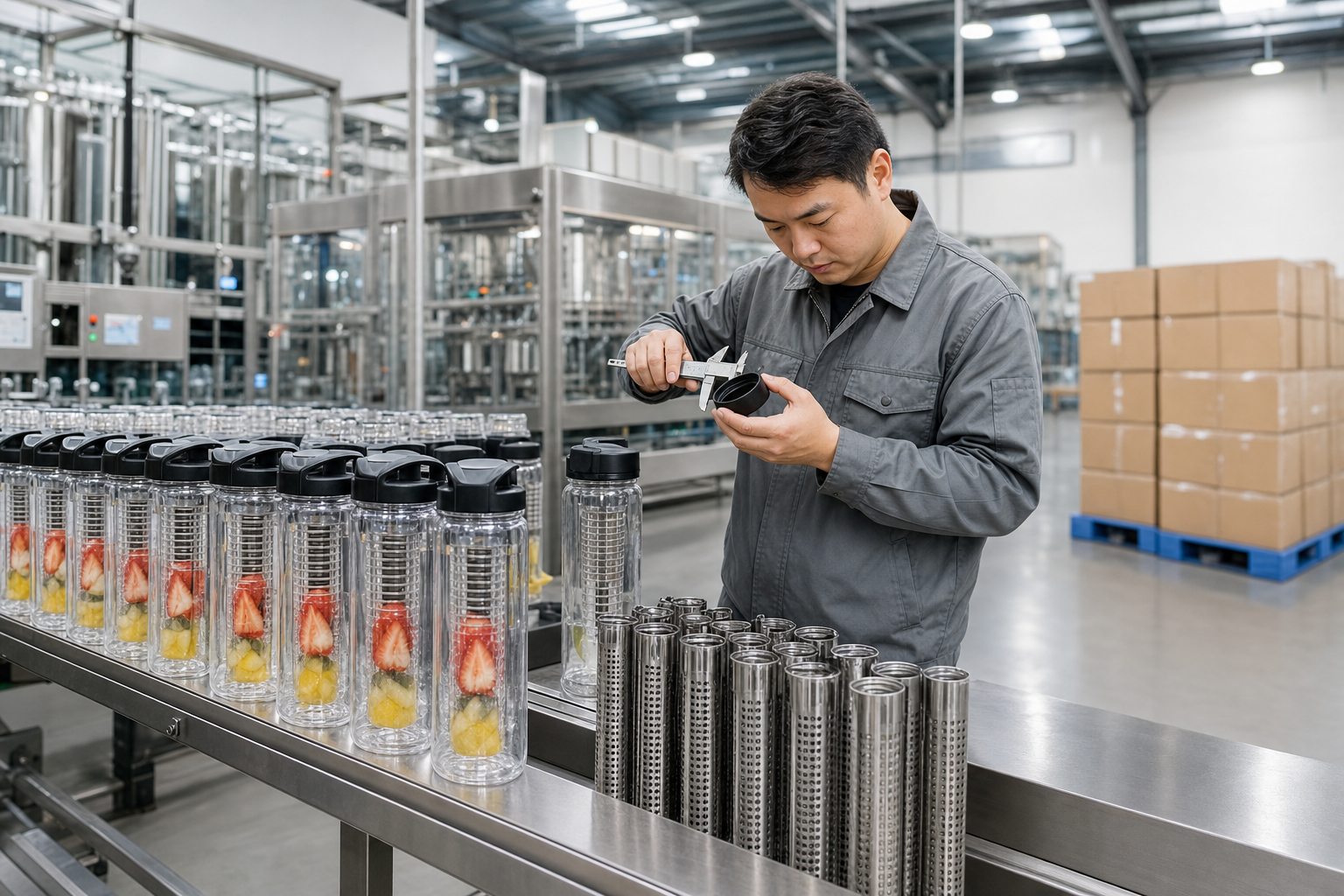
Key Takeaways
- Tea infuser bottle wholesale pricing usually starts around USD 1.10-2.80 FOB China for basic PP/Tritan builds, before print and packaging.
- A practical MOQ for tea infuser bottle in bulk is 1,000-3,000 pcs; custom molds and private label can raise it to 5,000 pcs.
- Ask for AQL 2.5/4.0 inspection, food-contact declarations, and cycle-test data before you approve a tea infuser bottle supplier.
- Lead time is usually 18-30 days after sample approval; complex tea infuser bottle custom runs take longer if you need color matching or gift packaging.
If you are sourcing a tea infuser bottle wholesale for a wellness brand or hydration startup, the usual mistake is simple: buyers pick from photos, not build spec. The first shipment lands with weak seals, stained plastic, or an infuser basket that looks fine and clogs after two uses. We’ve seen a buyer flag a 0.3 mm gap at the cap seat and turn the whole order into a claim. In Zhejiang and across China, that small miss is the difference between a sample that passes and a line that ships.
You do not need a huge supplier list. You need a tea infuser bottle manufacturer that holds tolerances, passes REACH or LFGB where needed, and ships on time at a MOQ that fits your launch. At BottleForge in Hangzhou, Zhejiang, we run infuser bottle lines at about 180,000 units per month, with typical MOQs from 1,000 to 3,000 pieces depending on mold and decoration. QC pulled the sample on a 24-hour seal test before we greenlit the run. That is the kind of number that keeps your margin alive and your reviews clean.
What buyers mean by wholesale
When buyers search tea infuser bottle wholesale, they are not asking for a stock catalog. They want factory pricing, a clear MOQ, and bottles that survive carton drops, pallet stacking, and retail shelf handling. We run this every week: direct factory buying means you deal with a tea infuser bottle factory or a tea infuser bottle supplier that controls production, not a trader moving old inventory.
For wellness brands, the real question is not “Can it infuse tea?” It is whether the bottle holds hot water, acidic fruit, and dishwasher cycles without warping. A serious tea infuser bottle manufacturer will give you the resin type, working temperature range, lid torque spec, and wall thickness. On our line, Tritan bodies are often 2.5-3.0 mm, while PP lids usually sit around 1.8-2.2 mm. QC pulled the sample once and found a 0.3 mm wall drift; the buyer flagged it immediately.
There are two commercial paths. A tea infuser bottle vendor may ship small ready-made lots with faster lead time, while a tea infuser bottle OEM manufacturer handles tea infuser bottle custom made runs, private label work, and new mold development. If you need a tea infuser bottle promotional item for a 3-day event, simpler decoration is fine. If you are building a premium hydration line, the math does not work unless you lock down QC and packaging. Zhejiang factories do both, but pick one route before you ask for prices. We once saw a PO with “12,000 pcs” typed as “12000pcs / 12,0000” — that kind of typo wastes a day.
Choose the right bottle structure
A fruit infuser bottle is not just a bottle with a basket dropped inside. The geometry decides whether the product feels premium or annoying. The usual structure is a main bottle body, a central infuser rod or basket, a lid with venting or sealing geometry, and sometimes a removable tea chamber. If the mesh is too fine, steeping slows down. If it is too coarse, tea leaves and fruit pulp escape into the drink. QC pulled one sample with a 0.8 mm perforation pattern, and the buyer flagged pulp in the first 3 sips.
For tea infuser bottle wholesale, I’d check three dimensions first: internal diameter, basket volume, and cap seal depth. A 750 ml bottle with a 120-160 ml infuser basket works for loose tea and fruit slices without crowding the chamber. Drop to 500 ml and the math changes fast; the flavor load needs tighter balancing or the bottle feels stuffed. If the bottle is sold as tea infuser bottle customizable for commuting or gym use, the lid should open with one hand and still pass leak tests at 40-60 kPa negative pressure. We run this test on a vacuum box before packing.
Material choice matters more than marketing language. Tritan is common for premium reusable bottles because it stays clearer and resists odor better than cheap PET. PP is fine for caps and infuser parts. Stainless-steel infuser inserts can improve perceived value, but they raise cost and weight. A tea infuser bottle supplier list is useless if none of the factories can explain why they chose a 304 mesh gauge versus a molded perforation pattern. We’ve seen a 304 basket add 18 g and push freight into the next rate band.
- Body: Tritan or copolyester for clarity and durability
- Lid: PP with silicone gasket, or Tritan/PP hybrid
- Infuser: Fine mesh stainless steel or molded basket
- Seal: Food-grade silicone, usually 40-50 Shore A
Pricing, MOQ, and margin math
The price of a tea infuser bottle wholesale order comes down to three items: resin cost, decoration, and packaging. A plain 500-750 ml bottle in clear PP or Tritan with one-color print usually lands around USD 1.10-1.80 FOB China at 3,000 pcs. Add a stainless-steel infuser, custom color, and a retail box, and you are at USD 2.20-3.80 FOB fast. If a tea infuser bottle factory comes in far under that, ask what is missing. We have seen thin 1.2 mm walls, recycled resin, and a lid that fails the drop test after 12 drops.
MOQ is where a lot of hydration startups burn time. A tea infuser bottle manufacturer in Zhejiang may take 500 pcs on an existing mold, but tea infuser bottle private labeling with your logo and carton artwork is more often 1,000-2,000 pcs. New mold development for a tea infuser bottle custom shape usually starts at 3,000-5,000 pcs because the tooling bill has to make sense. If you are sourcing tea infuser bottle wholesale bulk for Amazon, retail, or DTC bundles, build in 2%-3% overage for samples, testing, and transit damage. The buyer flagged a typo on the PO once; the carton count was off by 100, and we had to stop the line for a reprint.
Ask for a clean quotation split. You want FOB unit price, printing fee, packaging fee, mold fee if any, and carton master-pack details. A proper tea infuser bottle supplier should quote lead time in days, not soft promises. Our standard lead time in Hangzhou is 18-25 days for repeat orders after sample sign-off, plus 3-7 days for export packing and booking. That is the number that keeps a launch on track. Anything looser, and the math does not work. QC pulled the sample last week and measured the cap thread at 38.2 mm; once that drifts, leakage claims start showing up.
Buyers do not lose margin because the bottle was expensive. They lose margin because freight, packaging, and rejection rates were hidden until the final invoice.
What to verify before you place an order
You can cut a tea infuser bottle supplier list to five names in a day, but paper beats promises. Start with compliance. For Europe, ask for REACH declarations and, where relevant, LFGB migration reports. For North America, ask for FDA food-contact declarations and material traceability back to the resin lot. If the bottle will hold hot liquid, ask for heat-resistance data and deformation testing at 80-100°C, since we have seen 80°C pass and 100°C warp on the same mold with a thin wall.
Then check production control. A real tea infuser bottle factory should show incoming IQC checks, in-process inspection, and final AQL standards. A common acceptance plan is AQL 2.5 for critical defects and AQL 4.0 for major defects. Ask for drop-test results from 1.0-1.2 meters, seal leakage tests, and cycle testing on the cap threads with at least 3,000 open-close turns. If they cannot tell you how many turns the cap needs before full seal compression, they are not ready for private label work. The buyer flagged this on a 500 ml Tritan bottle last month, and the cap failed at turn 8 instead of turn 6.
For tea infuser bottle suppliers serving export buyers, documentation matters as much as tooling. Ask for carton dimensions, gross weight, HS code guidance, and whether they can add barcode labels, FNSKU, or multilingual inserts. A tea infuser bottle vendor that only sends a product photo is not enough for a wellness brand that plans to scale. We ship with a carton spec sheet on the first quote, because the math does not work if the outer carton is 58 x 38 x 32 cm and the buyer expects 24 pcs per case. In Zhejiang, the better factories usually share test reports without drama; QC pulled the sample, checked the gasket, and the report was ready the same afternoon.
- REACH, FDA, or LFGB paperwork where relevant
- AQL inspection plan with defect categories
- Leak, drop, and temperature test data
- Packaging specs for retail or FBA
Custom logo and private label choices
Most buyers do not need a new mold. They need a tea infuser bottle with custom logo that looks like theirs on shelf and still holds up after 50 dishwasher cycles. We usually start with print on an existing bottle. Silk screen is the clean choice for 1 or 2 solid colors, and it sits well on clear walls. Laser engraving works better on stainless-steel lids or a metal sleeve. If you want a full wrap, gradient print, or a premium sleeve, the setup cost climbs fast and the scrap rate does too.
Tea infuser bottle private label programs usually cover logo placement, carton artwork, and sometimes a fruit slice recipe card or branded cleaning brush. We also get requests for color-matched lids and rings. Color is where buyers get picky. A Pantone match on PP is realistic, but the shade can move 5%-8% from resin batch to resin batch, and the warehouse lights make it look different again. We run a physical pre-production sample, then check it under daylight and store lighting. QC pulled the sample last week and the buyer flagged it before we packed the first 500 pcs.
If you are building a tea infuser bottle promotional range, keep the decoration simple and the box clean. Promo bottles fail when the print rubs off after one wash cycle. That is the wrong place to save 0.08 USD. For a retail wellness brand, I would take a smaller logo that stays readable after 50 washes over a big graphic that peels in 2 weeks. Buyers remember that. We do too. On the line, one bad PO even came in with the logo file named wrong, and the carton proof copied the typo straight across.
Decoration methods that make sense
- Silk screen: low cost, durable on flat areas, best for 1-2 colors
- Pad print: useful for curved caps and small logo zones
- Laser: best for stainless or coated parts, crisp and permanent
- Heat transfer: higher cost, good for wrap graphics and seasonal launches
Working with a China factory directly
Going tea infuser bottle factory direct is the right move if you want control over cost, QC, and timing. It also cuts out a lot of noise. You do not need 20 tea infuser bottle manufacturers; you need 3 serious quotes from a tea infuser bottle oem manufacturer, a second factory with a similar mold, and one backup tea infuser bottle distributor if your launch is urgent. We had one buyer send a 14-supplier RFQ, then complain the replies were all over the place. The math does not work.
In China, especially in Zhejiang, the difference between a real factory and a trading layer is often visible in answer speed and technical detail. A real tea infuser bottle factory can tell you mold cavity count, daily output, and which machine tonnage is used. For example, a 4-cavity cap mold on a 160-ton machine might support 12,000-16,000 caps per day, while body blow molding will depend on wall uniformity and cooling time. QC pulled the sample on a caliper at 1.2 mm, and the buyer flagged it because the cap thread was loose by 0.3 mm. That is the level of detail that helps you compare quotes properly.
Do not assume a tea infuser bottle supplier list gives you the best price. It gives you names. You still need to check BSCI status, export history, and whether they can handle mixed SKUs in the same container. We ship 2-3 mixed cartons a day for some accounts, and the PO typo that hurts most is simple: 5,000 pcs written as 50,000 pcs. Many tea infuser bottle distributors can move stock fast, but if you need tea infuser bottle customized packaging and stable reorders, direct factory work is usually cheaper over 2-3 production cycles.
Our own export workflow in Hangzhou is straightforward: sample in 7-10 days, mold or logo confirmation, then mass production. That is normal in Zhejiang if the buyer answers quickly and does not keep changing artwork after approval. One buyer sent back logo changes after we had already run the silk screen jig, and we stopped the line for half a day. If you keep the file clean, we move fast.
How to source without costly mistakes
Most sourcing problems are avoidable if you pin down the basics before you send a deposit. Ask for a sample built to the final spec, not a display sample from the showroom. Check whether the quote is for tea infuser bottle buy in bulk pricing or a one-off sample rate. Ask for photos from the current line, not archive shots from last quarter.
For tea infuser bottle wholesale bulk orders, put every commercial detail on one sheet: material grade, body capacity, infuser volume, print method, carton quantity, master carton size, gross weight, Incoterm, and payment terms. We usually see 30% deposit and 70% before shipment, and repeat buyers can sometimes push that around. If the order is going to Amazon, ask if the factory can do FNSKU labels and polybags on the line without mix-ups; QC pulled the sample on one job because the barcode was 3 mm off-center.
Know when a custom project earns its keep. A tea infuser bottle custom made shape makes sense when you expect 10,000-20,000 units a year and need a clear market identity. If demand is still unproven, start with a tea infuser bottle customizable stock mold and spend the budget on packaging, product photography, and ads. We’ve seen the math fail when a startup sinks cash into tooling before the first 3,000 units sell. A straight-talking tea infuser bottle supplier will say that, even if the first order is smaller.
If you want a working benchmark from China, use this: a stable factory should quote within 24 hours, send samples in 7-10 days, and ship repeat tea infuser bottle in bulk orders in under 30 days after approval. We run 8-hour shifts, and the line should not need more than one day to confirm a clean PO; if you see a typo on the carton count or a 12-day sample lead time, ask why before you pay.
Request factory pricing for your infuser bottle line
Send your target capacity, logo file, and order quantity. We’ll quote from Zhejiang with MOQ, lead time, and packaging options that fit your launch.
Frequently asked questions
What MOQ should I expect for tea infuser bottle wholesale?
For a standard mold, expect 1,000-3,000 pcs for tea infuser bottle wholesale. If you want tea infuser bottle private labeling, color matching, or retail cartons, 2,000 pcs is more realistic. New mold development often starts at 3,000-5,000 pcs because tooling has to be amortized. If a supplier offers 200 pcs with full customization, check whether they are actually just relabeling stock. For a wellness launch, a 1,500 pcs first run is often the sweet spot: enough for sales data, not so much that you carry dead inventory.
How much does a custom tea infuser bottle cost from China?
A basic tea infuser bottle custom order from China usually lands around USD 1.10-1.80 FOB for a simple clear bottle with one-color print at 3,000 pcs. Add stainless-steel infuser parts, custom lid colors, and retail packaging, and the price can rise to USD 2.20-3.80 FOB. Shipping, duties, and labeling are extra. If you want premium box packaging or special coatings, budget another USD 0.20-0.60 per unit. Zhejiang factories are efficient, but the final price depends on material grade, decoration, and packaging complexity.
What tests should a tea infuser bottle factory provide?
Ask for food-contact compliance paperwork, material declarations, and test data for leakage, drop resistance, and heat performance. For Europe, REACH and LFGB support are common asks. For the U.S., FDA food-contact declarations matter. On the quality side, request AQL 2.5 for critical defects and AQL 4.0 for major defects. A good tea infuser bottle factory should also show lid torque, seal compression, and cycle test results. If the bottle is for hot water, ask for deformation data at 80-100°C depending on resin type.
Should I choose a tea infuser bottle supplier or distributor?
Choose a tea infuser bottle supplier or direct factory if you need custom logo work, private label packaging, or repeat production control. Choose a distributor if you need a smaller stock order fast and can accept limited customization. Distributors are useful for quick market tests, but they usually have less control over color, packaging, and QC documentation. If you are building a long-term hydration brand, factory-direct is usually the better margin play. In Zhejiang, many real factories can still move fast if your artwork and spec are ready.
Can I use tea infuser bottle wholesale for Amazon FBA?
Yes, but the factory must package it correctly. Ask for master carton dimensions, barcode placement, polybag warning labels if needed, and FNSKU labeling. For Amazon FBA, I recommend drop testing the final retail pack at 1.0 meter and confirming that the bottle does not leak after vibration and carton compression. A tea infuser bottle wholesale order for FBA should also account for 2%-3% overage. If your supplier cannot handle FNSKU, carton labeling, and export packing, you will lose time at the warehouse.