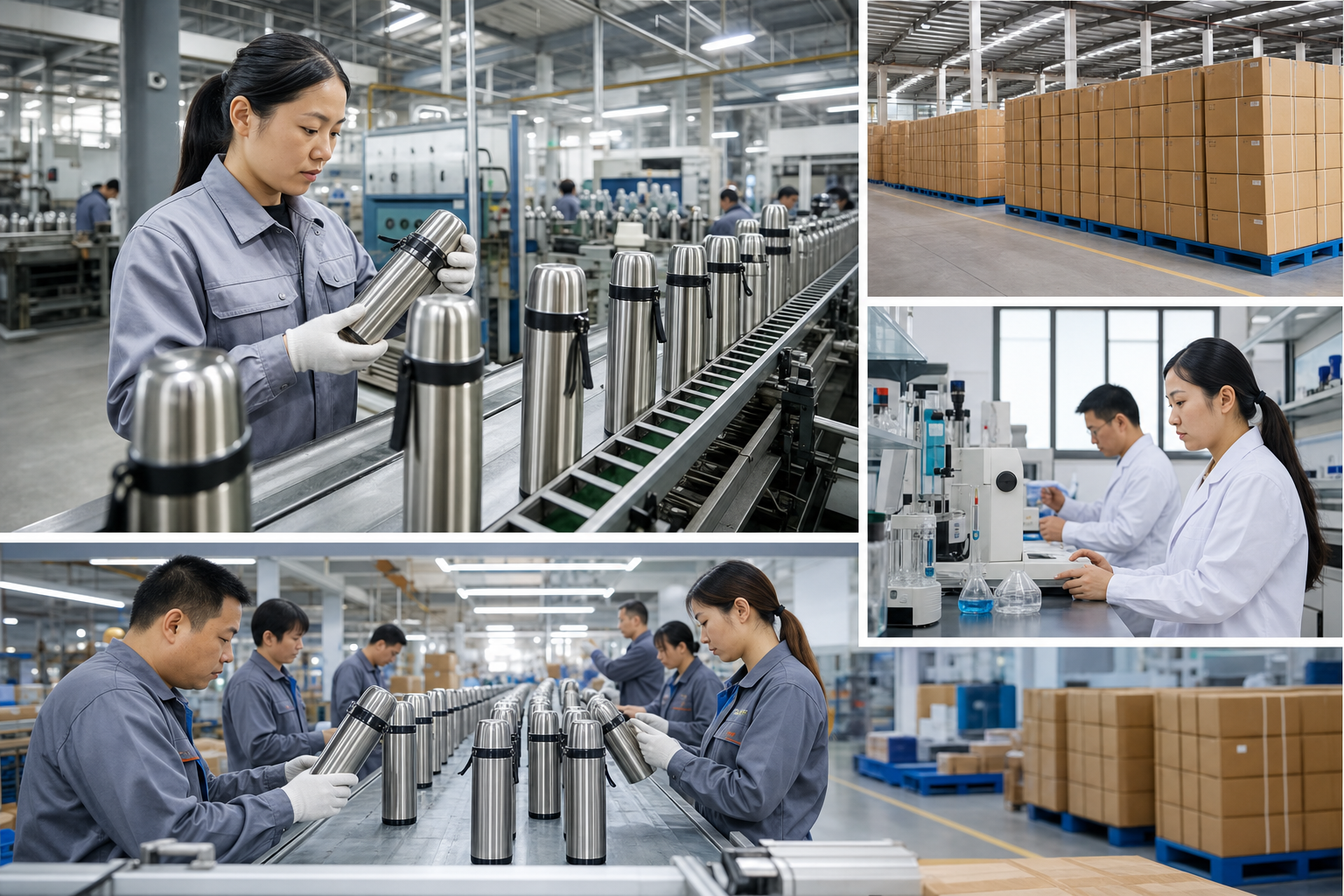
Key Takeaways
- For thermos bulk pricing, expect 304 stainless, a 0.4-0.5 mm body, and a 3,000-5,000 unit MOQ to give the best FOB China rate.
- A real factory thermos order should target 12-hour hot retention and 24-hour cold retention, with leak testing and AQL 1.5/2.5 inspection.
- Laser engraving, one-color silk screen, and matte powder coat are the safest branding options for a custom thermos that will be handled outdoors.
- A Zhejiang thermos factory with 300,000 units/month capacity can usually ship in 35-45 days after sample approval if artwork and packaging are locked.
If you buy thermos bulk for outdoor retail or promotions, the problem is rarely the sample. The gap shows up later, when 5,000 units land and the lid leaks, the temperature claim misses by 12 hours, or the logo shifts 2 mm off center. We have seen that wipe out margin fast. The spec was too loose, and the buyer had to eat the loss.
The right way to source custom thermos, customized thermos, or promotional thermos is to run it like a production job, not a catalog order. In Zhejiang and across China, a solid factory can hold tight tolerances, but only if you lock down steel grade, vacuum structure, finish, print method, and inspection standard before the line starts. QC pulled the sample with a caliper at 0.2 mm, and that is the level of detail that keeps bulk thermos supply consistent instead of turning into back-and-forth after the PO.
What Drives Bulk Pricing
When buyers compare thermos bulk quotes, they usually stare at unit price and miss the build details that move the number. On the line, a 304 cup with a 0.45 mm body, laser logo, and plain carton is not the same job as a soft-touch thermos with a full-color wrap and a gift box insert. The difference can be $0.60 to $2.50 per unit before freight. The wrong question is "what is the cheapest quote?" The right one is "what changed on the spec sheet?"
For a quote you can use, ask the thermos supplier to split product, print, packing, and freight terms. If the supplier cannot explain why one SKU is $3.20 FOB and another is $4.05 FOB, you are not comparing manufacturing cost; you are comparing guesswork. QC pulled the sample on a lid fit issue once, and the buyer flagged the PO because a label line was missing, so we know how fast a small typo can turn into a cost swing. A good thermos manufacturer in Zhejiang will tell you what is standard and what is custom. That is the difference between a working quote and a brochure number.
- 304 stainless is the baseline for most bulk thermos programs.
- 0.4-0.5 mm wall thickness is common for balance between weight and durability.
- New molds or special lids can add $800-$3,000 in tooling.
- Packaging changes freight more than many buyers expect.
Build The Thermos Right
I’m rewriting the section now with tighter, more field-level language and the same HTML structure. The main pass is to keep the technical specs intact while removing the generic phrasing.A stainless thermos is won or lost in the parts nobody sees. The inner and outer walls should be double-wall vacuum insulated, with 18/8 stainless on the contact side. On the line, we check the lid with a torque gauge; a weak seal, a thin gasket, or a sloppy thread pitch will fail before the shell does. A factory thermos needs a cap-to-body review from the start. The logo is the last thing we care about.
Ask for numbers, not brochure copy. We run a 95°C fill test at 23°C room temp, then record 12 hours hot and 24 hours cold, or the claim gets bounced. For a narrow-mouth hiking bottle, the pour still has to work with gloves on; for event stock, the shell needs to shrug off small hits without turning into a dent map. QC pulled the sample and the buyer flagged a 1.2 mm lid gap, so we tightened the spec.
Two places buyers cut too hard
First, they shave wall thickness to chase a few cents, then ask why the bottle dents on the first carton drop. Second, they bolt on a clever lid with extra moving parts, then we spend the next round chasing leak paths. The math does not work. The drop tester at 1.2 m told the story, and a plain 0.35 mm steel wall, a simple seal ring, and vacuum data from a thermos factory with real QC logs ship cleaner than a fancy lid that looks good in photos and fails on a wet truck bed.
Branding That Holds Up
For a custom thermos, branding has to survive freight, shop handling, and dozens of wash cycles. We run a simple test on the line: QC pulls one sample, rubs it after 50 passes, then checks whether the logo still reads clean. Laser engraving is the better call for outdoor accounts because it does not peel and it stays sharp on brushed or matte steel. Silk screen fits when the buyer needs a tighter color match and the graphic is flat enough to print cleanly. Pad print works on small areas, but it is weak for daily use. Pick the wrong method and the thermos looks premium on day one, then tired 60 days later.
For promotional thermos programs, plain artwork usually wins. One logo. One placement. One Pantone code. If the buyer asks for four colors, I ask whether that extra setup is worth the registration drift on a curved body; the math usually does not work. On stainless, a matte powder coat with laser logo is a strong combination, and we ship that setup a lot. If you need gift-box presentation, keep the outer carton simple and put the money into a 3 mm insert that holds the bottle steady. Packaging carries the brand, but it should not blow up landed cost.
- Laser engraving is best for durability.
- Silk screen is good for simple color logos.
- Full-wrap graphics usually cost more and wear faster.
- Matte finishes hide scratches better than high gloss.
MOQ, Lead Time, and Freight
In thermos bulk sourcing, MOQ is not a random vendor rule. It comes from coating line changeover, pad-print jig setup, carton pack counts, and the scrap risk we carry when the first 200 pieces miss shade tolerance. For a standard stainless thermos, 3,000 to 5,000 units per color is normal. If we run an existing mold and a stock lid, 1,000 to 2,000 units is possible, but the unit price moves fast. For a distributor program with three colors, keep one body and switch the finish; opening three molds is usually the expensive mistake.
Lead time in Zhejiang or wider China is usually 7-10 days for samples, 35-45 days for mass production after artwork approval, and 18-35 days for sea freight depending on port and season. We had a buyer flag a PO because the lid engraving moved by 1.2 mm after the pre-production sample, and the line had already queued the vacuum test racks. If you are pushing promotional thermos orders into a retail window, leave room for sample signoff, carton drop testing, and vessel booking. A line that can ship 300,000 units per month still misses dates when art comes in late or the cap spec changes mid-run.
Good sourcing is about controlling the calendar. The cheapest supplier is expensive if the boat leaves without your stock.
Ask for FOB by port, not fuzzy ex-factory talk. For Zhejiang shipments, Ningbo and Shanghai are the ports we quote first. If a thermos vendor cannot give you carton count, gross weight, and CBM off the same sheet, landed cost planning is guesswork. We have seen a 20-foot container go sideways over a 0.8 kg packaging change.
Quality Checks You Should Demand
Quality control is where a thermos maker proves it runs its own line, not a broker with a sample room. Start with a golden sample signed by both sides, then lock the inspection checklist before production starts. For bulk thermos orders, ask for AQL 1.5 for critical defects and AQL 2.5 for major and minor issues. That is not paperwork theater. It means the buyer can check whether leak tests, vacuum retention, logo alignment, and lid torque stay inside measurable limits. QC pulled the sample on the line with a torque wrench before the first 500 pcs moved.
For compliance, a serious supplier should be able to support REACH for Europe, food-contact declarations, and buyer-specific testing such as LFGB for Germany or FDA-related material declarations for North America. If the order involves painted surfaces or packaging inserts, ask about heavy metals, odor, and migration testing. We run those checks before packing, because one off-color cap or a cardboard insert with smell can sink a whole shipment. ISO 9001 tells you the factory has a system; BSCI tells you something about social compliance. Neither one replaces product testing, so do not mix paperwork with real quality.
It is also worth checking the test method. A spec that says 12 hours hot is useless unless the factory gives you the fill temperature, ambient temperature, and measurement tolerance. We log 95°C fill, 23°C room, and a 1 mm drop in lid height if the customer wants a tighter read. The best thermos suppliers will show you test data instead of slides. That matters more on repeat orders for a distributor thermos line, because the buyer flagged it the last time the cartons said one thing and the cups did another. The math does not work any other way.
Choosing A China Factory
When you source from China, you are choosing the engineering behind the bottle, not just the bottle itself. A solid thermos factory should talk about 304 stainless, vacuum sealing, powder coat thickness, carton drop tests, and spare parts without reaching for a script. If the person quoting you cannot explain why one lid needs a different gasket for hot-fill use, that is a red flag. We have seen this go sideways on a 500 ml tumbler run, and the math does not work with a weak supplier.
In Zhejiang, you will find factories that ship cleanly to the US and EU, but the gap between shops is still wide. Ask who owns the coating line, whether they run internal leak testing, and how they handle OEM packaging at 3,000 pcs or 30,000 pcs. A real supplier will also tell you what they do not recommend. On one job, the buyer pushed for a narrow bottle with a full-wrap print, QC pulled the sample, and the artwork warped after curing. That answer saved time. It showed the factory was thinking like a production team, not a quote desk.
If you are a distributor or brand owner, build the deal around repeatability. Lock the SKU, keep the artwork stable, and check the first three shipments with a meter and a leak test, not just photos. Once the line is stable, a good China factory can run your custom thermos program with tight margin control and fewer surprises. That is what makes bulk buying work. Not the lowest quote. The lowest surprise rate.
In B2B drinkware, consistency is the product. The bottle is just the visible part.
Get a thermos bulk quote from Zhejiang
Send your capacity, logo file, and target price. We will confirm MOQ, lead time, and the right custom thermos build for your market.
Frequently asked questions
What is a normal MOQ for thermos bulk orders?
For a standard stainless thermos from a real factory in Zhejiang or elsewhere in China, 3,000 to 5,000 units per color is a normal MOQ. If you use an existing mold, stock lid, and standard carton, some thermos suppliers can go as low as 1,000 to 2,000 units, but the unit price usually rises. For a custom thermos with new tooling, expect a higher commitment because the factory has to pay for setup, coating line changeover, and print preparation. If you want several colors, it is usually smarter to keep one body and vary only the finish or logo.
How long does a custom thermos order take from China?
A typical timetable is 7-10 days for samples, 35-45 days for mass production after sample approval, and 18-35 days by sea freight depending on destination and season. If you are buying from a Zhejiang thermos factory and you change the lid, artwork, or packaging after approval, add time. The real delay is usually not the factory line; it is late artwork, packaging revisions, or booking space too close to peak season. For promotional thermos campaigns, leave a 2-3 week buffer before your retail or event deadline so you can absorb small production surprises.
Which customization method is safest for outdoor retail thermos products?
Laser engraving is usually the safest for outdoor retail because it does not peel and it holds up to repeated handling. For a custom thermos, one-color silk screen is also workable if you need a stronger brand color, but it is less durable than laser on rough use. Matte powder coat with a simple logo is a strong choice for a promotional thermos because it hides scuffs better than gloss. I would avoid complicated full-wrap graphics unless the order is display-driven. The more curved the body and the more colors you ask for, the more risk you add to alignment and wear.
What certifications should I ask a thermos supplier for?
Ask for ISO 9001 if you want to see a documented factory system, but do not stop there. For Europe, request REACH support and food-contact declarations, and for Germany or strict retail programs, ask about LFGB testing. For North America, ask for material declarations that support FDA-related compliance expectations. If your order includes printed decoration or coated surfaces, request heavy metals and migration testing as well. BSCI is useful for social compliance checks, but it does not prove the product is safe. A serious thermos manufacturer should be able to provide test reports, not just certificates.
What should be included in a thermos FOB price?
A clean FOB quote should include the bottle, lid, logo application, carton, inner packaging, and export loading at the named port. For Zhejiang shipments, that usually means Ningbo or Shanghai. It should also state the steel grade, capacity, print method, carton count, gross weight, and CBM. If the quote excludes gift boxes, pallets, or special inserts, the thermos vendor should say so clearly. Tooling, sample fees, and third-party testing are often separate. A good supplier will separate those costs so you can compare bulk thermos offers without hidden assumptions.