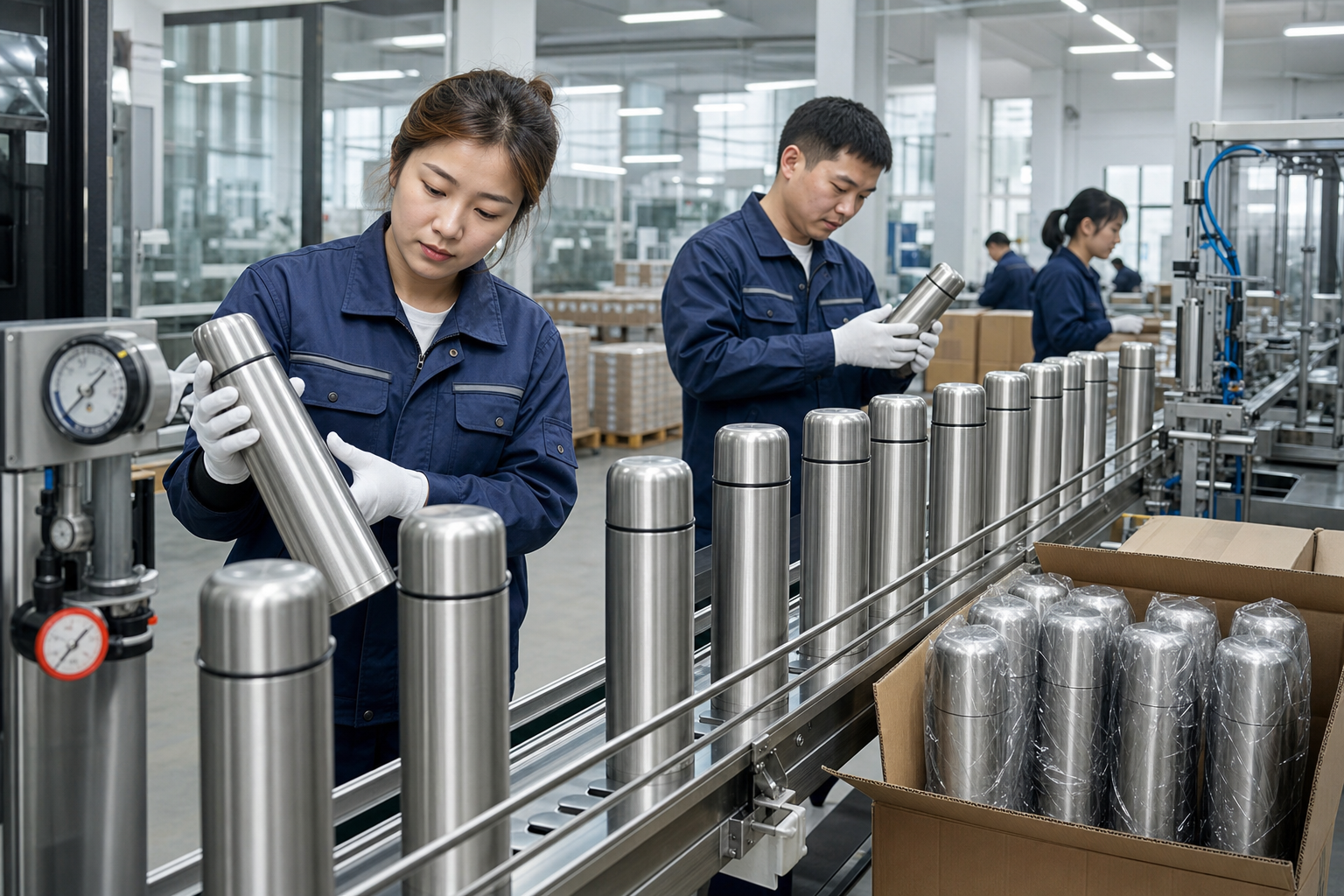
Key Takeaways
- For most thermos custom projects, 304 stainless and a 0.4-0.5 mm inner liner are the practical default.
- A 500 ml custom thermos is the most flexible size for outdoor retail, while 350 ml and 1 L fit promo and camping use better.
- Expect MOQ around 3,000 pcs per SKU, samples in 7-10 days, and mass production in 25-35 days from a Zhejiang factory.
- Compare quotes by steel grade, lid, coating, AQL, and compliance papers, not just FOB price.
A thermos custom order looks simple until you lock down 304 or 316 steel, lid torque, print method, and the insulation claim. On the line, QC pulls a sample and checks the cap against a 0.2 mm gap gauge before we ship. If you buy for outdoor retail or a promo run, the real job is not making a pretty bottle; it is keeping landed cost, defect rate, and repeat orders under control. A thermos is a sales tool, not a shelf ornament. This is the wrong question to ask if you start with artwork first.
We build this category in Zhejiang and ship across China and export markets every week, so the pattern is clear: tight specs win, vague inspiration images do not. The buyer flags the PO typo, the line stops, and we fix it before the first 5,000 pcs move. If you know the use case, the MOQ, and the compliance target up front, a factory thermos program can move from sample to mass production in 25 to 35 days with fewer surprises.
Start With Steel And Wall Thickness
For a bulk thermos program, start with stainless grade and wall thickness, not decoration. On the line, we check 304 stainless, often called 18/8, before we talk print color or box art. It is the baseline for most custom thermos and customized thermos orders because the corrosion resistance holds up, the welding runs clean, and the price does not swing as hard. Use 316 only when the fill is harsher, like salty water or acidic drinks, or when the buyer is paying for a stronger materials story. Chasing 316 on a standard water bottle is the wrong question to ask.
The next decision is wall thickness. A sensible 500 ml bottle usually sits around 0.4 to 0.5 mm on the inner liner and 0.35 to 0.45 mm on the outer shell. We have seen 0.32 mm outer shells arrive with dent marks after a single carton drop test. Too thin and the bottle dents in transit. Too thick and the weight climbs without better insulation. A good thermos manufacturer should talk about the full structure, not just the grade on the spec sheet.
- Inner liner: 304 stainless for mainstream retail
- Inner liner: 316 stainless for harsher contents or premium positioning
- Outer shell: 304 for consistency or 201 for a lower entry price if your margin model allows it
- Typical capacity range: 350 ml, 500 ml, 750 ml, and 1 L
If you are buying thermos bulk for outdoor retailers, ask for weight per unit and not just list price. We run a 500 ml sample at 20 to 40 grams difference, and the buyer flags it fast when the cup feels cheap in hand. A 1 kg carton limit can change the pallet count and freight math before the product ever hits the shelf. In Zhejiang, the better thermos suppliers will show you where that weight goes and what it does to cost. We have seen this go sideways when a PO typo swaps 304 for 201.
Choose The Right Capacity And Shape
The right size comes down to how the bottle will actually be used. For a promo thermos, 350 ml to 450 ml is the cleanest range. It keeps gift cost under control and fits office desks, event handouts, and carry-on bags. QC pulled a 420 ml sample off the line last month, and that size moved cleanly. For outdoor retail, 500 ml is the workhorse. It carries enough for a full day, stays light in the hand, and still leaves room for margin. We ship that size every week. For camping or cold-weather buyers, 750 ml and 1 L make more sense because fewer refills matter more than compact size.
Shape matters just as much as capacity. A straight body is easier for silkscreen and laser engraving. The 58 mm print zone stays clean, and the logo does not drift. A slightly tapered body gives better grip, but it makes decoration harder and cuts pack efficiency. We saw a buyer flag a taper that looked fine on screen and turned into a packing-table headache. If you run a thermos distributor program across mixed channels, keep the body simple and repeatable. You want one mold that carries different artwork and lid options, not three shapes that look almost the same.
The wrong capacity sells once. The right capacity sells through the season.
Ask your supplier thermos team for carton dimensions, unit weight, and pallet loading before you approve the design. A 500 ml bottle that looks compact on screen wastes carton space when we pack 24 pcs per case. A 1.8 kg carton drew buyer pushback on ocean freight, and the math did not work. That hits warehouse storage and Amazon-style fulfillment too, even if you never sell on Amazon. A practical thermos custom brief starts with the channel, then the size, then the shape.
Decoration That Survives Daily Use
Decoration is where a customizable thermos turns into something a buyer can actually sell. The wrong question is which method looks best on a render; the real question is how it holds up after 30 days in a backpack and a few drops on the desk. For clean corporate gifts, one-color silkscreen is still the safest call. For a premium mark that needs to stay put, laser engraving is hard to beat. UV print gives more color and detail, but QC pulled the sample after a 200-cycle rub test and the surface had already started to look tired.
Here is the practical rule we run on the line: simple artwork and tight budget, use silkscreen. Durable mark with a single-color look, use laser. Brand color on a smooth body, use UV print or a coated finish with print on a defined panel. For a thermos customizable for several distributors, leave a clean area of 25 to 35 mm wide so different logos fit without forcing a new bottle shape. The math does not work if the branding area is too small.
- Silkscreen: best for one to two colors and sharp cost control
- Laser engraving: best for permanence and a premium finish
- UV print: best for detail, but confirm rub resistance
- Powder coat: best for grip and scratch hiding
Do not approve artwork from a flat PDF alone. Ask for a wrapped mockup on the actual cylinder. On a curved factory thermos body, a logo can drift 3 to 5 mm and still pass, but a two-line slogan can go unreadable fast. Last month the buyer flagged a 4 mm shift on a 320 mm bottle, and that was before tooling started. A seasoned thermos vendor will catch that before the first sample leaves the line.
Lids, Seals, And Heat Retention
Lid design decides whether a customer carries the bottle every day or leaves it on a shelf. We run screw caps, push-button lids, flip-top lids, and cup-style lids on the line, but they do not sell the same way. For outdoor retail, a screw cap with a solid silicone gasket is the safer bet. For office and commute use, a one-hand push-button lid moves faster because buyers feel the convenience right away. For a promotional thermos, keep the mechanism simple unless the branding story really needs the extra parts.
Seals matter more than most buyers expect. A weak gasket turns a decent bottle into a return pile. Ask for food-grade silicone, a clear disassembly method, and a leak test on every production lot. QC pulled the sample into a vacuum chamber and checked the cap thread with a torque meter; that is the kind of basic control that saves trouble later. A good 500 ml custom thermos should usually hold a hot beverage above 60 C for around 6 hours and stay useful beyond 12 hours in a room at 20 C, assuming it is preheated and properly sealed. Real performance shifts with fill level and ambient temperature, so do not print a claim you have not verified.
The best thermos manufacturers also test lid cycle life. You want a lid that survives at least 2,000 open-close cycles without thread damage or gasket failure. We have seen this go sideways when a buyer pushed for a cheaper cap and ignored the thread pitch on the drawing. If you are sourcing from China, ask whether the lid is molded in-house or bought from a third party. An integrated thermos factory can hold tolerances tighter than a vendor stitching parts together from three sources, and a 0.2 mm gap on the sealing face is enough to show up in leakage complaints.
One more detail: if you plan to call the bottle dishwasher safe, confirm the coating, print, and gasket before you say it on the carton. The buyer flagged one PO because the label said dishwasher safe while the pad print and silicone ring were not tested for that cycle. That mistake is small on paper and expensive in returns.
MOQ, Pricing, And Lead Times
For thermos bulk orders, the quote structure matters more than the first line price. A standard custom thermos usually starts at 3,000 pcs per SKU for one-color decoration and standard packaging. If you want a special coating, a custom lid, or several colorways, the floor moves to 5,000 pcs or more. Sample lead time is usually 7 to 10 days. Mass production normally runs 25 to 35 days after deposit, sample approval, and artwork sign-off. QC pulled the sample on the bench, checked the lid torque, and the buyer still asked for a logo shift by 2 mm. That is how schedules slip.
In Zhejiang, a thermos manufacturer running 300,000 units per month can cover a retail calendar without drama, but only when the spec is locked early. That capacity means little if the buyer keeps changing logo size, lid color, or carton insert after approval. The cost impact shows up fast. A 500 ml 304 stainless bottle with one-color silkscreen may land around USD 2.80 to 4.20 FOB, depending on coating and packing. A premium 316 build or a more complex finish can move into the USD 4.50 to 7.50 range. We have seen the line stop for a wrong Pantone call, and the math does not work if that happens twice.
If you are comparing suppliers thermos quotes, ask for these lines separately:
- Steel grade and thickness
- Lid style and gasket material
- Decoration method
- Inner box and master carton spec
- Test reports and claim basis
That is the wrong question to ask if you only want the cheapest unit price. A low number can hide weak packaging, no test report, or a slow shipping schedule. We have watched a PO slip because the buyer wrote "304/316" in one line and left the factory to guess. A proper thermos distributor program is built on landed cost, not just EXW or FOB numbers.
QC And Compliance Before Shipment
If you sell into Europe or North America, quality control is not optional. On our line, we check the compliance file before the first cap goes through the torque station, because a missing REACH, LFGB or FDA-related food-contact report will stop the order fast. Ask for a clear statement on any Prop 65 risk if the product goes to the U.S., plus ISO 9001 or equivalent process control, and BSCI or another social compliance audit if your retail customer asks for it. This is not paperwork theater; one buyer flagged a PO typo on the country of origin line, and customs held the cartons for days.
For production control, a sensible AQL target is 2.5 for major defects and 4.0 for minor defects on a standard export run. Leak testing should be done on every carton lot, and a drop test at around 1.0 to 1.2 m is useful for checking the outer pack before the shipment leaves Zhejiang or another China export hub. If you are ordering a customized thermos program for a chain or distributor, ask for a golden sample, pre-production sample, and a batch photo set with lot codes. On a 2,000-piece run, QC pulled the sample after the vacuum tester failed one lid, and we fixed the seal before the truck booked out.
Here is the checklist I would expect before release:
- Material declaration for 304 or 316 stainless
- Migration or food-contact test report
- Artwork proof on the actual body curve
- Carton drop and transit test
- Leak and vacuum retention check
For a factory thermos order, the final proof is simple: the sample you approved should match the mass production bottle in weight, color, lid feel, and print location. We check that with a digital scale and a 0.5 mm gauge, not guesswork. If it does not match, hold the shipment and correct the process before the next run. We've seen this go sideways when the print drifts 2 mm and the buyer spots it on the shelf.
Build Your Thermos Program Right
Send your spec, target MOQ, and artwork. We will turn it into a production-ready thermos custom quote with clear cost, timing, and compliance.
Frequently asked questions
What MOQ should I expect for thermos custom orders?
For most thermos custom projects, plan on 3,000 pcs per SKU for a standard one-color print and normal packaging. If you want a special lid, mixed colors, or premium coating, 5,000 pcs is more realistic. Some Zhejiang factories will quote 1,000 pcs, but the unit price usually jumps by 15 to 30 percent and the decoration options narrow. Samples are usually 1 to 3 pcs, and the sample lead time is often 7 to 10 days. If you are a distributor thermos buyer, always ask for pricing at 3,000, 5,000, and 10,000 pcs so you can see the real break point.
Is 304 stainless enough, or should I choose 316?
For most custom thermos and promotional thermos programs, 304 stainless is enough. It handles coffee, tea, and water well, and it keeps the cost in a sensible range. Choose 316 when the drink is more acidic or salty, or when you need a stronger premium story for outdoor retail. The cost difference is usually 10 to 20 percent on the material side, sometimes more depending on market prices. A good supplier thermos quote should show whether 316 is used on the inner liner only or on both layers, because that changes performance and margin.
Which decoration method lasts the longest?
Laser engraving is usually the most durable because the mark is physically etched into the surface. It is the safest choice for a customized thermos that will be handled every day. One-color silkscreen is also strong if the coating is matched well and the print is cured properly, but it can wear faster than laser on heavy-use bottles. UV print gives more design freedom, yet it is more sensitive to abrasion. If you are selling thermos bulk for outdoor use, I would choose laser or a protected silkscreen panel before I would choose a full-wrap decorative print.
What compliance documents should I ask for?
Ask for food-contact support that matches your market: REACH for Europe, LFGB or FDA-related test data depending on the buyer, and Prop 65 awareness for U.S. shipments. You should also ask for ISO 9001 or process control evidence, plus BSCI if the retailer wants social compliance. A complete thermos manufacturer file should include material declarations for stainless steel and silicone, a migration report, and carton or drop-test evidence. If the order is going into a chain store or distributor network, insist on a golden sample and batch photos with lot codes. That keeps the thermos distributor side of the business much easier.
How do I compare two supplier thermos quotes properly?
Compare the same spec line by line. Check steel grade, wall thickness, lid structure, gasket material, decoration method, carton count, master carton strength, and test reports. A quote at USD 3.10 FOB can be worse than one at USD 3.65 if the cheaper bottle uses thinner steel, weaker packaging, or no QC checks. For thermos custom sourcing, the landed cost matters more than the unit price, especially if you ship to Europe or North America. Also compare lead time. A thermos supplier who needs 45 to 50 days may cost you more in missed season sales than the one who can ship in 25 to 35 days.