Key Takeaways
- A practical MOQ for thermos customized orders is usually 500 to 3,000 pieces, depending on logo method and lid tooling.
- 304 stainless is standard for most bulk thermos programs; 316 is worth it only when corrosion resistance is a real requirement.
- Typical production lead time from a China thermos factory is 25 to 40 days after sample approval.
- For outdoor retail, a 500 ml to 750 ml customized thermos with double-wall vacuum and powder coating gives the best sell-through.
When you buy thermos customized for outdoor retail or promotion, the job is not just putting a logo on steel. You need a bottle that survives hot-fill abuse, holds temperature, and still looks clean after 300 washes. In Zhejiang, we see buyers send over a sample that looks fine on day one, then the lid starts leaking, the coating rubs thin, or the logo flakes after a few cartons move through distribution. That is where most custom orders go sideways.
If you are sourcing from China, the gap between a good custom thermos and a return pile usually comes down to a short list of calls: 304 versus 316 stainless, single-wall versus vacuum structure, powder coat thickness, and whether the factory can hold cap and gasket tolerance within 0.2 mm. A serious thermos manufacturer talks in numbers, not adjectives. We run a line at 120,000 units per month, and QC pulled the sample at AQL 2.5 because the buyer flagged a loose lid on the first carton; that is the kind of detail that tells you whether the factory can ship on time or just talk.
Start With The Use Case
Before you ask a supplier for a price, lock down how the bottle will be used. A promotional thermos for a trade show is a different job from a distributor thermos sitting in an outdoor chain. If it rides in a backpack, we look at dent resistance, 1.0 mm wall thickness, and a lid that stays shut after a drop test. If it is for corporate gifting, print area and box presentation matter more. If it is for retail, the buyer will check temperature retention, finish consistency, and how the cap feels after 200 open-close cycles. We have seen buyers skip this step and then ask for a redesign after the first sample. The math does not work.
For most buyers, the right starting point is a 500 ml or 750 ml custom thermos with double-wall vacuum insulation. That size fits common cup holders and gives enough room for branding without making the bottle bulky. A factory quote should state usable volume, insulation time, and finish type. Do not accept a vague claim like 'keeps hot all day.' Ask for test conditions: starting water temperature, ambient temperature, and measured drop after 6, 12, and 24 hours. QC pulled the sample on the line with a thermocouple probe before lunch, and that is the kind of data you want. One buyer once flagged a PO typo on the finish code, and the sample came out matte instead of brushed. Small mistake, expensive delay.
If you are building a thermos bulk program, map the end use first, then choose structure, lid, finish, and packaging. That sequence keeps you from paying for the wrong cap mold or a box insert you do not need. We run this sequence on the factory floor every week because it saves tooling changes later. Start with use case, then lock the spec sheet, then ask for price. Anything else is the wrong question to ask.
Choose The Right Steel
Material choice is where buyers either spend too much or cut the wrong corner. For a standard stainless thermos, 304 inner and outer walls are the practical baseline. It runs fine for coffee, tea, and most drinks, and it is the default spec on a lot of bulk orders we ship to Europe and North America. If the bottle will sit near salt air, hold acidic drinks, or face tighter corrosion tests, 316 is the better call. It costs more. Use it only when the use case justifies it.
Wall thickness matters just as much. A common spec is 0.4 mm to 0.5 mm for the inner wall and 0.35 mm to 0.45 mm for the outer wall, depending on size and target price. Thicker steel resists dents, but it adds weight and pushes material cost up. On the line, QC pulled the sample with a caliper at 0.42 mm, and that kind of check tells you more than a sales sheet. A good thermos supplier should tell you the steel grade, the vacuum draw process, and whether the base is spun or welded. That affects heat retention and the way the bottle sits in the hand.
For custom thermos orders, ask for the steel certificate if you need compliance paperwork. REACH and food-contact requirements are not fixed by a logo on the carton. They come from material control, traceability, and steady production at a qualified China thermos factory. We have seen a PO with the wrong 316 code typed as 361, and the buyer flagged it before the run started. That is the wrong question to skip.
Pick A Logo Method
Your branding method changes unit cost faster than most buyers think. Screen printing is the cheapest route for a promo thermos with 1 or 2 colors. On our line, a 120 mesh screen holds a clean edge on flat powder coat, but once the body gets a heavy curve, ink starts to build up. Laser engraving costs more, yet it looks sharper and lasts longer on brushed or matte metal. Heat transfer and UV printing carry fine detail, though they need tight surface prep; if the wipe is off, scrap climbs.
For a customizable thermos that looks premium without a complicated process, powder coating plus laser engraving is the setup we ship most often. QC pulled the sample after 200 cycles and the mark stayed readable because the laser cuts through the coating and exposes the steel. For a distributor program, this gives a better cost-to-brand mix than a full-color print, and the math works.
Logo placement is where a lot of orders go sideways. A large print near the shoulder gets in the way of the grip, and a full wrap can look strong on a mockup while feeling crowded on the real bottle. The buyer flagged a PO once because the artwork sat 8 mm too high, right into the hand zone. Ask for a 1:1 layout and a decorated sample before mass production. A solid thermos factory should show color tolerance, edge sharpness, and how the mark holds on curved steel. This is the wrong question to ask if you only care about the logo; the bottle has to work in hand first.
Check The Lid And Seal
Most thermal failures start at the cap, not the bottle body. We run a thread gauge on the line for a reason: if the lid, gasket, or thread tolerance is off, the vacuum spec does not matter. A screw lid is the cleanest option. A flip lid gives convenience, but the hinge and spring add failure points. A cup lid still works for gift sets, yet it adds bulk and looks wrong on a hiking pack or commuter bag.
Use food-grade silicone for the seal, and make sure the fit survives inversion and shake tests. On our line, QC pulls 10 samples per batch, fills them hot, inverts them for 3 minutes, then checks the seam against a white cloth. If the supplier skips that step, the leak shows up after the cartons hit the warehouse, and then you are paying for returns.
For distributor thermos programs, ask about spare gasket supply before you place the PO. This is the wrong question to skip. We have seen a buyer flag a 60-day wait for a replacement ring after the first sell-through, and that kind of delay kills repeat orders. Good manufacturers in Zhejiang keep 18 mm and 22 mm gasket sizes in stock because they know service wins the second order, not a cheap unit price.
Practical rule: if the lid leaks in a drop test from 75 cm, the design is not ready for bulk production.
Understand MOQ And Lead Time
MOQ is not just a number on a quotation. It tells you how the thermos factory actually runs the line. For a standard stainless steel bottle with one-color silk screen, MOQ may start around 500 pieces. For custom colors, special lids, or multi-color decoration, it usually moves to 1,000 to 3,000 pieces. We saw one buyer push for 100-piece customization on a rotary-print setup, and the math did not work. If a vendor offers that on complex tooling, check whether they are pulling from stock or burying setup cost in the unit price.
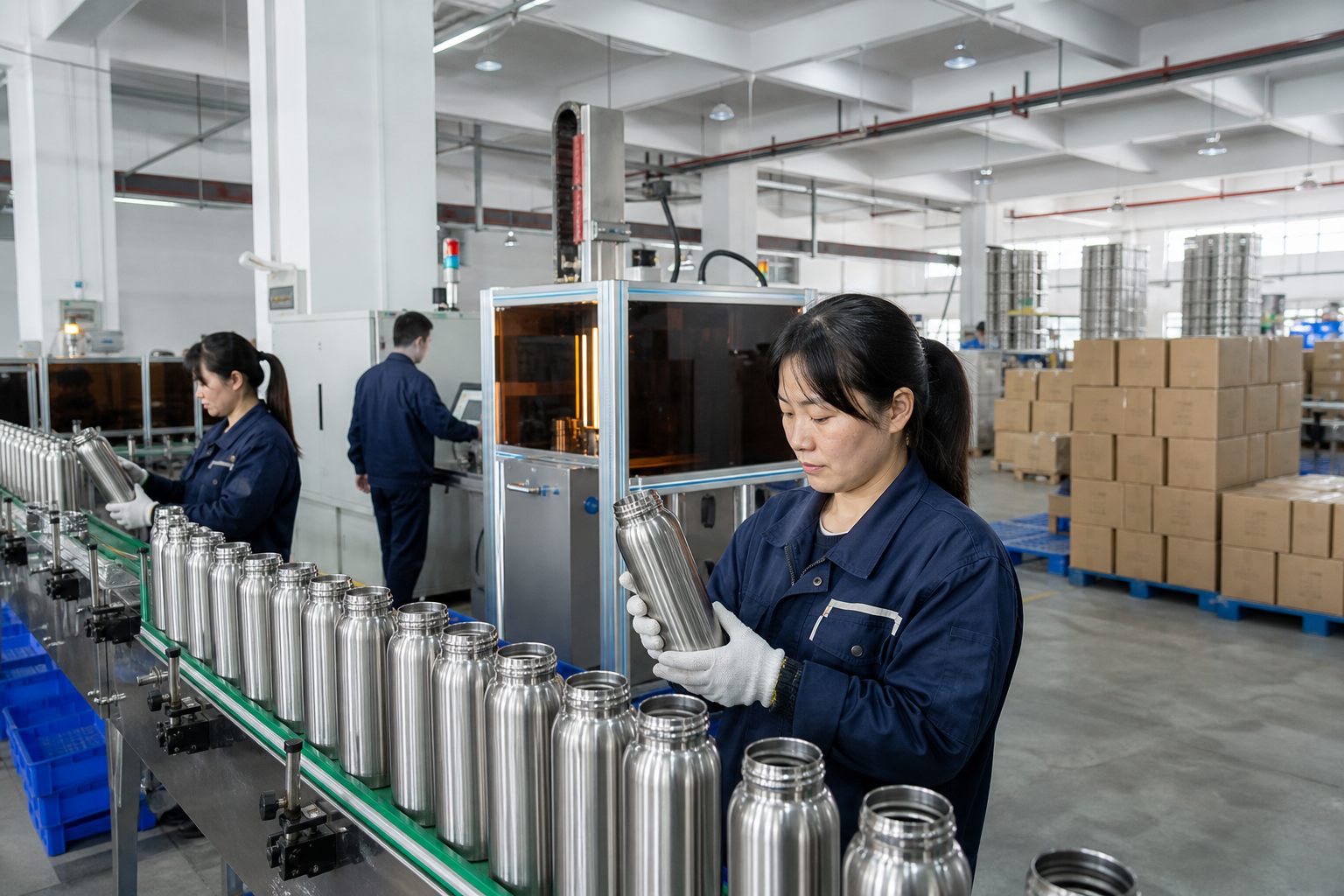
Lead time is where margin gets eaten. A realistic production window for thermos customized orders is 25 to 40 days after sample approval and deposit. Then add shipping time if you are moving FOB China to Europe or North America. A Shanghai-to-Rotterdam sail is often 32 to 38 days; Los Angeles is usually 15 to 18 days on a normal schedule. A factory thermos program should include pre-production sample signoff, in-line inspection, and final carton count. QC pulled the first sample off the line at hour 6 for a reason. If the supplier cannot walk you through each step, they are not ready for a retail or promo run.
For China sourcing, ask how much capacity the plant has. A Zhejiang thermos factory producing 120,000 units per month can usually handle staggered shipments better than a small workshop, but only if the production plan is controlled. We run 4 assembly lines here, and a 30,000-piece PO split across three ship dates is normal when packing is tight. You want a supplier, not a guesser. When the thermos bulk order matters, capacity, schedule discipline, and carton accuracy matter more than a low quote.
Inspect Quality Before Shipping
Quality control goes in the PO, not after the first 500 pcs leave the line. For customized thermos runs, we write AQL 2.5 for major defects and AQL 4.0 for minor defects into the order sheet. Check vacuum loss, print registration, lid torque, coating pull test, and carton drop from 60 cm. If the shipment is going to Amazon or a retail DC, the carton and the label are part of the product. This is the wrong question to ask after loading.
For premium retail, ask the factory to fill samples with water at 95 C and record the reading at 2, 4, 6, and 12 hours. We do not need a lab report on every bottle. We do need the same start temp, the same lid, and the same timer on every batch. A trustworthy thermos supplier in China will hand over batch sheets and QC photos, not just a polished sample room. We have seen a buyer flag a 1 mm logo shift on a 500 ml mug, and QC pulled the sample to check the pad print plate.
- Verify 100 percent logo placement on the first production run.
- Check 10 to 20 units per color for coating consistency.
- Confirm inner wall welds and rim finish on random samples.
- Review carton marks, barcode placement, and master case count before loading.
If you are building a long-term thermos distributor line, this is where the account becomes repeatable. The best suppliers in Zhejiang do not chase a one-off PO; they keep the same mold, the same carton spec, and the same QC checklist for the next 6 months. We run 18-day and 12-day reorders off the same file when the spec does not drift. One typo on a PO can still send 304 caps with the wrong finish, so we catch it before the line starts.
Build your custom thermos line with factory control
Send your target size, logo file, and price point. We will match the right spec, MOQ, and lead time for your market.
Frequently asked questions
What is the usual MOQ for thermos customized orders?
For a standard custom thermos with one-color print, MOQ is often 500 to 1,000 pieces. If you add custom coating, special lids, or multi-color decoration, 1,000 to 3,000 pieces is more realistic. A factory in China may quote lower, but confirm whether it is stock-based or true new production.
How long does a custom thermos order take from China?
Typical lead time is 25 to 40 days after sample approval and deposit. If you need new tooling, unusual packaging, or a peak-season slot, build in extra time. From Zhejiang to your warehouse, ocean freight adds roughly 20 to 40 days depending on destination and routing.
Is 304 stainless enough for a stainless thermos?
For most bulk thermos and promotional thermos programs, yes. 304 is the standard choice for coffee, tea, and water. Use 316 only when you need higher corrosion resistance, such as coastal retail, acidic drinks, or a premium specification that justifies the added cost.
Which logo method lasts the longest on a thermos custom order?
Laser engraving is usually the most durable because it removes the coating and exposes the metal beneath. Powder coat plus laser engraving is a strong option for a customizable thermos. Screen printing is cheaper, but it can wear faster with abrasion and frequent washing.
What quality checks should I require before shipment?
Ask for leak testing, insulation checks, logo inspection, coating adhesion review, and carton drop testing. AQL 2.5 for major defects is a practical baseline. For distributor thermos orders, also confirm spare gasket availability, barcode accuracy, and master carton count before booking freight.