Key Takeaways
- A bulk thermos order should lock steel grade, lid type, and print method before sampling, not after.
- For China sourcing, expect MOQ from 500 to 1,000 pcs per color and 25 to 35 days for standard lead time.
- AQL 2.5 on major defects and 100% leak testing are the minimum if you want fewer chargebacks.
- For Europe and North America, ask for REACH, FDA, and production traceability before you confirm the PO.
If you are a thermos distributor, you already know the hard part is not finding a bottle. The hard part is buying a custom stainless thermos that lands on time, clears inspection, and still leaves room for margin after freight, printing, and cartons. A quote can look cheap on paper, then the buyer flags a dented carton count or a lid typo on the PO and the profit is gone fast.
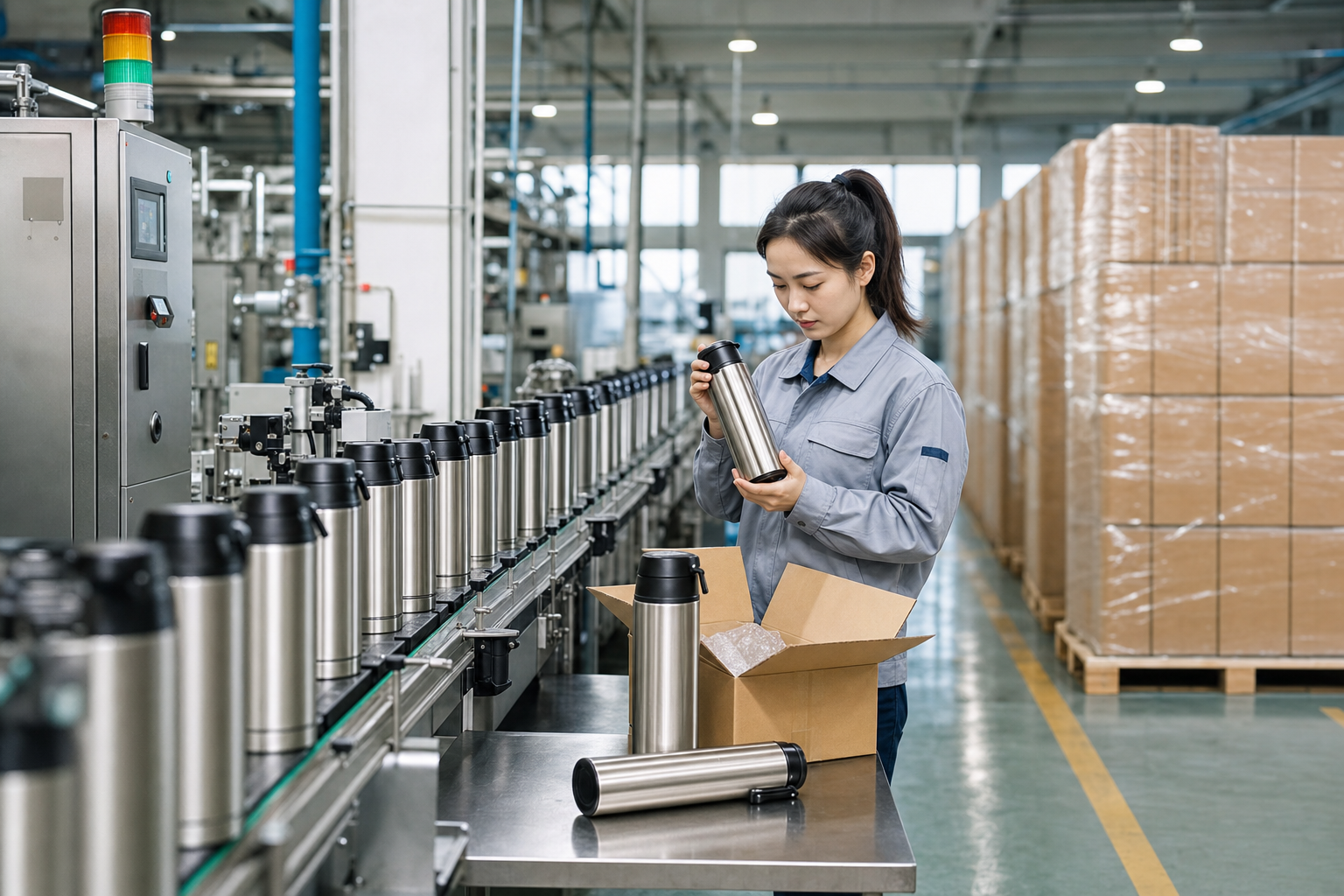
At a serious thermos factory in Zhejiang, the difference sits in the details: steel grade, lid seal, vacuum control, and packing discipline. We run a mid-size line at 300,000 units per month, but your order still lives or dies on MOQ, lead time, and the test standard. QC pulled the sample, checked the vacuum loss after 12 hours, and that is where distributor thermos programs win or fail. This is the wrong question to ask if you only look at unit price.
Start With The Sales Channel
Before you price the bottle, decide where it will move. A thermos distributor selling to outdoor retailers needs a different mix from a buyer doing promo runs for banks or fairs. Shelf stores punish weak print and a lid that feels cheap in the hand. Gift programs punish color drift, dented cartons, and a truck that shows up two days late. Treat every custom thermos the same and you will pay for features nobody wants, or skip the details that trigger claims. That is the wrong question to ask.
Start with three checks: who drinks from it, what heat hold they expect, and the retail price you have to hit. A 500 ml custom thermos for a hiking chain may need a hard powder coat, one-hand button lid, and 12-hour hot retention. A distributor thermos for a trade show may only need a clean logo, low MOQ, and fast top-up. We ran this split on the line last month and QC pulled the sample twice because the cap torque was off by 0.3 N·m. Those are different builds. A factory thermos partner worth your time asks about channel first, not decoration.
- Outdoor retail: prioritize grip, dent resistance, leak security, and shelf appeal.
- Promotional programs: prioritize MOQ, logo cost, pack-out speed, and repeatability.
- Distributor stock: prioritize stable lead time, carton efficiency, and spare parts that do not go missing on reorder.
Buy the version that fits the channel, not the version that only looks good in a sample room.
If you are buying for distributor thermos sales, keep the range tight. One base body. Swap lids, colors, or packaging only when the margin clears the extra setup. We have seen this go sideways when a buyer wanted four lids for one 304 stainless bottle and the PO still showed one carton spec. The math does not work if every variation needs its own mold, its own label, and its own recheck. That is how manufacturer thermos programs stay under control in China and easier to reorder later.
Choose The Right Stainless Build
Most thermos suppliers start with 304 stainless. For a standard stainless thermos, that is usually the right call because it keeps cost in line and gives solid corrosion resistance for normal tea, coffee, and water use. On our line, we see buyers push for 316 too early, then complain the margin is gone. Use 316 for acidic drinks, salty coastal markets, or premium outdoor retail. If the use case does not need it, the math does not work.
Ask for wall thickness, not just the grade. Many thermos manufacturers quote 0.4 mm inner walls and 0.5 mm outer walls on mainstream models, and that is enough when the vacuum is stable. Go thinner and the bottle dents faster in transit. QC pulled the sample on a 1.2 m drop test once, and the shell marked up before the lid failed. The vacuum gap and welds do the real work here, not a heavier steel wall.
- 304 stainless: best value for bulk thermos orders.
- 316 stainless: better corrosion resistance, higher cost, use selectively.
- Powder coating: better grip and scratch hiding for outdoor retail.
- Mirror or brushed finish: lower decoration cost, but shows fingerprints faster.
For Europe, confirm REACH compliance and food-contact documents. For North America, ask for FDA-related material declarations and a clear BPA-free statement for the lids. We once found a PO typo that listed the outer cup as plated steel while the sample was brushed 304, and the buyer flagged it before shipment. If the supplier cannot explain the bottle wall, the finish, and the lid parts in plain terms, treat that as a warning. A solid thermos vendor knows exactly what touches the drink and what does not.
Set Specs That Protect Margin
A customizable thermos only makes money when the spec is tight. Leave the choices wide open and every small tweak hits the cost sheet. We lock body shape, lid family, print location, and carton count before we send final pricing. That is how we keep distributor orders repeatable. On the line, the jig for body embossing is set for one shell only; once the buyer asks for a 1 mm wall change or a new cap mold, the math stops working.
Use the sample stage to decide what matters. For a promo run, a one-color silkscreen logo is often enough. For a premium custom thermos going into outdoor retail, laser engraving or a multi-pass print pays off because it survives wash cycles and abrasion. We also settle the pack-out early. Gift packaging can add 5 to 12 percent to landed cost, depending on board grade and insert style. QC pulled the sample last week and found the foam insert added 8 g per unit, which was enough for the buyer to push back on freight.
What to lock early
- Capacity: 350 ml, 500 ml, 750 ml, or 1,000 ml.
- Lid type: screw lid, push-button, cup lid, or tea filter lid.
- Finish: matte, glossy, brushed, or coated.
- Carton count: 24, 50, or 60 pcs per master carton.
For thermos custom projects, ask the factory to quote bottle, logo, box, and freight-ready carton as separate lines. That is the clean way to see margin. A thermos bulk order looks cheap when the quote is missing half the pieces. It turns ugly after approval when the buyer flags a typo on the PO, the carton count changes, and the hidden cost lands on your side.
MOQ And Lead Time In China
Buying from China works only when you understand the factory schedule. On our line in Zhejiang, one 28 mm lid set can move fast, but once you split a SKU into three colors, two logo positions, and mixed cartons, the whole plan shifts. We run that math every day. A thermos distributor should ask for the production calendar and the changeover plan, not just the unit price. A buyer once pushed back on a 7-day split because the art file changed after the sample was signed off, and the slot was gone.
Typical MOQ for a standard stainless thermos is 500 to 1,000 pcs per color and per logo position. If you add a special lid or custom box, the MOQ goes up. Sampling usually takes 5 to 7 days. Bulk production is often 25 to 35 days after deposit and artwork approval. In peak season, plan for 40 to 45 days. If someone promises 18 days in August without showing the current line load, the math does not work. QC pulled the sample with a 0.3 mm print shift once, and that kind of miss is why we do not trust fast talk.
For import terms, FOB Ningbo or FOB Shanghai is common in China. If you want landed-cost control, ask for carton dimensions, net weight, gross weight, and pallet pattern before you confirm. We check those with a tape measure and a pallet jack before the first carton leaves the packing table. A good supplier thermos partner should also tell you whether the factory runs ISO 9001 processes and whether it can support BSCI audits if your buyer asks for social compliance. Those documents matter more than glossy sample photos. One PO had a typo on the carton count, and the freight quote jumped 12 percent overnight.
Distributors thermos programs work best when the factory keeps one base platform and changes decoration only. That keeps the line simple, cuts changeover time, and lowers defect risk. We ship repeat orders faster that way, and the recheck on a 304 stainless body stays consistent. For a manufacturer thermos relationship, steady output beats chasing the lowest quote by 3 cents. We've seen that go sideways too many times, usually when someone tries to squeeze three models into one week and expects the pad printer to keep up.
Logo And Pack-Out Choices
The decoration method comes down to use case and shelf life. For a promo thermos, one-color silkscreen is still the lowest-cost, fastest run. For a premium custom thermos, laser engraving holds up better because it does not chip or fade on hard-use gear. UV print can work on coated bodies, but we pull a scratch test first and check whether the ink survives 24 hours of abrasion before we approve a big order.
Ask the thermos manufacturer for artwork limits in millimeters, not loose promises. A curved body will pull thin lines off register, and small text drops out fast. If the logo has fine detail, clean it up before the line starts. We had a buyer flag a 1.2 mm stroke on a 500-piece reorder, and the print still looked weak after the first sample pass. Use one approved artwork file and one approved Pantone match for distributor reorders. Changing fonts or line weights between runs is where the trouble starts.
- Silkscreen: best for low-cost thermos promotional orders.
- Laser engraving: best for long life and premium positioning.
- UV print: useful for multi-color branding on coated surfaces.
Pack-out matters just as much as the logo. Ask for each unit in a polybag or tissue wrap, then an inner box, then a master carton with shipping marks. If you sell through retail or Amazon-style channels, request barcode placement, FNSKU labeling if needed, and carton drops tested to 80 cm. We run this with a simple 3-step pack-out sheet on the line, and QC pulled a sample last week that was missing the barcode by 8 mm. Clean pack-out cuts warehouse labor and keeps damage claims down before the goods hit the shelf.
Quality Checks Before Shipment
Quality control belongs in the purchase order, not in a late-night email after the containers are already booked. For a thermos distributor, the cheapest defect is the one QC pulls at the factory gate, not the leak that shows up in Hamburg or Los Angeles after a 40HQ lands. We write the inspection standard before the line starts packing.
Start with AQL. For mainstream orders, AQL 2.5 for major defects and 4.0 for minor defects is a common baseline. If the bottle is premium, tighten it. A serious thermos factory should also run 100% leak testing on finished units, especially for screw lids and push-button lids, and the vacuum tester should be on the line, not in the office. Ask for temperature-retention testing on sampled units, plus visual inspection for dents, print offset, and finish variation. If the vendor cannot lay out the test sequence in order, the system is weak.
Documentation matters too. Ask for material declarations, batch traceability, and photo records of pre-shipment inspection. For Europe, confirm REACH and any local food-contact needs. For North America, keep the product file ready for retailer or marketplace requests. We have seen a buyer flag a PO because “stainless” was typed as “stainles” on the paperwork, and that kind of slip slows customs and follow-up. A thermos suppliers portfolio with ISO 9001, BSCI, and stable QA records is easier to scale than one built on verbal promises.
One practical rule: if the factory says yes to every test without hesitation, push harder on the details. Real thermos programs have limits, tolerances, and tradeoffs. A line that can explain why a lid passes at 0.5 kg torque but fails at 0.3 kg is worth more than a supplier who just nods. Honest answers are usually the best sign that the factory can actually ship what you ordered from China.
Request a factory quote for your next thermos line
Send your target price, capacity, and logo file. We will match the right stainless build, MOQ, and lead time for your market.
Frequently asked questions
What MOQ should I expect for a custom stainless thermos order?
For a standard custom stainless thermos, a realistic MOQ is 500 to 1,000 pcs per color and logo version. If you want a special lid, gift box, or mixed body colors, expect the MOQ to rise. Many thermos distributors also separate MOQ by artwork, because one silkscreen logo and one laser logo may need different setup. In Zhejiang and other China sourcing hubs, factories often quote lower trial MOQs for stock molds, but the price per unit will be higher. If your channel is retail, I would rather see one clean SKU at 1,000 pcs than three weak SKUs at 300 pcs each.