Key Takeaways
- A serious thermos factory in Zhejiang can run 300,000 units per month, but your MOQ is usually 500 to 1,000 pcs per SKU.
- 304 stainless is the standard choice for most custom thermos programs; 316 is better when you need higher corrosion resistance and a stronger price point.
- For Europe and North America, ask for REACH, LFGB, FDA-related material declarations, and AQL 2.5 inspection on every bulk lot.
- Lead time is usually 25 to 35 days after sample approval, and FOB pricing for a retail-grade stainless thermos often starts around USD 3.20 to 7.80.
If you are buying a stainless thermos for outdoor retail or a promotional program, the bottle itself is the easy part. The real job is finding a thermos factory that keeps insulation stable, keeps logo placement clean, and ships the order on time without turning it into a one-off project. We run the vacuum line, the laser marking station, and the final water test every day in Zhejiang, and that process control is what separates a workable supplier from a costly headache.
A proper thermos factory should work like an engineering partner, not a trading desk that forwards specs. You need a clear MOQ, a lead time you can plan around, and a straight answer on why one customizable thermos uses 304 steel, another uses 316, and a third starts failing after 500 dishwasher cycles. The math does not work any other way. For outdoor retailers and distributors, that is the wrong question to skip, because bulk thermos orders live or die on margin, compliance, and repeat sell-through.
What A Thermos Factory Really Controls
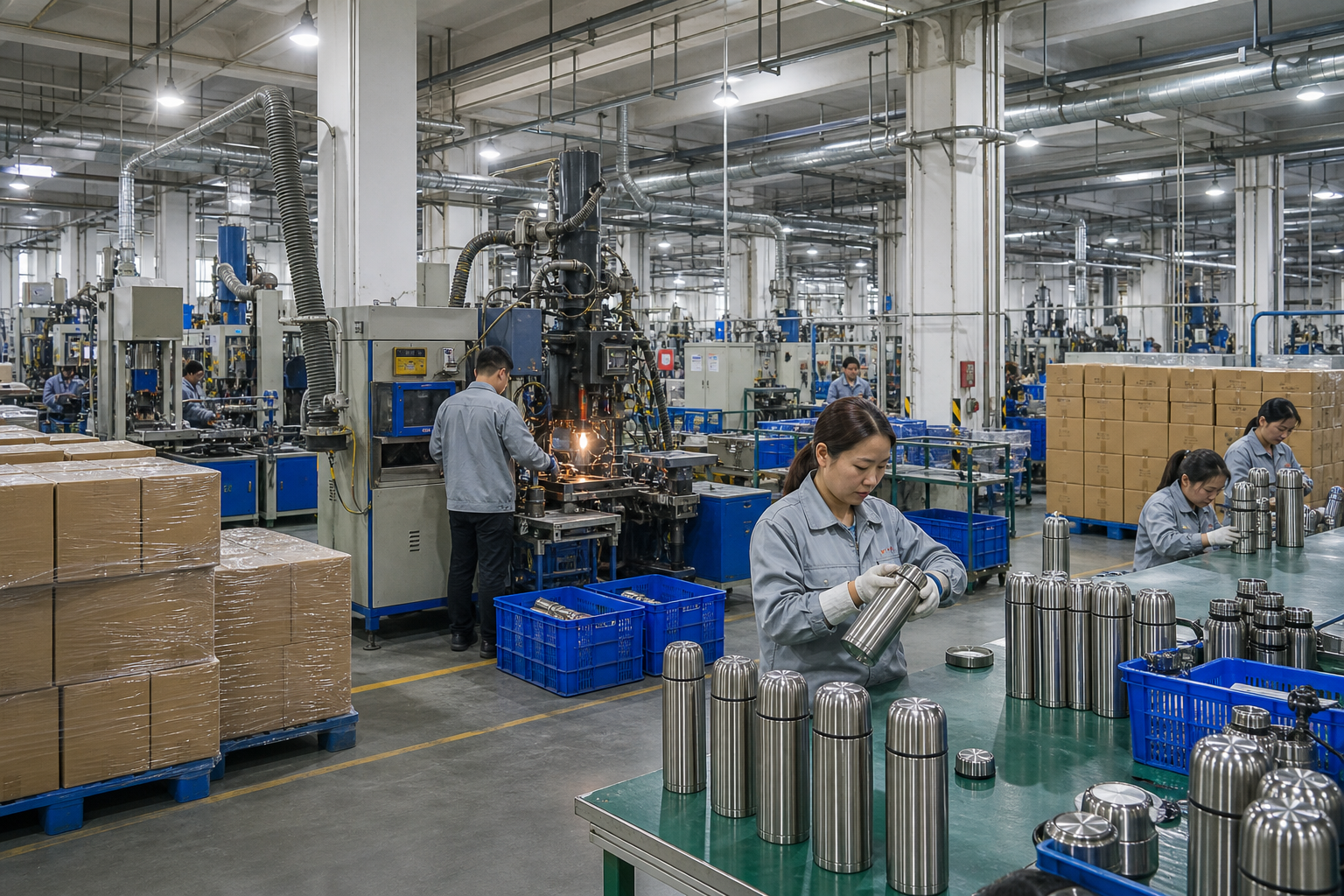
When a buyer says they need a thermos factory, they usually mean control over the steps that decide pass or fail. We run vacuum forming, neck welding, polishing, lid assembly, and final leak testing in-house. If one of those steps gets pushed out without tight control, the result is obvious: seam marks, weak seals, and heat retention that drifts from lot to lot. This is a process problem, not a sales problem.
A real factory thermos program starts with engineering drawings, not a catalog photo. Ask how the body is formed, how the vacuum chamber is sealed, and whether the line runs 100% pressure or vacuum leak checks before packing. On one Zhejiang line, QC pulled the sample at the spin-weld station because the neck runout was 0.3 mm over spec, and the buyer flagged it before shipment. That is the point. A plant that runs separate lines for straight-wall bottles, travel mugs, and promo shapes is doing the work, while a shop mixing them on one line is asking for trouble.
For outdoor retailers, the real question is whether the factory can hold the same heat-retention result on repeat orders. A plant shipping 300,000 units per month is not automatically better, but that volume usually means the steel coil, cap molding, and buffing schedule are steady. If you are buying thermos bulk for a seasonal launch, lock the 0.8 mm body spec, artwork, and PO terms only after the factory shows you the line output. The math does not work any other way.
Ask for process photos, not just a sample. A clean sample can hide a weak production line.
Choose The Right Stainless Build
Most custom thermos jobs start with 304 stainless steel unless the buyer has a real corrosion or chemical exposure requirement. On the line, we check sheet thickness with a micrometer before forming; 0.5 to 0.6 mm for the inner wall and 0.4 to 0.5 mm for the outer wall is a common retail build, with vacuum insulation in between. Go thinner and dent resistance drops fast. Go thicker and the bottle gets heavier, which pushes up bulk freight. For an outdoor line or a premium custom run, 316 stainless is the cleaner upgrade, but the cost math has to work.
Capacity is a sales choice, but it is also a practical one. A 500 ml custom thermos moves well for commuting and day hikes; 750 ml usually fits outdoor retailers who want longer heat retention and a stronger shelf presence. We have seen buyers ask for "bigger" without checking the lid stack-up, then the first sample goes to QC and the wide-mouth cap is a pain to wash. If the sealing ring is not replaceable, that bottle will come back as a service problem. That is why we run multiple lid systems on the same body tooling.
- 304 stainless: standard, cost-controlled, good for most custom thermos orders.
- 316 stainless: better for salt exposure, premium builds, and long-term brand positioning.
- Powder-coated body: better grip and scratch resistance for promotional thermos programs.
- Food-grade silicone gasket: required if you want fewer leak complaints in distribution.
If you are comparing thermos manufacturers, ask for cross-section drawings and a thermal retention chart at 95 C fill temperature. We pull that data from the test bench, not from a sales sheet. A supplier that cannot explain wall thickness, vacuum level, or lid gasket material is not ready for distributor work. We have seen this go sideways when the buyer flagged a PO typo on the lid material and the factory built the wrong seal.
Branding That Survives Real Use
I’m rewriting the section in place, keeping the HTML structure and links intact while stripping the generic marketing tone. I’m also adding the factory-floor specifics and tighter, more direct phrasing the section needs.Decoration is where a lot of custom thermos jobs go wrong. The sample can look clean, then QC pulls it after a week in a backpack and the logo starts to nick, lift, or fade. We see it on the line all the time. Choose the method by abrasion, not by sticker price. Silkscreen fits simple one-color marks. Laser engraving stays sharper on stainless steel. Powder coat and UV print give more visual impact, but they need clean surface prep and tight curing control, or the 5,000 pcs run turns into rework.
Logo placement needs to be locked before we cut tools. A curved body changes how the mark reads from 1 meter on a retail shelf, and a PO typo can put the artwork 8 mm too low for a capacity mark or QR code. If you sell through distributors or run private label, a side logo is often the better call because it leaves room for 350 ml, barcodes, and compliance text. This is the wrong question to ask if the team is only chasing the first sample; match the decoration to the channel, not to the mood in the sample room.
The best thermos factory will tell you where artwork is risky before you sign off. Small fonts, thin strokes, and gradients are the first things to fail on metal. Keep critical line weight above 0.25 mm for print, and switch to laser when the logo has to survive rough use and repeated washing. For more on logo methods, see thermos custom logo options and custom logo decoration for stainless drinkware.
Testing For Europe And North America
If you sell into Europe or North America, testing is not optional. Your thermos supplier should support REACH, LFGB, and food-contact declarations, plus migration testing where your market asks for it. For North America, buyers usually want material files that fit FDA expectations, even when the first request is just a factory letter. We run into this all the time: a sample report from a 500 ml demo cup is not a production control system, and the buyer flagged it on the first round.
At the lot level, ask for AQL 2.5 for major defects and AQL 4.0 for minor defects, unless your channel requires tighter control. For a custom thermos going to an outdoor chain or a promo brand, QC should check sealing, vacuum retention, finish defects, lid torque, logo placement, and carton condition. A carton with a 3 mm crush on one corner can kill the program before the bottle leaves the pallet, and that is the wrong place to lose margin.
A practical factory thermos test set should include:
- 100 percent leak check on the finished bottle.
- Hot-fill retention check after 6, 12, and 24 hours.
- Drop test from 1.0 meter on packaged and unpackaged units.
- Dishwasher or abrasion simulation if the sales channel expects repeated use.
China has plenty of factories that can make a decent sample. The real question is whether the same result holds when you order 5,000 units from Zhejiang instead of 20 showroom pieces. We have seen this go sideways on a PO with one wrong lid code, and the line had to stop while QC pulled the sample against the carton mark.
MOQ, Lead Time, And Real Pricing
I’m rewriting the section now, keeping the HTML structure and links intact while tightening the pricing and lead-time language so it reads like factory-side sales copy.Before you sign off on samples, lock the MOQ. For a bulk thermos order, our line usually runs 500 to 1,000 pcs per color or per print method, because the pad printer setup and carton labels do not reset for free. Add a special lid, a matte coating, or a wrapped carton, and the MOQ moves up. If someone promises 100 pcs with zero setup charge, ask where the cost went. We have seen that story turn into a higher unit price or a hidden tooling line on the PI.
On FOB China terms, a plain stainless thermos usually lands at USD 3.20 to 4.50 at scale. A retail model with better insulation, coating, and logo work often sits at USD 5.00 to 7.80. That gap comes from body gauge, lid parts, decoration passes, and carton spec. The wrong question is "What is the cheapest quote?" The math does not work if a thin 0.35 mm body, a weak lid, and a bad insert trigger claims after the first 2,000 units.
Lead time is usually 25 to 35 days after sample approval and deposit, then 5 to 10 more days if you need special packaging or new tooling. On our line, the bottleneck is often the vacuum check and carton print approval, not the steel itself. If your artwork is still moving, you will miss the window for outdoor season or Q4 promo freight. We run better when the buyer flags the final PO text before plating starts.
For planning and budgeting, see bulk thermos MOQ explained and stainless thermos product options. If you are comparing a distributor and a direct thermos factory, ask who owns the mold, who signs the QC sheet, and who fixes a typo on the PO when the carton count says 5,000 and the art file says 5,500. That is where delays usually start.
How To Brief Your Supplier Clearly
The quickest way to get a clean order is to send a brief that leaves little room for guessing. Put in capacity, target retail price, body finish, logo method, carton style, test requirements, and whether you need FSC cartons, FNSKU labels, or export-ready master packs. We run quotes off that sheet in one pass when it is complete; if the buyer sends half a page and a few screenshots, the line spends two days chasing blanks. A solid thermos vendor should quote from that brief without three rounds of back-and-forth.
For outdoor retailers, spell out the use case. A hiking bottle needs grip, dent resistance, and low spill risk, and we have seen a 0.8 mm wall fail a drop check that passed on paper. A promo thermos is a different job: lower cost, lighter packaging, and a faster lead time. For distributors, the brief should name spare gasket policy, carton drop standard, and the approved defect limit. That is the wrong question to leave open, because different suppliers will answer it three different ways.
Use this checklist before you send RFQs:
- Capacity and dimensions.
- Stainless grade and wall thickness.
- Decoration method and Pantone reference.
- Packaging, label, and barcode requirements.
- Inspection standard and required certifications.
If you want to compare factory thermos options with your procurement team, start with the product page at custom stainless thermos products, then review thermos manufacturing capabilities and quality control standards before you request samples. QC pulled the sample on a 32 oz run last month and caught a carton typo on the PO, which is why we insist on the details first.
Request a custom stainless thermos quote
Send your target price, MOQ, logo method, and market. We will match the right thermos factory setup for your retail or promo program.
Frequently asked questions
What is a realistic MOQ for a custom stainless thermos?
For most thermos factory programs, a realistic MOQ is 500 to 1,000 pcs per SKU, color, or logo method. If you choose a standard body and one-color print, you may stay near 500 pcs. If you want a special lid, two-tone coating, or retail carton printing, MOQ often rises to 1,000 to 3,000 pcs. A manufacturer that promises 100 pcs with no tooling or setup cost is usually shifting fees into the unit price. For distributor thermos orders, ask for MOQ by version, not just by total quantity, because mix-and-match orders can hide replenishment problems later.
How do I know if the thermos will actually hold temperature?
Ask the factory for a thermal retention report at a fixed fill condition, usually 95 C water, ambient room temperature, and a defined lid type. A credible thermos manufacturer should be able to show performance at 6, 12, and 24 hours, not just one marketing claim. In real production, a good 500 ml stainless thermos often stays above 60 C after 12 hours and above 45 C after 24 hours, depending on lid design and ambient conditions. If the supplier refuses to define test conditions, the numbers are not useful. China factories vary widely here, so insist on a written test method before you approve bulk thermos production.
Which logo method is best for a promotional thermos?
If the bottle will be handled heavily, laser engraving is the safest choice because it does not flake or peel. For a promotional thermos with a simple brand mark, silkscreen is cheaper and works well on flat or lightly curved surfaces. If your campaign needs stronger shelf appeal, powder coating plus laser can give a premium look with good scratch resistance. The best choice depends on the channel. Outdoor retail usually favors durability; promo programs sometimes favor speed and cost. A thermos supplier should show you logo samples on the exact stainless finish you plan to buy, not just on a random sample body.
What compliance documents do I need for Europe and North America?
For Europe, ask for REACH-related declarations, LFGB or equivalent food-contact documentation where applicable, and a clear material statement for 304 or 316 stainless steel and silicone parts. For North America, buyers usually want material declarations aligned with FDA expectations, plus carton and labeling accuracy. Some distributors also ask for nickel and heavy metal limits, especially when the product is sold as a premium thermos custom line. Your quality file should also include AQL inspection records, leak-test results, and batch traceability. A thermos factory in Zhejiang that serves export markets should know these requirements and prepare them before shipment, not after a claim.
How long does a bulk thermos order take from sample to shipment?
A normal schedule is 7 to 10 days for samples, 3 to 5 days for sample revisions if needed, and 25 to 35 days for mass production after approval and deposit. If you need special packaging, new tooling, or a custom lid, add 5 to 10 days. Freight timing is separate: air can be a few days, while sea shipping from China to Europe or North America is usually measured in weeks. A practical thermos vendor will lock artwork, carton marks, and inspection criteria before production starts, because late changes are what stretch the calendar and create extra cost.