Key Takeaways
- A workable MOQ for a custom stainless thermos is usually 1,000 pcs, with 25-35 days lead time after sample approval.
- For most bulk thermos programs, 18/8 stainless steel and 0.4-0.5 mm inner wall thickness are the practical baseline.
- FOB pricing for plain 500 ml units from China often starts around USD 2.80-4.20, before decoration and special lids.
- Ask for AQL 2.5/4.0 inspection, 100% leak testing, and REACH or LFGB documents if you sell into Europe.
If you are sourcing from a thermos manufacturer, the wrong question is whether the bottle looks good in photos. The question is whether the factory can hold vacuum quality, keep logos sharp after 200 wash cycles, and ship a bulk thermos order on time without hiding defects in the carton count. We run leak checks on the line with a vacuum gauge and a water bath for a reason. A custom thermos for outdoor retail or promotion has to survive real use, not just a sample table.
In Zhejiang and across China, the better factories treat stainless thermos production as a controlled process: steel grade, welding, vacuum sealing, coating, decoration, and final leak testing all have to line up. QC pulled the sample, checked the lid thread, and one 0.3 mm gap was enough to stop the lot. If you are buying for distributors, retail chains, or a seasonal promotional campaign, you need numbers, not vague promises. A credible China factory should quote MOQ, lead time, and inspection method upfront, then prove it with samples and test data. The math does not work any other way.
What Makes a Real Thermos Manufacturer
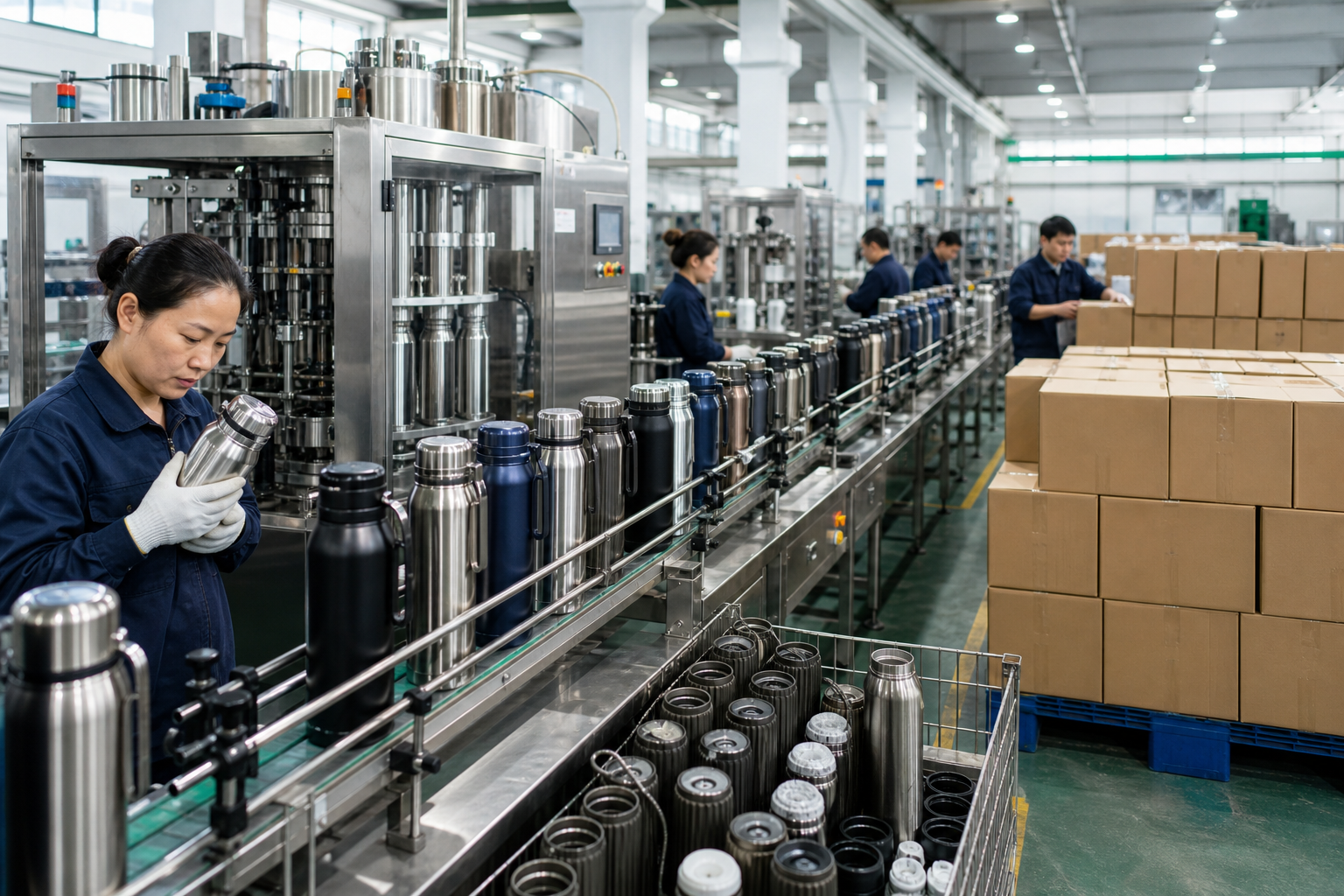
A real thermos manufacturer is not a trading desk with glossy product photos. It is a factory thermos operation with its own forming presses, welding, vacuuming, coating, and packing control. If the supplier cannot tell you where the inner liner is drawn, how the neck is welded, and how vacuum loss is measured on the gauge, you are dealing with a reseller, not a thermos manufacturer.
For outdoor retailers and promotional brands, the gap shows up fast. A factory that runs 300,000 units per month can keep raw material stable, but volume alone does not ship clean orders. You need the exact line setup, the defect rate, and how many style changes the line can absorb in a month without slipping your shipment. We have seen buyers get burned by a 2 mm logo shift and a PO typo on carton marks. In Zhejiang, the better factories will give you sample lead time, mass production lead time, and carton drop-test data before you place the order. Ask for the real process flow: stainless coil to cup body, vacuum chamber sealing, coating line, logo decoration, then final inspection. If they skip a step in the explanation, they will usually skip it in production too.
When you compare thermos suppliers, ask the same questions every time: do they own the mold, can they support custom thermos shapes, and what is on the in-house test list? A thermos supplier that controls process and QC will make fewer excuses when you need a second-order repeat or a new lid variant for distributor thermos programs. We have seen this go sideways when QC pulled the sample, the 38 mm lid thread missed tolerance by 0.3 mm, and the buyer had to restart packaging.
Steel Grade And Vacuum Build
For a stainless thermos, the steel grade and vacuum structure decide whether the product feels premium or just looks premium. We run into this on the line all the time: QC pulled an 18/8 liner from the rack and the salt-spray cabinet made the difference obvious after 72 hours. For higher corrosion resistance, especially in coastal markets or for acidic drinks, 316 on the inner liner is the right call, but it raises cost and the math has to work. Most bulk thermos buyers should start with wall gauge, seal geometry, and vacuum retention. Chasing a material upgrade before those three is the wrong question to ask.
The practical spec for a custom thermos usually starts around 0.4 mm to 0.5 mm inner wall thickness and 0.35 mm to 0.45 mm outer wall thickness, depending on size and finish. On the line, we check that with a micrometer before forming, because a 0.05 mm miss shows up later in dent resistance and weld stability. Double-wall vacuum insulation is standard; a good factory will also give you a target temperature retention, such as 12 hours hot or 24 hours cold, measured under a defined ambient condition. If the supplier gives you only marketing language and no test setup, treat it as a sales claim, not a performance claim.
Look at the weld line, the shoulder, and the neck finish. These are the places where failure starts. For a promotional thermos, the lid often fails before the body, so we pressure-test the lid seal and run boiling-water plus inverted-leak tests with a 250 ml fill. A PO typo once turned “leak proof” into “leke proof,” and the buyer still flagged the lid after QC pulled the sample. China has many thermos manufacturers, but not all of them control the same tolerance band. In Zhejiang, the better factories will show you cycle tests, vacuum decay results, and whether the production standard matches the sample standard. That is what separates thermos manufacturers that can scale from thermos vendors that can only quote.
Customization That Actually Sells
I’m rewriting the section in-place, keeping the HTML structure intact and tightening the sales-engineering voice. I’m also folding in a few concrete factory details so it reads like someone who actually runs the line.Customization has to help the buyer sell, not just help the sample stand out. A logo on a custom thermos is table stakes. On our line, we check one simple thing first: if the body is too slick for a glove grip or the lid needs two hands, the retailer will push back. Real value sits in shape, lid, finish, packaging, and the use case. Outdoor buyers usually ask for a grip-friendly body, an 18 mm carry loop, and a lid that opens cleanly with gloves on. Promotional brands want a bigger print panel, a lower unit price, and a carton that carries campaign copy without looking like a throwaway box.
There are a few ways to set up a thermos custom program. Screen printing works for 1 to 3 colors on smooth powder coat. Laser engraving stays clean on stainless steel and does not rub off. UV printing can carry more complex graphics, but we have to test the coating first; QC pulled the sample last week when the ink failed the tape test after 200 cycles. A customized thermos should not rely on decoration alone. Lid color, silicone ring, and carton insert can all match the brand palette. For distributor thermos orders, that is what helps a buyer spot the line fast at shelf level. One PO typo on a Pantone code can throw the whole set off, so the math has to be checked before we run.
- Use a powder-coated body if you want a better hand feel and branding that survives 1,000 rub cycles.
- Use laser engraving if the buyer wants a permanent mark on a premium model.
- Use molded or color-matched lids if the program needs a recognizable series with a tight MOQ.
If you are buying thermos promotional items for a campaign, do not overload the design. This is the wrong question to ask if the buyer wants reorderable stock. One strong logo, one usable color, and one reliable lid beat four decorations that add scrap risk. We have seen this go sideways on a 10,000-piece run when the buyer asked for three print methods on one model, and the line started missing the ship date. A thermos customizable enough to work across channels will bring better reorder potential than a flashy one-off sample.
MOQ, Price, And Lead Time
MOQ is where a lot of projects stall. On a standard custom thermos, a real factory usually asks for 1,000 pcs per color or model, while a simple one-color decoration can start at 500 pcs. Mixed colors, mixed lids, or mixed gift boxes push the number up because the line has to stop, swap fixtures, and recheck carton labels. The wrong question is “what is the lowest MOQ?”; ask how we run it across decoration, packaging, and master carton setup.
Price is a stack of choices. A plain 500 ml stainless model from China may start around USD 2.80-4.20 FOB, depending on wall thickness, coating, and lid type. Add laser engraving, gift box packaging, or a better lid, and the number moves fast. We had a buyer flag a quote because the supplier hid the carton spec and testing cost, then added them after sample approval. That math does not work. A proper thermos supplier should break out mold charge, sample charge, decoration cost, and packing details so you can see where the money goes.
Lead time matters just as much. A credible Zhejiang factory should give you 7-10 days for samples and 25-35 days for mass production after deposit and sample approval. If someone promises 15 days for a customized thermos with new tooling, they are probably compressing QC or overselling the line. We ship faster when the process is clean, but the schedule still has to fit the vacuum test, the leak check, and the final carton drop test. For bulk thermos programs with seasonal demand, place the order early enough to leave room for rework and freight delays.
Quality Checks You Should Require
I’m rewriting the three paragraphs to keep the same HTML structure while making the language sound like a real factory-side sales engineer: tighter, more specific, and less generic.Quality control on a stainless thermos should be on paper before the first shell hits the line. Ask for the test plan before production starts, and get it signed off. At minimum, your thermos supplier should cover vacuum retention, leak testing, finish adhesion, lid torque, carton drop test, and a visual check under 1,000 lux. For export, ask for the market documents up front: REACH for Europe, LFGB when your buyer asks for it, and FDA-style food-contact declarations for the US market. We have seen buyers lose two weeks because the file was still being prepared; that is the wrong place to find a gap.
AQL 2.5 for critical defects and AQL 4.0 for major defects is a common starting point, but the numbers only work if the factory samples the right cartons. The better thermos manufacturers inspect incoming steel coils, check vacuum welds in process, and re-open finished cartons before packing. On one line, QC pulled a bad lot because the weld bead was 0.3 mm off and the vacuum gauge dipped under spec after 24 hours. If you are buying thermos bulk for retail chains, ask how they track each lot. You need the shift, the sealing operator, and the date code, because once a leak shows up, the recall trail has to be clean.
Packaging is where a lot of claims start. A crushed carton can bend a lid thread and turn into a leak after shipping. Ask for inner box compression data, carton drop height, and whether the factory uses partition inserts. One buyer once sent a PO with 24 pcs/carton against a 12-piece insert, and QC caught it before sealing. For a thermos manufacturer in China, this is basic discipline, not a special favor. The better factories in Zhejiang keep the final pack test strict because export claims are expensive and repeat orders depend on consistency.
Choosing The Right Sales Channel
The right custom stainless thermos depends on the channel, not the catalog. Outdoor retailers care about a 1.2 mm body wall, a lid that still seals after backpack drops, and a finish that survives trail dust and 200 hand washes. Promo buyers push for low unit cost, strong logo contrast, and a ship date that lines up with the campaign. Distributors want repeatable reorders, spare lids, and color consistency from one season to the next. One model seldom fits all three without changes on the line.
For retail, 500 ml to 750 ml usually sells best. For corporate gifting, 350 ml or 500 ml is easier to pack, palletize, and ship. For thermos distributors, we run one core bottle with 2 or 3 lid options and one carton spec that can carry different branding. That keeps the SKU count under control. If a supplier keeps adding small variants, the math does not work. We have seen freight go up and warehouse picks get messy fast. The wrong question is, "How many versions can we offer?" The right one is, "How many can QC hold in AQL 2.5 without drift?"
A practical custom program also needs a clean repeat-order path. Ask the thermos factory how they store Pantone notes, artwork files, and carton measurements, and whether the sample room keeps the signed master sample. If the buyer flags a lid shade in month 6 and the factory cannot match it, you end up explaining a problem that should have been caught at the mixer or on the spray booth. In Zhejiang, the factories that do this well know the first order is a trial. The second order tells you whether the shop can really hold a 304 stainless program across 12 days versus 18 days, without a PO typo or a carton mismatch.
Get a factory quote for your thermos line
Send your capacity, finish, and logo specs. We will quote MOQ, lead time, and FOB pricing for China production.
Frequently asked questions
What is a normal MOQ for a custom stainless thermos?
For most thermos manufacturers, a standard MOQ is 1,000 pcs per model or color. Simple logo work can sometimes start at 500 pcs, but once you add a new lid, special coating, or gift box, the MOQ usually rises. If you need several colors in one order, ask whether the factory can combine them under one tooling set. For distributors and promotional buyers, the real cost driver is not only quantity, but how many production changes the line must make. A clear MOQ policy protects your price and reduces surprise charges later.
Which stainless steel grade should I choose?
For most bulk thermos orders, 304 or 18/8 stainless is the right starting point. It balances corrosion resistance, cost, and availability. If you are selling to premium outdoor retailers or expect frequent use with acidic drinks, 316 can be a better option for the inner liner, but it increases cost and is not required for every program. The more important question is whether the factory controls wall thickness, weld quality, and vacuum retention. A good thermos supplier in China should be able to explain the difference between material grade and finished performance without hiding behind marketing language.
How long does production take after sample approval?
A realistic lead time for a customized thermos is 25-35 days after sample approval and deposit. If the project needs new tooling, special printing, or a unique lid, add time for sample iterations. Most Zhejiang factories can provide samples in 7-10 days if the artwork is ready and the spec is clear. If someone promises mass production in 15 days for a fully custom model, check what they are skipping. In thermos manufacturing, vacuum sealing, curing, and final leak tests cannot be rushed without risk.
Can you print logos without them wearing off?
Yes, but the method matters. Screen printing is good for simple logos and lower-cost promotional thermos orders, but it can wear if the bottle is heavily washed or abraded. Laser engraving is the most durable option because it marks the metal directly. UV printing can handle more color detail, but it depends on coating adhesion and curing quality. If you want a long-lasting result, ask the factory for a rub test and dishwasher exposure guidance. A serious thermos manufacturer will not just show a sample; it will explain how the decoration behaves after use.
What documents should I ask for when importing into Europe or North America?
Ask for REACH compliance, food-contact declarations, and any market-specific test reports your buyer requires. For Europe, many importers also want LFGB testing when the product is positioned as a food-contact item. For the US market, buyers often ask for FDA-related declarations and packaging compliance. You should also request AQL inspection records, carton packing details, and a product spec sheet with materials, dimensions, and capacity. A reliable thermos supplier should be able to support your customs file and retailer review without guessing. If the paperwork is weak, the shipment becomes your problem at the border.