Key Takeaways
- A 500 mL custom thermos from a Zhejiang factory often starts at MOQ 3,000 pcs, with 35-45 day production after sample approval.
- 304 stainless is the standard choice; 316 costs more but is worth it when corrosion resistance matters in coastal or high-use programs.
- A realistic FOB quote for a branded bulk thermos usually changes by USD 1.00-2.50 depending on lid, coating, box, and logo method.
- Ask for leak tests, vacuum retention data, REACH or LFGB documents, and AQL 2.5/4.0 inspection records before you approve mass production.
If you are buying a custom stainless thermos for outdoor retail or a promotion, the hard part is not finding a factory. The hard part is finding thermos manufacturers that can hold the same spec across 3,000 pieces, not just 30 samples. We have seen a bottle pass on the bench and fail after 12 days in a warehouse test because the lid gasket was 0.2 mm off and the print started scuffing. Clean outside, weak inside.
In Zhejiang, China, a serious thermos factory talks about steel grade, wall structure, and inspection data before it talks price. That is the right order. For a bulk thermos order, you need a supplier thermos partner that can ship in 35 to 45 days, support AQL inspection, and keep unit cost steady when your repeat PO moves from 3,000 to 20,000 pieces. The buyer flagged a typo on a PO once, and the line caught it before packing, which saved a delay. If a factory cannot answer those points fast, the math does not work.
What A Thermos Factory Actually Builds
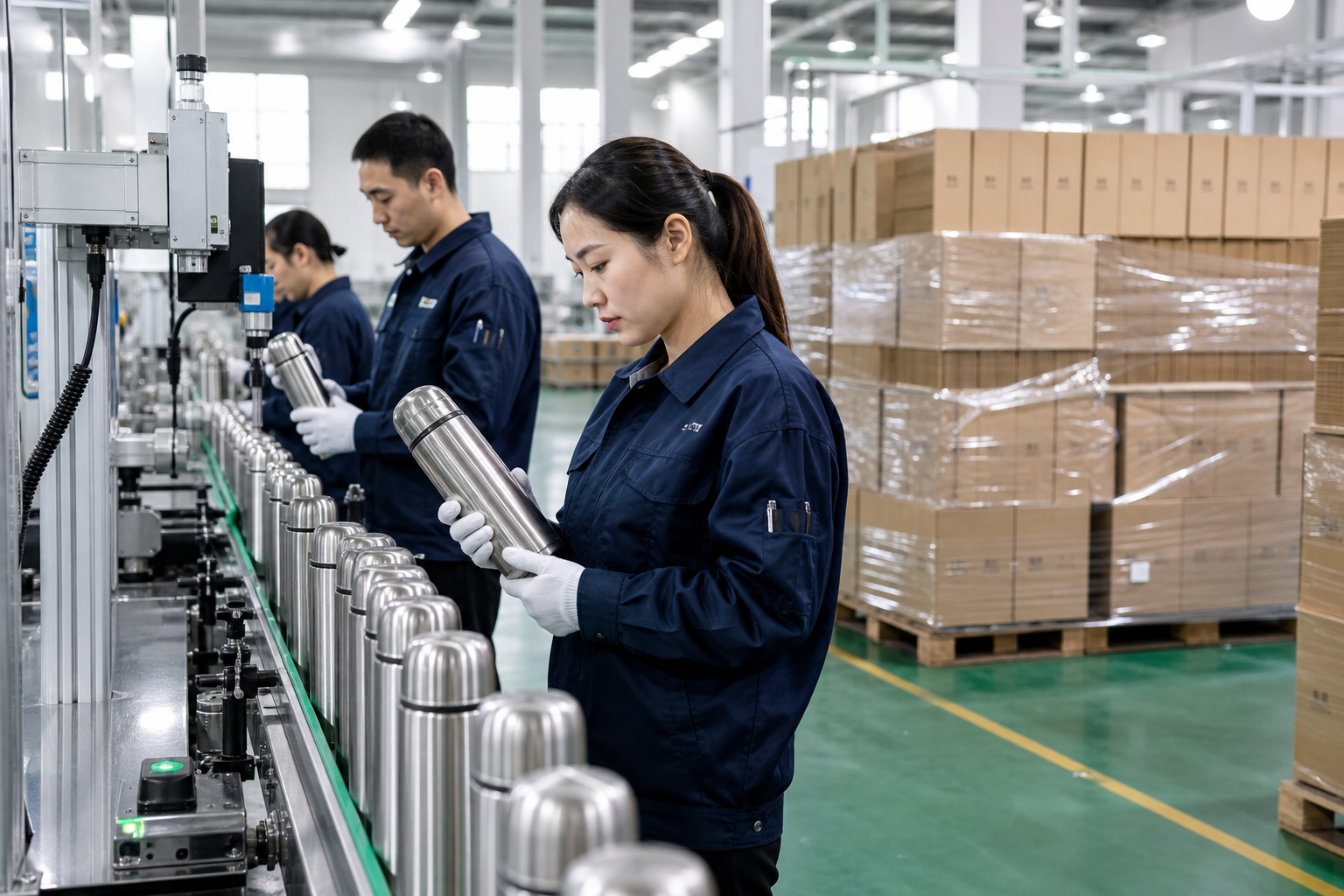
When buyers say thermos manufacturers, they often mean any supplier with a vacuum bottle line. That is too vague. On a real factory floor, we watch sheet thickness, weld quality, vacuum level, sealing ring fit, and how the lid behaves after 50 hot-fill cycles. If one step slips, the bottle can still look premium in photos and fail in use. QC pulled the sample with a torque wrench, and the lid already felt loose before the leak test started.
The common structure is straightforward: an inner liner, an outer shell, a vacuum layer between them, and a lid system that controls heat loss. For most custom thermos projects, 304 stainless is the default because it balances cost, forming stability, and corrosion resistance. 316 stainless is the better call when the buyer wants stronger resistance to salt air, acidic drinks, or a longer service life, but it pushes the unit price up. We run lines in Zhejiang that ship 80,000 to 150,000 units per month, yet only the tighter shops keep the same finish and insulation curve from batch to batch. The math does not work any other way.
- Inner liner: usually 304 or 316 stainless, often 0.4 to 0.5 mm thick.
- Outer shell: matched to the liner for rigidity and dent resistance.
- Vacuum gap: controlled during evacuation and sealing, not guessed later.
- Lid and gasket: where most leak complaints actually start.
If you are comparing thermos suppliers, ask how they measure vacuum performance and what percentage of units are reworked before packing. A serious manufacturer thermos partner will answer with process data, not slogans. We had a buyer flag a PO typo on the lid color code once, and that kind of mistake is exactly why the line needs a clear check sheet, not hand-waving.
Specs That Move The Price
Bulk thermos pricing usually comes down to four specs: steel grade, lid complexity, surface finish, and packaging. Buyers often stare at the bottle shape and miss the lid drawing, then the quote jumps after QC pulls a sample with a bamboo cap or a soft-touch coating that adds a second spray pass. We see this on the line all the time. The price has to match the finished item, not a bare shell.
For a 500 mL custom thermos, a plain 304 brushed body with one-color silk print can sit around USD 2.35 to 2.95 FOB from China at 3,000 pcs. Add powder coating, laser logo, and a color box, and the same item moves to USD 3.60 to 4.80. If you ask for 316 stainless, a better sealing cap, and retail-ready packaging, USD 4.90 to 6.20 is the range that makes sense. The buyer flagged a typo on the PO once and the whole carton spec had to be rechecked. This is the wrong question to ask if you only want a single number.
- Capacity: 350 mL, 500 mL, and 750 mL are the easiest to scale.
- Finish: brushed, powder-coated, spray-painted, or UV print.
- Lid: screw cap, push-button, cup lid, or handle lid.
- Carton pack: bulk inner pack or retail box with barcode and FNSKU if needed.
If a thermos vendor gives you one price and skips these details, you do not have a real quote yet. We have seen that go sideways in 2,000 pcs runs when the carton test failed at 12 kg compression and the packing line had to change inserts.
Customization That Sells
A custom thermos only works when the decoration fits the channel. Outdoor retailers want a coating that holds up, calm colors, and a lid that can take daily carry; on our line, we check lid torque at 0.8 N·m before we sign off. Promotional buyers ask for 12-day art turnaround, a 1,000 pcs MOQ, and a larger imprint panel. Those are different buying calls, so your thermos custom brief should say exactly where the bottle will be sold and used. If the buyer says "make it universal," that is the wrong question.
The options that matter are the ones people can see and touch. Color matching only matters if the coating stays stable after handling; QC pulled one sample after a 48-hour rub test, and the logo still read clean at 1 m. Logo placement matters if it survives abrasion. Packaging matters if the carton survives export. A customizable thermos program can include spot color printing, laser engraving, embossing, a silicone base pad, an integrated handle, or a gift sleeve. A customized thermos for B2B giveaway use may also need a low-cost single-wall accessory pack, while a premium retail line may justify a dual-layer lid and a matte finish. We have seen a glossy sample look fine in photos and then fail after one carton run.
Lock these details before sampling
- Logo method and size: silk print, laser, or 360 degree wrap.
- Color standard: Pantone reference or physical sample.
- Target audience: outdoor retail, corporate gift, or distributor thermos program.
- Packout: polybag, insert card, master carton, or full retail box.
The best thermos manufacturers will tell you when a design is too costly for the channel. If the PO asks for three Pantone colors, a debossed logo, and a 500 ml bottle at giveaway pricing, the math does not work. That is not resistance; it keeps you out of rework on the pad printer and saves a round of sample edits.
Testing And Compliance Buyers Need
You do not buy a vacuum bottle on appearance alone. You buy leak performance, heat retention, and paper trail. On the line, QC pulled the sample after a 1.2 m drop test and checked the cap threads with a go/no-go gauge; if the supplier cannot show records for those checks, you are trusting the weakest part of the product.
For export to Europe and North America, ask for REACH or LFGB material declarations when applicable, plus FDA-friendly material information for the US market. If the product contacts food or drink, the ink, gasket, liner, and coating all matter. Ask the thermos team whether the lid uses BPA-free plastic and whether the gaskets were checked for odor retention after 24 hours at 60 C. The buyer flagged it once because a PO typo listed the wrong resin grade, and that kind of slip is how shipments get delayed. On the production floor, a practical inspection plan often uses AQL 2.5 for major defects and AQL 4.0 for minor defects, with zero tolerance for leak failures.
Pressure test the lid, then test the bottle inverted for 12 hours. If the factory skips that step, you are not buying a thermal product, you are buying a complaint.
For insulation, ask for a clear test method, not a vague claim. A common internal benchmark is filled at 95 C and measured after 6 hours and 12 hours under defined room conditions, with the probe set in a 25 mm opening and the lid torqued to the same spec each time. Exact results vary by capacity and lid design, but the method should be documented. That is how reliable thermos suppliers separate themselves from a generic vendor, and this is the wrong question to ask if you only want a sales promise.
Buying From China Without Guesswork
If you are sourcing from China, start the RFQ with hard facts. Send thermos manufacturers the capacity target, target market, logo file, packaging spec, target MOQ, and required ship date on the first round. Leave out one item and the quote drifts fast; we saw a buyer flag a missing carton size, then the line had to rework a 38 mm insert after sampling. In Zhejiang, the better factories expect this level of detail because they run multiple export orders at the same time.
A clean buying process usually runs sample confirmation, pre-production sample, inline inspection, final inspection, then shipment against the approved carton list. For bulk thermos orders, 30 percent deposit and 70 percent before shipment by T/T is the usual setup. FOB Ningbo or FOB Shanghai keeps freight and customs visible from day one. QC pulled the sample at 9:20 a.m. and found a 0.3 mm lid gap on the vacuum flask, which is why we do not treat the first sample as a green light. If you are running a promotional thermos program with six SKUs, the art proof and carton labels have to stay clean across all six, or the whole plan slips.
- Ask for a factory audit or BSCI status if your customer requires social compliance; we have seen buyers lose a tender over a missing audit PDF.
- Request production photos tied to the PO number, not generic marketing shots; one wrong PO typo can send you the wrong 500 pcs carton print.
- Confirm spare parts availability for replacement lids and gaskets; a 1 mm gasket mismatch can turn a finished order into spare-part chaos.
- Set a written defect clause before mass production starts; AQL 2.5 only works when the buyer and the factory agree on the same cutoff.
That is how you buy from manufacturers thermos suppliers in China without turning the project into a guessing game.
Request a custom thermos quote today
Send your capacity, logo, target MOQ, and market. We will price the bottle, packaging, and inspection plan for your next bulk order.
Frequently asked questions
What MOQ should I expect from thermos manufacturers?
For a custom stainless thermos, a realistic MOQ is often 3,000 pcs per design and color, though some thermos suppliers may accept 1,000 to 2,000 pcs if the model is already tooled and decoration is simple. If you want special packaging, laser engraving, or a nonstandard lid, the MOQ usually rises because the factory has to allocate line time and packaging materials. In Zhejiang, larger factories can handle higher volume better, but they still need a clear forecast. If you plan to reorder, tell the factory your expected annual volume. A good thermos manufacturer will price 5,000 pcs differently from 20,000 pcs because setup cost and carton efficiency change fast.
Is 304 or 316 stainless better for a custom thermos?
304 stainless is the standard choice for most bulk thermos programs because it is cost-effective, easy to form, and widely accepted for beverage contact. 316 stainless is better when corrosion resistance matters more, especially for salty environments, acidic drinks, or premium retail positioning. The cost difference is usually visible on the quote, often adding USD 0.40 to 1.00 per unit depending on capacity and construction. For outdoor retailers, 304 is usually enough unless the product will face harsh conditions. For a premium distributor thermos line, 316 can help you justify a higher shelf price. Ask the thermos factory to show the material declaration for both the inner liner and the lid parts.
How do I compare insulation claims from different suppliers?
Do not compare slogans. Compare test conditions. Ask each thermos supplier what temperature, fill volume, ambient temperature, and measurement time they used. A meaningful report should state the method clearly, such as 95 C fill, 500 mL capacity, and readings at 6 hours and 12 hours. Also ask whether the bottle was preheated, because that changes the result. A factory thermos that reports only one number with no method is not giving you enough data. For a practical buying decision, you should also ask for leak test results and lid cycle testing. One strong insulation number does not matter if the lid leaks or the gasket deforms after repeated use.
What should I check before approving a promotional thermos sample?
Check the logo alignment, coating consistency, lid torque, seal fit, and carton packout. A promotional thermos can fail at the sample stage if the imprint is off-center by even 2 to 3 mm or if the lid feels too loose. Fill the sample with hot water and leave it inverted for at least 12 hours, then inspect the gasket and threads. If you are selling into Europe or North America, ask for REACH or LFGB-related material information as needed, plus a declaration for BPA-free plastic parts if the lid contains plastic. For a branded giveaway, you should also confirm whether the print survives normal abrasion and whether the box can take shipment without crushing.
How long does custom thermos production usually take in China?
For a straightforward custom thermos order, sample development often takes 5 to 10 days if the base model exists. Mass production usually takes 35 to 45 days after pre-production approval, but a busy thermos factory in China may need longer during peak season. If you add new tooling, special coating, or complex packaging, expect the schedule to stretch. Shipping time then depends on the destination and lane. Buyers who work with thermos manufacturers in Zhejiang often get better schedule control when the spec is final before the deposit is paid. The biggest delay is usually not the bottle itself; it is artwork approval, packaging proofs, or late changes to the lid.