Key Takeaways
- A workable thermos promotional MOQ is usually 500 to 1,000 units, with 25 to 35 days lead time from a China factory.
- For outdoor use, 18/8 stainless steel and 0.5 mm to 0.6 mm inner wall thickness are safer than thin budget builds.
- Laser engraving, silk screen, and UV print each fit different thermos custom budgets; choose based on abrasion and color count.
- Ask for REACH, LFGB, and AQL 2.5 inspection data before you approve a customized thermos shipment.
If you treat a thermos promotional order like a generic gift item, you pay twice: once for the unit, again for the complaints. The right custom stainless thermos is not a logo carrier. It has to hold temperature, survive shipping, and still look clean after months of use. On the line, we check 304 stainless, 0.5 mm wall thickness, lid sealing, and whether the print leaves a ridge after a 1 m drop test.
We keep this decision practical. Judge a thermos promotional order by use case, not by a glossy catalog photo. We ship for outdoor retailers and promo brands that ask the same questions every week: 500 ml or 750 ml, 12 hours hot or 18, and what MOQ the factory can hold without cutting corners. In Zhejiang, a solid thermos factory line can run 300,000 units per month, but a weak brief still creates returns. The wrong question is “which model is cheapest?” Start with the spec, then lock the MOQ, test standard, and packaging before you send a PO.
What makes a thermos promotional order work
A thermos promotional order works when the bottle fits the user and the decoration still looks clean after real handling. For outdoor retailers, trail crews, field teams, or giveaway programs, the item has to read like gear, not a cheap handout. We run samples on the line with a tape drop test, a lid torque check, and a backpack rub test. If the finish chips in a week, the buyer flags it and the order turns into a complaint.
The wrong question is unit price alone. A $2.80 promotional thermos can look fine on a sample table and fall apart once it moves through a 3,000-piece distribution run. Start with the use case: hot coffee for 6 to 8 hours, tea for 10 to 12 hours, or water through the full day. Then pick the shape around that job. Straight-wall bottles print easier and pack tighter. Slim travel shapes fit retail sets. Wide-mouth custom thermos designs work better for ice, cleaning, and the 304 stainless interior. We have seen this go sideways when a buyer tried to force one SKU into three uses, and the math does not work.
From a factory thermos angle, packing is part of the order, not an afterthought. A carton that wastes 15 percent of cube space can wipe out the savings from a lower FOB price. In Zhejiang, the better thermos manufacturers quote the bottle, the insert, the master carton count, and the drop-test spec together before bulk thermos production starts. That is the number set you want. I would also check the PO against the actual pack plan, because one stray typo on carton count can hold the line for a day.
Choose the right stainless build
Material spec is where a customized thermos either builds trust or comes back as returns. For most promotional thermos jobs, 304 stainless steel on the inner and outer wall is the baseline we run. If the buyer needs stronger corrosion resistance for salty or acidic use, ask for 316 on the inner liner for premium models. We checked one batch last month with a wrong PO typo on the steel grade, and QC pulled the sample before the line kept going. Steel grade alone is not enough; thickness and forming quality decide whether the bottle holds up.
For a practical promotional product, target 0.5 mm to 0.6 mm wall thickness on the inner cup and confirm the vacuum gap stays stable. Thinner walls cut cost, but they also raise dent risk and can hurt thermal performance if the drawing process is rough. The math does not work if the factory cannot keep the forming die consistent. A proper thermos manufacturer should give insulation test data, usually with hot-water retention readings at 6, 8, and 12 hours. If a sample does not show a clear temperature curve, the spec is incomplete.
- Budget promotional use: 304 steel, 0.5 mm wall, basic PP lid, FOB starting around the low single digits depending on size and decoration.
- Retail-ready use: 304 steel, powder coat or spray finish, silicone seal, and improved box insert.
- Premium customized thermos: better paint system, engraved logo, and tighter leak testing.
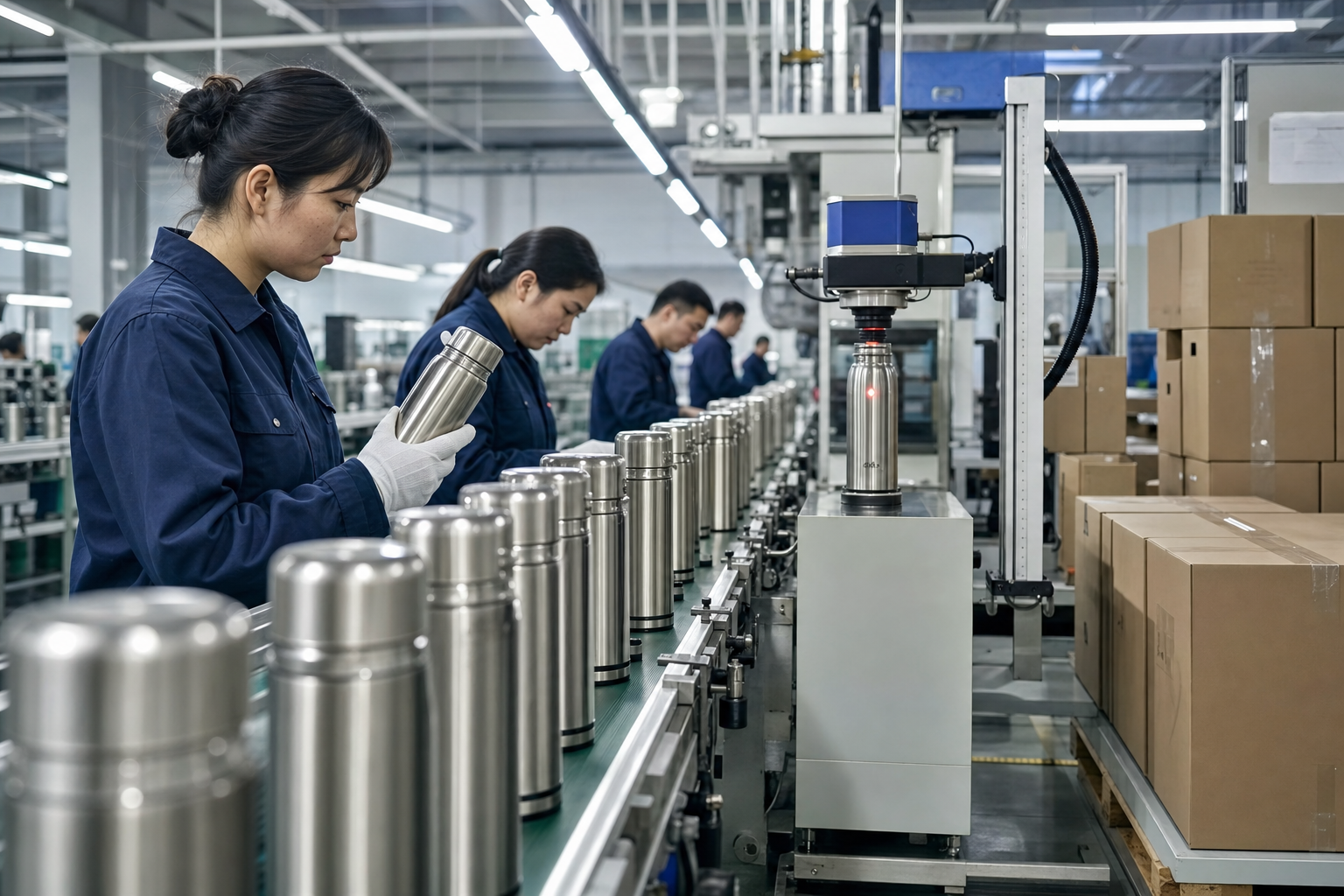
On a good line in China, the gap between average and strong is not obvious in the photo. It shows up after 200 drops, repeated washing, and daily carry. We ship a lot of samples that look fine on day one, then fail after the buyer flags a lid scratch or a weak vacuum reading. That is why distributors thermos programs should ask for sample aging, not just one clean prototype.
Branding that lasts longer
Decoration is not a logo-only decision. It sits in the product life cycle. If the thermos promotional item goes out at a trade show or through a retailer bundle, the mark has to survive abrasion, dishwashing, and the scuffing we see in backpacks and car cupholders. On the line, we run a quick rub test with a cotton cloth and a coin. The safest method still depends on artwork, color count, and target price.
Laser engraving is the toughest choice for a metal thermos custom order. It cuts through the coating and exposes the steel, so there is nothing to peel. Silk screen works for one or two colors on a flat or slightly curved body, but it needs a stable coating and a clean setup. UV print gives more color detail, though we have seen it go sideways when the buyer wants heavy rubbing resistance and the coating is too thin. For a promotional brand, powder coating plus laser engraving usually gives the best balance: solid hand feel, sharp contrast, and fewer complaints.
If you want a thermos customizable program with multiple SKUs, keep the body fixed and change only the lid color, print, or gift box. That keeps tooling simple and protects MOQ. A supplier may say yes to everything, but that is the wrong question to ask. The real test is whether they can hold registration and color consistency across 5,000 or 10,000 units. Ask for Pantone tolerance, logo placement tolerance, and a photo of the first-article approval sample. We have seen a 2 mm logo shift turn into a rejected carton.
Rule of thumb: if the branding can be scratched off in a week, it is the wrong decoration method for a promotional thermos.
For a thermos vendor serving outdoor retailers, durability wins over decoration complexity most of the time. QC pulled a sample with a faint print after 18 days of abrasion testing. The buyer flagged it immediately, and the whole batch needed a recheck.
Compliance and testing you should ask for
If your thermos promotional shipment goes into Europe or North America, compliance is not optional. We ask for a material declaration, food-contact test reports, and a clear coating-system statement before we run the line. For Europe, buyers usually want REACH and LFGB support, plus migration testing if the cup uses inks, coatings, or silicone parts; for the U.S. market, request the food-contact file and raw-material traceability. If a supplier cannot show the resin batch and ink lot on the same page, the paper trail is weak.
Quality control needs more than a promise. A serious thermos factory should work to an AQL standard, commonly AQL 2.5 for major defects and AQL 4.0 for minor defects, unless your program is stricter. That matters because one leaking lid in a 5,000-piece retailer batch can damage the whole distributor thermos relationship. Ask how they test vacuum retention, drop resistance, screw-thread fit, and leak performance on the bench. If they cannot explain the method in plain language, they are not operating at export level.
For custom logo items, look hard at ink adhesion and abrasion resistance. We have seen a 24-hour salt spray test on cap hardware save a shipment after the buyer flagged a dull spot on the first carton. A good supplier thermos file should also show a temperature-retention test after packaging, not just before it. Since a lot of promotional thermos work is built in Zhejiang and nearby provinces, the shortage is not factories. The shortage is discipline. The best manufacturers document inspection photos, carton counts, and final random checks before loading, with the QC sheet signed off at the line.
Do not ignore the lid. That is where most field failures happen. Silicone ring hardness, thread engagement, and vent design matter more than most buyers expect, and a 0.3 mm mismatch on the cap can turn into a slow leak. We have seen this go sideways on a PO with the wrong liner spec. This is the wrong question to ask if you only check the bottle body.
MOQ pricing and lead time
MOQ is where the deal gets real. For a standard thermos promotional order, 500 units is a common entry point if you accept a stock color or a simple one-pass logo. For a fully customized thermos with a new body color, branded packaging, or a special lid part, 1,000 to 3,000 units is the more normal number. If the program has multiple SKUs, split it by body and decoration. Forcing six variants into one line item usually creates trouble on the packing bench, and we have seen a PO typo turn a 500-piece lid mix into a 5,000-piece headache.
Pricing changes with size, finish, lid structure, and carton spec. A basic thermos bulk quote can jump fast when you move from one-color print to laser engraving, or from a stock gift box to a custom mailer with insert. Ask for FOB China first, then break out freight, duty, and inland handling. That keeps the math clean. A good thermos manufacturer should also tell you whether the price is based on full container load or mixed shipment. QC pulled a sample last week and found a 0.3 mm gap on the cap ring; that kind of detail is why the cheapest line is not always the lowest cost.
Lead time is usually 25 to 35 days after sample approval and deposit for a standard run. If the bottle needs new tooling, a special coating, or imported packaging parts, add another 7 to 15 days. A factory in Zhejiang with 300,000 units of monthly output still needs a real slot on the line, because capacity on paper is not the same as usable capacity in peak season. We run into this every year: the buyer wants a tight ship date, but the coating oven is already booked and the carton fold test fails on the first batch.
For distributors thermos programs, lock the spec, approve the golden sample, and place repeat forecasts in batches. That gets you better pricing without pushing the factory into unstable short runs. This is the wrong question to ask: "Can you do it faster?" The better question is whether the spec is frozen and the reorder plan is clear. When we ship a 304 stainless thermos on a repeat schedule, the line stays steady and the unit price holds.
How to brief your factory clearly
A clean thermos brief is short, specific, and measurable. Start with product type, size, target users, decoration method, and compliance requirements. Then add the quote details the line actually needs: body color, lid color, logo size in mm, packaging format, carton count, and test standard. We have seen a PO say "blue" with no Pantone, and the sample room had to guess. QC pulled the sample, the lid print missed by 0.8 mm, and the price changed. Vague requests lead to vague pricing. The math does not work.
Use this order: product name, capacity, steel grade, finish, logo method, order quantity, target market, and ship date. If you want a thermos customized for outdoor retail, say that. If you want a promotional thermos for trade shows, say whether the priority is low cost or a heavier feel in hand. That changes lid tooling and print setup. This is the wrong question to ask: "Can you make it cheap?" Ask what spec fits the market. A factory thermos team will quote the build that fits your budget instead of padding for guesswork. We run a 3,000 pcs MOQ on some colors, so the buyer should know that before asking for a "small trial."
- Capacity: 350 ml, 500 ml, 750 ml, or 1 L.
- Decoration: laser, screen print, UV print, or embossed badge.
- Packaging: white box, color box, or mailer-ready retail carton.
- Testing: leak test, drop test, vacuum retention, and AQL final inspection.
When you work with supplier thermos teams in China, especially in Zhejiang, clear wording cuts sampling from 18 days to 12 days. It also stops the factory from defaulting to a spec that misses your market. QC pulled the sample, checked the vacuum on the bench, and found the logo size was 8 mm too small. We've seen this go sideways on a simple typo in the PO. A tight brief is the fastest way to get a quote you can ship.
Get a thermos quote built around your spec
Send your target price, MOQ, and artwork. We will match the right stainless build, decoration method, and compliance path.
Frequently asked questions
What MOQ should I expect for a thermos promotional order?
For a standard thermos promotional model, expect 500 to 1,000 units as a practical MOQ. If you only change the logo on a stock body, some thermos suppliers can start at 300 to 500 units. Once you add custom color, special lid parts, or new packaging, 1,000 to 3,000 units is more realistic. For a factory in China, that range usually gives stable pricing and enough room for AQL inspection, packing loss, and test sampling. If you need multiple artwork versions, keep the same body spec and vary only print or box artwork so the order stays efficient.
Which decoration method is best for a custom stainless thermos?
For most custom stainless thermos projects, laser engraving is the most durable. It does not peel and usually holds up best in outdoor use. Silk screen is fine for one or two colors and works well on coated surfaces, but it can wear if the bottle is rubbed often. UV print allows more color and detail, but you should confirm scratch resistance before release. If your target price allows it, powder coating plus laser engraving is a strong combination for promotional thermos orders. Ask the factory for a first-article photo, logo size in millimeters, and an abrasion test result if the product will be handled daily.
How do I check if a thermos supplier is reliable?
Start with documents, not promises. A reliable thermos supplier should provide material specs, food-contact compliance support, and a clear QC flow. Ask for AQL levels, leak test method, and insulation test data at 6, 8, and 12 hours. A credible thermos factory will also show you carton packing details, master carton counts, and traceability on raw materials. If they export to Europe or North America, they should be able to discuss REACH, LFGB support, and coating or ink safety without hesitation. In China, especially Zhejiang, many factories can make the product; fewer can explain quality control clearly.
What lead time should I plan for bulk thermos production?
For bulk thermos orders, a standard production window is 25 to 35 days after sample approval and deposit. If the order needs new tooling, a special finish, or custom packaging, plan for 40 to 50 days. Shipping time is separate and depends on destination and freight method. If you are buying from a China manufacturer during peak season, add a buffer because line capacity can be booked early. A factory with 300,000 units per month still needs scheduling discipline, so do not assume capacity alone guarantees faster delivery. The safest approach is to approve one golden sample, then place the purchase order with a clear ship date.
What should be included in a thermos custom brief?
A good thermos custom brief should include capacity, steel grade, finish, logo method, artwork placement, packaging, order quantity, and target market. Add the performance expectation too, such as 6-hour or 12-hour heat retention, because that affects the build. If the order is for outdoor retail, mention abrasion resistance and leakproof requirements. If it is for a distributor thermos program, specify carton count, barcode format, and whether you need retail-ready packaging. The more specific the brief, the cleaner the quote. It also reduces sample revisions and keeps the factory from assuming a generic promotional thermos spec that does not match your channel.