Key Takeaways
- Most thermos suppliers can quote a custom thermos, but only a few can hold AQL 2.5 and keep lead time at 25-35 days.
- A workable MOQ for a bulk thermos program is often 500-1,000 pcs per SKU, depending on color, finish, and logo method.
- A 304 stainless body with 0.4-0.5 mm wall thickness is a practical baseline for retail and promotional thermos orders.
- A Zhejiang thermos factory with 300,000 units/month capacity can support distributors thermos programs without constant stock gaps.
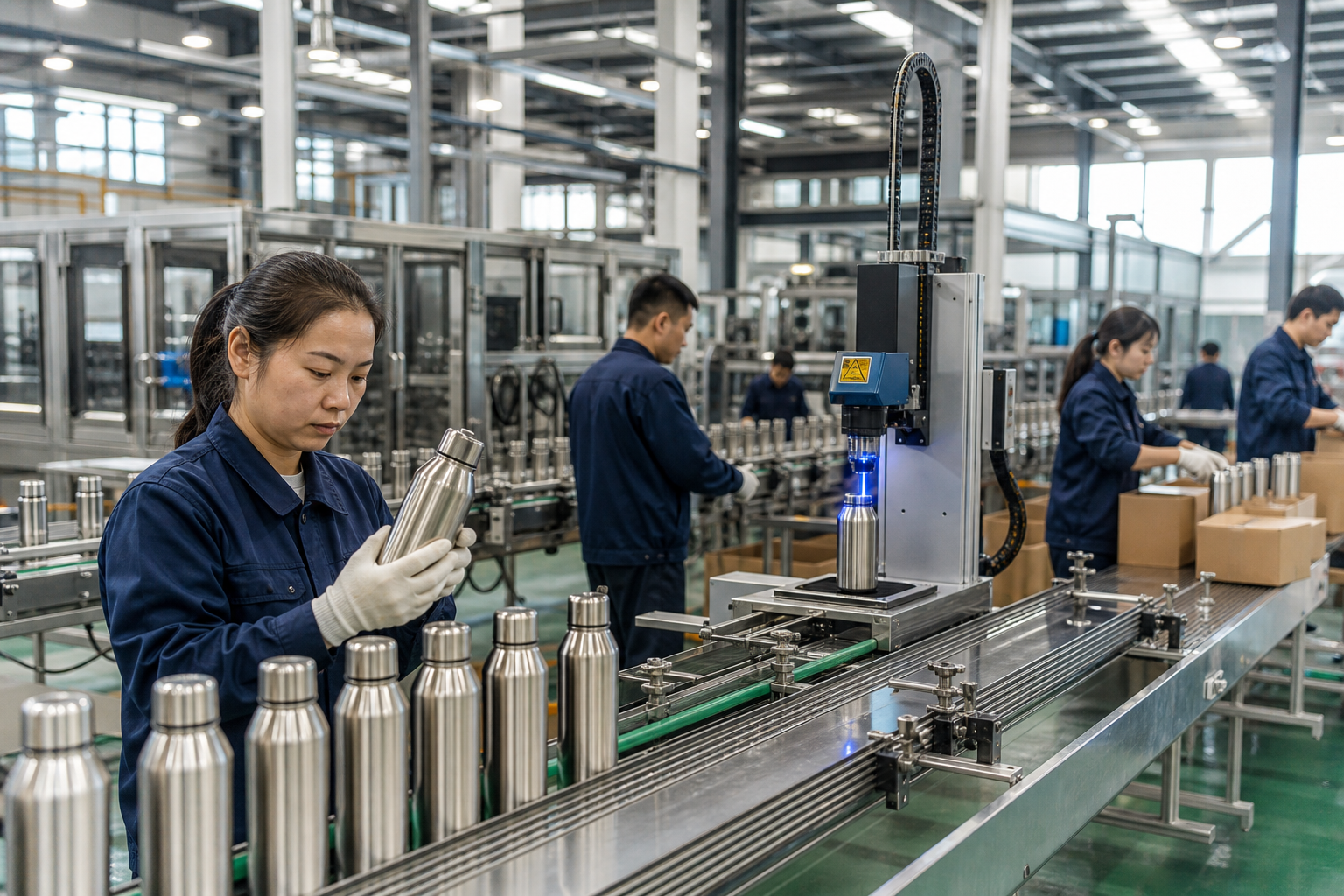
If you are sourcing from thermos suppliers, the usual mistake is simple: you compare samples by looks and forget the job behind the product. A stainless thermos for outdoor retail or promo use has to hold temperature, survive a 1.2 m drop test, print cleanly, and clear customs without surprises. We run this kind of order in Zhejiang every week, and the first thing we check is lid seal and wall thickness, not the mockup. This is the wrong question to ask if you start with color cards.
For bulk thermos orders, the gap between a supplier thermos and a real manufacturer thermos shows up in the details: steel grade, lid sealing, coating durability, packaging structure, and whether the line can ship 30,000 pcs a month without drifting on quality. QC pulled the sample after a 0.3 mm gap showed up at the cap thread, and that is the sort of issue that decides whether a program runs 12 days or slips to 18. We handle custom thermos programs for distributors and brand owners, so the math has to work. If you want a customizable thermos that sells, you need a factory thermos process that repeats cleanly at scale, not just a nice sample photo.
What separates real suppliers
When buyers search for thermos suppliers, they usually land on a mixed list: trading companies, small workshops, and actual manufacturers. You can buy from all three, but they do not behave the same on the floor. A thermos manufacturer controls tube forming, welding, vacuuming, coating, and packing. A thermos vendor may only assemble or resell. The first sample is easy; the second PO is where the truth shows up.
For outdoor retailers and promotional brands, the check is plain. Ask for the steel spec, the vacuum structure, the lid material, and the carton drop-test result. A serious thermos factory will answer in numbers. A weak supplier keeps saying “premium quality” and never says 0.4 mm or 0.5 mm. On our side, QC pulled the sample from the 24-hour heat-retention rack and checked the 304 inner, 201 outer, and wall thickness against the drawing. If they dodge the spec sheet, the math does not work.
- Request a written spec sheet, not just a catalog photo.
- Confirm whether the sample was hand-made or run on the line.
- Check whether the manufacturer thermos process is in-house or pushed out to another shop.
- Ask for monthly output and whether the line can repeat custom thermos colors without a shade shift.
If you are buying thermos bulk for a distributor program, consistency matters more than novelty. We ship a lot of repeat orders, and a loose logo or cap fit on a 5,000 pcs run turns into a headache fast. The buyers who push back on this usually want a cheaper quote, but the line tells the story: if the lid torque, coating, and carton count stay steady across 5,000 pcs, you have a real supplier.
Materials that hold up
Stainless thermos quality starts with the metal, not the decoration. For a bulk thermos order, 304 stainless steel is the standard baseline because it gives solid corrosion resistance and is widely accepted for food contact use. Some lower-cost factory thermos models use 201 on the outer shell to cut cost, and that only works if the buyer knows where the tradeoff sits. On the line, we run XRF checks on incoming coils, and if a buyer is shipping into Europe or North America, we also ask how the material is tested against REACH and whether the setup is right for LFGB or FDA expectations.
The vacuum layer, weld quality, and lid gasket matter just as much as the steel. A good custom stainless thermos should keep hot liquid above 60 C after 6-8 hours in normal use, and better builds will push past that when the test is set up right. We have seen this go sideways when someone waves a 24-hour claim without a test sheet. QC pulled a sample last month and found a 0.2 mm weld pinhole, and the hold time dropped fast. A thermos supplier that knows the job will spell out initial fill temperature, ambient temperature, and test load.
Useful spec points to request
- Inner and outer steel grade: 304/304 or 304/201.
- Wall thickness: usually 0.4 mm to 0.5 mm for retail.
- Cap liner: silicone or PP, with seal compression detail.
- Surface finish: powder coat, spray paint, or brushed steel.
If you want a thermos customizable enough for branding but still tough in the field, start with structure first and decoration second. A buyer once approved a clean matte print, then flagged the same SKU after a 3,000-piece trial because the cap hinge flexed on drop testing. The math does not work the other way around. That is how you avoid returns from retailers and distributor accounts.
Logo and custom options
I’m rewriting the section now with the same HTML structure, but tightening the sales language so it sounds like a factory-side spec discussion rather than generic copy.Most buyers stare at logo placement and skip the full decoration package. That is the wrong question to ask. On our line, a brushed steel bottle with a 0.3 mm laser mark holds up better under scuffing than a soft print that looks fine on day one and weak after a few drops. Outdoor retail needs abrasion resistance. A promo thermos needs lower unit cost and a 12-day ship window, not a decoration method that slows QC. Laser engraving stays clean on brushed steel. Silkscreen suits simple logos on larger promotional runs. Pad print works for a small mark on curved lids or caps, but it is not the answer for every custom thermos.
If you want a customized thermos that feels like a branded product, build the spec around three layers: bottle shape, lid style, and finish. We had a buyer flag a PO that mixed matte body notes with a glossy lid request and no clear Pantone callout, and the sample came back looking split. Small changes here do more for shelf impact than throwing on extra colors. A thermos distributor cares about carton fit, pack-out speed, and whether the artwork stays aligned across 5,000 pcs. That is the math that matters.
- Logo methods: laser, silkscreen, heat transfer, debossed sleeve.
- Surface options: matte powder coat, glossy spray, metallic sheen, bare steel.
- Packaging: single box, gift box, mailer, or FNSKU-ready retail carton.
- Accessory options: tea infuser, carry strap, extra lid, or spare gasket.
For a promotional thermos campaign, keep the setup tight. One bottle shape. One lid type. One logo method. We ship faster that way, and the line does not get bogged down by changeovers or rework. On a 3,000 pcs order, this is how thermos manufacturers hold cost under control and keep the schedule clean. Stack too many options, and QC pulled the sample twice before the order even left the packing table.
MOQ, pricing, and lead time
For most thermos suppliers in China, MOQ is the real commercial gate, not sample approval. On a normal 500 ml straight tumbler, we usually run 500 pcs per color for stock models and 1,000 pcs when the buyer wants mixed finishes, printed gift boxes, or a new cap. If the order calls for full customization and fresh tooling, the MOQ climbs fast. That is not a sales trick. The mold shop, the powder coat line, and the carton run all need volume to make sense.
Price follows steel grade, capacity, lid structure, and decoration. A basic promo thermos can be pushed down on FOB, but a retail-ready bottle with a better lid, sleeve print, and a rigid box will land higher. The buyer flagged a 0.3 mm wall difference on one PO, and that tiny change moved the quote. Chasing the lowest FOB is the wrong question to ask. Compare landed cost per usable unit, carton strength, and how much scrap the line is likely to throw.
In a Zhejiang factory with 300,000 units per month capacity, a typical production window is 25-35 days after sample approval and deposit, assuming the art files are final and the color is already in the standard range.
Ask your supplier thermos contact to break out sample fee, tooling fee, unit price, carton cost, and test fee separately. We have seen this go sideways when a PO typo changed the lid code by one character and QC had to pull the sample again. Then you can tell whether you are buying a real factory thermos program or a cheap quote that will move on you later.
Quality control that matters
Quality control on a thermos looks simple until you start tracing where it fails. We see vacuum leaks, coating scratches, lid odor, weak thread fit, and cartons crushed at a 1.2 m drop on the corner. On our line, the vacuum gauge and torque wrench catch different problems. You need incoming steel inspection, in-process leak checks, final thermal testing, and carton drop tests. For bulk thermos orders, skipping any of that is the wrong question to ask. One bad lot can kill a retail season.
Ask for the inspection standard before you place the order. A practical target is AQL 2.5 for major defects and 4.0 for minor defects, with photo records from final inspection. On a recent 12,000 pcs run, the buyer flagged a PO typo on the carton mark, and we fixed it before packing. That is why pre-shipment third-party inspection matters. If you buy a distributor thermos program, confirm the factory accepts that step. It keeps the line honest.
- Leak test every batch, not just random samples, using the water bath or pressure rig.
- Check lid torque and seal fit on multiple units per carton; we run a 0.8 N·m torque check.
- Confirm print adhesion after abrasion or tape pull, and mark the scuff area before the test.
- Verify temperature retention using one written test method, with the same 95°C fill and 6-hour readout.
Good thermos manufacturers do not hide process data. They hand over numbers, photos, and a clear rejection path. On a 304 stainless order, QC pulled the sample and found one loose cap thread before shipment, which saved a return claim. That is what separates a stable supplier thermos relationship from a one-time deal.
How to choose a partner
Choosing thermos suppliers comes down to fit. If you need a short-run promo bottle, 12-day lead time and unit price carry the weight. If you are building a retail line that ships every month, we care more about repeatability, carton control, and whether the cap torque stays at 2.0-2.5 N·m on the line. A Zhejiang thermos manufacturer should tell you what is standard, what is custom, and what will slow production. That honesty saves headaches.
Start with three questions. Can they make your spec in-house? Can they repeat the order without swapping the lid, liner, or packing insert? Can they show compliance docs for the market you sell into? If the answer stays vague, you are talking to a thermos vendor, not a manufacturing partner. That might work for a one-off PO, but it is the wrong base for a distributor program. We had a buyer flag a PO typo on “18/8” versus “304”; the sample room caught it before tooling.
For outdoor retailers, I push a pilot first: 500-1,000 pcs, one print method, one carton spec, one freight plan. Then we look at sell-through, returns, and customer feedback before you scale. QC pulled the sample and found a 1.2 mm gap at the mouth on one lot, which would have turned into leaks on a busy shelf. That is the practical route for thermos distributors who do not want dead stock. The math does not work any other way.
China has the scale advantage, but scale only helps when the factory process is disciplined. A good partner in Zhejiang should make that visible in every quote, sample, and shipment. If they cannot explain why the MOQ is 3,000 pcs for one body shape and 5,000 pcs for a new lid, they are guessing. We ship better when the numbers are clear, and the buyer gets fewer surprises.
Get a factory quote that matches your market
Send your spec, target price, and packaging needs. We will quote a thermos bulk program built for your channel, not a generic sample order.
Frequently asked questions
What MOQ should I expect from thermos suppliers for a custom order?
For a standard custom thermos, expect 500 to 1,000 pcs per SKU if you use an existing mold, existing lid, and one logo method. If you want a new shape, special cap, or unique packaging, MOQ can move to 3,000 pcs or more because the setup cost has to be spread across the run. Some thermos suppliers will quote lower, but check whether they are mixing colors, using stock cartons, or changing components after sample approval. A serious Zhejiang factory will spell out the MOQ by decoration method, color count, and carton spec so you can plan the landed cost correctly.
What is a realistic lead time for bulk thermos production?
For a bulk thermos order with final artwork and a standard finish, 25-35 days after deposit is a realistic factory lead time in China. Add 5-7 days if you need packaging approval or a pre-production sample sign-off. If you are ordering a customized thermos with new tooling, expect another 15-25 days for mold work and trial runs. Freight is separate, of course. Many buyers lose time because they approve samples late or keep changing logo placement. A good thermos factory will give you one production calendar and lock the critical path before the order starts.
Which logo method is best for a promotional thermos?
For a promotional thermos, laser engraving is the safest if you want the mark to survive daily use. It is clean, permanent, and works well on stainless steel. Silkscreen is cheaper and fine for simple artwork, but it can wear sooner if the bottle is handled hard. Pad print is useful on lids and small curved areas. If you are buying thermos promotional stock for events, I would usually choose one color silkscreen or laser, then keep the packaging simple. That keeps cost down and reduces the risk of delays from color matching or rework.
How do I check if a thermos manufacturer is actually reliable?
Ask for three things: factory photos with the production line, an inspection report from a recent order, and a written compliance list for your market. A reliable thermos manufacturer should know whether the product is suitable for REACH, LFGB, or FDA-related requests, and they should be able to explain AQL targets. Also ask how many units per month they make. If a thermos factory says 300,000 units/month, that is useful only if they can also show you the line balance, QC steps, and packaging output. Capacity without process control is not enough.
What should I ask about packaging for distributor thermos programs?
Ask whether the cartons are export-grade, how many pcs fit per master carton, and whether the packaging can support FNSKU labels if you sell through Amazon or other retail channels. For distributor thermos programs, carton strength matters because damage rates rise quickly with heavy stainless bottles. I also recommend asking for a drop-test method and whether the inner box is designed for shelf display or e-commerce. If you are buying thermos bulk for North America or Europe, packaging should be part of the quote, not an afterthought. It affects freight cost, damage claims, and how quickly your team can receive and rework stock.