Key Takeaways
- A practical thermos wholesale order usually starts at 500-1,000 units, with lead times of 25-45 days after sample approval.
- A good vacuum stainless thermos should target 8-12 hours hot retention and use 304 stainless steel for food-contact parts.
- Logo methods change cost and durability: silkscreen is usually cheapest, laser engraving lasts longer, and full-color wrapups raise the unit price.
- For Europe and North America, ask for REACH, LFGB, and tested insulation data before you confirm any custom thermos order.
If you are buying thermos wholesale for outdoor retail or a promo campaign, the real risk is not the low price. It is a stainless thermos that looks clean in photos, then fails on heat retention, lid wear, or print quality after it reaches your warehouse. We have seen buyers approve a sample, then the first carton arrives with a loose cap thread and a logo that rubs off after one wash. The math does not work. A proper supplier gives you measured specs, not loose talk.
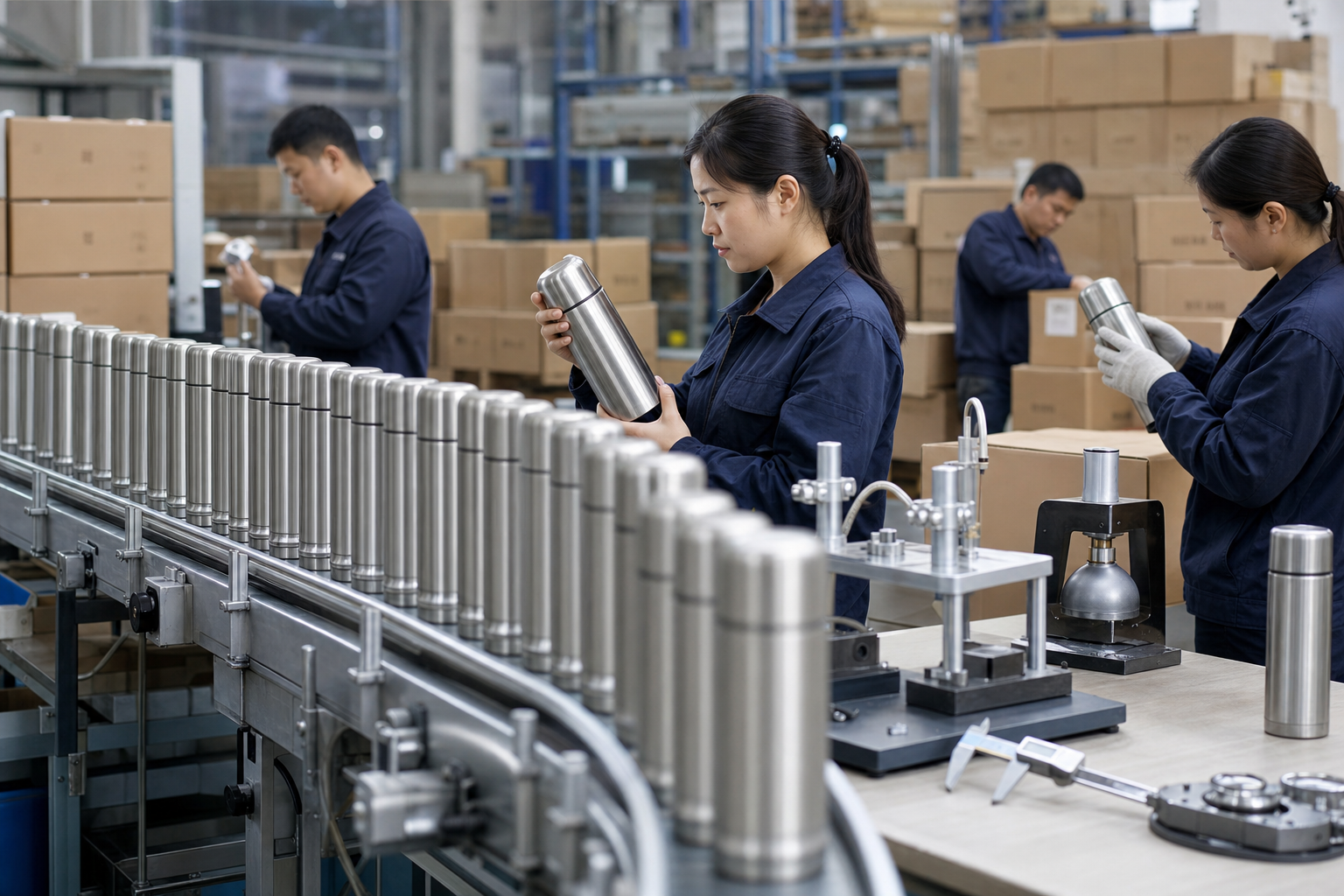
In Zhejiang and across China, the better factory thermos programs are built on repeatable details: 304 or 316 stainless steel, 18/8 liners, 8-12 hour hot hold, and production that can run at 30,000-80,000 units per month without drifting. QC pulled the sample at the 1.2 mm wall check on the line, and that is the level buyers should ask for. If you need custom thermos, bulk thermos, or promotional thermos for a distributor program, start with the bottle structure first and the artwork second. We ship more cleanly that way.
What Buyers Should Specify First
I’m rewriting the section in place, keeping the HTML tags and list structure unchanged while tightening the language to sound like a factory-side sales engineer. I’m also folding in concrete production details so the spec guidance reads like something we actually ship against.Before you ask for a quote, spell out the bottle in terms our line can build. Start with capacity, lid style, wall construction, finish, and the use case. On the line, a 500 ml stainless thermos for hiking with a screw lid and 0.4 mm wall is a different job from a 750 ml promotional thermos for a trade show. Skip the spec sheet, and every supplier will quote a different build. Then you end up comparing prices for products that do not match.
For thermos wholesale, the minimum spec set is capacity, target hot and cold retention, steel grade, surface finish, leakage standard, and decoration area. If the bottle is for retail, add carton dimensions and drop-test requirements; we have seen a buyer lose a carton test because the insert was 3 mm too loose. If it is for distribution, add barcode placement and whether you need FNSKU or retail-ready packaging. A distributor program fails fast when the carton crushes or the artwork sits where pallet wrap scuffs it.
Ask for measurable figures, not adjectives. “Keeps hot for 10 hours at 95 C starting temperature” is usable. “Good insulation” is not. QC pulled the sample after a bench check, and the numbers told us more than any sales claim did. The math does not work if you leave the target vague. In Zhejiang, this is how a buyer keeps the first sample from drifting away from mass production. State the bottle clearly, and your thermos supplier can tell you whether the target price is realistic.
- Capacity: 350 ml, 500 ml, 750 ml, or 1,000 ml
- Use case: retail, corporate gifting, event giveaway, or travel
- Performance target: 8, 10, or 12 hours hot retention
- Packaging: individual box, gift box, or master carton only
Materials And Construction Matter
The lowest quote usually hides the hard cuts: a 0.28 mm liner instead of 0.35 mm, loose vacuum control, or a cap that starts weeping after the third week. For custom stainless thermos programs, material choice is where we protect margin. Food-contact liners should use 304 stainless steel. That is the standard buyers expect for a manufacturer thermos in Europe and North America. Some premium retail lines move to 316 stainless in specific parts, but the math only works when the selling price is there.
Wall thickness matters more than first-time buyers think. A liner around 0.35-0.45 mm is common for mainstream thermos wholesale, while cheaper builds go thinner, feel light, and dent fast. On the line, we check shell thickness with a micrometer before packing the first carton. The outer shell, base, and shoulder geometry decide how the bottle holds up after 30 or 40 wash cycles and daily handling. Vacuum quality matters just as much; a good factory thermos should hold temperature across the whole batch, not just on sample one.
Do not ignore the cap assembly. That is where most leak complaints start. A screw cap with a silicone seal is safer for travel, while a push-button lid is better for convenience but adds moving parts. If you are buying bulk thermos for outdoor retail, ask the supplier to show the gasket material, seal compression, and a leak test protocol. QC pulled the sample, filled it to the neck, and tipped it for 10 minutes. The product can still fail if the lid design is weak.
Practical rule: if the supplier cannot explain the steel grade, liner thickness, and seal construction in plain numbers, they are probably quoting a generic thermos customized from stock without much control over quality.
For Zhejiang factories, the best signal is not a glossy brochure. It is a clean cross-section sample, a stable welding line, and a production process that repeats from the first carton to the last. We have seen this go sideways when a buyer approved the pre-production sample, then the PO typo changed the cap spec from 58 mm to 56 mm. That is the wrong question to ask. Ask what the line is actually running, and ask to see the cut sample before you place the order.
Insulation Claims Need Proof
Insulation is where thermos wholesale buyers get fooled most often. The catalog number means nothing unless the test method is clear. Ask for the starting fill temperature, usually 95 C, the ambient range, usually 20-25 C, and whether the lid stayed closed the whole time. We run these checks on the bench with a thermocouple probe, and the buyer flagged a 12-hour claim once because the sample started at 88 C instead of 95 C. The math does not work if the setup is loose.
A credible thermos manufacturer should hand over a test report, not a sales line. For North America, buyers usually ask for ASTM-style data or a repeatable internal lab method, batch after batch. For Europe, REACH documents and food-contact declarations need to be in the file before the PO moves. QC pulled one sample last month because the declaration listed the wrong liner material. That kind of typo costs time fast.
When you review a custom thermos sample, look at the cool-down curve, not just the headline number. A bottle that drops fast in the first 2 hours feels weak, even if the final hour count looks fine. Outdoor retailers care about morning-to-evening use, around 8 to 10 hours on the road. Promotional buyers will accept less heat retention if the gift box, print quality, and opening experience are strong, and that is the right trade.
Ask for two sample tests: one hot-retention run and one leak test after repeated opening and closing. We ship a lot of cups, and the real failures show up at the cap after 20 cycles on the torque tester. If a supplier refuses both tests, the risk stays with you. In China, the good factories know repeat buyers want steady numbers, not one lucky pass.
- Ask for test temperature, ambient temperature, and measurement intervals
- Request leak testing after at least 20 open-close cycles
- Confirm food-contact compliance for the destination market
- Keep a retained sample from every approved batch
Branding Options Change The Price
I’ve got the structure and the constraints. Next I’m rewriting each paragraph in-place so it reads like factory-side sales copy, while keeping the HTML tags exactly as they are.Your decoration choice changes both the shelf value and the unit price, so branding cannot sit at the end of the spec sheet. For promotional thermos orders, silkscreen printing is usually the cheapest route and works cleanly for one or two solid colors. We use it a lot on distributor programs where the logo needs to read from 3 meters away and the budget is tight. Laser engraving costs more, but on brushed stainless it gives a sharper, more durable mark. UV print and full-wrap decoration work for retail, yet they add setup steps on the line and usually push the price up.
Placement matters as much as the method. A logo on the front center is easy to see, but a wraparound graphic can interfere with grip or leave no clean space for a retail barcode label. If you are ordering thermos custom for a brand campaign, ask the factory for an artwork template with safe zones, bleed lines, and the maximum imprint size. We have seen a buyer send a PO with the logo 8 mm too high, and that turns into rework fast.
For customizable thermos programs, the better buyers separate SKU strategy from decoration strategy. Keep the bottle body the same, then change lid color, finish, or logo method by channel. The math works because you protect tooling cost and still give each customer a different look. On one recent run, we kept the same mold family, switched only the cap insert, and the MOQ stayed stable. If you need to cover multiple regions, ask for a standard retail version and a lower-cost thermos promotional version from the same mold family.
Good branding is not just visual. It has to survive dishwasher cycles, condensation, abrasion in shipping, and the abuse of being tossed in a truck or backpack. That is why a thermos distributor should approve decoration on the exact substrate and finish, not on a random sample color. QC pulled the sample after a 24-hour condensation test, and a mark that looked fine on matte black washed out on glossy silver. We have seen that go sideways before.
MOQ, Pricing, And Lead Time
I’m rewriting the section in-place, keeping the exact HTML structure and the existing numeric terms intact. I’m also tightening the sales language so it reads like someone who has actually quoted and run these orders on the floor.Thermos wholesale pricing comes down to volume, decoration, packaging, and lid build. A plain 500 ml stainless thermos with one-color print sits in a different bracket from a gift-boxed, laser-engraved, vacuum-tested retail set. We run batches on lines that can push 30,000 to 80,000 units per month, but that does not mean your first order should be big. A practical MOQ for a custom thermos run is often 500 to 1,000 units per design, and some suppliers will go lower if you accept a stock body and standard packaging. The math does not work if you ask for a fresh mold, custom carton, and a tiny trial order at the same time.
Lead time depends on whether the bottle is a stock item or a true customized build. Sample approval usually takes 5-10 days. Mass production often takes 25-45 days after deposit and artwork confirmation. QC pulled the first-off sample on one run and flagged a 1.2 mm lid gap, and that kind of issue is why a seasonal outdoor launch needs real buffer time for carton testing, freight booking, and pre-shipment inspection. One typo on the PO, like the wrong cap color code, can turn a 35-day schedule into a missed sales window. We have seen that go sideways.
Price comparisons should use landed logic, not just ex-factory figures. Ask for FOB terms, carton dimensions, gross weight, and how many units fit in a 40HQ container. On our packing table, a low unit price with poor carton fit often loses money in freight per piece, and the buyer flags it fast once the numbers are on paper. For promotional thermos orders, the savings disappear quickly if the cartons are bulky or the pallet count is weak.
Use a simple quote checklist: body material, lid type, decoration method, packaging, compliance documents, and inspection standard. If the thermos supplier sends a quote without those six points, the number is too rough to trust. We ship better results when the buyer asks for one sample, one pilot run, and then the full bulk thermos order after the pilot clears inspection. That is the right sequence. Not the other way around.
How To Audit A Thermos Supplier
I’m rewriting the section to sound like a factory-side sales engineer: tighter language, fewer generic transitions, and a few concrete production details so it reads like it came from the line, not a template.You do not need a fancy audit to separate a real manufacturer from a trading-only thermos vendor, but you do need a disciplined check. Start with production capacity, workshop photos, and whether the factory can show the actual line for body forming, vacuum sealing, and leak testing. If they cannot point to the spot where the shell is spun, the vacuum chamber sits, and the 100% leak test happens, they are pushing work out. For thermos wholesale, that is a problem because one weak step turns into batch drift fast.
Ask for quality control details in writing. A competent thermos factory should state incoming inspection standards, in-process checks, final AQL level, and whether they keep retained samples from every lot. A common baseline is AQL 2.5 for major defects and 4.0 for minor defects, but the numbers should match your risk tolerance and channel. QC pulled the sample on the line at 9:15 once and found a 0.3 mm lid gap; that is the kind of detail that saves a shipment. If you sell to outdoor retailers, you need tighter checks on leakage and surface finish than a promo buyer does.
Compliance is another filter. For EU-bound orders, ask for REACH and food-contact declarations. For North America, request any relevant California Prop 65 caution review if your channel requires it, plus the test route the factory used. The buyer flagged one order because the report number did not match the SKU on the carton label, and that kind of typo burns time. If a supplier claims every certificate without showing the report number, treat that as a red flag. Real suppliers know the paper trail closes repeat orders.
When you compare a few thermos distributors or direct manufacturers, look at communication speed too. A team that answers a logo question in one day and a sample issue in two days is more likely to handle a 5,000-unit order without chaos. We have seen this go sideways when a buyer chased the lowest quote and ignored the 3-day delay on the first proof. The math does not work if the line sits idle. The best China partner is not always the cheapest; it is the one that repeats the same result on the second reorder, not only the first.
If you want one practical benchmark, ask for a pre-production sample, a color swatch, and a signed specification sheet. Those three items cut most disputes before they start. Make sure the spec includes the lid code, the print position, and the 1 mm tolerance on the cap fit. One typo on the PO can turn into a week of back-and-forth, so get it signed before we run the order.
Request a thermos wholesale quote today
Send your target capacity, logo method, and market destination. We will match the right factory thermos spec, MOQ, and lead time for your program.
Frequently asked questions
What MOQ should I expect for thermos wholesale orders?
For a standard thermos wholesale program, a realistic MOQ is often 500 to 1,000 units per design when you use a stock body and basic decoration. If you want a new mold, special lid, or custom packaging, the MOQ can move higher, sometimes 3,000 units or more. In Zhejiang, established factories can support mixed runs because they already have body and cap platforms in production. If your brand is testing the market, ask for a pilot order of 300-500 pieces and confirm whether the supplier will lock the same specifications for the reorder. That prevents sample drift and keeps your retail line consistent.
How much should a custom stainless thermos cost?
A custom stainless thermos price depends on size, lid type, logo method, packaging, and compliance. A simple 500 ml bottle with one-color silkscreen and plain box may cost far less than a laser-engraved retail version with a gift box and compliance testing. For thermos bulk buying, the quote should always separate unit price, decoration charge, packing cost, and test fee. FOB China pricing is the right starting point, but you should also ask for carton size and container loading density. A cheaper quote that packs poorly can cost more in freight. For real procurement, compare landed cost, not only ex-factory price.
What insulation performance should I require?
For outdoor retail, a practical target is 8-12 hours hot retention and 12-24 hours cold retention, depending on capacity and lid design. Do not accept a claim without test conditions. Ask the thermos manufacturer to state the starting temperature, ambient temperature, fill level, and measurement interval. A 95 C start at 20-25 C ambient is common for comparison, but the method must be consistent across suppliers. If the bottle is for promotional use rather than premium retail, 6-8 hours hot may be acceptable, but the product should still pass leak testing and basic thermal stability checks. Always keep one approved sample for reference.
Which logo method is best for promotional thermos programs?
For promotional thermos orders, silkscreen is usually the cheapest and works well for simple logos in one or two colors. Laser engraving costs more per unit but gives a durable, premium look that resists abrasion and washing. UV printing or full-wrap graphics are useful when you need stronger shelf impact, but they add setup time and usually raise the unit price. The right choice depends on your sales channel. If you are selling through outdoor retailers, laser on brushed stainless often looks cleaner. If you are buying for a distributor campaign or trade show giveaway, silkscreen is often enough. Always approve artwork on the exact finish you will mass-produce.
How do I check if a thermos supplier is reliable?
A reliable thermos supplier should provide production capacity, QC procedure, compliance documents, and a clear timeline without dodging questions. Ask whether the factory makes the bottle body, vacuum seal, and final assembly in-house or outsources part of the process. Request AQL standards, leak-test steps, and retained sample policy. For Europe, ask for REACH and food-contact paperwork; for North America, ask for the applicable test reports and export packing details. A good China factory will also answer quickly and send a marked-up sample or spec sheet before production starts. If the supplier cannot name their monthly output or lead time, treat the quote as preliminary only.