Key Takeaways
- MOQ for a custom Tritan Renew glass bottle usually starts at 1,000 pcs per SKU; printed gift boxes can add 7-10 days.
- FOB China pricing for a 500-750 ml Tritan Renew glass bottle typically lands around USD 2.30-4.80 depending on lid, sleeve, and logo method.
- Ask for REACH, LFGB, and drop-test documentation; retail breakage usually drops below 2% when the bottle and carton are engineered together.
- Private label buyers should lock the shape first, then choose silkscreen, laser, or decal based on 300-500 piece decoration economics.
If you are buying a Tritan Renew glass water bottle wholesale, the first problem is not design. It is spec discipline. Buyers often ask for “glass” when they actually want a bottle that looks premium, ships safely, and survives retail handling. That usually means a glass bottle with a protective outer shell, a Tritan Renew part, or a hybrid build for daily use. In Zhejiang and across China, factories will quote those three options differently, so you need to lock the material stack before you compare prices.
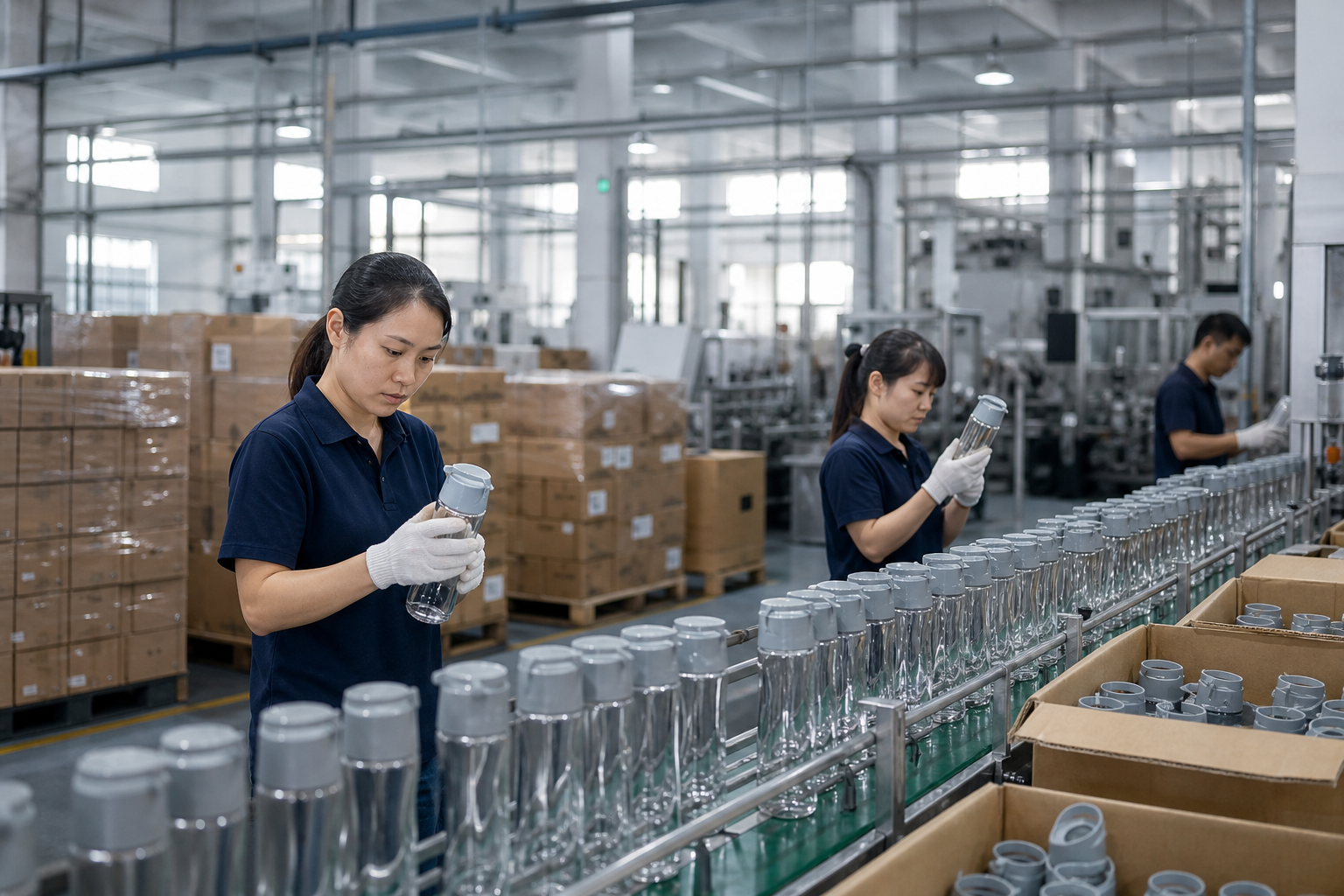
For wellness brands and sustainable retailers, unit price is only half the story. Decoration yield, leak rate, carton breakage, REACH testing, and how many cartons fit per pallet decide the real landed cost. A serious Tritan Renew glass bottle manufacturer talks in grams, wall thickness, MOQ, and lead time, not slogans. We run 180,000 units a month in Hangzhou, with a standard MOQ of 1,000 pieces per SKU and 25-35 days for repeat orders, depending on decoration and packaging. QC pulled a sample last week at 2.1 mm wall thickness, and the buyer flagged a PO typo on the color code before we cut the line.
What buyers mean by Tritan Renew glass
“Tritan Renew glass” is a search term, not a material standard. Buyers use it for a bottle that keeps the clear glass look while putting Tritan Renew into the lid, handle, outer shell, or drinking cap. We see this a lot in Zhejiang. A factory will call a bottle “glass” even when the outside guard is high-clarity plastic and the top is a Tritan Renew assembly. That is where sourcing goes sideways.
If you want a true tritan renew glass water bottle wholesale program, put the stack in writing. We ask buyers to lock down:
- Inner vessel: soda-lime glass, borosilicate, or another grade
- Outer component: Tritan Renew, PP, silicone sleeve, or stainless guard
- Capacity: 350 ml, 500 ml, 650 ml, or 750 ml
- Seal type: silicone ring, threaded cap, flip lid, or straw lid
- Target use: office, gym, travel, or retail gift set
The math does not work if “glass bottle” stays vague. We quote to the drawing, not the buyer’s memory. One PO last season had “650 ml” in the email and “600 ml” on the file name; QC pulled the sample, and the line caught the mismatch before mold opening. A tritan renew glass bottle manufacturer in China will build to the exact spec you approve. For sustainable retailers, the usual sweet spot is 2.0-2.5 mm glass wall thickness, Tritan Renew lid parts, and a sleeve or base guard to cut breakage in transit.
Choose the right factory model
Not every tritan renew glass bottle factory is set up for the same job. Some run pure glass lines with decoration in a separate room. Others buy glass bodies from one plant, then handle lids, sleeves, and printing in-house. The second type works only when they can show process control, not just a nice catalog. We had one buyer flag a PO because the lid code was right but the bottle neck finish was off by 1.2 mm.
For wholesale sourcing, you will usually see three factory models in China:
- Glass-first manufacturer: better for custom shape, wall thickness, and hot-end production consistency
- Assembly supplier: better for mixed-material lids, private label sets, and faster sample turnaround
- Trading-led supplier: useful for small test orders, but you must verify the actual factory before payment
A reliable tritan renew glass bottle supplier should answer basic production questions fast: What is the daily output? Can you hold 3,000 pcs per color? What is the defect rate after packing? We run 180,000 units per month on the assembly and packing lines, and that number matters because a good quote means nothing if the carton leaves 18 days late. For North American and European buyers, stable lead time beats a 5% lower unit price. The math does not work the other way.
Ask for the factory address, export license, and a recent BSCI or ISO report before you discuss artwork. If they stall, you are not talking to a serious tritan renew glass bottle manufacturer. QC pulled the sample on our line last week and found a missing 0.5 mm gasket, so paperwork alone never closes the deal.
Pricing that actually makes sense
Wholesale pricing for a tritan renew glass bottle bulk order comes down to four cost drivers: glass grade, lid material, logo method, and packaging. For a 500-750 ml bottle, this is the working FOB China range we run on the line: the plain bottle with a basic PP/Tritan Renew lid sits at USD 2.30-3.10, and QC checks cap torque before packed cartons leave the floor.
- Plain bottle with basic PP/Tritan Renew lid: USD 2.30-3.10
- Added silicone sleeve or protective shell: USD 0.35-0.85 extra
- Laser logo or one-color silkscreen: USD 0.08-0.25 extra
- Color box with insert and barcode: USD 0.18-0.55 extra
These numbers are normal for China if you are buying at 1,000-5,000 pcs. Once you move to 10,000 pcs or more, the unit cost can fall by 8-15%, but only if your artwork and packaging stay fixed. Mix SKUs and the math stops working. The line has to reset carton counts, print files, and packing specs, and that eats the savings fast.
If you are comparing quotes, do not compare only the bottle body. Compare the full landed structure: product, inner pack, master carton, palletization, and testing fees. A supplier in Zhejiang may quote a lower base price, then add cost later for logo setup, carton inserts, or lid color matching. We have seen that go sideways after a buyer flagged a PO typo on the carton spec. Get those lines on the proforma invoice before you approve samples.
Spec the bottle for real-world use
The right tritan renew glass water bottle custom program starts with the use case, not the mood board. A yoga studio buyer and a grocery chain buyer ask for different things. For active use, we usually run 500-650 ml, a 2.2 mm glass wall, a silicone base, and a threaded lid with a 100% leak check. For gift retail, a heavier hand feel, a matte sleeve, and a printed carton matter more. QC pulled the sample, and the 500 ml bottle came in at 515 ml with a 3.8% fill variance, which is fine; the math stops working once buyers ask for “premium” without a spec.
What to lock before sampling
- Capacity tolerance: usually ±5%
- Drop test target: 80 cm to 100 cm, depending on sleeve design
- Leak test: inverted for 24 hours at room temperature
- Logo placement: front center, wraparound, or lid mark
- Carton spec: 3-ply or 5-ply, with dividers if needed
For a tritan renew glass bottle oem or tritan renew glass bottle odm project, control is the real difference. OEM means you bring the drawing and we build to it. ODM means you pick a bottle we already run, then change color, logo, and packout. If you need to launch fast, ODM is the cleaner path. If the wellness brand wants a specific shoulder line or a 68 mm mouth, OEM fits better, but the sample cycle usually stretches from 12 days to 18 days, and MOQ climbs if the mold moves.
One practical note: say whether the bottle is for cold drinks only. If you want hot-fill compatibility, put the thermal range in the PO and ask us to confirm the glass type and cap seal limit. We’ve seen this go sideways when a buyer flagged “premium bottle” as if that meant universal use. It does not. A wrong PO typo on the temperature line can cost a full re-sample.
Private label details that matter
A tritan renew glass bottle branded program lives or dies on execution details. A logo can look clean and still fail if the lid lands one shade off, the carton feels flimsy, or the print rubs after transit. Private label buyers in Europe and North America need to look at the full pack, not a single part.
Good private label execution usually includes:
- Brand color matched to Pantone or a close production sample
- Logo method selected by durability, not just price
- Retail-ready packaging with barcode and country-of-origin marking
- Instructions or insert card if the closure system is unusual
For a tritan renew glass bottle private label order, silkscreen is often the right call when the logo is simple and you want unit cost under control. Laser engraving works on compatible metal parts and some lids, and it holds up through repeated washing. Decals and heat transfers suit detailed graphics, but the reject rate is higher; we have seen that go sideways on a 1,000-piece pilot. If you want to sell through wellness retailers, the finish has to survive shelf handling, carton compression, and customer washing cycles. That is why we run a 3-stage sample approval: blank sample, decorated sample, packed sample. Skip one stage, and the claims land on your desk. QC pulled a sample with a 2 mm print rub, and the buyer flagged it before shipment.
In Zhejiang, a lot of factories will say “yes” to every branding request. That is the wrong question to ask. Ask whether they can repeat it on 5,000 units now and 12,000 units next quarter without color drift or misaligned placement. We check the PO line by line; one buyer once typed the lid color as “sliver” instead of silver, and the line started with the wrong cap. Repeatability pays the bills.
Compliance, testing, and buyer due diligence
If you are importing a tritan renew glass bottle wholesale program into the EU or the US, testing is not optional. We ship into both routes, and the paper has to match the market, not some generic one-page certificate the buyer flags and then bins. For Europe, REACH and LFGB come up again and again. For North America, brands also ask for FDA food-contact support, plus internal QA references such as AQL 2.5 for major defects and 4.0 for minor defects on packed goods.
At minimum, verify these points:
- Food-contact declaration for all wet-contact parts
- Material disclosure for Tritan Renew and silicone parts
- Drop and leak test records by batch
- Carton compression or transit test if shipping long distance
- Traceability labels for lot control and recall readiness
When you work with a tritan renew glass bottle supplier in China, ask whether testing is done in-house or through a third-party lab. We run both. In-house checks cover routine QC, but final import clearance is cleaner when the file includes independent test reports from a lab like SGS or Intertek. A serious tritan renew glass bottle factory should hand over batch numbers, production date, and inspection records without drama. If they stall on those basics, the line is not export-ready.
Check the packaging too. A good bottle can still miss the mark if the insert, box, and shrink wrap are overbuilt. We had a buyer reject a PO because the inner tray looked like a gift set, not a retail pack, and the carton spec said 5-ply on every shipper when 3-ply would have worked for a 12 kg master carton. In Europe, that hurts the brand story. In North America, retailers push back on cost and cube. The better move is a lean pack with 5-ply master cartons only where the transit data calls for it.
How to source without expensive mistakes
The fastest way to place a tritan renew glass bottle wholesale order is to send one tight spec sheet and make every supplier quote the same basis. Use one capacity, one closure, one logo method, one carton spec, and one Incoterm. If you send a loose inquiry, you get apples-to-oranges quotes from every tritan renew glass bottle manufacturer and lose a week sorting them out. We run this on the line all the time.
Use this sourcing sequence:
- Confirm whether you need OEM, ODM, or a standard stock shape
- Ask for sample photos, dimensions, and weight in grams
- Request a written quote with MOQ, lead time, and packing data
- Review test reports and factory audit status
- Approve pre-production sample before mass production
A solid tritan renew glass bottle factory will usually ship samples in 5-10 days if the shape is already in production, and 15-25 days if a new logo mold or packaging insert is needed. Production lead time for repeat orders is often 25-35 days after deposit and artwork approval. If a supplier promises 7 days on a customized glass bottle, they are probably quoting stock inventory, not a true custom run. QC pulled a sample last month and the buyer flagged a 2 mm cap mismatch; that sort of miss turns into rework fast.
For buyers in wellness and sustainable retail, I would rather see you buy 2,000 clean, compliant units than 10,000 cheap ones that break in transit. The math does not work the other way. China has the capacity, Zhejiang has the export base, but your result depends on controlling the spec down to the carton size and the print position. That is what separates a reliable tritan renew glass bottle custom program from an expensive trial order.
Request a custom Tritan Renew quote today
Send your capacity, lid style, and packaging target. We will quote with MOQ, FOB price, and lead time from Zhejiang.
Frequently asked questions
Is Tritan Renew glass the same as a glass bottle with a Tritan lid?
Usually, yes in buyer language, but not as a technical standard. Most orders described as Tritan Renew glass use a glass bottle body plus Tritan Renew on the lid, cap, or outer components. A typical 500-650 ml build may use 2.0-2.5 mm glass wall thickness and a food-grade silicone seal. Always confirm the material breakdown in writing, because a tritan renew glass bottle manufacturer in China may quote different constructions under the same name. If you need EU compliance, request REACH and food-contact declarations for every component, not just the bottle body.
What MOQ should I expect for private label orders?
For a standard tritan renew glass bottle private label order, MOQ commonly starts at 1,000 pcs per SKU. If you want custom printing, special packaging, or a new lid color, 3,000 pcs is often the point where pricing becomes cleaner. Some tritan renew glass bottle supplier quotes may offer 500 pcs, but the per-unit cost usually jumps 15-30%. If your goal is a retail test launch, start with 1,000-2,000 pcs and lock one decoration method. That gives you enough volume to evaluate breakage, sell-through, and customer feedback without overcommitting cash.
What is a fair FOB China price for these bottles?
For a 500-750 ml tritan renew glass bottle wholesale order, a fair FOB China range is about USD 2.30-4.80 per unit depending on lid construction, sleeve, logo, and box. A plain version with a basic Tritan Renew cap is at the low end; a premium branded set with sleeve and printed carton is at the high end. If the supplier quotes far below that, ask what is missing. Often the answer is packaging, testing, or a higher defect allowance. In Zhejiang, well-run factories price on actual build cost, not guesswork.
How long does production take in China?
For a repeat tritan renew glass bottle custom order, plan on 25-35 days after deposit and final artwork approval. New molds or new packaging inserts can extend that to 45-60 days. Sample lead time is usually 5-10 days for stock shapes and 15-25 days for OEM changes. If your supplier claims a faster timeline, check whether they are pulling from stock inventory. A true tritan renew glass bottle factory in China will separate sample lead time, production lead time, and shipping lead time clearly so you can manage launch dates with less risk.
What quality checks should I request before shipment?
Ask for full inspection against AQL 2.5 for major defects and 4.0 for minor defects, plus a 24-hour inverted leak test, visual print inspection, and carton drop confirmation. For export orders, also request batch photos, lot numbers, and a packing list that matches the final carton count. If you are buying from a tritan renew glass bottle manufacturer in Zhejiang or elsewhere in China, do not accept “checked by QC” as enough. You need measurable pass/fail criteria, especially if the order is for wellness retail where presentation and breakage rates matter.