Key Takeaways
- Typical MOQ for vacuum insulated bottle wholesale starts at 1,000 units per SKU, with lead time of 25-35 days after sample approval.
- A workable FOB China price for a 500 ml 304 stainless bottle is often USD 3.20-6.80 depending on lid, coating, and print.
- Double-wall vacuum construction usually uses 304 inner/outer steel, 0.4-0.6 mm wall thickness, and a 0.08-0.12 mm vacuum gap target.
- Ask for AQL 2.5 major / 4.0 minor, REACH documentation, and thermal test data before you place vacuum insulated bottle in bulk orders.
If you buy vacuum insulated bottle wholesale, the first mistake is treating every stainless bottle as the same item. It is not. A 500 ml bottle with 18/8 stainless steel, a 0.5 mm inner wall, and a proper vacuum gap behaves one way; a cheap unit with a rushed weld line behaves another. We have seen bottles dent in transit, start leaking after 20 wash cycles, or lose insulation because the seam was sloppy. That turns into returns and chargebacks fast.
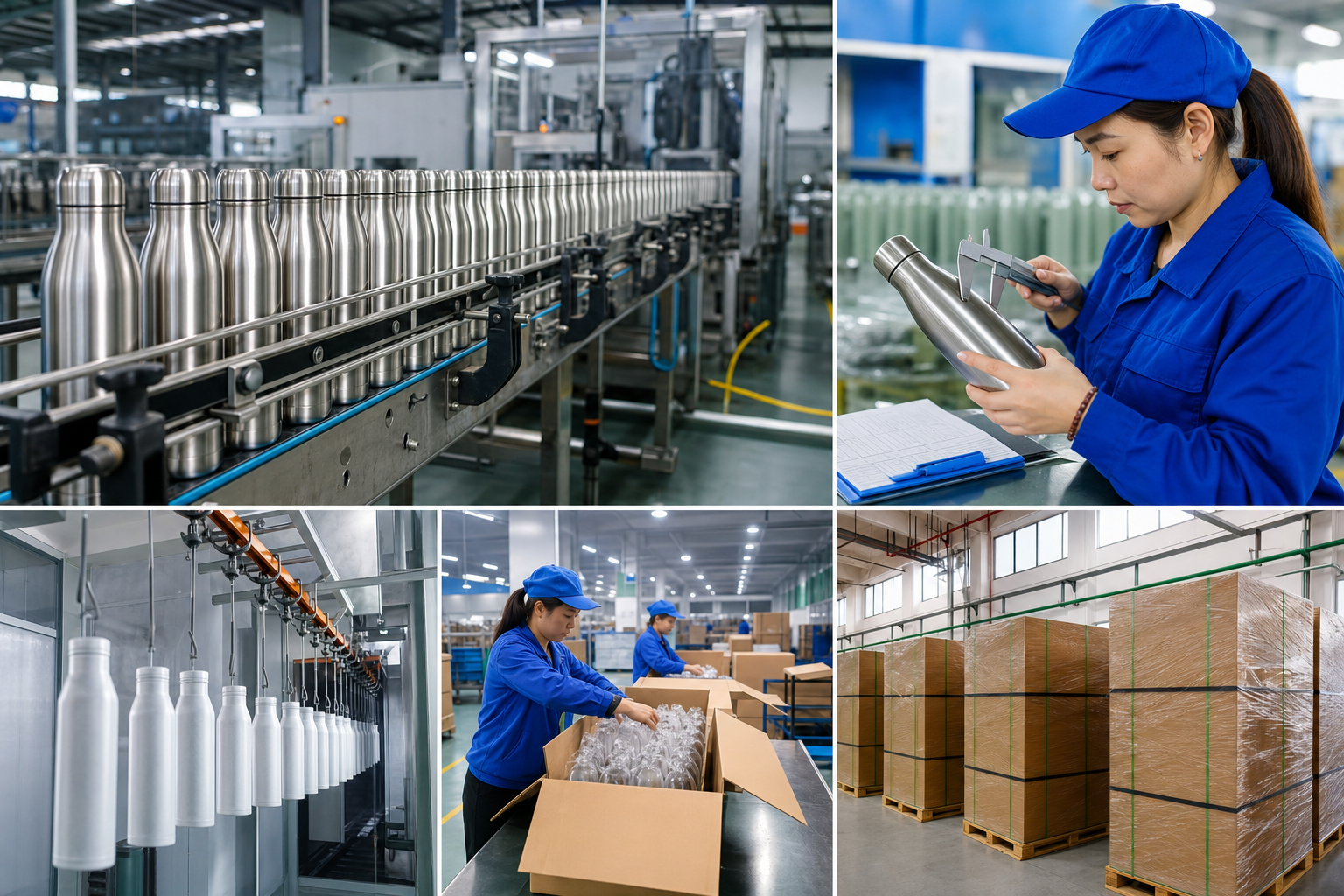
We run production in Zhejiang, China, where factory direct sourcing is common because the supply chain is tight and the MOQ is clear on paper. Price still does not tell the full story. A buyer once flagged a PO because the lid code had one wrong digit, and QC pulled the sample before packing. You need to check coating, lid construction, compliance, sample approval, and AQL inspection, then compare lead time in days, not guesses. Start with the spec sheet. The catalog photo can wait.
What wholesale buyers should verify first
Before you place a vacuum insulated bottle wholesale order, check the build, not the sales copy. A serious vacuum insulated bottle supplier should state steel grade, capacity tolerance, finish type, lid material, and carton spec. For Europe and North America, 304 stainless steel is the baseline for the inner body. If you want a premium price point or saltwater resistance, 316 stainless is on the table, but the unit price usually rises by USD 0.40-1.20 per bottle depending on size and finish. We’ve seen buyers miss that and then try to claw it back after PO signoff. The math does not work.
Ask for three files on day one: the technical spec sheet, thermal retention data, and the test method. A bottle that says 12 hours hot and 24 hours cold means little unless you know the test setup. We need water fill temp, room temp, and the drop curve, not a marketing line. On the line, QC pulled the sample and the buyer flagged a typo on the PO because the spec said 500 ml but the carton label said 550 ml. In Zhejiang, good factories run 80,000-150,000 units per month and keep separate lines for powder coating, laser engraving, and color spray. That separation matters. Your vacuum insulated bottle custom order should not be shoved into a mixed line without process control.
- Check capacity tolerance: ±5% is acceptable.
- Check wall thickness: 0.4-0.6 mm is common for mid-range export SKUs.
- Confirm BPA-free lids and silicone seals.
- Request REACH and LFGB if you sell into the EU.
Pricing, MOQ, and factory terms
Vacuum insulated bottle bulk pricing comes down to four things on the line: steel grade, lid build, finish, and decoration. A plain 500 ml matte powder-coated bottle with a standard screw lid usually sits at USD 3.20-4.20 FOB Ningbo or Shanghai at 1,000 units MOQ. Add a flip lid, a matching handle, or a custom gift box, and that same bottle jumps to USD 4.80-6.80. For a vacuum insulated bottle with custom logo by laser engraving, the print cost is often USD 0.08-0.25 per unit. Multi-color silk print needs more setup, and QC pulled the sample on one job because the second color shifted 1.5 mm off register.
Most vacuum insulated bottle factories in Zhejiang work on MOQ 1,000-3,000 units per color per design for standard wholesale orders. If you ask for vacuum insulated bottle customized colors, plan for a Pantone match fee and 7-10 extra days while coating gets approved. We ship plenty of private label runs, and the buyer often pushes for 500 pieces, but the math does not work once packaging, artwork, and carton allocation are spread too thin. If you are buying vacuum insulated bottle in bulk across several SKUs, talk carton mix first, not only unit price. On a 10,000-unit program, a clean order can save 5-12% landed cost versus three small POs with different art files and carton marks.
Do not chase only the lowest FOB. Ask for FOB, carton details, drop-test standard, and sample lead time. The buyer flagged one PO typo on carton count, and that mistake changed the whole freight calc.
Materials and insulation that affect returns
The term vacuum insulated bottle sounds simple, but the build inside decides whether you get repeat orders or complaints. We run 304 stainless steel for the inner liner on standard export drinkware. The outer shell is usually 304 too, though some budget lines switch to 201 outside to shave cost. That works for a promo order, but it is the wrong call if you want a reliable vacuum insulated bottle promotional item with a cleaner finish and fewer rust claims.
Insulation comes down to vacuum seal integrity and weld quality. On our line, QC pulled the sample after production, then checked vacuum leak rate and thermal hold, not just a pretty box sample. For a 500 ml bottle with a solid lid and normal room conditions, expect hot retention around 8-12 hours and cold retention around 18-24 hours. A straw lid, push-button lid, or sports cap cuts that number. If the buyer wants vacuum insulated bottle private label for travel or outdoor use, choose the lid first, then write the claim around that lid. The math does not work the other way.
For North America, buyers want a leakproof claim that survives courier handling and shelf pressure. Ask for a 24-hour inverted leak test and carton compression testing. We have seen a PO typo on the carton count turn into a messy claim, so check that line twice. For Europe, confirm decorative coatings, inks, and silicone parts meet REACH and food-contact rules. A good vacuum insulated bottle supplier sends the test report fast; a weak one sends copy about performance instead of numbers.
Customization that sells, not just decorates
Vacuum insulated bottle custom work is not just a logo slapped in the middle. We build the decoration around the sales channel. A corporate gifting order may call for laser engraving, a one-color imprint, and a kraft box. A retail SKU may need matte coating, a shelf-ready sleeve, and barcode labels. For subscription boxes or Amazon FBA, the carton has to hit the right dimensions, FNSKU labels must scan clean, and the 3PL file needs to load without someone fixing it by hand.
Vacuum insulated bottle customizable options usually cover color, finish, lid type, body shape, silicone sleeve, handle, and packaging. If you want vacuum insulated bottle custom made for a premium consumer brand, ask for pre-production samples with your exact Pantone target and logo position. We once had a buyer flag a 2 mm logo shift on a 500 pcs sample run, and QC pulled it back before the line moved to mass production. For vacuum insulated bottle private labeling, the bottle can stay standard while the packaging, warning labels, and inserts carry the brand story. That is the cleaner move when you are testing demand. It keeps tooling risk low and the unit math makes more sense.
Practical customization choices
- Laser engraving: clean, durable, and a good fit for premium monochrome branding.
- Silk screen: lower cost for 1-2 colors, though it wears faster on high-touch areas.
- Heat transfer or UV print: useful for complex graphics, but ask for scratch-resistance test results.
- Gift box and mailer: important if the bottle ships direct to consumer.
If you are comparing vacuum insulated bottle manufacturers, ask which finishes still look good after 50 dishwasher cycles. We run that test on a small batch, and the answer should come from data, not sales talk. We’ve seen this go sideways when a buyer chose a soft-touch coating without checking abrasion resistance, then the first 1,000 units came back with scuffed caps.
Quality control and compliance standards
If you buy direct from a vacuum insulated bottle factory, the QC plan needs numbers, not “we inspect everything.” We run AQL 2.5 for major defects and AQL 4.0 for minor defects, then lock the defect list before the line starts. Major defects are leakage, missing vacuum, logo off by tolerance, heavy denting, or lid failure. Minor defects are small paint specks, light scratches, or carton print errors that do not stop retail sale. QC pulled the sample on a 30,000 pcs order last month; the buyer flagged a 0.8 mm logo shift, and we fixed the jig before mass production.
Ask supplier candidates for BSCI or an equivalent social audit, REACH declaration, food-contact declaration, and a thermal test report. For the U.S. market, ask for material declarations that match FDA food-contact expectations on the parts touching liquid. For the EU market, LFGB testing is often requested by serious buyers even when some channels do not require it. Batch traceability helps when a claim lands on your desk. We keep batch records by carton code and date code in Zhejiang, and that saves days when a buyer asks for one bad lot instead of the full shipment. If the factory cannot show that, the math does not work.
Packaging needs the same discipline. A vacuum insulated bottle distributor loses money fast when a bottle arrives dented because the carton failed a 1.2 m drop test. Ask for corner drop and compression results, then check whether the carton spec matches the bottle weight, not just the artwork. A plant running 50,000 to 120,000 units per month should have fixed packaging test records, a drop tester on site, and a clear reply on carton GSM. We ship enough breakage claims to know this: weak outer boxes create headaches long after the container leaves port.
How to source factory direct in China
Source a vacuum insulated bottle supplier in China, and the real decision is price versus risk control. A trading company helps when you need mixed categories or one person to chase files in English, but factory direct usually gives tighter control on mold change, decoration, and the production schedule. We run this every week in Zhejiang. Being close to steel forming, coating, and accessory shops cuts dead time; a lid sample can move from drawing to hand sample in 3 days instead of 7, and that matters when a buyer is pushing for launch dates.
Shortlist vacuum insulated bottle suppliers and vacuum insulated bottle vendors that can show production photos, QC flow, and export references. Ask straight questions. How many bottle lines do you run? What is your monthly output? What is your standard MOQ? How long is sample lead time? If the answer sounds polished but thin, the math does not work. For most private label buyers, 80,000+ monthly output, 1,000-unit MOQ, and 7-day sample lead time is usable. For custom printing or special lids, we usually see 10-15 days for samples and 25-35 days for mass production after approval. QC pulled the sample on one order and found a 0.3 mm gap at the cap thread; that kind of miss tells you more than a sales deck.
Do not build your list from a vacuum insulated bottle supplier directory and stop there. Use it to start, then audit the factory, compare sample quality, and pin down terms. The buyer flagged a PO typo on one shipment because the lid code was one digit off, and that turned into a week of back-and-forth. We’ve seen this go sideways when the supplier looked fine on paper but could not hold the next order size. Pick the factory that can ship your repeat volume, not just win the first carton.
Ordering process that protects margin
A clean ordering process protects margin and launch date. We start with the spec sheet: capacity, material, lid, coating, decoration, packaging. Then QC pulls a physical sample, not photos on WhatsApp. After that, confirm the proforma invoice with FOB terms, payment split, and shipment window. Set the QC standard and the pre-shipment inspection date before the line starts. Carton labels, barcode, and shipping marks must match your warehouse or 3PL file; one PO typo can hold a truck at the port.
For a vacuum insulated bottle wholesale bulk order, 30% deposit and 70% balance before shipment is the common setup. On repeat orders, some vacuum insulated bottle distributors will discuss better credit terms, but a new account should not ask for 60 days net from a Chinese factory. If the order goes to Amazon, lock the carton size, master carton count, and FNSKU application before production starts. We have seen a 2 mm carton mismatch turn into relabeling fees in the U.S. and Germany. That bill is on you.
The cheapest unit price is usually the wrong question to ask. A bottle that is USD 0.20 cheaper but triggers a 3% return rate will burn margin fast. We ship plenty of programs where the buyer pushed for the lowest price, then the lid torque was off and the complaint rate spiked. A steady vacuum insulated bottle manufacturer in China should keep cost, claim accuracy, and on-time delivery in balance, not chase the lowest sticker price.
Get factory-direct pricing on your next order
Send your spec sheet, target MOQ, and destination market. We’ll quote a vacuum insulated bottle wholesale program with real lead times and compliance details.
Frequently asked questions
What is a normal MOQ for vacuum insulated bottle wholesale orders?
For standard SKUs, MOQ is usually 1,000 units per color or per design from a vacuum insulated bottle factory in Zhejiang or elsewhere in China. If you want custom lids, special coating, or private label packaging, 3,000 units is more realistic. Sample orders can sometimes start at 100-300 pieces, but pricing will be much higher and lead time is less predictable. For mixed container programs, some vacuum insulated bottle distributors will combine models, but factory production still needs a minimum run to keep coating and printing efficient.
How much should I budget per unit FOB China?
For a 500 ml 304 stainless bottle, a practical FOB China budget is USD 3.20-6.80 depending on lid type, decoration, and box quality. Basic powder-coated models sit near the low end. Laser engraving, flip lids, and custom gift boxes push the price higher. If you choose 316 steel or complex multi-step printing, the cost rises further. Always ask for a landed cost estimate, because freight, customs, and inland delivery can add 12-28% depending on destination and shipment size.
Which tests matter most before I place a bulk order?
Ask for thermal retention, leak testing, drop testing, and material compliance documents. A good benchmark is 24-hour inverted leak testing, 1.2 m carton drop testing, and AQL 2.5 major / 4.0 minor inspection. For Europe, REACH and food-contact declarations matter; for some channels, LFGB is requested. If the factory cannot explain the test method and conditions, do not treat the result as reliable. A real vacuum insulated bottle supplier should document batch-level QC, not just send a marketing sheet.
Can I do private label or custom logo on the bottle?
Yes. Vacuum insulated bottle private label programs usually combine a standard bottle body with your logo, packaging, barcode, and inserts. Vacuum insulated bottle with custom logo can be done by laser engraving, silk screen, or UV printing. Laser engraving is the cleanest and usually costs only USD 0.08-0.25 per unit, while multi-color print is more sensitive to surface curvature and wear. If you want a vacuum insulated bottle custom made with a unique shape, expect tooling costs and a longer development cycle.
How do I choose between suppliers, vendors, and manufacturers?
Start with a vacuum insulated bottle supplier list, then separate actual factories from trading companies. A vacuum insulated bottle manufacturer or vacuum insulated bottle factory direct partner is better if you need stable quality, specific coating control, and repeat ordering. A vendor or distributor can help if you want mixed products, lower initial complexity, or consolidated shipments. Ask each candidate for monthly output, MOQ, compliance documents, and sample turnaround. If they cannot give precise numbers, they are not ready for serious B2B sourcing.