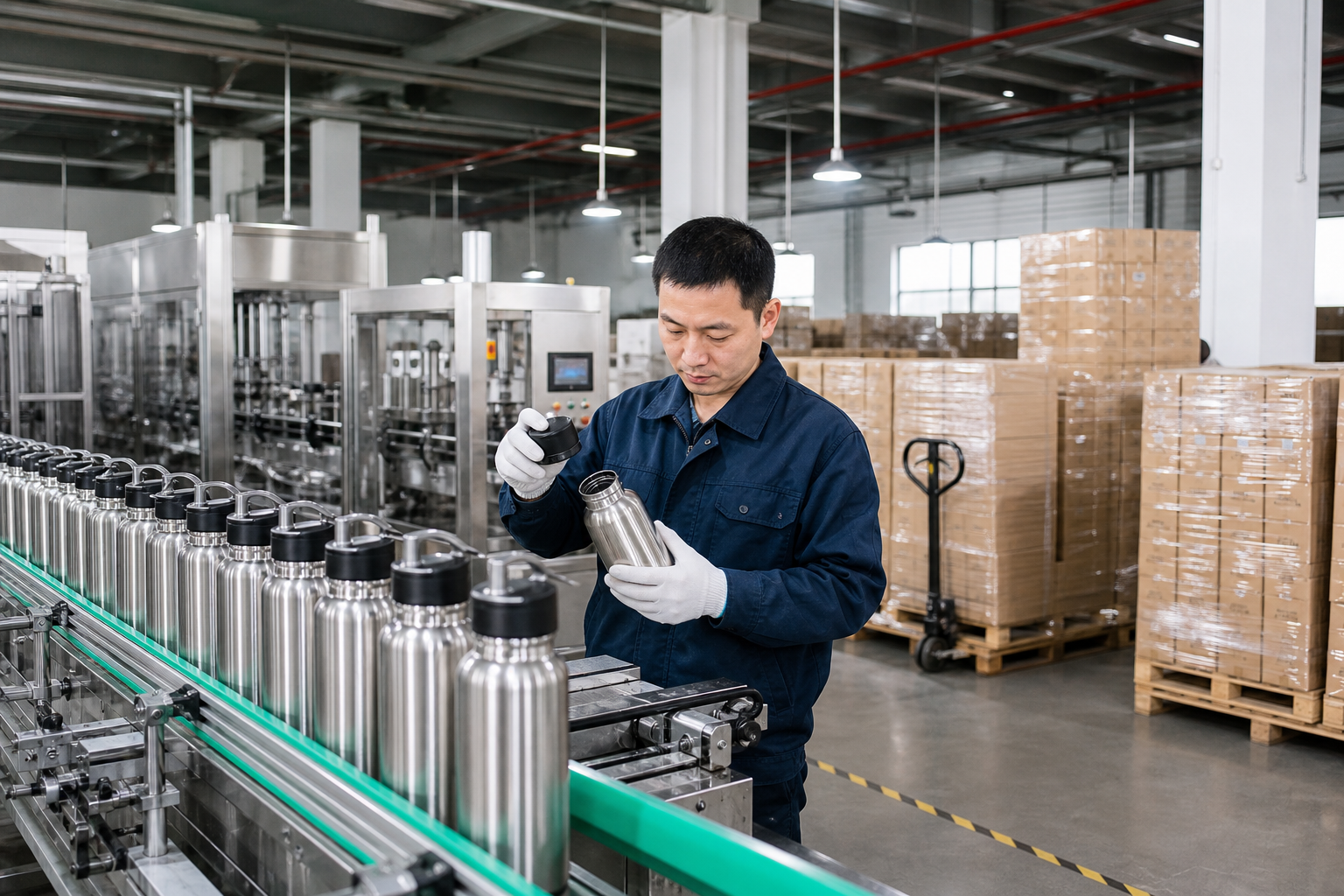
Key Takeaways
- A practical vendor canteen program usually starts at 500-1,000 pcs MOQ, with sample lead time around 5-7 days and mass production in 25-35 days.
- For stainless steel canteen customized orders, 304 is standard; 316 is the safer choice when corrosion resistance matters and the price premium is justified.
- AQL 2.5 for major defects and 4.0 for minor defects is a common inspection baseline for custom drinkware shipped from China.
- A capable canteen factory in Zhejiang should support 300,000+ units/month, export cartons, and logo methods that survive repeated washing.
If you are buying a vendor canteen for resale, a campus program, or a canteen promotional campaign, the real risk is not the bottle shape. It is ordering a 0.8 mm wall from the wrong supplier and finding out after QC pulled the sample. We have seen a 12-day lead time beat an 18-day quote on paper, then fail when the cap torque was off by 2 N·m. Cheap looks cheap until the first leak test.
For buyers in Europe and North America, treat the canteen as a controlled product, not a commodity. The right question is whether the factory can run the same 304 stainless spec, the same print, and the same drop test across 5,000 units without swapping tools halfway through the run. In Zhejiang, that usually means stable molds, export paperwork that clears on the first pass, and monthly capacity that can cover reorders without the buyer flagging a new sample on shipment two.
What A Vendor Canteen Buyer Needs
When buyers say vendor canteen, they usually mean one of two jobs: a canteen vendor moving finished stock, or a canteen manufacturer building a custom line for resale, promotions, or distributor catalogs. The sourcing logic does not change. You need a canteen that can handle transit, repeated use, and the compliance rules in your target market. If it is going to retail, Amazon, corporate gifting, or a distributor canteen list, the spec sheet has to be tighter than the sales pitch. We have seen a buyer flag a 2 mm lid gap on the line before shipment, and that kind of miss will cost you.
Start with the use case. A stainless steel custom canteen for outdoor retail needs a different lid, coating, and carton pack than a canteen promotional item handed out at a trade show. If the buyer wants price-sensitive volume, a canteen supplier should push fewer colors, a simpler logo, and standard packaging. If you are building a premium distributor canteen for Europe, expect more paperwork and tighter visual control. A serious canteen vendor should quote the same body as custom canteen, canteen customizable, or customized canteen without changing the core build. That is the right way to do it. We ran a 5,000-unit MOQ last month and the buyer still asked for a matte finish swap; the math only worked because the structure stayed fixed.
Ask for a full spec before price. You want capacity in milliliters or ounces, material grade, coating type, lid material, gasket material, carton count, and test standard. If the supplier cannot put that in writing, they are not ready for export work. In China, good factories know this. The weak ones treat every canteen customized order like a new sample run, and QC ends up chasing the same typo on the PO twice. For export, that is the wrong question to ask.
Choose Materials That Will Last
Material choice drives performance more than most buyers expect. On the line, we check 304 stainless steel with a salt-spray cabinet before release, because it gives the right balance of corrosion resistance, price, and food-contact acceptance for a vendor canteen. If the bottle will see salty air, rough handling, or a 3-year service promise, 316 stainless steel is the better call, but the math does not work unless the margin or brand promise supports it. For a custom growler or insulated outdoor drinkware line, we use the same rule: standard grade for value, upgraded grade only when the use case justifies the extra cost.
Wall thickness matters too. In sourcing terms, a 0.4-0.6 mm stainless shell is common for lightweight products, while heavier builds go above that to add stiffness. QC pulled the sample on one 0.38 mm run, and it dented in the corner drop test; too thin ships badly, too thick burns freight for no gain. The lid matters just as much. PP lids are economical, Tritan gives better clarity and impact resistance, and silicone seals should be specified by hardness and food-contact grade. If your canteen supplier cannot tell you the gasket compound, you are buying blind.
For canteen manufacturers in China, a good material discussion also covers finish. Powder coating gives a durable matte surface, and we ship it often for distributor orders because it hides handling marks better. Spray paint costs less but scratches faster, while bare stainless stays simple and works well for a custom canteen sold through channel buyers. For canteen promotional projects, keep the finish stable and the color count low; the buyer flagged a PO typo on one Pantone code last month, and that kind of mistake turns into rework. This is the wrong question to ask if you are chasing a low quote without checking defect risk.
Practical rule: choose the lightest construction that still passes your drop test, leak test, and vacuum or insulation target. On a 5000-piece order, an extra 20 g per bottle can change the freight bill fast, so do not pay for weight you do not need.
Branding Changes Your Cost
Logo work is where canteen distributors lose margin. The same body can go out as a bare distributor SKU or a higher-priced canteen customized program, and the gap starts with the decoration method. We run silkscreen for 1 to 2 colors on flat panels or a light curve, laser engraving for 304 stainless when the buyer wants a cleaner mark, and heat transfer or wrap printing when the art has fine lines. Those last two need tighter artwork and a steadier line. This is the wrong question to ask if you only compare unit price; the real issue is which process matches the PO and the carton pack-out.
If your canteen custom project is for retail, ask the supplier to break out decoration from the bottle body. That is where the cost sits. On a recent 3,000 pcs order, a one-color silkscreen logo added a small amount per unit, but three print positions, Pantone match, and a full-wrap sleeve pushed the quote up fast. For a customizable canteen in a corporate run, we have shipped better margins with no body print at all, then brand the carton and hangtag. The buyer flagged it on one PO because the logo was 2 mm too close to the seam, and that kind of error burns a week.
For a custom drinkware line sold into the United States and Europe, do not pick a decoration that looks sharp on day one and then flakes after 20 dishwasher cycles or a steel-wool rub. Ask for rub tests, dishwasher tests, or a documented wipe check from QC; on our line, QC pulled the sample after 24 hours and caught a weak transfer before packing. If the item is supposed to perform like a customized growler or a premium canteen vendor SKU, the logo has to stay readable after real use. The math does not work otherwise. This is not a branding preference; it is part of the spec.
MOQ, Price, And Lead Time
The cheapest quote usually leaves out half the job. A real canteen manufacturer in Zhejiang should line up sample cost, MOQ, production lead time, and carton configuration before the first PO draft. We have seen a buyer flag a 2 mm lid gap only after QC pulled the sample, so these details are not optional. For a standard custom canteen, MOQ is often 500-1,000 pcs per color or per print method. When tooling gets more complex, or you want multiple colors for a launch, MOQ can move to 3,000 pcs or more. If a canteen factory says 100 pcs for a fully custom build, ask whether it is just a stock body with a logo.
Price depends on material, finish, lid complexity, and packaging. A simple stainless canteen promotional item may sit in the low single-digit USD range FOB China, while a double-wall insulated model with cleaner brushing and premium branding moves up fast. We run these quotes every week, and the math does not work any other way. Ask for unit price, sample cost, mold or setup cost if any, inner box, master carton, and freight-ready dimensions. One missed carton spec, such as a 52 x 38 x 24 cm master box, can wipe out the margin on sea freight. Buyers who skip these lines usually pay for it later in shipping.
Lead time should be explicit. A normal sample cycle is 5-7 days after artwork approval. Mass production for a stable order is commonly 25-35 days. If the factory is actually scaled, it should support at least 300,000 units/month on standard drinkware runs without turning every order into a rush job. QC pulled the sample, we checked the weld seam, and the count held. For a canteen distributor, that capacity matters more than chasing the last cent on unit price. A late shipment costs more than a small unit-price gap.
Check Quality Before You Ship
Quality control is where export buyers protect margin or pay for mistakes. For a vendor canteen order, we run incoming material checks, in-process inspection, final inspection, and packing verification. AQL 2.5 for major defects and 4.0 for minor defects is the usual floor. If the supplier cannot explain AQL, that is a warning sign. If they understand it but will not sign off on it, the problem is already at the line.
Ask for the test plan before production starts. A solid canteen supplier should show leak testing, lid torque checks with a torque wrench, thermal retention testing for insulated items, and drop testing on packed cartons. For Europe, ask about REACH and food-contact compliance. For North America, request the relevant FDA food-contact statement and any third-party test reports. If the product or packaging claims sustainability, verify the basis. We have seen buyers accept a green claim on the PO, then the carton ink failed the rub test and the buyer flagged it at inbound. If you are shipping into retail or warehouse programs, ask for carton strength, barcode placement, and FNSKU handling early, not after packing.
For a canteen customized project, quality is also visual. Check color tolerance, logo placement, seam lines, and lid fit. A bottle can pass a leak test and still fail in the market because the logo is crooked or the coating chips at the edge. On one 5,000-piece run, QC pulled the sample because the lid gap was 0.8 mm on one side and 1.6 mm on the other. That is why serious canteen manufacturers in Zhejiang keep photo standards and defect samples on file. It keeps the decision objective. It also stops arguments when the buyer says the print is off by 2 mm and the line says it is fine.
How To Vet A China Supplier
Not every canteen vendor is built for export, and not every canteen supplier understands how European and North American buyers work. Start with factory proof. Ask for the business license, any audit record they can share, and a straight answer on whether they are a factory or a trading company. A real canteen factory will talk about the 160-ton press, tooling lead time, material sourcing, and why a 0.3 mm wall change affects yield. A middleman usually skirts those questions.
If your order is for a canteen distributor, distributor canteen, or distributor drinkware program, ask for three things at once: a production sample, a pre-production sample, and a packing sample. Those are not the same. The production sample shows the actual line output. The pre-production sample locks your final color and print. The packing sample tells you whether the carton survives a 76 cm drop test. The math does not work if they try to cover all three with one sample, and we have seen that go sideways when the buyer flagged a PO typo on carton count after goods were already packed.
China has strong manufacturing clusters, and Zhejiang is one of the best places to source if you need speed, repeatability, and export experience. But location is not a substitute for process. A good canteen manufacturers list should narrow to factories that can document specs, keep a stable BOM, and hold reorder consistency on the same mold cavity. For long-term programs, that matters more than saving a few cents on the first shipment. The right question is not whether Zhejiang is cheap. It is whether the supplier can ship the same product again six months later without changing the lid, the print, or the carton.
Source your vendor canteen with real specs
Send your target price, capacity, and artwork. We will match the right custom drinkware build, packaging, and QC plan for China export.
Frequently asked questions
What MOQ should I expect for a custom vendor canteen?
For a standard vendor canteen with one logo method, MOQ is often 500-1,000 pcs per color. If you want multiple print positions, special coating, or a custom lid, 3,000 pcs is more realistic. For a simple stock body with branding only, some canteen suppliers will accept lower quantities, but the unit price usually rises sharply. In China, the cleanest way to control cost is to lock one spec, one artwork version, and one carton plan before production starts. If your program needs repeat orders, confirm that the same tooling and same color formula will be used on every run.
Which logo method is best for a canteen custom order?
If you want value, silkscreen is usually the first option. If you want durability on metal, laser engraving is stronger because it does not wear like ink. For a canteen customized for premium retail, engraving often wins even if the unit cost is higher. For a canteen promotional run, one-color silkscreen can be enough if the product is low price and the audience is short-term. Ask the supplier for rub-test results or wash-test samples. A logo that looks good in the photo but fails after a few washes is not a useful branding method.
Can I use a custom growler spec for a vendor canteen project?
Yes, but only if the use case matches. A custom growler usually needs larger capacity, a wider mouth, and a stronger seal for beverage handling. A vendor canteen for general drinkware may not need that. If your customers want outdoor, brewery, or event use, a customizable growler format can make sense. If the product is for school, office, or retail shelves, a narrower canteen shape is often easier to pack and ship. The practical question is not the name. It is whether the lid, seal, and wall structure fit your actual customer behavior and freight target.
What compliance documents should a canteen supplier provide?
For Europe, ask for REACH and food-contact documentation. For North America, request FDA food-contact statements and any third-party lab reports tied to the exact material set. If the product has coatings, inks, or silicone parts, make sure the reports match those components, not just the steel body. A serious canteen manufacturer should also be able to provide ISO 9001 or similar quality-system evidence, and BSCI if you need social compliance for retail accounts. For export cartons, keep the packing spec, gross weight, and barcode data on file so your warehouse team can receive the order without relabeling.
How do I avoid problems with a canteen factory in China?
Use a written spec, not a verbal brief. Confirm material grade, finish, lid type, gasket material, decoration method, and carton details before sample approval. Then require pre-production samples and final inspection photos. For a Zhejiang or other China factory, ask how they handle AQL 2.5 major defects, how they test leaks, and how they prevent color drift on repeat orders. If the answer is vague, the supplier is not ready. If they can show process controls, lab results, and repeat-order records, you have a much safer starting point for a long-term canteen vendor relationship.