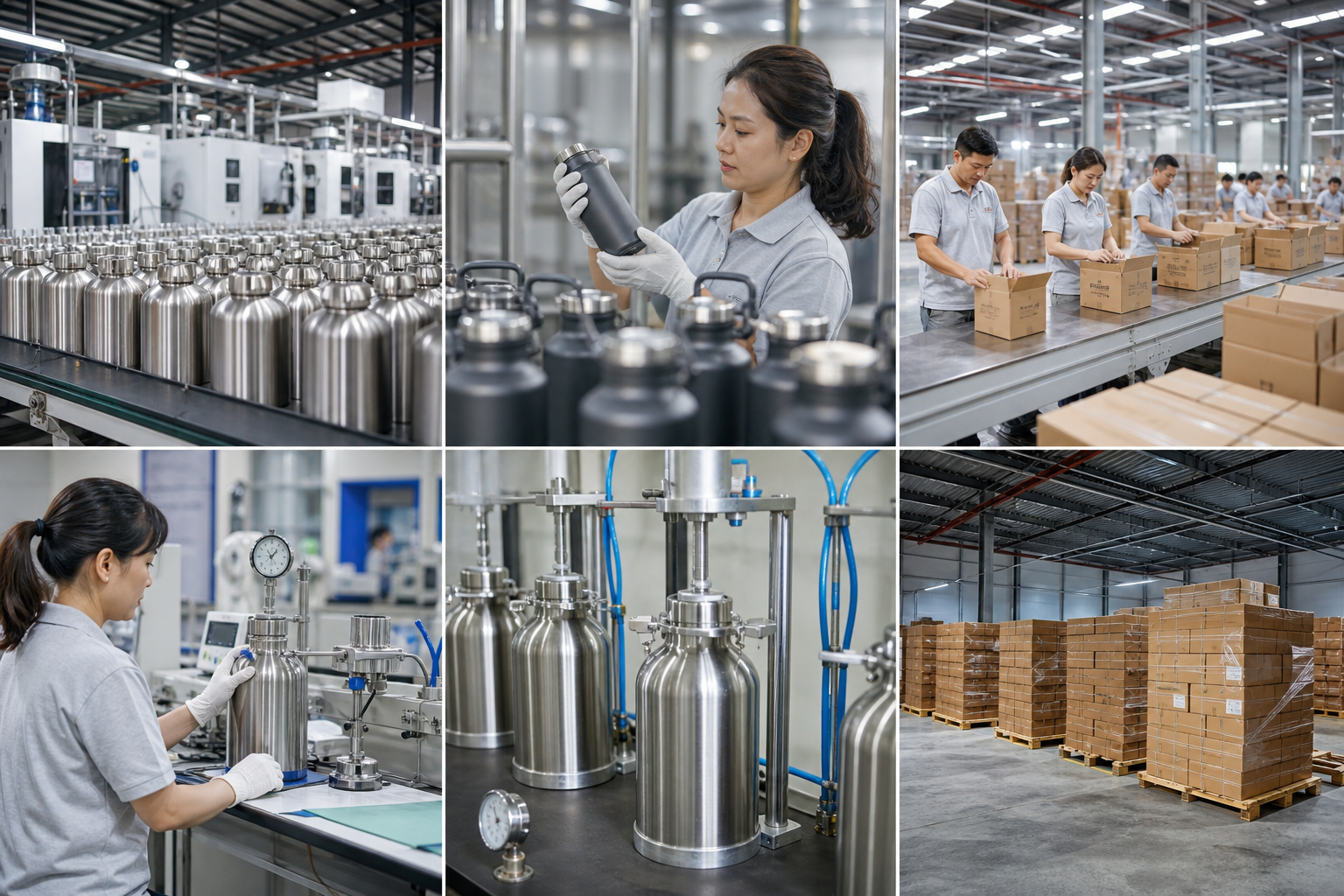
Key Takeaways
- Most custom drinkware mistakes come from unclear specs, not bad factories; lock material, finish, and lid details before sampling.
- A workable MOQ for vendor drinkware usually starts at 300-1,000 units, with 25-35 day lead times for standard orders.
- For export, ask for REACH, food-contact declarations, and AQL 2.5/4.0 inspection details before you approve production.
- A canteen promotional order and a premium custom growler should not use the same QC plan, carton spec, or decoration method.
If you buy vendor drinkware for retail, promotions, or private label, the real problem is not finding a factory. It is sorting the pieces that move your landed cost, your margin, and your complaint rate. A canteen that looks fine on the sample table can still fail coating adhesion, lid sealing, or a 1.2 m drop test once you place a 3,000-unit order. We have seen the buyer flag a tiny print shift on the PO, then QC pulled the sample and found the cap torque was off by 0.3 N·m. That is the part that bites.
In Zhejiang and across China, the better suppliers speak in numbers: MOQ 300 to 1,000 units, 25 to 35 days for standard custom work, and monthly output above 500,000 units when the line is running well. You should expect that level of clarity. If a canteen manufacturer cannot tell you wall thickness, decoration limits, or the AQL they inspect to, the math does not work. We run 0.8 mm and 1.0 mm body specs all the time, and the wrong question is still “can you do it?” The right one is whether they can hold it on the line without drifting.
What vendor drinkware really means
Vendor drinkware is the buying term we use for bottles, tumblers, canteens, growlers, mugs, and the rest of the line you source from a canteen supplier, canteen vendor, or custom drinkware factory. Usually, you are not pulling stock off a local shelf. You are ordering a controlled item with your logo, your PMS color, your lid choice, and often your own carton. We run that kind of order every week.
That is where buyers get burned. A canteen customizable on paper may only allow one printing method, one cap color, and one carton size. We had a buyer flag a PO typo once because the lid spec said 38 mm but the sample run was 42 mm, and the math did not work. A distributor drinkware program may need mixed SKUs, then the factory treats each color as a separate order. In Zhejiang, the stronger canteen manufacturers tell you that before deposit; the weak ones say yes to everything and sort it out later. We’ve seen that go sideways.
Use one simple filter: is this a custom canteen for giveaways, a custom growler for beverage retail, or a distributor canteen line that has to stay stable on reorders? The answer changes MOQ, decoration, and QC. A canteen promotional item can live with a simpler finish. A customized drinkware program for Europe or North America usually needs tighter tolerances, cleaner compliance docs, and packaging that survives 12 days at sea, then another 6 days in a warehouse without crushed corners. This is the wrong question to ask if you only compare unit price.
Choose the right drinkware type
You do not win on price alone. You win by matching the product to the channel. A 500 ml stainless custom canteen for outdoor retail has different requirements than a 750 ml customized growler for brewery merchandising. A 12 oz insulated tumbler sold through Amazon FBA needs different carton dimensions and barcode placement than a metal bottle used in a corporate gift campaign. We had a buyer flag a PO because the barcode sat 8 mm too close to the seam. The math does not work if you treat every SKU the same.
For most vendor drinkware programs, the split is simple:
- Canteen promotional: one-color print, 300-500 MOQ, cheaper lid, less decoration risk.
- Custom canteen / canteen custom: more design control, often powder coat or matte paint, 500-1,000 MOQ.
- Customized growler: heavier gauge stainless, leak-tested lid, thicker box, usually 1,000+ MOQ.
- Distributor drinkware: keep the same spec for 12 months, because reorder stability matters more than a new shape.
If you are building a private-label line, ask the canteen factory whether they can hold the same tooling, finish codes, and lid parts across reorders. We run this check on the line with a caliper and a lid gauge, because a canteen supplier with 500,000 units per month can still miss when every PO brings a new cap, a new Pantone, and a new retail sleeve. QC pulled the sample and found a 1.2 mm gap on the lid thread. Stability wins. Variety causes headaches.
Materials and wall thickness
Material choice changes performance more than marketing copy does. On stainless vendor drinkware, we run 304 stainless for the inside on most export jobs. If a buyer wants stronger corrosion resistance or a cleaner margin story, ask whether any internal part uses 316, but do not pay for an upgrade you cannot explain to your customer. For single-wall steel, the line usually sits at 0.4 mm to 0.6 mm. For double-wall insulated canteen custom work, 0.4 mm inner and outer shells are common, and vacuum integrity is the real gate. QC pulled one sample last week with a weak weld seam, and that is where the real issue showed up.
For plastic lids and parts, ask about PP, Tritan, or silicone grades and whether they are food-contact compliant for your destination market. A canteen manufacturer in Zhejiang that ships export orders should be able to provide REACH-related declarations, food-contact statements, and lot-level material traceability. If the supplier cannot name the exact grade or the body thickness, that is a red flag. The buyer flagged a PO typo on a 0.5 mm lid spec before, and that kind of slip turns into a claim later.
Practical spec points to request
- Body thickness: 0.4 mm, 0.5 mm, or 0.6 mm
- Cap gasket: silicone, with hardness and size noted
- Finish: powder coat, spray paint, or bare metal
- Test: leak test, drop test, and vacuum retention where relevant
For a customized canteen sold as premium customizable drinkware, ask for the real wall gauge, not a broad marketing line. The math does not work any other way. That is how you compare canteen suppliers on the same basis, and it stops a weak spec from hiding behind a glossy quote.
Decoration that survives shipping
Decoration is where a lot of canteen distributors lose margin. We’ve seen a logo pass on a hand sample and then chip after carton vibration, a 65°C hot wash, or a simple rub test on the line. The usual choices are screen printing, laser engraving, heat transfer, water transfer, and powder coat with masked branding. Each one has its own cost, wear resistance, and MOQ.
For a canteen promo run, silkscreen is usually the cheapest route, but it wants a flat panel and works best with 1 to 2 colors. Laser engraving holds up better on stainless and is the first pick for a custom growler or a premium distributor canteen program. Powder coat with laser cut-through gives the metal reveal and a cleaner retail look. If you are comparing custom drinkware for North America, ask the canteen vendor one direct question: will the decoration survive 50 dishwasher cycles? If your channel needs that claim, the math does not work without testing.
Do not approve artwork before you approve the exact print method. A logo that works in laser may need stroke changes for silk screen, and small text below 1.2 mm often disappears. QC pulled the sample, and the buyer flagged a 0.3 mm line in the PO proof.
Good canteen vendors ship a decorated sample, not just a blank pre-production body. If they send only a blank shell, you are signing off on shape, not the final piece your customer will unpack. We’ve seen that go sideways on a 500-piece order when the buyer assumed the logo position was fixed at 18 mm from the base, but the factory had never run the print.
MOQ, pricing, and lead times
MOQ and pricing are where a lot of buyers get unreal. A canteen supplier can quote a lower unit price if you take a bigger MOQ, but the real question is whether your cash flow and inventory plan support that order size. For standard vendor drinkware, MOQ often starts at 300-500 units for a simple printed item and 1,000 units for more complex customized drinkware with multiple colors or special packaging. We run that math on the line all the time, and the buyer usually pushes back once they see the carton count.
From a Zhejiang canteen factory, a 500 ml stainless custom canteen with one-color logo might land around USD 2.10-3.20 FOB at 1,000 units, depending on material grade, coating, and cap style. A premium insulated customized growler with a better lid and box can move into USD 4.80-7.50 FOB. Lead time is often 25-35 days after sample approval and deposit, but custom tooling or special packaging can add 7-15 days. QC pulled the sample yesterday and flagged a 0.8 mm lid gap, so that extra week is not theory.
Do not ask only for the lowest price. Ask for the price at 500, 1,000, and 3,000 units, and ask what changes at each break. A serious canteen manufacturer will tell you whether the price is driven by raw steel, decoration labor, carton cost, or testing. That is the wrong question to ask if you skip the details. The buyer who sent us a PO with “30O0 pcs” instead of “3000 pcs” got a corrected proforma and a longer back-and-forth, and the math still had to work.
Quality control you should demand
Quality control is not a nice extra. It decides whether you get a reorder or a return pallet. For export vendor drinkware, get the inspection standard in writing before we run the line. AQL 2.5 for critical and major defects is common for finished goods, and AQL 4.0 is sometimes used for minor cosmetic issues if your channel can live with it. Ask which defects count as critical. Leaks, sharp edges, coating peeling, wrong capacity, missing parts, and a logo printed 3 mm off center should never be left open to debate.
If you are working with canteen manufacturers in China, ask whether they do in-line checks, final random inspection, or third-party checks. Good canteen factories will test vacuum insulation retention, lid torque, and leakage on sampled units with a torque meter and a water bath. For distributor drinkware, carton drop tests and barcode scan checks matter just as much as the cup itself. If you sell into Amazon FBA, carton labels, FNSKU placement, and master carton dimensions have to match the PO. We have seen a buyer flag a 2 mm carton overage and the booking got held.
You should also ask for batch photos, inspection reports, and a retention sample. Keep one approved sample in your office and one at the factory. When a reorder lands six months later, that sample settles print color, gloss, and lid fit fast. Without it, every discussion turns into opinion. QC pulled the sample, checked the laser logo against the signed proof, and the issue was a typo on the PO. That is the wrong question to ask if you want stable production.
How to brief a factory properly
The quote is only as good as the brief. If you send one logo file and tell a canteen factory to “make it premium,” the math does not work. We need a proper spec sheet: capacity in ml and oz, target market, material, wall thickness in mm, decoration method, Pantone color code, packaging, and compliance requirements. For a canteen custom program with multiple SKUs, write down what stays fixed and what can change.
Take a canteen customizable program for a distributor. We can lock the bottle body, lid family, and carton size, then let logo and color move by order. That keeps stock from getting messy. If you want a canteen customized with retail packaging, say whether the inner tray is pulp, EVA, or molded plastic. For a custom growler, tell us if it is for beer, kombucha, or cold brew; the closure and washing spec change, and we’ve seen that go sideways on the line.
Good suppliers in Zhejiang and other parts of China will push back with real questions. They ask for vector artwork, Pantone references, target carton weight, and whether you need BSCI, ISO 9001, or other factory documents. QC pulled the sample last week on a 500 ml order because the buyer’s PO typo said “5000 ml” in one line and “500 ml” in another. If a vendor never asks these things, they probably do not handle export canteen work well enough to be your long-term supplier.
Request a quote from a Zhejiang factory
Send your spec sheet, target MOQ, and destination market. We will quote vendor drinkware with real numbers, not guesswork.
Frequently asked questions
What is a normal MOQ for vendor drinkware?
For standard vendor drinkware, a realistic MOQ is 300-500 units for simple printed items and 1,000 units for more complex custom drinkware with special packaging or multiple colors. A canteen promotional job can sometimes start at 300 units if the decoration is one color and the body color is stock. For a premium custom growler or insulated custom canteen, expect 1,000 units or more. The important thing is not just MOQ, but whether the factory can hold the same spec on reorders without changing the lid, coating, or carton.
How much does a custom canteen usually cost FOB China?
A basic 500 ml stainless custom canteen with one-color logo often sits around USD 2.10-3.20 FOB at 1,000 units. A better insulated customized canteen or custom growler with upgraded lid and retail box can land around USD 4.80-7.50 FOB, depending on material grade, finish, and testing. In Zhejiang, a serious canteen manufacturer should quote at multiple quantity breaks, not just one price. If you are comparing canteen suppliers, make sure the quote includes decoration, inner packaging, and carton details, not just the body price.
What compliance documents should I ask from a canteen supplier?
For Europe and North America, ask for food-contact declarations, material specifications, and any relevant REACH-related documentation. If the product uses stainless steel, request the steel grade and a lot traceability statement. If plastics or coatings are involved, ask for the exact resin or coating system and whether the factory can support customer testing or third-party lab reports. A good canteen factory in China should also be able to show ISO 9001 or BSCI if your buyer requires social compliance. Do not rely on verbal claims.
Which decoration method lasts longest on customized drinkware?
Laser engraving is usually the most durable on stainless vendor drinkware because it removes the top layer instead of sitting on top of it. Powder coat with laser reveal is also strong and looks premium. Silkscreen is cheaper, but it is more vulnerable to abrasion and repeated washing, especially on a canteen promotional order that moves through rough distribution channels. If your customer wants a premium custom canteen or distributor drinkware program, ask the canteen vendor to provide abrasion-tested samples or at least a decorated sample for approval.
How do I avoid problems with reorder consistency?
Lock the spec sheet before the first PO. Keep one approved sample, one signed artwork file, and one written sheet with capacity, color, decoration, packaging, and carton size. Ask the canteen manufacturer to retain a production sample from the approved batch. For distributor canteen programs, hold the same cap family and coating code for at least 12 months. If you change one part, treat it as a new SKU. That discipline matters even more when you source from a Zhejiang canteen factory serving multiple canteen distributors at once.