Key Takeaways
- Typical MOQ for a custom canteen is 1,000 units per SKU, with 35-50 days lead time after sample approval
- For North America and Europe, request REACH, LFGB, FDA, and an AQL 2.5 / 4.0 inspection plan
- A 0.6 mm 304 stainless body is usually the practical floor for a durable customized canteen
- FOB pricing for a simple canteen custom program often starts around USD 2.10-4.80 depending on finish and packaging
If you are sourcing vendors canteen products for a retail program, promotion, or distributor line, the first mistake is treating every canteen as the same. It is not. A 500 ml stainless custom canteen with powder coat, laser logo, and a leak-tested cap runs on a different cost sheet than a 750 ml promotional bottle with a printed wrap. Your margin, freight cost, and complaint rate change with those details. QC pulled the sample on our bench last week, and the cap seal failed at 3 kPa before the logo issue even mattered.
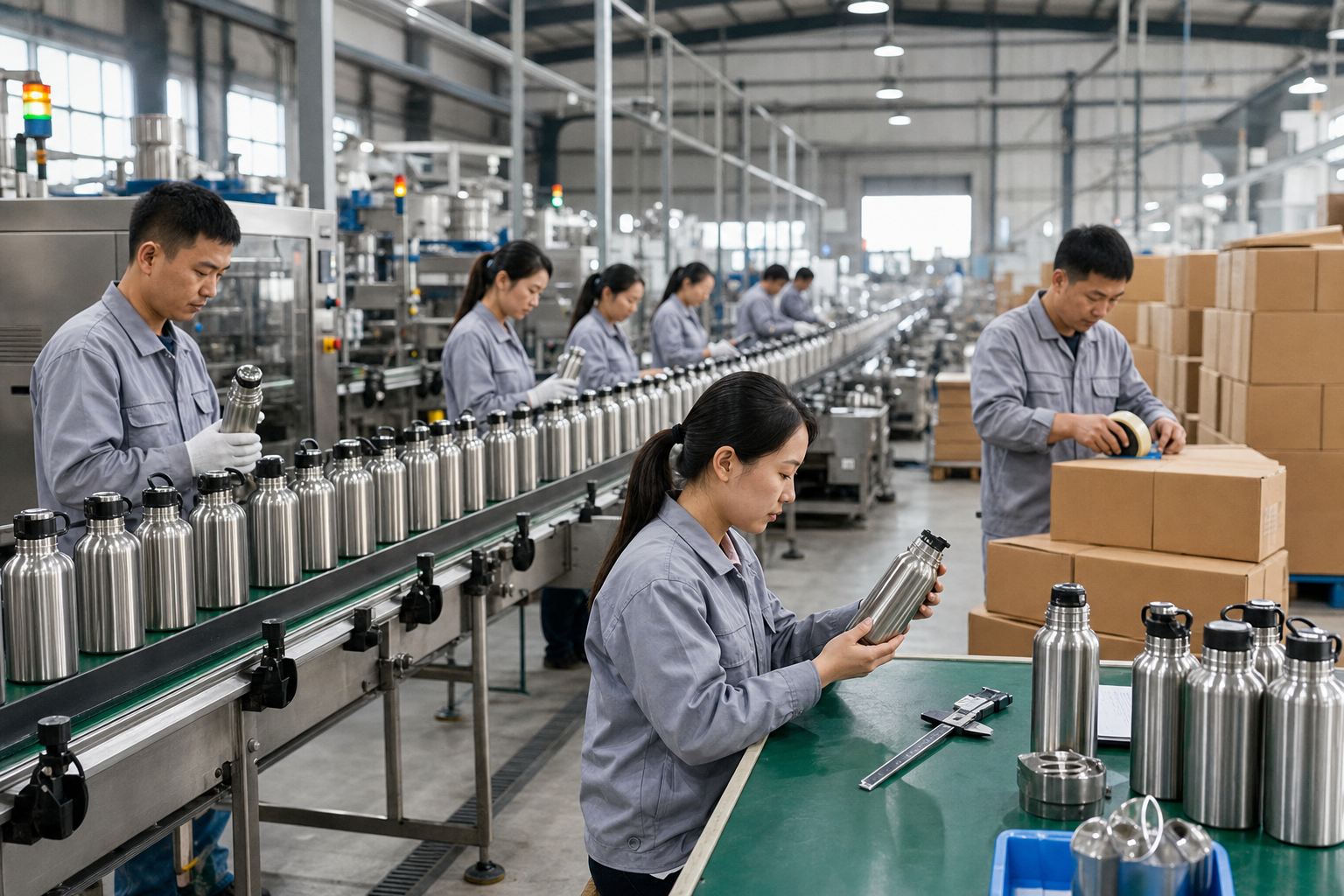
We build custom drinkware in Zhejiang, China, and the pattern stays the same: buyers want speed, but they still need a clean spec. For a serious canteen vendor or canteen distributor, the right questions are simple: what steel grade, what wall thickness, what coating, what test standard, what MOQ, and how many days? Ask that before PO. We saw a buyer flag a 304 stainless line item as “304SS” on the order, then chase us for two days because the packing list used the wrong abbreviation. Get those answers early, and sourcing from a canteen factory in China gets a lot less risky.
What vendors canteen really means
When buyers say vendors canteen, they usually mean one of three jobs: a canteen supplier for branded retail, a canteen distributor holding promo stock, or a canteen factory making one product line to spec. Those are different orders on the line. A canteen vendor may need 500 units in 7 days for an event. A canteen distributor may need mixed cartons and steady repeat supply. A canteen factory needs a clean spec before we open the mold sheet.
If you buy custom drinkware for Europe or North America, define the channel before you talk price. A canteen promotional item for giveaways can run with simpler packaging and a single-color print. A premium custom canteen for sporting goods retail may need 304 stainless, matte powder coating, and a 1.5 mm silicone base. A customizable canteen for an online catalog needs color variants we can repeat without changing tooling every month. We had one buyer flag “best price” on a PO and forget the sales channel; the math did not work, and we lost 3 weeks on quote rounds.
- Retail: keep the carton strong, the barcode clean, and the finish consistent across 2,000 units.
- Promotion: keep unit cost down, leave enough logo area, and make the print fast.
- Distribution: keep packing repeatable, check the damage rate, and avoid carton mix-ups at 48 pcs per case.
Materials that survive real use
The material choice decides whether your custom drinkware program sells once or comes back for reorder. For a customized canteen, 304 stainless steel is still the baseline for food-contact bodies. We run 0.6-0.8 mm wall thickness on most export orders because the math works better in transit and on shelf. If the buyer pushes for 201 stainless to hit a lower target, we spell out the tradeoff: weaker corrosion resistance and a thinner story for premium channels. For a customizable growler or large-capacity drinkware line, 18/8 stainless is the safer commercial pick.
Do not ignore the cap system. Most leakage complaints come from closures, not the bottle body. Last month QC pulled the sample after a PO typo listed the gasket as 1.2 mm instead of 2.0 mm, and the lid failed the tilt test. A flip lid with a 2-piece seal works for a sports program. A threaded cap with TPE gasket fits a customized drinkware SKU going through distributor shelves. If you want a premium feel, ask for a silicone bumper or sleeve, but every extra part adds assembly time and more QC checks. In Zhejiang, we see unit cost rise by roughly 8-15% when buyers move from plain brushed steel to powder coat plus matching lid plus gift box. That is normal.
Recommended baseline spec
For a standard custom canteen program, start with a 304 stainless body, 0.6 mm wall thickness, BPA-free lid, and a 1 meter drop-test target on concrete for packed samples. We ship a lot of this spec because it passes carton abuse better than the thin stuff. If your market is price-sensitive, simplify the finish, but do not cut the seal quality. A low-cost lid that leaks will kill a distributor program faster than a slightly higher FOB price. We've seen that go sideways too many times.
MOQ, samples, and lead time
Price gets attention first, but MOQ and lead time decide whether the canteen program actually works. A normal canteen manufacturer in China often sets MOQ at 1,000 units per design; 500 units is possible when the body mold already exists and only the logo or print changes. Sample lead time usually sits at 5-10 days. Mass production runs 35-50 days after approval. If you need a repeat order fast, ask whether the factory keeps semi-finished stock in Zhejiang. We ship from Hangzhou every week, so this is not theory.
A serious canteen supplier should show a sample plan with two steps: pre-production sample and sealed golden sample. No short cut there. Without both, color drift and print misalignment slip through. A buyer flagged a 2 mm logo shift on one of our early samples, and QC pulled it before the line moved on. For a canteen distributor, that mistake lands on your desk, then your retailers start asking why carton one looks different from carton six. We run about 300,000 units per month across drinkware lines in Hangzhou, Zhejiang, and staged approval keeps the schedule clean: artwork, material, sample, order.
Ask for written tolerances. If the wall thickness is 0.6 mm, state the allowed variation, usually ±0.05 mm on a stable production line. The math does not work without that line on the PO.
Print methods and branding choices
Your branding method should fit the sales channel, not a buyer’s taste. For a canteen custom order, silkscreen is the low-cost route for one or two colors on a flat panel. We run it that way on the line. Laser engraving costs more, but the mark stays clean and does not peel. UV print works when the artwork carries 3 or 4 colors, and QC should check abrasion after 50 rubs or 100 rubs, not just look at the sample under shop light. If you are building a distributor program, the logo has to survive carton drop tests, shelf rubbing, and consumer washing.
For a customized canteen or canteen customizable line, keep the decoration zone fixed across variants. That lets us reuse the jig and cut setup time. We had a buyer flag a PO once because body color, cap color, and logo position all changed on the same SKU; the math did not work, and replenishment dragged. Better to lock the base bottle and offer 3 to 5 repeatable colorways. If you want a retail look, matte powder coating with a laser logo is the cleaner play. If the target is a promo price, one-color silkscreen on brushed steel wins on cost.
For a custom growler style bottle, the wider body changes print placement. The curved area will stretch a logo, so ask for a digital artwork proof on the actual dieline, not only a flat PDF. We caught a 2 mm shift on one sample after QC pulled the proof tape against the curve, and the buyer approved the correction before mass run.
Compliance for Europe and North America
If your market is Europe or North America, compliance is not optional. Ask for REACH test reports for coatings and lids, LFGB or FDA food-contact evidence where applicable, and a signed declaration of conformity. Many buyers also ask for CA Prop 65 screening on US orders. “Food grade” on a sales sheet means nothing without papers. A real canteen factory should know what gets tested: body, lid, gasket, paint, print.
For audit-heavy channels, ask whether the factory holds BSCI, Sedex, or ISO 9001. Those certificates do not make a weak canteen manufacturer strong, but they cut down obvious process risk. We run AQL 2.5 for critical defects and 4.0 for major defects, then add carton drop testing and a check on print alignment with a steel ruler and caliper. The buyer flagged barcode placement once because the UPC sat 8 mm too close to the seam, and that sort of mistake will get a PO bounced. For North America marketplace fulfillment, carton size and label position need to match FNSKU or UPC rules from the start.
China factories in Zhejiang can handle this well when the requirement is clear. The problem is not capability; the problem is vague sourcing briefs. One PO typo can turn “inner box 24 pcs” into “inner box 42 pcs,” and then the math does not work on packing. If you want a compliant canteen promotional order, state the market, the test standard, and the pack method in that order.
Pricing that makes margin sense
Price only works if your landed cost supports the channel. A plain 500 ml stainless custom drinkware SKU usually starts around USD 2.10-2.80 FOB China for a basic build, simple print, and standard packaging. Add powder coating, laser branding, and a color box, and you move closer to USD 3.60-4.80 FOB. A larger customized growler or vacuum-insulated model can go higher, and lid structure pushes it up fast. We run that math on the line every week.
Freight changes the picture. A light product with compact cartons ships cleanly, but a bulky gift box can add 12-18% to landed cost just through volume. One buyer sent a PO with the carton spec missing, and the math did not work once we re-quoted at 0.12 CBM per master carton. This is the wrong question to ask if you only compare unit price. A canteen distributor should ask for carton count, gross weight, and master carton dimensions before sample approval. If your retail margin target is 35-45%, you need those numbers before you issue a PO. The cheapest supplier quote is useless if the carton breaks or the logo fails inspection.
- Ask for FOB, not just EXW: FOB gives a cleaner export baseline, and it keeps the forwarder and port charges visible.
- Confirm packaging units: 24 pcs/carton, 36 pcs/carton, or retail box each changes freight; QC pulled a sample once and found 18 pcs/carton on the packing list, which was a PO typo.
- Check color consistency: ΔE under 2.0 is a practical target for repeat orders, and we test it with the spectrophotometer before release.
How to choose the right factory
You do not need the biggest factory. You need the one that can repeat your spec. A solid canteen supplier answers within the same day, sends production photos from the line, and tells you where the risk sits instead of hiding behind sales talk. We run a lot of this in Zhejiang. The real split is process control. Check for a stable QC team, incoming material checks, and an approved sample archive with dated labels.
Ask these questions before you place a trial order: Can they make a customizable drinkware range across 3-5 capacities? Can they support low-MOQ trial runs for a distributor drinkware program? Can they repeat a saved color code six months later? Can they offer spare lids or replacement seals? A good canteen vendor says yes only when the line is set up for it. If they promise every finish, every logo, every shipment date without checking capacity, the buyer flagged it for a reason. We once saw a PO with “blue” typed twice and no Pantone code. That job went sideways fast.
For a practical sourcing workflow, keep the first order modest: 1,000-3,000 units, one material, one lid system, one packaging format. That gives you clean data. Once the sell-through data is in, you can expand into more canteen manufacturers or build a wider private-label line. We usually tell buyers to test one carton spec first, not three. The math works better that way.
Send your canteen spec and get a quote
We can review your artwork, suggest a build spec, and quote FOB China with MOQ, lead time, and compliance details in one reply.
Frequently asked questions
What is a realistic MOQ for vendors canteen orders?
For a standard custom canteen, MOQ is usually 1,000 units per SKU in China. If the body mold already exists and you only change color or logo, some Zhejiang factories can do 500 units, but pricing rises 10-20%. For a full custom shape, expect 3,000 units or more. Always confirm whether MOQ is per color, per logo, or per carton configuration, because that changes your budget fast.
How long does custom drinkware production usually take?
A normal schedule is 5-10 days for samples and 35-50 days for mass production after sample approval. If your design needs new tooling, add 15-25 days. For a repeat order at a canteen factory in Zhejiang with available raw stock, you may cut total time to around 30 days. Do not forget packing confirmation, because artwork changes often add another 3-5 days.
Which material is best for a customized canteen?
For most North America and Europe programs, 304 stainless steel is the safest baseline. A 0.6 mm wall thickness works for everyday use, while 0.8 mm feels more premium and heavier. If the program is price-driven, 201 stainless may reduce cost, but it is harder to position as premium. For lids and seals, request BPA-free materials and document food-contact compliance for the target market.
What documents should a canteen distributor request from suppliers?
Ask for product specs, food-contact declarations, REACH or LFGB reports where relevant, and factory certifications such as BSCI, Sedex, or ISO 9001 if your channel requires them. You should also request a golden sample, packing list, carton dimensions, and inspection standard. For marketplace or retail programs, barcode placement and carton marks matter as much as the bottle itself.
How do I reduce defects in a custom canteen order?
Use a written approved sample, set AQL 2.5 for critical defects and 4.0 for major defects, and require seal testing plus carton drop testing. Keep the first order to one body color and one lid color if possible. Most complaints come from leaks, print mismatch, or damaged packaging, not from the steel body. Clear specs save money more effectively than chasing the lowest FOB quote.