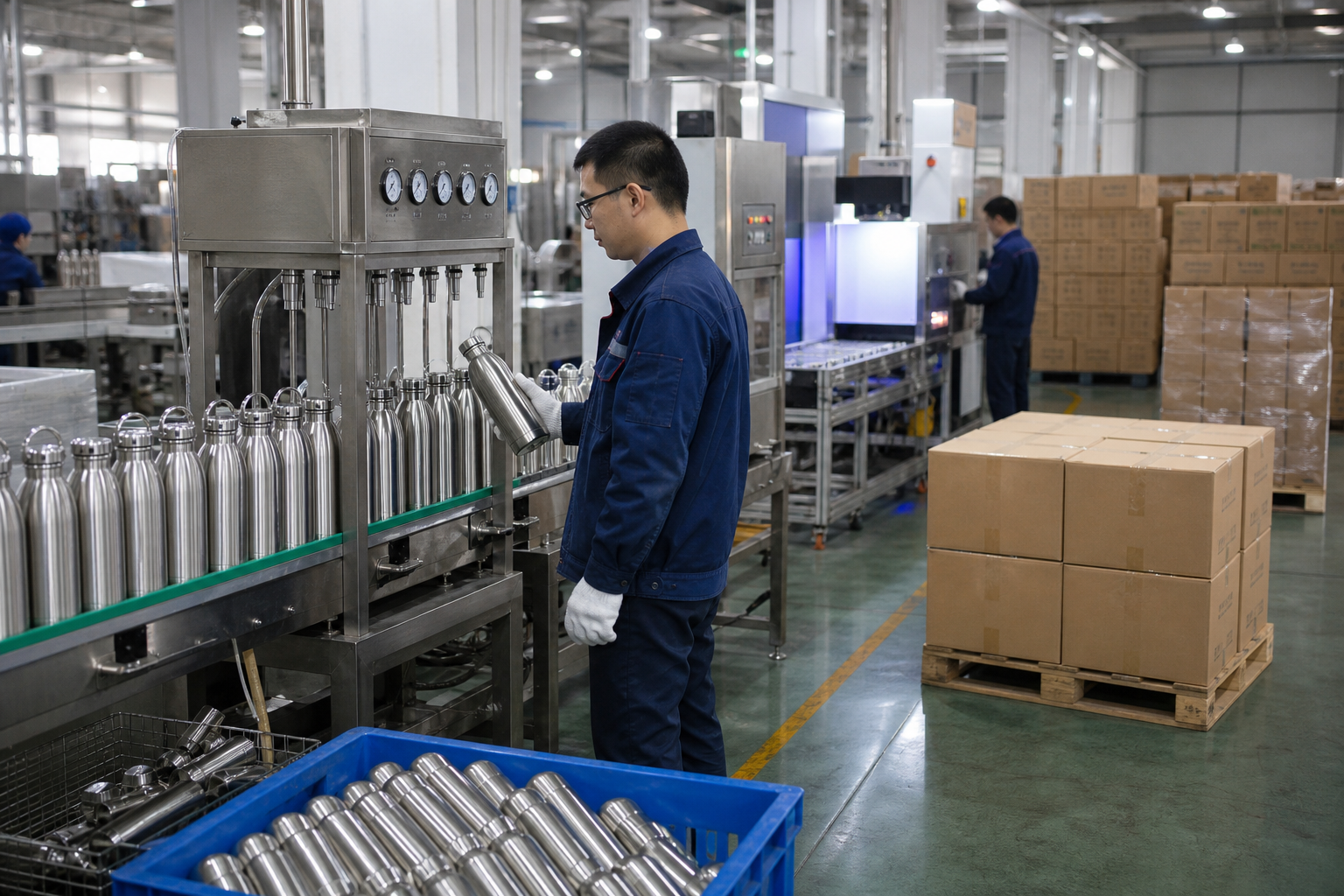
Key Takeaways
- MOQ for a custom canteen usually starts at 1,000-3,000 units, not 100.
- A real canteen manufacturer should quote lead times in 25-35 days for samples and 35-55 days for mass production.
- For export, ask for REACH, food contact, and AQL 2.5/4.0 inspection terms before you approve.
- If you want distributor drinkware with logos, choose decoration by use case: silkscreen for volume, laser for durability, UV for color.
If you buy vendors drinkware for retail, promotions, or e-commerce, the real risk is not price per unit. It is ordering the wrong spec, the wrong decoration, or the wrong compliance file and finding out after 30,000 units are already on the water. We run this every week in Zhejiang, and the ugly cases start with a typo on the PO or a buyer who forgot to call out lid color.
You need to know what makes a canteen custom order workable: MOQ, mold cost, leak test standard, coating durability, and whether your supplier can ship on time from China with the paperwork your market expects. For a distributor canteen program, the difference between a usable quote and a headache is often one decimal point in wall thickness, one missing REACH document, or a lead time that reads 12 days on paper and 18 days on the floor. QC pulled the sample on a 500 ml run and found a 1.2 mm variance; that kind of miss is why we push back when a buyer says, “just make it the same as last time.”
What vendors drinkware really means
When buyers search vendors drinkware, they usually mean one of three jobs: a canteen supplier for stock goods, a private-label partner, or a distributor drinkware source that can keep SKUs on the shelf. Those are not the same. A canteen vendor that only resells stock items will not give you the control of a canteen factory in Zhejiang that handles forming, coating, printing, and packing in one line.
For B2B procurement, split canteen suppliers into two groups. One group is trading companies that can move fast but do not always hold the line on consistency. The other is real canteen manufacturers with production lines, QC staff, and monthly capacity. At BottleForge Industrial in Hangzhou, we run 600,000 units per month, with sample lead time of 7-12 days and bulk lead time of 35-50 days depending on decoration. QC pulled the sample last week and flagged a 0.3 mm lid gap. That is the difference when you are planning a retailer rollout or Amazon FBA replenishment.
Do not buy on the word “custom” alone. Custom drinkware can mean a logo on a standard body, or a fully customized canteen with a new lid, new finish, and new packaging. The second path costs more and takes longer, and the math does not work if you only need a short run. If you want a private mold or a shelf look no one else has, that is the right ask.
Canteen materials that survive export
Material choice drives price, weight, compliance, and how buyers judge the bottle on first touch. For a custom canteen, we run 304 stainless steel, 316 stainless steel, Tritan, AS, and aluminum most often. If you ship into Europe or North America, stainless is still the safest default because buyers know it, it holds up, and the paperwork is easier to close.
Here is the practical split:
- 304 stainless: best value for most customizable canteen programs; typical wall thickness 0.4-0.6 mm.
- 316 stainless: higher corrosion resistance, better for sports or acidic beverages, usually 8-15% more cost.
- Tritan: clear body, lighter weight, useful for a customizable drinkware line where visibility matters.
- Aluminum: lower cost, but coating quality and dent resistance need tighter QC.
If you want a custom growler or customized growler for beer, ask about the interior liner and coating chemistry. The buyer flagged a bad liner on a 64 oz sample once, and that one mistake killed the reorder. For a distributor growler program, that math does not work: a slightly cheaper FOB cannot cover lost repeat sales. Ask for food-contact declarations and migration test reports too. We see this go sideways when a factory has the test file but cannot explain the numbers line by line. That is one reason Zhejiang sourcing is cleaner when you need production and documents handled in the same building.
For insulated models, insist on a real vacuum structure, not decorative claims. A good double-wall stainless bottle should hold 6 hours hot and 12 hours cold at minimum, and better models should beat that by 20-30%. QC pulled the sample on one line because the weld seam showed a 0.3 mm gap at the neck, and that is the kind of miss that turns into warranty pain. If the supplier cannot tell you the foam level, weld seam, or vacuum test method, move on.
MOQ, pricing, and the hidden math
Most buyers ask for a price first. We ask for the full unit economics. A canteen manufacturer can quote $1.80 FOB, then decoration, inner box, accessory, and carton add another $0.70; your landed cost moves on day one. For vendors drinkware programs, the better question is: what will sell at your target margin with acceptable QC risk? We saw a buyer push back on this last month, and the math did not work.
MOQ is usually clear once you split the job by part. A stock-body canteen customized with one-color logo often starts at 1,000 units. A new mold or special lid usually needs 3,000-5,000 units. A canteen promotional order for an event can go lower, but the per-unit price often jumps 18-35%. That is normal. No factory in China gives you private label at stock price and eats the cost. QC pulled the sample on a 500 ml bottle last week because the lid thread was off by 0.3 mm.
When comparing canteen suppliers, ask for a line-by-line quote:
- Base bottle price
- Decoration cost per color or per laser area
- Packaging cost
- Accessory cost: lid, straw, handle, carabiner
- Sampling fee and refund rule
- Tooling or mold amortization
As a rule, a trustworthy canteen distributor should know the difference between FOB Ningbo, FOB Shanghai, and EXW Zhejiang. If the quote only gives one number and no Incoterms, you do not yet have a real export offer. You have a sales lead. We ship this every week, and the typo on the PO is usually where the trouble starts.
Decoration choices that hold up
Decoration is where a lot of custom drinkware orders go wrong. A clean sample can still scratch, fade, or peel after 2 weeks in a warehouse and one round of courier handling. For a custom canteen or customizable growler, we match the decoration method to the product and the channel, not to a nice mockup.
Silkscreen is the volume workhorse. We run it on 5,000+ units when the buyer wants one logo color and a clean cost per piece. Laser engraving gives a permanent mark on stainless steel, so it fits executive gifts and retail SKUs meant to stay in use. UV printing handles full-color artwork, but the surface prep has to be right; if the primer is off by even 0.1 mm, edge wear shows up after shipping. Powder coating adds grip and hides fingerprints, yet it still has to pass adhesion and abrasion tests. QC pulled the sample before we packed it, and the buyer flagged a faint rub mark on the rim.
Pick the decoration for the buyer, not for your own taste. A canteen promotional item for a trade show can run a one-color print and move fast. A customized canteen sold through distributors needs a finish that survives shelf handling, box rub, and return logistics. If you are buying distributor drinkware for marketplaces, ask for a scratch test, dishwasher note, and packaging drop test. A 1.2-meter carton drop simulation is the floor, not the upgrade. The math doesn't work if the print looks good on day one and fails on day seven.
For a canteen custom project, ask the factory for pre-production artwork proof in vector format, Pantone reference, and decoration tolerance. We usually build the first fixture in 24 hours, then check alignment before the line starts. Zhejiang factories that handle this well will also show fixture photos and QC checkpoints, so you can see where the mark is set and who signs off. That saves time and cuts rework.
Compliance and QC you should demand
If you sell into Europe or North America, compliance is the first gate. At minimum, your canteen supplier should hand over food-contact declarations, REACH material statements, and FDA-compliant component files where they apply. For silicone seals, coatings, and drinking surfaces, ask for LFGB test reports. A real canteen factory will show the paperwork; “factory standard” is not a document. We got burned once on a 0.8 mm gasket spec because the buyer flagged a missing declaration before shipment.
QC is where orders live or die. For a normal export run, AQL 2.5 for major defects and 4.0 for minor defects is standard on the line. For premium retail or a customized drinkware launch, tighten that call. Leak test every unit, or set a valid sampling plan with the lid torque spec written down. We run 12 days vs 18 days on different inspection scopes, and the math changes fast when a lid opens at the first shake. Too loose, complaints. Too tight, returns.
Packaging gets buyers in trouble more often than they expect. If you sell to Amazon or retail, carton marks, inner box strength, and barcode placement need to match the PO, not guesswork. A canteen distributor who skips packaging checks pays twice: damage claims first, chargebacks after. The buyer once sent a PO with the barcode position typed as “left side,” then complained when the carton scan failed. In Zhejiang, good factories already run inline QC with calipers, drop-test rigs, and seal checks, but you still need your own spec sheet and final sign-off list.
Ask for three things before PO release: material certificates, signed artwork proof, and a sample retention seal. If one is missing, you do not control the order.
Choosing the right supplier type
Do you need a canteen manufacturer, a canteen supplier, or a canteen vendor? Start with the order, not the title. For 500 pieces for a local promo, a distributor can move fast. For a retail line that needs repeat replenishment, you want a China factory with stable tooling, in-house QC, and export paperwork handled cleanly.
There is a middle layer too: canteen distributors who hold stock and mix SKUs. That works when the buyer wants 3 colors, 2 cap styles, or a bridge shipment in 12 days instead of 18. They do not give you a new lid, a private mold, or the same coating lot every time. We’ve seen that go sideways on a PO where the buyer flagged a typo on the carton spec, and the distributor could only say, “take the stock as is.” For private label, direct factory sourcing from Zhejiang is usually the cleaner path.
Use this simple filter:
- If you need speed: choose stock goods from a canteen distributor.
- If you need branding: choose a customizable canteen program from a factory.
- If you need product differentiation: choose a canteen customized build with tooling and packaging control.
- If you need quarterly replenishment: choose a supplier that can show 2 production lines, QC records, and export history.
At BottleForge in Hangzhou, we work with brand owners, distributors, and importers who want clear lead times and no drama. QC pulled the sample at 9:20 a.m., checked the 304 stainless wall thickness, and that tells us more than a polished pitch. That is the baseline you should expect from any serious Zhejiang partner.
How to brief a custom order
A clean brief saves weeks. Send a vague email that says “need custom bottles,” and you get a vague quote back. For a vendor drinkware project, write the spec down: capacity, material, lid style, insulation yes or no, logo size, print method, color code, packaging, target market, and test list. On our side, QC pulled the sample, checked the lid gap at 0.3 mm, and the whole quote got cleaner because the buyer stopped guessing. A solid brief turns a generic reply into a real procurement talk.
Include these details:
- Capacity: 500 ml, 750 ml, 1 L, or 32 oz
- Material: 304, 316, Tritan, or aluminum
- Finish: matte, gloss, powder coat, or bare metal
- Decoration: one-color silkscreen, laser, UV, emboss, or full wrap
- Target MOQ: 1,000, 3,000, or 5,000 units
- Required compliance: REACH, LFGB, FDA, or market-specific docs
If you are buying a custom growler, add pressure expectations, cap type, and the beer use case. If the buyer flagged it for draft beer, we also ask about gasket material and whether the cap needs to hold 2 bar. For a distributor canteen line, spell out carton quantity and shelf display needs. If you want customizable drinkware for multiple regions, ask the factory to quote a universal base body with local logo variation. That is the right move. It cuts tooling risk and keeps SKU count under control.
Good factories in China will not promise impossible specs. The better ones will tell you where cost rises by 12%, where lead time slips by 8 days, and where a lid material change affects the seal. We’ve seen a PO typo on “silkscreen” turn into a re-quote and a lost week. That honesty is worth more than a fake low quote.
Request a factory quote with real specs
Send your capacity, logo method, and target MOQ. We’ll quote a custom canteen or distributor drinkware program with clear lead time and compliance files.
Frequently asked questions
What MOQ should I expect for vendors drinkware orders?
For most custom drinkware, expect 1,000 units for logo-on-stock products and 3,000-5,000 units for private mold or custom lid work. A simple one-color silkscreen can keep setup costs low, but a new canteen customized design raises tooling and sampling costs. If a supplier in China offers 200 units at a normal factory price, check whether they are just reselling stock or hiding the real decoration cost. A realistic factory will quote MOQ, lead time, and packaging separately.
How do I know if a canteen factory is real?
Ask for factory photos that show production lines, vacuum testing, printing equipment, QC stations, and warehouse racks. A real canteen factory can usually tell you monthly output, sample lead time, and current export markets without hesitation. Look for an actual business license, BSCI or similar audit if relevant, and clear Incoterms. In Zhejiang and across China, many suppliers look similar online; the difference is whether they can handle 600,000 units per month or only source from someone else.
What is the best decoration for customized drinkware?
For volume sales, silkscreen is usually the best balance of cost and speed. For premium retail or long-life use, laser engraving is more durable because it will not peel. UV printing works when you need multi-color graphics, but it needs stronger surface prep and tighter QC. On a stainless custom canteen, laser is often the safest choice. On a coated canteen promotional order, silkscreen is cheaper and faster. The right answer depends on your channel, not just your artwork.
Can I order custom growlers for beer distribution?
Yes, but you should be strict on liner, seal, and pressure-related use. For a custom growler or customized growler, ask for the material specification, closure type, and whether the interior coating is food-safe and beer-compatible. If you are selling through distributors, request sample retention and a leak test. Typical MOQ starts around 1,000 units, and the factory should provide compliance documents for the target market. A distributor growler program without documentation becomes a liability fast.
What documents should my canteen supplier provide for Europe or North America?
At minimum, ask for food-contact material declarations, REACH-related statements, and test reports that match your materials and decorations. If silicone parts are involved, request LFGB or equivalent testing where needed. For North America, you may also want FDA-related component documentation. A good supplier will also confirm AQL levels, carton specs, and barcode compliance. Do not approve a PO until the paperwork matches the exact canteen customizable version you are buying, not a generic sample.