Key Takeaways
- A workable MOQ for custom growler orders usually starts at 500-1,000 pcs, with 15-25 day sample lead time.
- For stainless custom drinkware, 0.5-0.8 mm wall thickness and 18/8 steel are common commercial specs.
- A good China canteen factory should support AQL 2.5 inspections, REACH documentation, and FOB quotation clarity.
- Decoration choice can change cost by 8-20%, especially between silkscreen, laser engraving, and full-color wrap.
If you are searching vendors growler, you are not just buying a bottle. You are buying a product that has to hold a logo, survive carton drop tests, pass compliance, and still leave room for margin. That is where first-time buyers get burned. They check the print and miss the 1.2 mm wall, the closure torque, the 12-pack carton spec, and the real lead time.
At BottleForge in Hangzhou, Zhejiang, we see this every week from distributors and brand owners in Europe and North America. QC pulled a sample, and one buyer flagged a cap leak at 55°C before the PO even landed. A good canteen manufacturer or canteen supplier does not stop at unit price. They give you the MOQ, the sample cycle, the test standard, and the place where the cost hides. If you want a custom growler or custom canteen that we can ship without drama, buy like a procurement manager, not like a shopper.
What vendors growler buyers actually need
Buyers searching vendors growler usually want one of three things: a beer or cold brew growler for retail, a branded promo piece, or a tough custom drinkware item for distribution. The label shifts. The buying logic does not. We ship a lot of these, and the same questions come up every time: price at 500 pcs, print repeatability, and whether the sample you approved in March still looks the same in September.
A serious canteen vendor should answer in numbers, not slogans. Ask for steel grade, capacity tolerance, cap torque range, and carton drop-test results. On a 32 oz custom growler, we usually run 304 stainless, 0.6 mm body thickness, and either powder coat or brushed finish, depending on the channel. QC pulled the sample last week and checked the lid torque with a torque meter at 18-22 N·cm. If the seller cannot explain the gap between customizable drinkware for retail and canteen promotional goods for events, the buyer is talking to a trader, not a factory.
In Zhejiang, a low unit price is often the wrong question to ask. We’ve seen a $2.80 piece pass the quote stage and fail leakage testing on line 3; that one gets expensive fast. A $4.10 item that ships clean at AQL 2.5 is the cheaper buy. One buyer once flagged a PO typo on capacity — 30 oz instead of 32 oz — and the carton labels had to be reprinted. That is the export lesson most canteen distributors learn after one bad season.
Pick the right material and format
The biggest cost and performance calls happen before print or laser. If you want a custom canteen or custom growler, start with material. Stainless steel is the default for drop resistance and temperature hold. Aluminum works for a giveaway run, but it dents fast and usually needs a liner. Glass looks clean on shelf, yet it changes carton spec and adds breakage on the line. Tritan and PP fit lighter customizable canteen programs when the buyer is chasing a lower FOB.
For North American and European buyers, 18/8 stainless is the safe pick. On insulated models, we run a double-wall vacuum build with a 0.4-0.5 mm inner shell and 0.5-0.8 mm outer shell, depending on size. A non-insulated beer growler or water canteen at 0.6 mm is a practical commercial spec. Drop it thinner and you might save $0.15 to $0.30, but the hand feel turns hollow and the retailer will flag it. We’ve seen that go sideways on a 32 oz PO where the buyer wrote “heavy-duty” in the notes and then complained about the wall thickness.
- 304 stainless: best balance of cost, corrosion resistance, and compliance.
- 316 stainless: higher corrosion resistance, usually the choice when the buyer pays for it.
- Aluminum: good for lightweight distributor drinkware, less premium in hand.
- Glass: premium look, higher breakage and freight cost.
If your channel is outdoors, gym, or brewery merchandise, a canteen manufacturer should match the format to the use case, not push the cheapest SKU. We had a brewery buyer ask for a 750 ml growler with a 63 mm neck, then change the cap type after sample approval; QC pulled the sample and the math stopped working. This is the wrong question to ask if the goal is sell-through, not just a low unit price.
Decoration drives margin and MOQ
Decoration is where a canteen distributor or brand owner builds margin or gives it away. One-color silkscreen is the lowest-cost route, and we run it on a lot of canteen custom orders at 500-1,000 pcs. Laser engraving costs more per unit, but the line looks cleaner and the mark stays put on 304 stainless. Full-wrap heat transfer or UV printing makes sense when the art has gradients or more than two colors.
The math is simple. A one-color print may add $0.12-$0.25. A wrap print can add $0.35-$0.80. Laser engraving on a stainless custom canteen might add $0.18-$0.45 depending on the area. We had a buyer flag a PO typo once—12,000 pcs listed with the 500 ml bottle code—and the decoration choice changed the landed price enough to break the margin. If you sell on Amazon or to retail chains, that gap hits FNSKU labeling, carton pack, and the shelf price at the same time.
Ask your canteen supplier for a pre-production sample with the actual logo, not a blank prototype with “logo to follow.”
For a customized canteen or customized drinkware program, the real question is not “can you print it?” The question is whether the factory can hold the same logo at 5,000 pcs with no color drift, no shift in placement, and no ragged edge. QC pulled the sample with a 1.2 mm offset on one order, and we stopped the line before packing. That is where a real canteen factory earns its keep.
MOQ, lead time, and factory reality
Buyers ask for one-off flexibility all the time. The line does not work that way. A reliable canteen factory in Zhejiang usually runs 300,000 to 600,000 units a month across several lines, and that schedule keeps the quote honest. For a custom growler run, MOQ is usually 500 pcs for simple print or laser marking, and 1,000 pcs when the build changes, like mixed colors or a special lid. If you want two lid colors or gift boxes, the MOQ goes up. We’ve had buyers push back on that, then the sample room pulled the numbers again and the math still did not work.
Lead time is usually 25-35 days after sample approval and deposit. In November, we ship a week slower than off-season, and that is normal. A solid canteen manufacturer should break the schedule into 5-7 days for tooling or artwork sign-off, 7-12 days for production, 3-5 days for packing and QC, then freight booking. QC pulled the sample on a 316g growler run last month and found a lid print mismatch; that one fix added 2 days. If someone says 10 days for a fully customized growler with new packaging, they are guessing or dodging the real plan.
For a canteen manufacturer serving distributors, the clean setup is a stable core SKU plus a seasonal promo variant. We run that split on the floor all the time. The core stock keeps sales moving, and the promo version gives you room for canteen promotional campaigns without stopping the whole line. A buyer once sent a PO with the lid color code wrong by one digit, and that small typo would have burned a week if the order had gone straight to packing.
Quality checks you should demand
If you buy custom drinkware at scale, quality inspection is not optional. Ask for a written QC plan that covers leak testing, drop testing, finish checks, and carton verification. We run AQL on every export lot, and a serious canteen supplier should show incoming material inspection, in-process checks, and final random inspection on the line. For export orders, AQL 2.5 for major defects and 4.0 for minor defects is a common baseline; for a premium retail PO, we have seen buyers tighten that to 1.5 on key defects.
For stainless items, ask for REACH paperwork for Europe and food-contact declarations where needed. If you sell in the U.S., your retailer or channel partner may ask for California Proposition 65 review, even on a plain bottle. We had one buyer flag a PO because the spec said "304 stainles" instead of 304 stainless, and the broker would not clear it until the paperwork matched. A serious canteen suppliers network in China knows these requests; if they do not, the cost shows up later in rework, holds, and missed ship dates.
- Leak test: 100% on assembled units, not random only. QC pulled the sample at 50 pcs from the first 500, then we ran water upside down for 30 minutes.
- Drop test: 1.0 m to 1.2 m depending on packaging spec. One carton at 1.2 m with corner drops first tells you more than a polite yes from sales.
- Vacuum retention: for insulated models, confirm target hours in writing. We ask for the exact hours, like 12 hours hot versus 18 hours, because "keeps temperature" is not a spec.
- Print adhesion: tape test or abrasion check for decorated units. If the logo flakes after 20 tape pulls, the line needs to stop before the order grows.
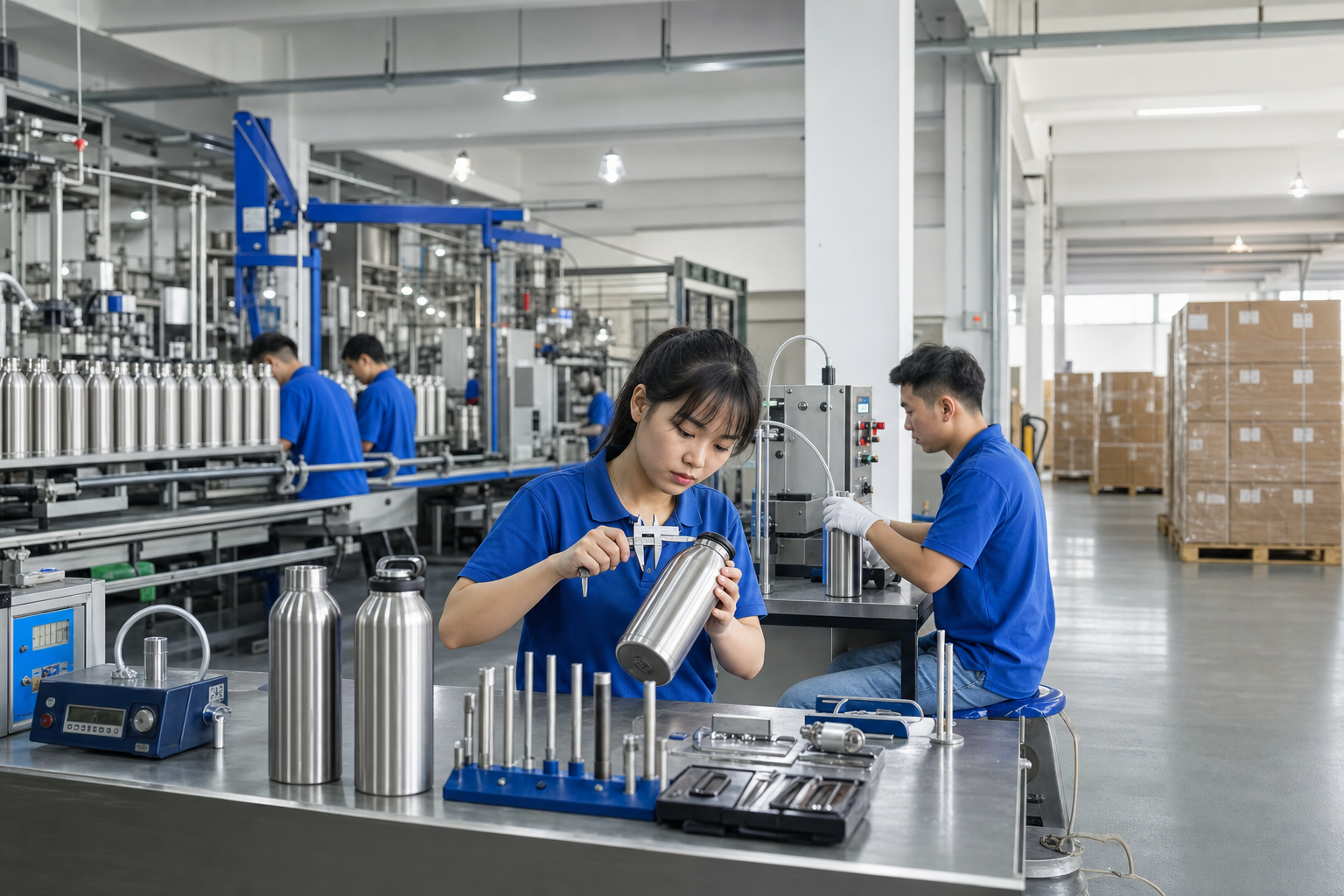
When you audit a canteen vendor, ask for photos of the lab setup and the actual inspection report, not just a certificate PDF. A real report shows the gauge, the batch number, and the AQL count; a clean PDF alone proves nothing. We have seen this go sideways when the sample looked fine but the carton drop test was never done.
How to buy from China without chaos
Buying from a canteen distributor in your market is simpler. The margin is thinner, too. Direct buying from China can cut unit cost, but only if the order runs in a clean sequence: request the spec sheet, confirm samples, lock artwork, approve the pre-production sample, then issue the PO. We run orders like that because one missing step can turn a 3,000-piece job into a mess.
In Zhejiang and across China, the better suppliers are direct and a bit strict. They will tell you if a color match is off by 1-2 Delta E, or if a cap style will push scrap above 5%. Listen. We have seen buyers insist on a glossy finish that looked sharp on the render and then failed on the line. A proper distributor growler program is built on repeatability, not just a low opening price.
If you need retail packaging, barcode setup, and export cartons, ask whether the factory does it in-house or sends it out. In-house packing control usually means fewer headaches. For a customizable growler sold through distributors, the carton spec matters as much as the bottle. A weak ship carton can add 2-3% breakage or dent claims before the goods reach your warehouse. QC pulled the sample carton with a 5 kg drop test last week, and the buyer flagged the corner crush right away.
At BottleForge in Hangzhou, we usually tell first-time buyers to start with one size, one lid, and one decoration method. That is the right starting point. Once the market proves sell-through, then you move into a broader customized canteen line or a second promotional SKU. We have seen this go sideways when a buyer tries to launch 4 SKUs at once and mixes up the PO codes on the first run.
Request a custom growler quote today
Send your target capacity, logo file, and order volume. We will quote MOQ, lead time, and export packaging clearly, with no guesswork.
Frequently asked questions
What MOQ should I expect for vendors growler orders?
For a standard custom growler, expect 500-1,000 pcs MOQ if you use an existing body shape and one decoration method. If you want a new lid, special coating, or retail box, MOQ often moves to 1,500 pcs. Sample lead time is usually 7-15 days, and mass production is commonly 25-35 days after approval. If a canteen vendor quotes 100 pcs for a complex export item, check whether they are a trader reselling stock rather than a real canteen factory.
Which is better for retail: custom canteen or custom growler?
It depends on the channel. A custom canteen usually sells better for hiking, gym, school, and general outdoor use. A custom growler works better for breweries, cold brew, beer merch, and premium beverage programs. For North American distributors, 32 oz and 64 oz are the most practical growler sizes. For Europe, lighter customizable drinkware often performs better in price-sensitive retail. The best margin usually comes from choosing the format your buyer already understands.
How do I compare canteen suppliers from China?
Compare them on 5 things: material spec, documented QC, MOQ, lead time, and export experience. A good canteen supplier should share production photos, test reports, and packaging details. Ask whether they support REACH for Europe and can print barcodes or FNSKU labels for Amazon. If you are buying from a China canteen manufacturer, ask for a live sample video and a pre-production sample with your logo. That saves expensive misunderstandings later.
What decoration method is best for a customized growler?
For simple logos, one-color silkscreen is usually the cheapest and works well for canteen promotional orders. For a premium permanent look, laser engraving is cleaner and more durable on stainless steel. Full-color UV or heat transfer is better when your artwork has gradients or multiple colors. On stainless, laser may add $0.18-$0.45 per unit, while wrap printing can add $0.35-$0.80 depending on coverage. Choose the method that matches your margin, not just your design preference.
Can a canteen manufacturer handle European and U.S. compliance?
Yes, if they are experienced with export. Ask for REACH documentation for Europe, food-contact declarations, and clear material specs such as 304 or 316 stainless. For the U.S., your retailer or platform may require additional review, including labeling and packaging compliance. A serious canteen manufacturer should also understand carton drop tests, AQL inspections, and export packing. If they cannot explain these, they are not ready for distributor drinkware programs.