Key Takeaways
- Typical MOQ for a custom stainless thermos starts at 3,000 pcs, with samples in 7-10 days
- A 304 inner / 201 outer build can save USD 0.25-0.60 per unit versus full 304, but it changes durability
- For bulk thermos projects, expect FOB China pricing around USD 3.20-8.50 depending on capacity, coating, and lid type
- AQL 2.5 major and 4.0 minor is a realistic inspection target for distributor thermos orders
If you are searching for vendors thermos, you are usually solving three things at once: price, batch consistency, and branding. For outdoor retailers and promo buyers, a stainless thermos is not just a bottle with a lid. It has to survive carton drop tests, pallet stacking, and daily abuse. If the vacuum gives up, the coating chips, or the logo prints off-center, the return claim lands on your desk.
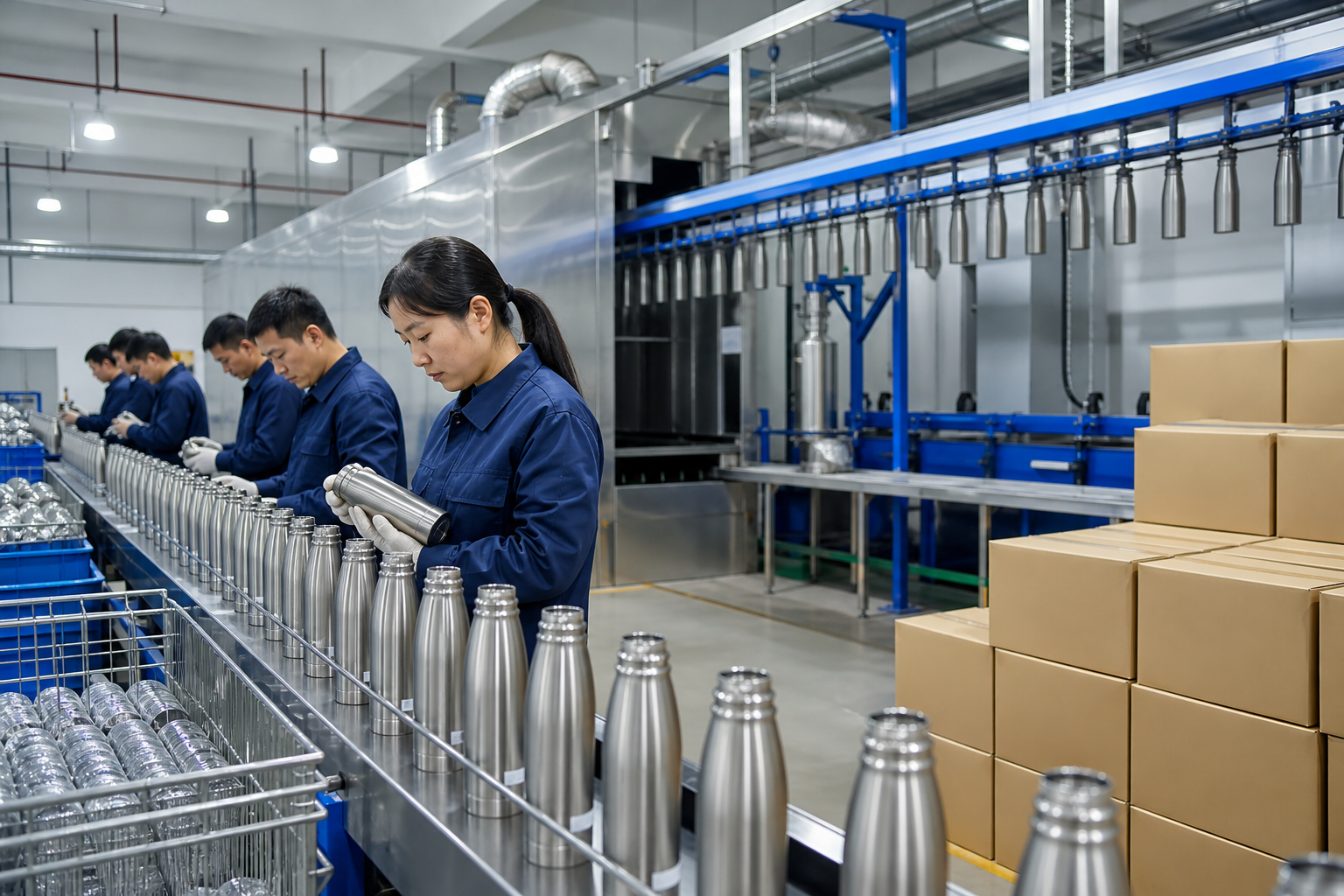
The right move is to treat this as an engineering buy, not a catalog order. A solid thermos factory in Zhejiang should show wall thickness data, vacuum retention numbers, finish samples, and a production plan you can actually hold them to. We run up to 300,000 units per month in Hangzhou, Zhejiang, with a typical MOQ of 3,000 pcs and a 35-45 day lead time for custom stainless thermos orders. Last month QC pulled a 500 ml sample and found a 0.3 mm neck deviation; the buyer flagged it before we shipped, which saved a rework headache.
What vendors thermos really means
When buyers search vendors thermos, they are usually after one thing: a supplier that can handle thermos bulk orders and branding without turning the job into a mess later. The term is broad. The buying decision is not. You need a stainless thermos with the right insulation, finish, packaging, and compliance papers at a steady cost.
In practice, you are choosing between a thermos vendor, a thermos supplier, and a thermos manufacturer. A vendor may work for 300 pieces, but for a promo run or retailer replenishment, we run a direct thermos factory with controlled welding, vacuum sealing, powder coating, and leak testing on the line. That gap shows up fast in China. We have seen 20-35% swing in landed cost once the buyer flagged carton damage, slow artwork approval, and mixed stock from a paper trader.
If you buy for outdoor retail, the end customer judges the cup in the first week. Lid squeak. Print rub-off. Weight off by 80 g from the PO. That kills reorders. This is the wrong question to ask if someone says, “Can you just quote me fast?” Experienced distributors ask for dimensional drawings, coating specs, and sample approval before a 20' container leaves the dock.
Ask for the spec sheet before you ask for the price. A cheap quote with no wall thickness, no vacuum retention target, and no packaging detail is not a real quote.
Stainless thermos specs that matter
Most buyers talk about capacity and logo. The line cares about the build. A solid custom thermos for retail or promotion usually starts with 304 stainless steel on the inside, and we check that spec before we run the first sample. For tighter budgets, some factories switch the outer shell to 201 stainless to shave cost, but the buyer needs to approve that on paper. The common build is 304 inner / 201 outer, with a vacuum layer of about 0.25-0.35 mm between walls after forming, depending on the body shape.
Wall thickness is not a marketing line. Typical inner wall thickness runs from 0.35 mm to 0.5 mm, while the outer wall is often 0.35 mm to 0.45 mm. For premium retail thermos customizable projects, 18/8 stainless is the usual ask, which is 304-grade food-contact steel. One buyer once pushed for a thinner shell to hit a price point, and the math did not work for a bottle meant for daily carry. Fine for desk giveaways. Bad idea for hiking or winter promos.
Vacuum retention decides whether the bottle earns reorder. For a 500 ml stainless thermos, a solid result is 12 hours hot above 65°C and 24 hours cold below 10°C under standard test conditions. Do not accept vague claims. Ask for test methods, ambient temperature, and starting fill temperature. QC pulled the sample on one run because the insulation curve dropped early after 6 hours, and that saved a complaint later. A real manufacturer thermos partner in Zhejiang should have internal test records, not just a brochure promise.
- 304 inner liner for food contact
- Powder coating or spray finish for grip and abrasion resistance
- Leak test at 100% before packing
- Vacuum retention test on each batch
Pricing, MOQ, and lead time reality
Buyers ask us this on every RFQ: what should a bulk thermos cost? Price comes down to capacity, wall structure, coating, lid parts, and print method. For a 500 ml stainless thermos with standard powder coating, a single-color logo, and a normal gift box, FOB China usually sits at USD 3.20-5.10 at 3,000 pcs. Step up to double-wall 304, a premium flip lid, laser logo, and a custom insert box, and USD 5.80-8.50 is the range we quote. If someone comes in far below that, ask for the steel grade and test report. We have seen this go sideways before.
For thermos custom projects, MOQ usually starts at 3,000 pcs per design. Some thermos manufacturers will split colors after 5,000 pcs, but once each color drops under 1,000 pcs, the setup fee starts biting. Sample lead time is usually 7-10 days for plain or logo samples, and production runs 35-45 days after sample approval and deposit. On our line in Zhejiang, the laser marker and leak test bench keep the schedule steady; a loose supplier chain does not. The buyer flagged it once when a PO typo changed the lid code.
If your sales plan is seasonal, use that lead time on purpose. Outdoor retailers should place thermos bulk orders at least 60 days before peak season. Promotional brands should add another 7-12 days for artwork approval and packaging sign-off. Otherwise you end up paying air freight because somebody approved the wrong lid color on Friday night. QC pulled the sample, found the carton mark mismatch, and the whole shipment had to wait.
One more practical point: distributors thermos buyers should ask for carton loading data. A 500 ml unit may pack 24 pcs per master carton, but carton size, pallet pattern, and container fill can move freight cost by 5-12%. This is the wrong question to skip. One extra 10 mm in carton height can cost you a half pallet on the booking sheet.
Customization options that sell
A strong customizable thermos program does more than print a logo. You want the bottle to look owned, not just branded. So we pick the body finish, lid type, print method, and retail packaging as one set. A promotional thermos with a one-color silkscreen logo is fast and cheap, but if your channel sells premium outdoor gear, laser engraving or a full wrap print fits better. QC pulled the sample on a 500 ml straight-wall body last week, and the buyer flagged the logo size at 18 mm because it looked lost on matte black.
Common customization options include:
- Finish: matte powder coat, glossy spray, metallic paint, or raw brushed stainless
- Logo: silkscreen, laser engraving, embossing, or UV print
- Lid: screw lid, flip-top, tea infuser cap, or cup lid
- Packaging: color box, gift box, mailer box, or FNSKU-ready retail carton
If you are selling into Amazon or big-box retail, packaging matters as much as the bottle itself. We see customized thermos projects slip because the buyer missed barcode placement or carton drop-test requirements. That is the wrong question to ask after production starts. For e-commerce, ask whether the supplier can apply FNSKU labels, polybags, warning labels, and master carton marks before export. A serious thermos supplier in China should run that process cleanly, and the PO typo we fix most often is a missing SKU suffix on the outer carton mark.
One practical rule: if your logo is small and your customer base is price-sensitive, use one finish and one lid. If your brand sits above mid-market, spend the extra USD 0.15-0.40 per unit on better coating or laser marking. The math works. We have seen this go sideways when a buyer chased a USD 0.08 saving, then had to rework 12,000 cartons because the print looked weak under store lighting.
Quality control before you pay
Too many buyers treat QC like a checkbox. Bad move. A proper thermos factory should send a batch control plan, not a sales pitch. On stainless thermos runs, we check body dimensions, lid fit, vacuum seal, coating adhesion, drop resistance, and logo accuracy. For bulk orders, we use AQL 2.5 for major defects and AQL 4.0 for minor defects. If the order is price-sensitive, you can push minor defect tolerance up a bit, but leak checks stay locked down.
Here is what matters before shipment:
- 100% leak test on finished units
- Random vacuum performance test on each lot
- Carton compression and drop test for export packing
- Logo placement verification against approved artwork
For European and North American customers, compliance is not optional. Ask for REACH-related material declarations where applicable, food-contact statements, and FDA-aligned material information if your file needs it. On one 20,000-piece PO, the buyer flagged a 2023 lab report because the model code was off by one digit. The math does not work if the report does not match the actual cup. We ship from Zhejiang, and yes, some factories can pull recognized lab reports, but you still need the exact model, material, and test date tied to your order. A generic report is dead weight.
Also check the weld seam. On a cheap factory thermos, the seam line can be visible, rough, or a touch warped. That is not just cosmetic; it hits coating quality and long-term corrosion resistance. QC pulled the sample on a 0.2 mm seam ridge before polishing, and the line stopped it there. A better manufacturer thermos line keeps seam smoothness under control before polishing, which cuts rejects later.
How to choose the right supplier
If you are comparing thermos suppliers, do not start with the lowest unit price. Start with whether the factory can repeat the same quality across 10,000 pcs, not just 10 samples. Ask for production photos, test equipment, and whether they run in-house vacuum sealing or outsource it. On our side, we run the vacuum line in-house, and that changes the risk fast. In China, one answer can save you two weeks of trouble.
A credible thermos distributor or direct factory should answer these questions without hesitation:
- What is your monthly capacity?
- What is the real MOQ per model and per color?
- Can you provide 3D drawings and dielines within 48 hours?
- What is the defect rate on the last three export orders?
If they pause, you are probably looking at a trading layer, not a true factory thermos partner. That does not make them useless, but it does mean less control over lead time and spec stability. We had one buyer flag a PO because the carton size was typed as 12 pcs instead of 24 pcs; small typo, big headache. For promotional brands, a direct Zhejiang source usually gives faster sample feedback and clearer accountability. For distributors thermos programs, repeatability beats sales pitch. The right supplier can rerun the same model six months later with the same cap torque, same coating shade, and the same carton size.
That is why many buyers prefer a thermos manufacturer that supports OEM and ODM, not a reseller who changes factories every quarter. We have seen that go sideways: same logo, different lid fit, different leak result, different complaint. If a supplier cannot hold the spec on a 304 stainless body and keep the line steady, your brand pays for it later.
Request your thermos quote from Zhejiang
Send your capacity, logo file, and target price. We will match you with a factory thermos specification that fits your channel, margin, and schedule.
Frequently asked questions
What MOQ should I expect for vendors thermos orders?
For a standard stainless thermos with logo customization, a realistic MOQ is 3,000 pcs per design. Some factories in Zhejiang can do 1,000 pcs for stock bodies, but custom color and custom packaging usually push the minimum higher. If you want mixed colors, expect 5,000 pcs total or a surcharge of USD 80-150 per color setup. Samples usually take 7-10 days, and mass production takes 35-45 days after approval. If a thermos vendor offers much lower MOQ, check whether the body is stock-only and whether the logo method is limited to one-color print.
How much does a custom thermos cost FOB China?
For a 500 ml custom thermos, FOB China pricing often falls between USD 3.20 and 8.50 per unit, depending on steel grade, lid type, coating, and packaging. A plain 304 inner / 201 outer model with one-color logo may sit around USD 3.20-5.10 at 3,000 pcs. A premium 304 build with laser logo, better lid, and gift box can reach USD 5.80-8.50. Freight, duties, and last-mile costs are separate. If you need thermos bulk pricing, ask for a tiered quote at 3,000, 5,000, and 10,000 pcs so you can see the real break.
What test standards should I ask for?
At minimum, ask for leak testing, vacuum retention testing, coating adhesion checks, and dimensional inspection. For export orders, AQL 2.5 major and 4.0 minor is a practical acceptance level. If you sell into North America or Europe, request material declarations and food-contact compliance documents relevant to your market, plus any lab reports the factory has on file. Do not accept a generic report without model numbers and dates. A good thermos manufacturer should know how to document the exact production lot and can usually provide photos or videos of the test process.
Can I order a customized thermos with my retail packaging?
Yes. Most thermos suppliers can support color boxes, gift boxes, mailer boxes, and barcode labels. If you sell on Amazon, ask for FNSKU labeling, polybags, and carton marks before production starts. Packaging changes are usually cheap if approved early, but expensive if added after the goods are finished. As a rule, packaging customization adds about USD 0.10-0.60 per unit depending on structure and print. For promotional thermos programs, simple kraft packaging is often enough; for retailer thermos distributors, shelf-ready packaging usually pays off.
How do I know if I am dealing with a real factory?
Ask for capacity, machine list, QC process, and in-house photos of forming, welding, vacuum sealing, and packing. A real thermos factory in China can usually share production details within one working day. If they cannot explain wall thickness, vacuum layer, or defect control, they may be a trading company. Also check whether they can give you a production schedule with clear milestones. At BottleForge Industrial in Hangzhou, Zhejiang, we run up to 300,000 units per month, which is the kind of scale you want when planning distributor thermos replenishment or seasonal retail programs.