Key Takeaways
- Most wholesale drinkware programs fail on spec control, not on price; one wrong lid or coating can kill a 20% margin.
- A serious Zhejiang factory should quote in 24 hours, offer 3D drawings in 48 hours, and run 30-day lead times on repeat orders.
- For North America and Europe, ask for REACH, food-contact declarations, and AQL 2.5/4.0 inspection plans before you approve.
- MOQ is usually 500-3000 pcs per SKU; decoration often starts at USD 0.18-1.20 per unit depending on method.
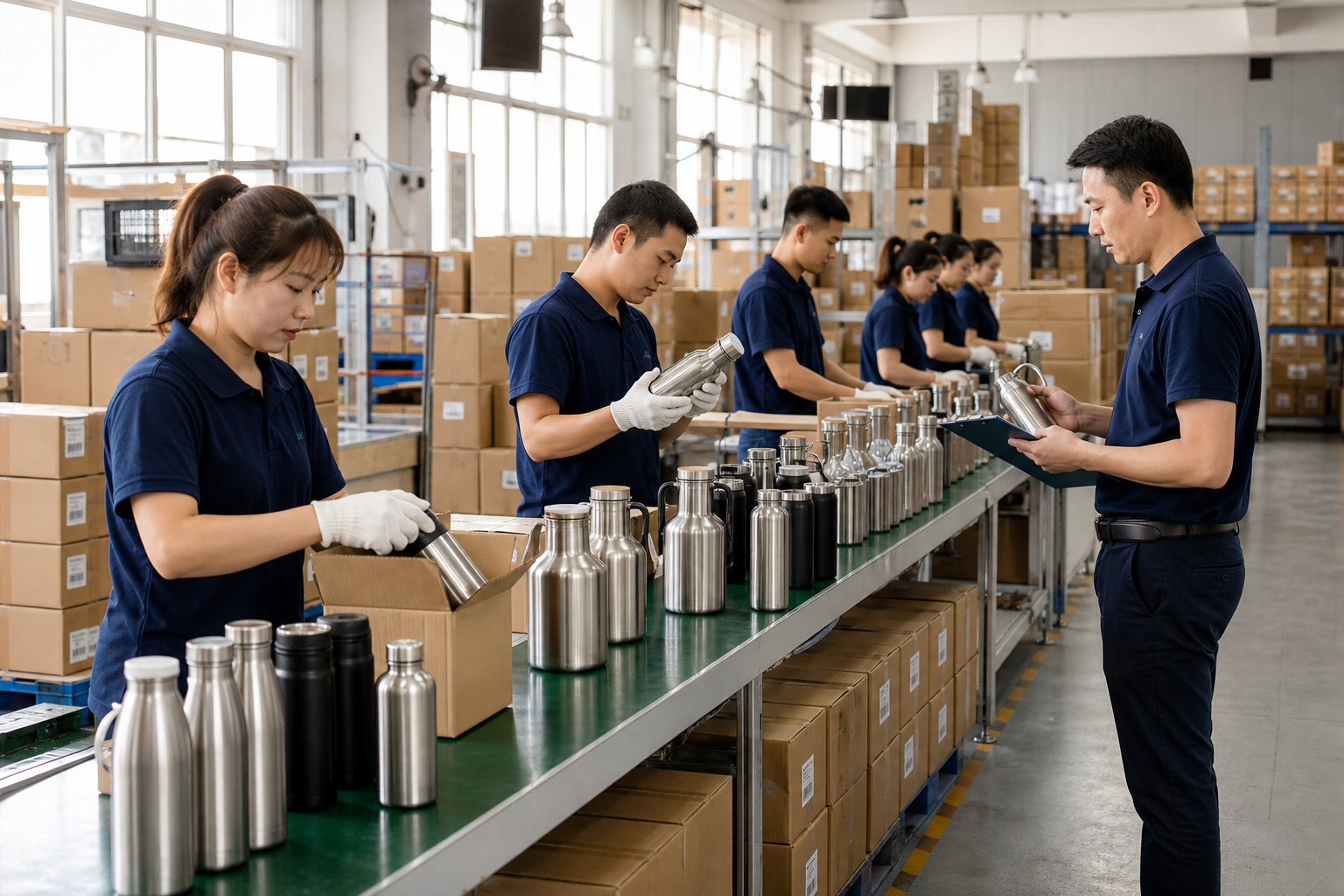
If you buy wholesale drinkware for retail, promotions, Amazon, or hospitality, price is only one line on the sheet. The bigger risk is ordering the wrong material, missing compliance paperwork, or tying up cash in a size and lid spec your market will not reorder. A solid supplier in Zhejiang should quote fast, show test data, and ship the same bottle on the 1st carton and the 500th.
At BottleForge in Hangzhou, Zhejiang, we see the same pattern every week. A buyer comes in asking for wholesale drinkware, then the PO says 500 pcs but the artwork file is 300 dpi, the lid thread is off by 0.5 mm, and the customer wants mixed SKUs. We run into this on the line all the time. The right answer depends on your channel, your margin, and how hard your customer pushes on durability and compliance.
Start with the right product family
Before you compare quotes, pick the product family first. A 500 ml stainless tumbler, a bulk canteen, a wholesale growler, and an alcohol flask wholesale bulk order do not price the same way. Mix them up in your head, and the quote review goes sideways fast. We had one buyer flag a PO typo where “canteen” was written as “container”; the line item got pulled back for recheck.
For retail-ready lines, buyers usually choose between:
- Wholesale drink bottle programs for gyms, schools, and promo channels
- Canteen wholesale lines for outdoor, military-style, and everyday carry use
- Beer growler wholesale or beer growler bulk for craft beverage and hospitality
- Alcohol flask in bulk for gift sets and seasonal promotions
If you want one hero SKU, choose the best wholesale drink bottle format your market already knows. If the buyer wants a giftable premium item, a beer tumbler bulk or alcohol flask bulk order fits better. We run these on the same line in Zhejiang, but the mold, lid, and finish still get checked one by one. Ask for material grade, wall thickness, and gross weight before you talk unit price. The math does not work if you compare a 0.4 mm stainless bottle with a 0.6 mm bottle and call them the same product. QC pulled the sample with a caliper at 0.02 mm resolution, and the hand feel was different immediately.
MOQ and pricing drive feasibility
Most buyers ask for the wholesale drinkware price first. Fair. The better question is whether the MOQ and landed cost fit your channel. At BottleForge, our standard MOQ for many stainless and aluminum items starts at 500 pcs per design, while custom printed SKUs usually run 1,000-3,000 pcs depending on decoration and packaging. On repeat orders, we ship from Hangzhou in 25-35 days after sample approval; QC pulled the sample from the 48-hour hold shelf before we release the line.
Typical ex-works pricing for a basic stainless steel tumbler sits around USD 2.10-4.80 per unit, while a heavier double-wall beer growler wholesale item can land at USD 5.80-12.50 depending on size, lid, and coating. An alcohol flask wholesale line is usually cheaper, often USD 1.20-3.60, but the math does not work until you add printing, polybag, carton, and freight. For Europe and North America, real landed cost often grows 18%-35% after ocean freight, duty, inland delivery, and prep work such as FNSKU labels or retail inserts; we had one buyer flag a PO because they forgot the 2 mm gift box insert, and the margin disappeared.
Procurement managers should ask suppliers to quote three versions: plain, one-color logo, full retail pack. That makes the money visible. A serious drinkware wholesale supplier will not hide setup fees. Screen printing might add USD 0.08-0.25, laser engraving USD 0.20-0.60, and gift packaging another USD 0.25-1.10. One PO typo on our side turned 3,000 pcs into 300 pcs on the draft, and the buyer caught it fast—good reminder that a clean breakdown matters more than a low headline price.
Materials decide performance and returns
Material choice is where buyers lose control and returns start. For bulk canteen or wholesale canteen products used every day, 304 stainless steel is the safe default. If the order is for cheap promo stock, 201 stainless can work, but you pay for it later in rust claims. We have seen that go sideways after 6 months. For a premium program, 316 stainless gives better corrosion resistance, but the price jump is real and the buyer needs a use case, like salty drinks or acidic juices.
For plastic lids, color is the wrong question to ask. We ask for a BPA-free declaration, food-contact compliance, and the exact resin grade before the line starts. On glass bottles, wall thickness and thermal shock matter more than the print color. For insulated items, we specify the inner and outer wall gauge. A practical range is 0.4-0.6 mm for stainless walls, with vacuum integrity tested at 100% on finished lots and sample leak checks during production. QC pulled the sample at 0.45 mm once, and the buyer flagged a 2 mm lid gap, so we corrected the mold before shipment.
Good buyers request:
- Material test reports for stainless and plastic parts
- Food-contact compliance for EU and U.S. markets
- Salt spray or corrosion test data where relevant
- Drop test expectations for retail and e-commerce packing
China has plenty of factories that can make one clean sample. Fewer can repeat it across 30,000 units. On our line, that is usually where the truth shows up. A 0.3 mm wall shift or a typo on the PO can turn into a claim. That is why Zhejiang sourcing works best when you lock the material, coating, and tolerances before the quote. The math does not work any other way.
Decoration changes cost and risk
Logo decoration is not a cosmetic detail; it changes lead time, reject rate, and return rate. On one beer tumbler wholesale bulk run, a 2 mm logo shift turned into 800 reprints because the buyer flagged it at packing. If you want beer growler wholesale bulk or beer tumbler wholesale bulk for retail, the decoration method has to match the surface and the price point. Screen printing is cheap and fast, but it wears once the customer bangs it on a bar counter. Laser engraving looks cleaner on stainless and holds up better, but the cost goes up. UV printing gives full-color options, yet it needs tighter process control and scratches easier on rough handling.
Use this rule: the more the item gets handled each day, the tougher the decoration should be. We run 304 stainless and powder-coated samples on the same line, and the mismatch shows up fast in QC. For a wholesale growler that sits in a bar or brewery, laser engraving or powder-coat plus engraved logo usually beats low-cost pad print. For an alcohol flask wholesale line sold as a gift, deboss, engraving, or a single-color print with premium carton packaging makes more sense. For beer growler in bulk orders, ask whether the finish is matte powder coat, polished stainless, or painted. That choice changes scratching, fingerprinting, and what the buyer thinks the product is worth.
Do not approve color from a phone screen. We have seen that go sideways on a 5,000-piece order. Ask for a physical Pantone target, a decorated pre-production sample, and a 3-point acceptance rule: logo placement tolerance, color deviation, and scratch standard. If your supplier in Zhejiang only says “beautiful printing” and never brings up cure time, adhesion, or abrasion testing, the math does not work.
Compliance is not optional
For wholesale drinkware sold into the EU or North America, the paperwork needs to be on file before shipment, not after a customs hold. We ask for REACH declarations, food-contact statements, and the test standard used. If the item is for children, CPSIA-related documents come up fast. For stainless steel and coated tumblers, the supplier should show the latest test date, not a stale certificate from 2022. We had one buyer flag a PO typo on the carton count, and the docs caught it before we loaded.
Inspection should be formal. Use AQL 2.5 for major defects and AQL 4.0 for minor cosmetic issues as the baseline, unless your channel calls for tighter control. If you are selling drinkware bulk into retail, ask for carton drop testing, barcode verification, and count accuracy. For Amazon FBA, the line has to match FNSKU labels, suffocation warnings, polybag thickness, and carton labels that match the warehouse appointment. That is the job. QC pulled the sample, measured the print height at 3 mm, and found one carton code too light to scan.
A supplier that can produce 50,000 units per month is useful only if their quality system holds the spec on the last carton, not just the first sample.
Factories in Zhejiang that ship export drinkware every week usually know this drill. Traders often do not. Still, check the documents yourself. Ask for photos of the actual production lot, the carton markings, and the inspection report before release. We’ve seen this go sideways on a 12-day vs 18-day shipping window because someone trusted a PDF and skipped the photos.
Choose the right channel packaging
Packaging can make or break your margin. A 30 oz tumbler shipped in a 48 mm sleeve is one thing; a 2-pack gift set for Amazon is another. We ship both. If the buyer wants direct-to-consumer, a scuffed carton means returns and bad reviews. If the buyer is going wholesale, overpacking kills pallet count and freight math.
For a standard unit carton, we run one inner bag, one divider or a molded tray if the shape needs it, and a master carton that passes a 1 m drop test. Typical master carton load is 12-24 pcs, depending on size and weight. QC pulled the sample last week and found a loose lid rattle on a 20 oz stainless cup, so we added a foam ring. For retail and e-commerce, check whether the SKU is ship-ready or needs barcode stickers, silica gel, or insert cards. Amazon is strict on carton limits, suffocation warnings, and oversize fees, and the buyer will flag it fast if the pack-out is sloppy.
Ask for cubic meter data, not just unit price. A cup that is USD 0.20 cheaper but uses 18% more carton space can wipe out the gain. We saw this go sideways on a PO with the wrong carton length typed as 38 cm instead of 48 cm, and the freight quote jumped. Good sourcing teams compare price per unit, price per carton, and price per sellable outcome. That is the real test for a canteen bulk order or a beer tumbler wholesale bulk order.
Build supplier control into the order
Your order should not run on trust alone. Put the critical points in the PO and the sample approval record. State the material, wall thickness, finish, decoration method, packaging, inspection standard, and tolerance. We had a buyer flag a PO typo on “0.8 mm” versus “0.08 mm” once, and that tiny slip would have wrecked the whole lot. If you buy wholesale canteen or wholesale growler items again and again, lock the approved sample and make it the master reference.
We run a simple control stack:
- Golden sample signed by both sides
- Pre-production sample for logo and color check
- In-line inspection at 20%-30% production
- Final AQL check before balance payment
If you source from China, especially a Zhejiang factory, ask who owns each step. Sales can say yes fast; the line has to execute. A factory making 100,000 units per month should still show how it tracks raw material, lot numbers, and packaging records. QC pulled the sample on one run and found a cap torque drift at 12 kgf·cm, which the buyer never saw in the showroom. For a bulk drinkware program, this is what keeps reorders clean. The math does not work if the lower quote turns into color drift, cap fit trouble, or print mismatch six months later.
Strong buyers do not just buy products. They buy process control, paperwork, and repeatability from the supplier.
Get a real wholesale quote, not a guess
Send your target price, market, and artwork. We will quote MOQ, lead time, and compliance details from our Zhejiang factory fast.
Frequently asked questions
What MOQ should I expect for wholesale drinkware?
For many stainless wholesale drinkware items, a realistic MOQ is 500-1,000 pcs per SKU for plain stock and 1,000-3,000 pcs for custom logo or custom color. A molded plastic part may need 3,000-5,000 pcs if a new mold is required. If a supplier offers 100 pcs on a custom build, check whether they are quoting from stock or hiding setup costs. In Zhejiang, serious export factories usually state MOQ clearly and separate sample cost, tooling, and production cost.
How do I compare wholesale drink bottle prices correctly?
Compare three numbers: ex-works unit price, decoration cost, and landed cost. A bottle at USD 2.40 with USD 0.35 printing and 28% freight/duty can cost more than a USD 2.75 bottle with better packaging and lower breakage. Ask for packing size, net weight, and carton count. That gives you the real price per sellable unit, not just the quote on paper.
What compliance documents should I ask for in Europe and North America?
At minimum, ask for food-contact declarations, REACH-related statements for the EU, and the test standard used for coatings and plastics. For kids’ lines, you may need additional child-product compliance. For Amazon or retail prep, ask for barcode, carton label, and packaging specs. Do not accept an old certificate without a test date. For export from China, the factory should provide documents linked to the exact SKU, not just a general company certificate.
Is a beer growler wholesale bulk order better than a tumbler program?
It depends on your channel. Beer growler wholesale bulk often gives you higher perceived value and stronger brewery or hospitality use, but it is heavier and more expensive to ship. A beer tumbler wholesale bulk line is usually easier to distribute and can sell across more channels. If your customer wants on-premise branding or refill use, growlers make sense. If they want broad retail turnover, tumblers are usually safer.
How long does production take in China for custom drinkware?
For repeat custom wholesale drinkware, a typical lead time is 25-35 days after sample approval and deposit. New molds or complex packaging can extend this to 45-60 days. If you need custom printing plus individual retail packaging, allow extra time for proofing and inspection. A Zhejiang factory with a 50,000-100,000 units per month capacity should still give you a firm schedule with milestone dates, not just a vague promise.