Key Takeaways
- A true 24 hour cold retention thermos depends on vacuum quality, not just stainless steel grade.
- Factory vacuum seal test data should show leak rate, temperature curve, and test ambient, usually 23°C ±2°C.
- A double wall vacuum bottle with poor neck weld can fail retention even if the insulation R-value looks acceptable on paper.
- For export programs, ask for AQL 2.5 sampling, REACH documentation, and a defined cold-fill test protocol.
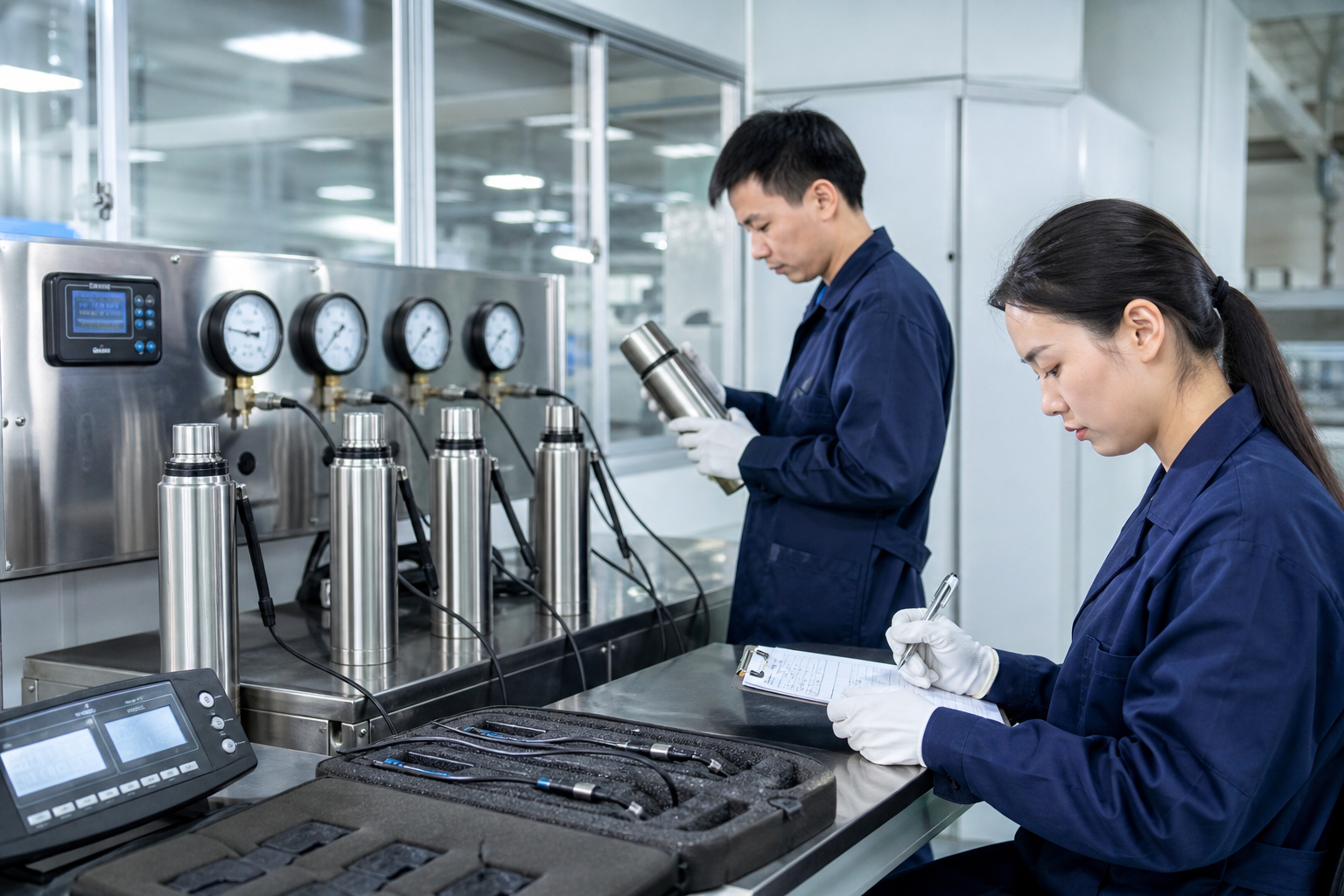
If you are buying or engineering a 24 hour cold retention thermos, the claim lives or dies on the vacuum inside it. A polished sample can look perfect and still drop temperature in 6 hours. In Zhejiang, serious drinkware factories do not guess on this. We run leak checks, track process data, and read the temperature curve.
“24 hours cold” is not one test. It is a stack of controls: stainless steel thickness, neck weld quality, evacuated interspace, stopper fit, and the ambient condition in the test room. At BottleForge in Hangzhou, we ship 120,000 units per month across vacuum bottle lines, and QC pulled the sample if the seam gap drifted past 0.2 mm. Buyers who avoid trouble ask for the test method first. That is the right question. If you know how the vacuum seal test works, you can spot a real double wall vacuum bottle fast, before a spec sheet with neat wording sends you the wrong way.
What 24-hour retention really means
When a buyer asks for a 24 hour cold retention thermos, the first thing we pin down is the test condition. Cold retention is not one fixed number. One line may test with 4°C water, 23°C room temperature, 1 cm headspace, lid torqued to spec. Another line may use 0°C water, a pre-chilled shell, and a probe sitting 8 mm deeper. Those results do not match.
For engineering work, define the claim before you define the bottle. We run the test this way:
- Fill medium: water, not ice slurry, unless the buyer asks for it
- Initial liquid temperature: 4°C or 0°C
- Ambient: 23°C to 25°C
- Measurement points: 0, 6, 12, and 24 hours
- Pass criterion: final temperature below a set limit, often 10°C to 15°C depending on the brief
That last number decides the result. A bottle can “retain cold” in sales copy and still reach 14°C after 24 hours. We had a buyer flag a PO once because the spec sheet said 15°C but the carton copy said 12°C; QC pulled the sample and the math did not work. For North American and European buyers, lock the method into the purchase order, especially if the claim goes on retail packaging. One clause saves a lot of back-and-forth.
How vacuum integrity is tested
The core of a vacuum bottle is the evacuated gap between the inner and outer walls. Once that gap loses vacuum, heat moves fast. That is why the vacuum seal test is the gatekeeper, not a shiny body check on the line. We run helium leak detection, hot water hold tests, and destructive sectioning on sample units; QC pulled one sample with a pinhole at the bottom plug last week, and the batch would have failed in the field.
In practical terms, the factory should verify three things:
- Leak tightness: the sealed cavity must hold vacuum with no measurable pressure loss over the set test window
- Process consistency: neck welds, bottom plugs, and laser weld seams need to stay within spec across 300 pcs or 3,000 pcs
- Retention output: the actual temperature drop after 6 hours and 24 hours must match the claim on the PO
Helium leak testing gives the cleanest read, but not every drinkware factory in China runs it on every SKU because the cost math does not work for low-margin orders. In Zhejiang, we usually see 100% air-leak screening on critical models and 3% to 5% performance sampling per lot. On a mature line, the reject target can sit below 0.5% for vacuum-related failures. That still sounds tight. We have seen a buyer flag a carton because the outer box said 12 hours while the spec sheet said 18 hours, and the product itself was fine. The real point is simple: once the vacuum is gone, no lid gasket saves the bottle.
Double wall vacuum physics
A double wall vacuum structure works because the air gap is pulled down to near zero pressure, so conduction and convection drop off fast. What stays in the game is radiation and the heat path through the neck, base, or weld points. We see this on the line: a bottle can have clean wall geometry and still miss spec if the weld ring is off by 0.2 mm.
Wall thickness is only one piece. On 18/8 stainless vacuum flasks, the inner and outer shells usually sit around 0.35 mm to 0.45 mm, depending on size and target cost. Thicker steel gives better dent resistance, but the math does not work if you assume thicker always means better cold hold. Too much material makes deep drawing harder, and QC will pull a sample that shows the vacuum seal drifting during the seal test.
Heat leaks through the small parts. The lid insert, stopper stem, handle attachment, and even a decorative base ring can give heat a shortcut. We had a buyer flag a PO because the neck opening was drawn 1 mm larger than the spec, and that one change hurt pouring and vacuum stability at the same time. This is the wrong question to ask if you only check wall thickness; the stopper polymer and neck geometry decide whether a bottle holds 24 hours of cold retention or just looks fine in a photo shoot.
Why insulation R-value is limited
Buyers often ask for the insulation R-value as if it were the whole answer. It is useful, but drinkware is not building insulation. The bottle has a curved shell, weld seams, a 28 mm neck, a lid gasket, and sometimes a straw channel, so the shell number never matches the finished cup on the line.
For product engineering, treat insulation R-value as an internal comparison number, not a consumer claim. We run it to compare material stacks, and QC pulled the sample at 23°C room temp before the cold test. The real check is cold retention in hours under fixed ambient conditions. If you are sourcing from China, ask whether the factory reports:
- Shell-only thermal data
- Finished-product retention data
- Lid assembly thermal loss
- Batch-to-batch variance
That variance matters. If one lot holds 24-hour performance at 8.5°C final temperature and the next lot lands at 11.8°C, the buyer flagged it for a reason; the math does not work the same way twice. A PO typo on one program changed the lid spec from 304 to 201, and we saw the retention curve slip on the second run. For private label programs in Europe, I want the conservative claim backed by repeatable data, not a hero sample that only one pilot batch can hit. This is where experienced Zhejiang factories separate engineering from sales talk.
Factory QC and acceptance limits
Good factories do not bet on one test bench. We run a chain from incoming coil to final audit. On a thermos line, the checkpoints are raw stainless certification, weld inspection, vacuum monitoring, leak checks, lid torque, and thermal sampling. At BottleForge, the usual MOQ for custom vacuum bottles is 3,000 units, with lead time 28 to 35 days after sample approval. QC pulled the sample, checked the seam, and the line had to stop once because the vacuum curve drifted 0.02 MPa. That is the kind of scale where process discipline beats promises.
A practical QC structure for export orders usually includes:
- IQC: check steel grade, surface finish, and gasket hardness
- IPQC: monitor forming, welding, and vacuum sealing parameters
- FQC: perform appearance checks and retention samples
- OQC: verify carton count, labels, and lot traceability
For audit language, many North American and European buyers ask for AQL 2.5 for major defects and 4.0 for minor defects on appearance. Fine. Retention performance is a different test, and this is the wrong question to ask if you treat it like print position. A bottle that is 1 mm off in logo placement is a nuisance. A bottle that misses cold retention by 5 hours becomes a claim. We have seen that go sideways when the PO said “24 h cold” and the test note said “22 h at 25°C.” Require lot traceability back to the vacuum sealing line, and keep one retained sample per lot for 12 months.
How to specify tests in your PO
If you want a defensible 24 hour cold retention thermos claim, put the test method in the purchase order. Do not write “factory standard.” That line causes disputes. State the liquid temperature, ambient temperature, fill ratio, closure state, pre-conditioning time, and pass threshold. If you sell on Amazon or through retail channels, match the claim to the packaging and compliance file from the first sample. We had one buyer flag a PO because the wording said “ice water” with no temperature. The math did not work.
A solid PO clause might require:
- Cold-fill water at 4°C ±1°C
- Ambient room at 23°C ±2°C
- Pre-chill bottle for 2 hours before filling
- Measurement at 0, 6, 12, and 24 hours
- Lot sampling with a minimum of 5 units per 1,000, or as otherwise agreed
Ask for the paper trail too. If the product uses powder coating, printing, or silicone parts, we need REACH compliance for Europe and material declarations for the lid and gasket. If you are shipping mixed cartons to a 3PL, get carton labels and FNSKU placement signed off before the line starts. QC pulled the sample on a 500 ml bottle last month and found a 1.2 mm gasket mismatch; that sort of thing is cheaper to catch at inspection than after loading. A good factory in Zhejiang will not fight this. We ship faster when the PO is tight, and we have seen this go sideways when buyers leave the details open.
Send your spec, get a real retention plan
We will map your claim, test method, and QC gates before production so your 24-hour cold retention thermos ships with defensible data.
Frequently asked questions
How does a factory verify 24-hour cold retention on a thermos?
A factory normally runs a controlled cold-fill test: water at 4°C ±1°C, room temperature at 23°C ±2°C, then measures at set intervals such as 0, 6, 12, and 24 hours. Serious lines also add leak testing and vacuum monitoring before thermal sampling. For export work, I prefer 5 samples per lot for thermal validation and AQL 2.5 for appearance. If the final temperature is below your agreed threshold, usually 10°C to 15°C depending on the brief, the claim is supportable. Without a defined method, “24-hour” is just a marketing phrase.
What causes a vacuum bottle to fail cold retention even if it looks fine?
Most failures come from hidden issues: a weak vacuum, a poor neck weld, a micro-leak at the bottom seam, or a lid system that creates too much thermal bridging. A bottle can look perfect on the outside and still lose performance fast. We have seen bottles that passed appearance inspection but failed after 8 to 10 hours because the evacuated gap was inconsistent. In China, good factories check both process data and finished retention because you cannot judge vacuum quality by eye. If the vacuum seal is compromised, no gasket can fix it.
Is insulation R-value useful for thermos sourcing?
Yes, but only as a supporting metric. R-value helps compare wall systems and material stacks, but it does not capture the full bottle geometry, lid losses, or weld bridges. For a thermos, the finished product’s actual cold retention is more important than a shell-only R-value. Ask the factory to show both internal comparative data and finished-product retention data. If they only offer a theoretical number, treat it as incomplete. In Zhejiang factories, the best engineers use R-value as a design tool, not a sales promise.
What MOQ and lead time should I expect for custom vacuum bottles?
For many custom thermos orders, a realistic MOQ is 3,000 units, sometimes 5,000 for heavily customized tooling or premium lids. Lead time is often 28 to 35 days after sample approval, plus shipping. If you need custom printing, special packaging, or a complex lid, add 7 to 10 days. A factory in Hangzhou or the wider Zhejiang cluster can move faster on repeat orders because tooling and process windows are already stabilized. Always confirm whether the lead time starts from deposit, artwork approval, or final sample sign-off.
What documents should I request for Europe or North America?
At minimum, ask for material declarations, REACH compliance for EU-bound goods, and if relevant, food-contact documentation for the inner vessel, lid, and gasket. For North American retail or marketplace programs, add carton labels, batch traceability, and if you use Amazon, correct FNSKU placement. If you are importing into a regulated channel, keep retained samples and a signed test report showing the retention method. A factory that exports regularly from China should be able to provide these without drama. If they cannot, you are taking avoidable risk.