Key Takeaways
- Recycled stainless steel is real and supported by mill certificates — but practical recycled content is usually capped at 30%.
- Tritan Renew is verifiably recycled-content Tritan from Eastman, with chain-of-custody documentation. Pay the premium.
- FSC bamboo lids are easy to source — but require FSC chain-of-custody certificates if your retailer is going to display the claim.
- "Eco-friendly" or "natural" claims with no certification are marketing, not sustainability. EU retailers will reject them under the new Green Claims Directive.
Sustainable drinkware is one of the fastest-growing B2B categories we ship — and it's also the category where buyers get burned most often. The problem isn't that sustainable claims are impossible; it's that "sustainable" has become a marketing word, not a measured one. A buyer who can't separate real claims from greenwash ends up either overpaying for symbolism or accidentally selling something a regulator can challenge.
Below is the honest breakdown of every major sustainable drinkware material we manufacture, with what's real, what needs documentation, and what to avoid.
Recycled stainless steel
The cleanest sustainability story in drinkware. Stainless steel is infinitely recyclable, and most steel mills already incorporate scrap stainless into new sheet production. The question is just how much.
What's real:
- Our standard 304 sheet contains 20–30% post-consumer recycled content as a baseline, with mill certificates available.
- Higher recycled content (up to 60%) is available from specific mills at a 8–15% material premium.
- The bottle remains 100% recyclable at end of life — a defensible claim with no additional cost.
What needs documentation:
- Mill test certificate (MTC) showing recycled content percentage, by batch.
- For higher claims (40%+), independent third-party verification (typically SGS or TÜV).
What to avoid:
- "100% recycled" claims. This is technically impossible at scale; mills always need some virgin material for quality consistency.
- Suppliers who can't tell you which mill the steel comes from.
Tritan Renew (recycled-content plastic)
If you're selling plastic drinkware, this is where to put your sustainability budget. Tritan Renew is the recycled-content version of Tritan, made by Eastman Chemical, using "molecular recycling" to convert waste plastic back into food-grade polymer.
What's real:
- Eastman provides chain-of-custody documentation tracing recycled content back to specific waste streams.
- Available in 50% and 100% recycled-content grades.
- Mechanically identical to virgin Tritan — same clarity, same impact resistance, same FDA/LFGB compliance.
- Material premium: ~15–25% over virgin Tritan.
This is the rare case where the premium is worth paying, because the documentation is bulletproof and major retailers (Target, REI, John Lewis) accept it as evidence without additional verification.
Borosilicate glass
Glass is the underrated sustainability winner. It's infinitely recyclable, chemically inert (no leaching, ever), and the manufacturing energy footprint is comparable to virgin plastic.
What's real:
- Glass bottles can be made with 30–80% recycled cullet (broken glass) input.
- Inert: no microplastic shedding, no flavor carry-over, no end-of-life chemical residue.
- The "100% recyclable" claim is unambiguous and accurate.
What to consider:
- Heavier than steel or plastic — adds 25–40% to your shipping carbon footprint vs. steel.
- Breakage rate during transit is higher; design packaging accordingly.
FSC-certified bamboo lids
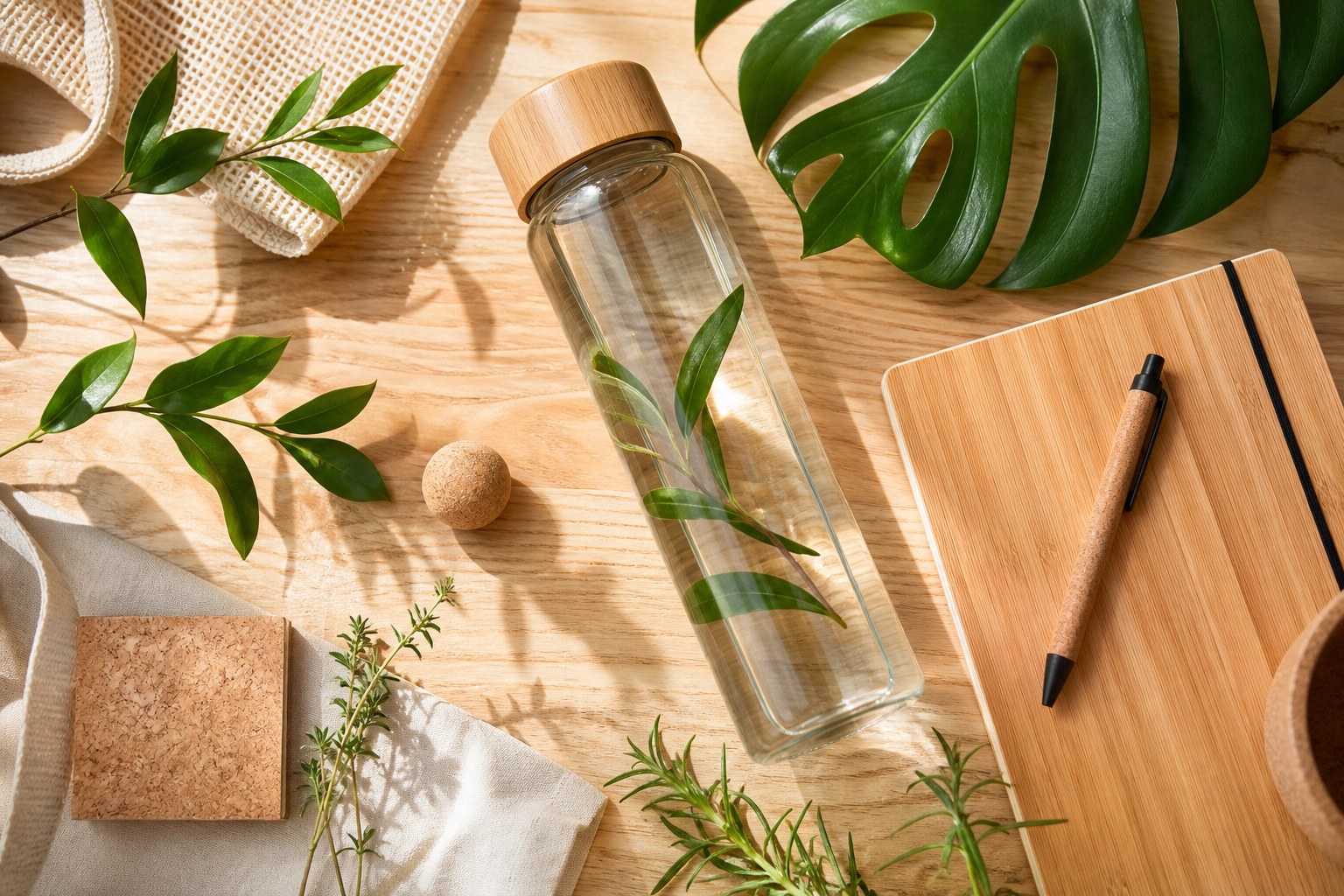
The bamboo lid has become the visual shorthand for "this bottle is sustainable." It's a strong choice — but the claim only holds if the bamboo is FSC-certified.
What's real:
- FSC-certified bamboo from approved Asian sources costs 30–50% more than uncertified bamboo.
- You get a chain-of-custody certificate that's accepted by every major retailer.
- Allows you to display the FSC logo on packaging — a significant trust signal.
What to avoid:
- "Sustainable bamboo" with no FSC certificate. Bamboo is often grown by clearing native forest. Uncertified bamboo can be worse than plastic in lifecycle terms.
- Suppliers who "lose" the FSC paperwork between sample and bulk.
Silicone, cork, and other accents
The smaller components — silicone sleeves, cork wraps, plant-based bottle finishes — usually account for less than 10% of the bottle by weight. The sustainability impact is real but limited.
Where they matter:
- Cork sleeves: Renewable, biodegradable, and visually distinctive. Sourced primarily from Portugal. ~$0.40–0.80 added per bottle.
- Recycled silicone: Available in 30% post-industrial recycled content. Premium is minimal (~5%).
- Plant-based PLA accents: Marketed as biodegradable. In practice, only compostable in industrial facilities, not home compost or landfills. Be careful with the marketing claim.
Packaging — where you can win or lose the eco story
The bottle is often less impactful than the packaging it ships in. We've seen sustainability-positioned bottles ship in plastic-clamshell + PE-foam packaging — undermining the entire story.
What works:
- Kraft cardboard outer (FSC-certified)
- Molded pulp inserts instead of foam
- Paper tape instead of plastic
- Recycled tissue paper
- No individual polybag — or biodegradable starch-based polybag if required
Total cost premium: usually $0.40–$0.90 per unit, less than most buyers expect.
The EU Green Claims Directive — read it
As of 2026, the EU's Green Claims Directive requires that any environmental claim on a product be substantiated with evidence before it can be displayed. Vague terms like "eco-friendly," "natural," "green," or "carbon-neutral" without independent verification are no longer allowed in EU markets.
"If you cannot point to a specific certificate, lab test, or third-party verification, you cannot make the claim. The fine for getting it wrong in the EU is up to 4% of annual turnover."
The practical implication for B2B buyers: budget for certification documentation alongside the material premium. The cost of an SGS report on recycled content is usually $400–$800. Trivial compared to a regulatory enforcement action.
Working on a sustainable launch?
We'll quote with chain-of-custody documentation included. No claim without paperwork.
Frequently asked questions
What does "recycled stainless steel water bottle" actually mean?
It refers to a stainless bottle whose sheet stock contains a verified percentage of recycled scrap steel — usually 20–30% post-consumer baseline, with up to 60% available at a 8–15% material premium. Always ask for the mill test certificate that proves the recycled content.
Is Tritan Renew really recycled plastic?
Yes. Tritan Renew is Eastman Chemical's recycled-content version of Tritan, made via molecular recycling. Eastman provides chain-of-custody documentation tracing the recycled feedstock back to specific waste streams. It is mechanically identical to virgin Tritan and FDA/LFGB compliant.
What is the most genuinely sustainable drinkware material?
Borosilicate glass is the strongest end-to-end sustainability case — fully and infinitely recyclable, chemically inert, and produced with lower energy than expected. The trade-off is weight (25–40% higher shipping carbon footprint) and breakage rate.
Do I need FSC certification for bamboo lids?
If you plan to display a sustainability claim on the packaging or use it in marketing, yes. The FSC chain-of-custody certificate is the only documentation accepted by major Western retailers and is required under the EU's Green Claims Directive.
What sustainability claims will the EU Green Claims Directive block?
Vague claims like 'eco-friendly', 'natural', 'green', 'environmentally friendly', or 'carbon-neutral' that lack independent third-party verification. Fines for non-compliance can reach 4% of annual turnover in EU markets. Always pair a claim with a specific certificate or test report.