Key Takeaways
- A practical alcohol flask bulk MOQ is usually 500-1,000 pcs per SKU, with lead times around 20-35 days after sample approval.
- 304 stainless steel is the safe default for wholesale drinkware; 201 can save 8-15% but raises corrosion risk and weakens your brand story.
- Laser engraving is cleaner for premium flasks; silkscreen is cheaper by about USD 0.08-0.25 per piece for simple one-color art.
- Ask for AQL 2.5 for critical defects, REACH-compliant ink/coatings, and carton-drop testing before you confirm a PO.
If you are buying alcohol flask bulk for retail, promotions, or private label, the hard part is not finding a supplier. The hard part is telling a real factory quote from a polished but thin one. One 0.3 mm wall and one 0.5 mm wall can change landed cost by 12-25%, and we have seen the complaint rate jump faster than that. QC pulled the sample, weighed it, and the buyer flagged the finish before we even sent the second carton photo.
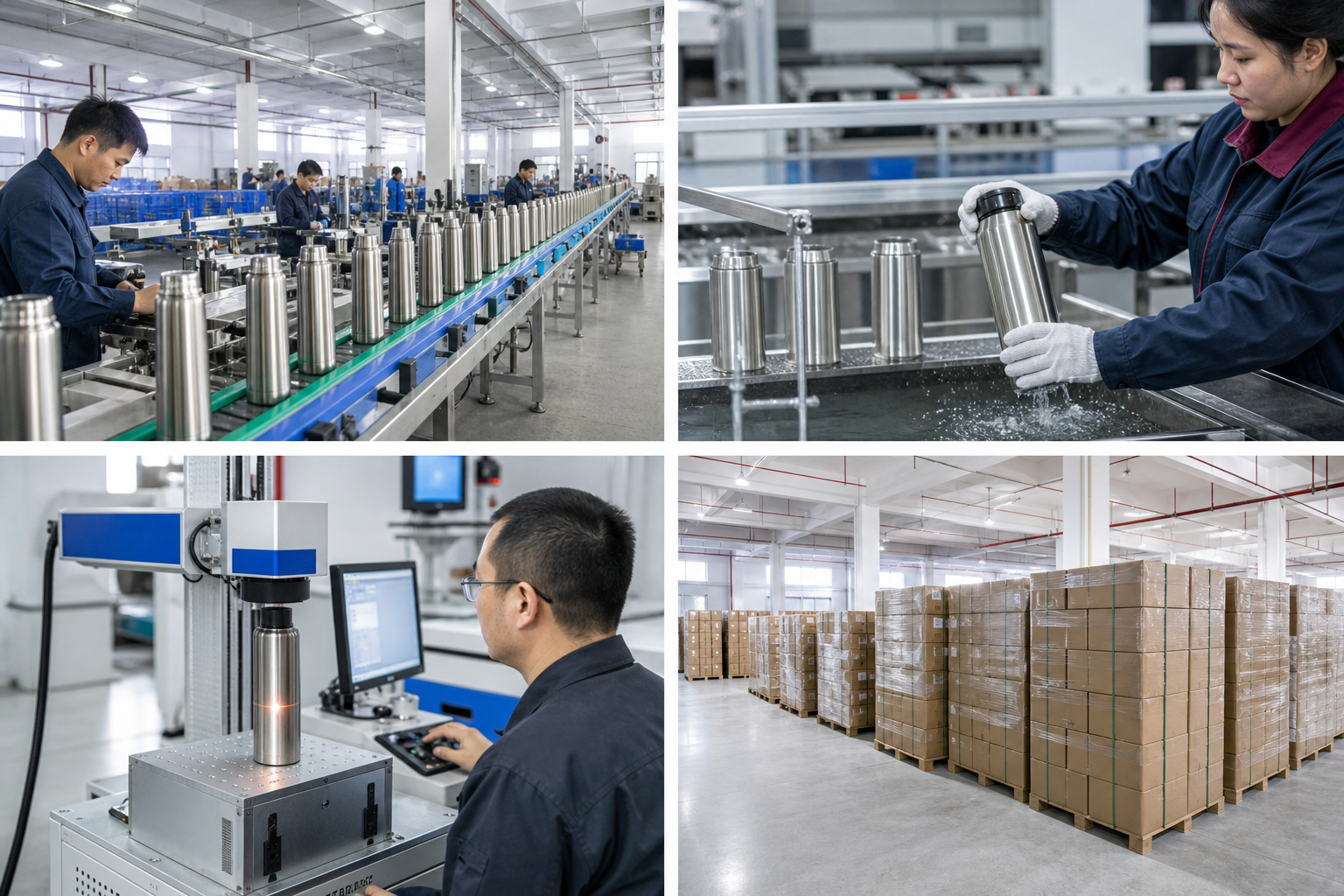
We build drinkware in Zhejiang, China, and the same pattern shows up every season: buyers want a quote in 24 hours, a low MOQ, and flasks that pass REACH, food-contact checks, and survive carton drop tests without a dent. That is doable, but only when the flask style, finish, capacity, and decoration method are written clearly. For alcohol flask wholesale bulk orders, the headline price is the wrong question to ask. The PO typo that causes trouble is usually small — 8 oz turned into 80 oz, or brushed stainless swapped for mirror polish — and the line has to stop to fix it.
What buyers mean by bulk
When buyers ask for alcohol flask bulk, they are rarely buying one plain item. They are buying capacity, shape, steel grade, closure, packaging, and print. A 6 oz gift flask is not the same as an 8 oz retail flask for outdoor sales, and both sit far from a beer tumbler bulk order. Pick the job first: pocket flask, slim canteen style, or a wider body that drops into a gift box without extra foam.
In China, especially in Zhejiang, factories file these under drinkware wholesale and metal gift items. That sounds tidy until you ask for tighter tolerances. For a real alcohol flask wholesale program, we run capacity at ±5%, steel thickness at 0.4-0.6 mm, and cap retention if the bottle has an attached cap. Last month QC pulled the sample because the lid swing broke at 18 cycles, not 30. If you are also buying wholesale canteen or bulk canteen styles, do not let the supplier mix hiking canteen tooling with hip-flask tooling. The shape changes the logo panel and the carton size, and freight follows that change.
- Typical flask sizes: 4 oz, 6 oz, 8 oz, 12 oz
- Common wall thickness: 0.4 mm, 0.5 mm, 0.6 mm
- MOQ range: 500-1,000 pcs per SKU
- Factory output in a mid-size Zhejiang plant: 80,000-150,000 units/month
Choose steel before you chase price
The lowest quote usually starts with the wrong steel. For a premium flask or alcohol flask in bulk, 304 stainless steel is the clean choice because it holds up against odor retention and corrosion better than 201. We checked a 0.5 mm sample on the line last month: the 201 piece picked up a faint smell after 72 hours with spirits, while 304 stayed neutral. If the order is for a promo give-away and every cent counts, 201 can cut unit cost by about 8-15%, but that math only works when the flask sees dry storage and short use.
For buyers comparing drinkware bulk, wholesale drinkware, and bulk drinkware across several SKUs, one steel choice can keep the program straight. Run 304 for the flask body, then use 201 only on parts that never touch liquid. If the factory says “18/8” or “18/10,” ask for a mill certificate, not a sales promise. QC pulled the sample, checked the coil tag, and found one PO typo where the buyer wrote 301 by mistake. We see that sort of mix-up often in Zhejiang. The buyer flags price first, then asks for compliance. That order does not work.
What to ask for on the spec sheet
- Material grade: 304 or 201, with mill cert
- Surface finish: brushed, matte, mirror, powder coat
- Thickness: 0.4-0.6 mm, stated at body and cap
- Food-contact compliance: REACH, LFGB if needed, and BPA-free if plastic parts are included
If you are also sourcing a bulk growler or wholesale growler in the same order, keep the material calls separate. A growler needs tighter seal work and pressure control than a flask, and we’ve seen buyers try to force one spec across both. That goes sideways fast. Ask for the lid gasket size, too—one missed 2 mm gasket change can turn a good sample into a leak claim.
Decoration changes your unit economics
Most buyers stare at bottle cost and miss the decoration line. That is where the margin slips. For alcohol flask wholesale bulk, we run laser engraving, silkscreen, pad print, and, if the tooling is set, embossing or debossing. Laser gives a cleaner retail look and works best for small logos, short text, and gift sets. Silkscreen is cheaper on flat one-color artwork, but after a few rounds in packing and transit, the print can scuff.
For a 1-color logo on a 6 oz flask, laser engraving usually lands at USD 0.20-0.60 per piece, depending on logo size and line count. Silkscreen is usually USD 0.08-0.25 per piece. That gap is real at 10,000 units. We had a buyer flag a PO typo once—same artwork, different carton spec—and the quote jumped because the packaging line was not separated. The same math applies to beer growler wholesale bulk or beer tumbler wholesale bulk; decoration is part of COGS, not a side note.
Ask the supplier to quote bottle, decoration, and packaging as three separate lines. If they send one blended number, you lose the room to compare, push back, and spot where the money is going.
For higher-end channels, laser plus an individual kraft box often beats a cheap printed carton. The buyer sees a stronger shelf impression. We hold logo placement tighter when you send vector artwork and Pantone references before sampling; on our line, QC pulled a sample with a 1.5 mm shift and we fixed the fixture before mass run. This is the wrong question to ask if you only chase the lowest print price.
MOQ, lead time, and price structure
For a factory order, the numbers need to be plain. A normal alcohol flask wholesale MOQ is 500-1,000 pcs per design, and we usually quote 20-35 days after sample approval. Custom packaging adds 5-10 days. Mixed colors, laser positions, or gift sets can slow the line by another 7 days. We had a buyer ask for 200 pcs, FOB China, and full-color packaging; that is reseller math, not factory math.
At current market levels, a simple 6 oz 304 flask in plain finish sits around USD 1.10-1.80 FOB, depending on quantity. Laser engraving moves it to USD 1.30-2.30. A gift box with a color insert can push it to USD 1.80-3.20. For beer growler bulk or beer growler wholesale orders, the price climbs because the body is larger and the closure weighs more; a 64 oz unit uses more stainless, and the cap assembly is not cheap. Split the quote by tooling, sample, decoration, and packaging, or the buyer will flag the PO later.
- MOQ: 500-1,000 pcs per SKU
- Sample lead time: 5-10 days
- Mass production: 20-35 days
- FOB pricing should be split by bottle, decoration, and carton
In Zhejiang and across China, good factories can scale fast, but only if the spec is frozen before the PO goes in. QC pulled the sample on a 0.2 mm lid gap before bulk start. One late logo tweak or carton typo adds cost and can turn a 20-day job into 27 days. We have seen that go sideways more than once.
Compliance and test reports matter
If you ship into Europe or North America, compliance is not optional. A flask can look clean in photos and still fail market-entry checks if the coating, ink, or cap material is off. For wholesale drinkware, ask for REACH papers for coatings and inks, food-contact declarations for every wetted part, and, if there is a plastic insert, the resin code and BPA-free proof. We had one buyer flag a cap gasket typo on the PO and the whole file stalled for 12 days. If the factory cannot lay out the material stack in plain terms, move on.
Put AQL terms into the PO. We usually see AQL 2.5 for critical and major defects, and 4.0 for minor defects, and that is the right baseline. Critical defects are leakage, sharp edges, bad odor, and loose caps. Major defects are wrong logo position, dents, finish marks, and carton mix-ups. On one line, QC pulled the sample and found a 0.8 mm lid gap that would have leaked in transit. If you want a tighter plan, require pre-shipment inspection with leak tests, 76 cm drop tests, and carton compression checks. That is normal work for a serious factory in Zhejiang, China.
For wholesale canteen or canteen wholesale products, ask for seam consistency and cap seal tests too. A 0.3 mm seam swing can turn into a return claim fast. Different products fail in different ways, and the supplier should know that without hand-holding. We have seen this go sideways when a buyer asked the wrong question and only checked the logo print. The math does not work.
How to buy the right factory way
The fastest way to burn a sourcing trip is asking for “best wholesale drink bottle” or “best wholesale drinkware” with no use case attached. Buy by channel. A retail flask for an outdoor store needs cleaner polishing, tighter neck tolerance, and better carton inserts than a promo flask for a conference giveaway. We’ve had buyers send the same PO to three channels, then wonder why the math breaks. For a North American private-label buyer, Amazon-ready packaging and barcode placement usually matter; for a European importer, REACH paperwork and carton load efficiency come first.
If your catalog includes beer tumbler in bulk, beer tumbler wholesale, beer tumbler bulk, or beer tumbler wholesale bulk, do not let the supplier dump it into one generic drinkware folder. Ask for family photos, tooling ownership, and sample shots from the exact line that will run your order. We run one line at 120,000 units/month and still see bad results when a SKU gets treated like spare work. QC pulled the sample once and found a 0.8 mm wall variance; the buyer flagged it fast, and that order never left rework.
Use this sourcing sequence
- Confirm product type, capacity, and target customer
- Request material spec, thickness, and finish options
- Ask for FOB price at 1,000 / 5,000 / 10,000 pcs
- Review sample, packaging, and compliance documents
- Lock artwork before production
- Set AQL and inspection rules before deposit
That sequence works whether you are buying canteen bulk, wholesale growler, or alcohol flask wholesale bulk. It keeps the supplier honest and makes landed cost easier to track. One typo on a PO, like 5000 pcs printed as 500 pcs, can stall the line for a day. Set the rules before you pay.
Request a factory quote with real specs
Send your capacity, finish, logo file, and target market. We’ll quote alcohol flask bulk with clear MOQ, lead time, and compliant options from Zhejiang, China.
Frequently asked questions
What is a normal MOQ for alcohol flask bulk orders?
For a standard stainless flask, a normal MOQ is 500-1,000 pcs per SKU. If you want custom color, special packaging, or mixed decorations, the MOQ may move to 2,000 pcs. Small sample orders of 50-100 pcs are possible, but the unit price is usually 30-60% higher because setup costs do not disappear. For Zhejiang factories, a clear MOQ also helps scheduling. If a supplier offers 100 pcs with a custom logo and full packaging at factory pricing, check whether they are a trader or a real producer.
Is 304 stainless steel worth the higher price?
Yes, for most alcohol flask wholesale programs it is worth it. 304 typically costs about 8-15% more than 201, but it gives you better corrosion resistance, better odor performance, and a cleaner compliance story. If your customers are in humid climates, use it. For premium retail, 304 is the right default. If the flask is a very low-cost promotional item with short use life, 201 can work, but you should price in the risk of staining and weaker perceived quality.
What decoration method should I choose for a branded flask?
For most private-label work, laser engraving is the safest choice. It looks cleaner, holds up well, and works on brushed, matte, and polished surfaces. Silkscreen is cheaper, often by USD 0.08-0.25 per piece, but it is best for simple one-color logos and lower-abuse channels. If your order is for gift sets or premium retail, laser plus a custom box is usually better than a cheap print. Always ask for artwork proof and placement tolerance before approval.
How do I check if a supplier is a real factory in China?
Ask for the business license, factory address, production photos, and a recent audit report such as BSCI or ISO 9001 if available. Then ask for product-line photos, monthly output, and whether they own the tooling. A real factory in Zhejiang should be able to explain capacity, QC steps, and lead time without changing the story every email. If they cannot separate bottle cost from decoration and packaging, they are probably not the right source for serious bulk drinkware programs.
What inspection standard should I use before shipment?
Use AQL 2.5 for critical and major defects as a practical baseline. Critical defects include leakage, sharp edges, odor, and unsafe closure issues. Major defects include dents, wrong logos, bad print, and finish problems. For a flask order, also require leak testing, cap torque checks, and a carton-drop test from 76 cm. If you are shipping to Amazon, add barcode and carton label verification so the goods do not get rejected at intake.