Key Takeaways
- A realistic wholesale thermos MOQ is often 1,000 units per color, with sampling in 7-10 days and mass production in 25-35 days.
- 304 stainless is standard; 316 costs more but makes sense for higher-end custom thermos programs and acidic beverages.
- For promo orders, FOB China pricing for a 500 ml stainless thermos can start around USD 2.80-5.50 depending on structure and decoration.
- Ask for AQL 2.5 inspection, REACH documentation, and lid leak testing before you approve a supplier thermos order.
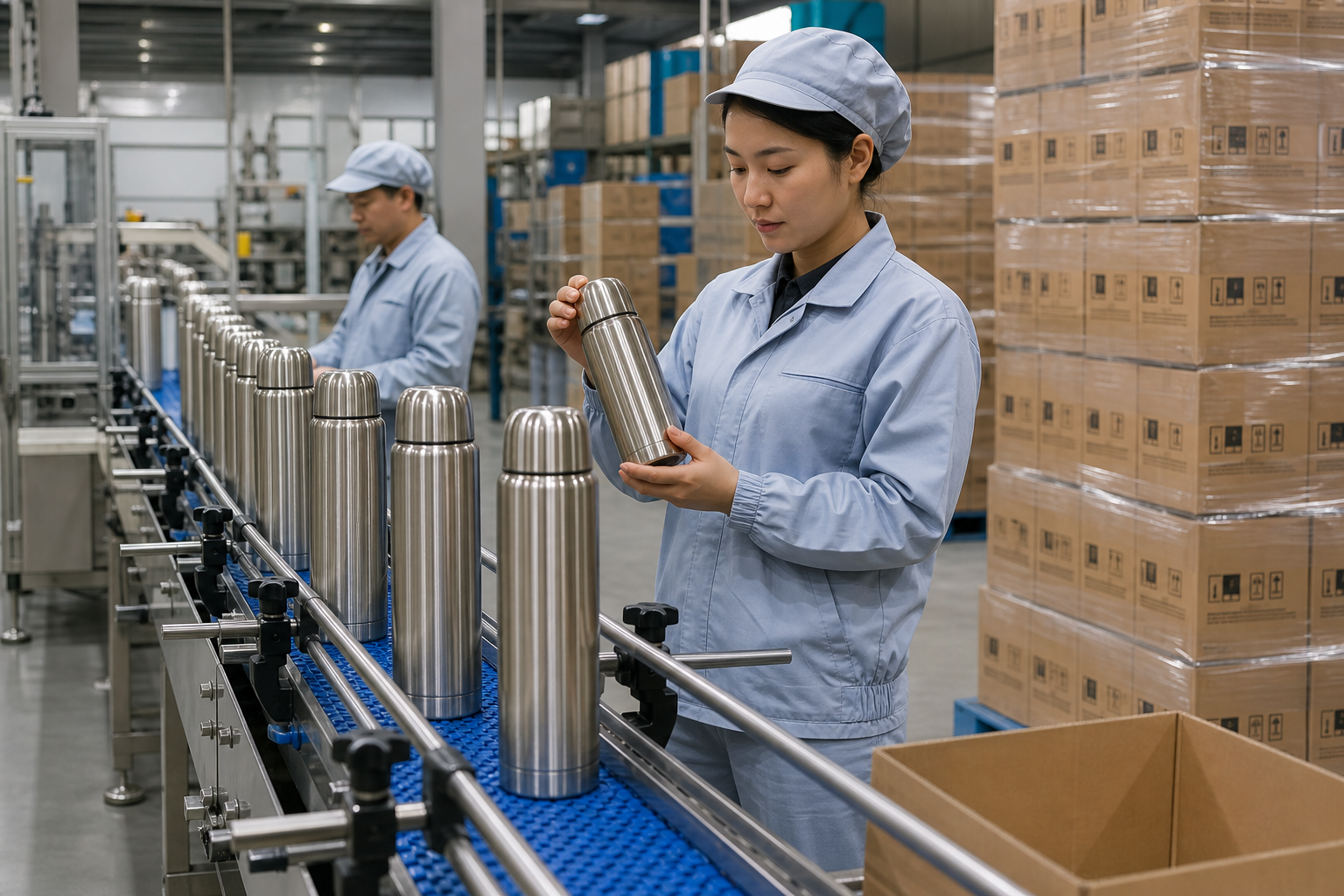
If you are buying wholesale thermos for outdoor retail or a promo program, the real question is not “can a factory make it?” We run this line in Zhejiang every day. The real question is whether the bottle survives repeated use, ships on time, and still leaves margin after freight, duty, and decoration. On a 5,000-piece order, a 2 mm dent on the carton or a missed laser logo can eat the profit fast.
In China, especially Zhejiang, you will see a lot of stainless steel vacuum flasks that look the same on the shelf. They are not the same. The gap is in the details: 304 versus 316 inner walls, 0.4 mm versus 0.5 mm stainless gauge, a 12-hour or 24-hour thermal claim, and whether the supplier can hold AQL 2.5 on a 30,000-unit run. QC pulled the sample at 95°C water fill and one cap leaked after 8 hours; the buyer flagged it, and that is the kind of miss that turns a cheap PO into a headache. If you buy bulk thermos products without checking those numbers, the math does not work.
What wholesale thermos buyers really need
Outdoor retailers and promotional brands do not buy a vacuum flask the same way a consumer does. You are not chasing one shelf SKU; you are managing wholesale thermos stock, fill rate, print repeatability, and landed cost. We run that job against actual use. A camper wants heat retention and a lid that does not drip in a backpack. A brand buyer wants a clean logo, stable color match, and a bottle that still looks right after 50,000 units. We have seen a 1 mm logo shift turn into a chargeback.
For most programs, the base spec is a double-wall stainless steel body, 304 inner and outer shell, vacuum between walls, and a leakproof lid with silicone gasket. If you want a premium customized thermos, move to 316 inner steel or add a copper-coated vacuum layer for better performance. A 500 ml unit usually holds heat for 12-24 hours, depending on wall design and lid construction. QC pulled the sample on the torque wrench, and the lid held at 0.8 N·m. In Zhejiang, many factories quote the same shell, but the lid system is what separates a usable factory thermos from an expensive return.
Do not ignore packaging. A promo box can add USD 0.18-0.45 per unit, and a retail-ready mailer may add another 8-12% to your cost. We checked a carton compression test at 1.0 m drop and 12 kg stack load before one shipment cleared. If you are selling through outdoor retail, ask for those numbers, not a sales deck. If you are a thermos distributor, ask whether the supplier can hold mixed-SKU assembly without mixing labels or lids. We had one PO with a typo on the carton mark, and the whole line had to stop. That is where a real thermos manufacturer earns the order.
Materials and build details that matter
Stainless steel looks simple until you put the spec sheet on the bench and read it line by line. For a standard bulk thermos, 304 stainless is the baseline we run. It is food-safe, holds up against corrosion, and covers coffee, tea, and water without drama. 316 stainless gives better resistance to chloride corrosion and harsh drinks, but the premium is real. In China, the metal cost gap is often 12-25%, and the final quote moves for more than the steel. We had a buyer flag a PO typo once—304 written on the body, 316 on the inner cup—and the line stopped until they clarified it.
Check wall thickness, because this is where cheap offers start to wobble. Most export models sit at 0.4 mm to 0.5 mm stainless. Drop below 0.35 mm and you get a lighter bottle, but dent resistance falls off fast in carton-to-carton handling. A good manufacturer thermos spec sheet should list:
- Inner wall: 304 or 316 stainless steel
- Outer wall: 201 or 304 stainless steel, depending on target price
- Vacuum layer: fully sealed with no visible weld leaks
- Lid: PP, Tritan, or stainless cap with silicone sealing ring
- Finish: powder coat, matte paint, or brushed steel
If the bottle is for outdoor use, powder coating is the better commercial finish. It hides fingerprints and gives better grip in cold weather. A promotional thermos with a glossy painted body may look sharp on the sample table, then scratches up after one week in distribution. Ask your thermos supplier for salt spray resistance data if the market is coastal or gets winter road salt. If they cannot explain the test method, they are selling appearance, not performance. We saw this go sideways with a 10,000-piece order where the coating started marking at 48 hours in the salt cabinet.
For China sourcing, ask for material certificates tied to your PO, not a generic brochure that gets recycled for every buyer. A serious Zhejiang thermos factory should provide traceable batch data for the steel coil, lid resin, and gasket material. That is normal export discipline, not a favor. QC pulled the sample, checked the gasket hardness at 70 Shore A, and matched it to the lot file before we ship. If a factory cannot do that, the math does not work for a wholesale order.
Pricing, MOQ, and lead time
Buyers ask for price first. Fair. But a price with no build sheet is noise. A 500 ml stainless wholesale thermos with a basic laser logo, 304 inner wall, and kraft box usually sits around USD 2.80-3.80 FOB China at 1,000-3,000 units. Add powder coating, 316 interior, a color box, or a custom lid, and you move to USD 4.50-7.20 fast. That is normal. The material list changes the math. On our line, even a 0.3 mm wall change or a better gasket shifts cost.
MOQ follows decoration and color, not wishful thinking. For a stock body with logo, many Zhejiang factories take 1,000 units per design. For a fully custom thermos mold, MOQ often goes to 3,000-5,000 units, especially if the buyer wants a unique lid or shaped body. Sampling usually takes 7-10 days; we run the first sample through a torque test and hot-water hold check before it leaves QC. Mass production is usually 25-35 days after sample approval and deposit. If the thermos manufacturer says 12 days for a custom molded program, ask which step got skipped. We've seen that story go sideways.
“Fast” is not the same as “controlled.” A clean 30-day lead time with QC checkpoints beats a rushed 15-day promise every time.
When you compare thermos suppliers, look at landed cost, not just FOB. A carton that saves USD 0.10 at origin can cost you more in damage claims, especially for Amazon FBA or warehouse fulfillment. The buyer flagged a typo on a PO last month, and that same order would have failed if the outer carton spec was loose by 2 mm. For distributors, a middle-weight bottle that survives transit is usually the better call. For brands, paying a little more FOB can make sense if it cuts the return rate by 1.5-2.0%.
Decoration options for brand programs
Logo decoration is where a lot of customizable thermos programs go wrong. If you want a premium look, do not pick the cheapest print method by default. Match the decoration to how the bottle will be used and how often the buyer will reorder. Laser engraving gives a permanent mark and works well on brushed stainless or matte coated bodies. Screen printing suits larger logos and solid colors, but it can wear if the bottle gets knocked around. Heat transfer handles more complex art, though the line needs tighter control, and we have seen a 0.3 mm misregister turn a clean logo into scrap.
For a thermos custom order, start with logo size, Pantone color, and decoration area. A safe logo width is 35-50 mm on a 500 ml bottle, depending on the curve. Push beyond that and the distortion shows up fast on a round body. Ask the factory for a wrapped artwork proof, not just a flat PDF. One buyer sent a PO with the logo position typed as “left center,” and QC pulled the sample because the cap color and print panel did not line up. In China, plenty of factories can print; fewer can keep print, bottle shape, and cap color aligned across a 10,000-unit run.
If your program is promotional, choose a decoration that still reads after 6 months of use. A thermos promotional item is a moving ad, and if the logo flakes off, the brand looks sloppy. For outdoor retail, a blind deboss or laser mark often sells better than a loud multi-color print. That is the better call for premium buyers who want a more understated customized thermos than a giveaway bottle. On one line, we tested a 50 mm laser mark on 304 stainless and it passed a 48-hour rub check; the buyer flagged the screen print sample because the edges broke up after hand washing.
Decoration questions to ask
- How many logo positions are available?
- What is the maximum print area without distortion?
- Will the decoration survive dishwasher cycles?
- Can you hold Pantone color within Delta E 2.0?
If the answer to any of those is vague, the supplier is guessing. A real thermos supplier or thermos vendor should show sample photos from previous export programs, even if they hide the customer name. We run into this every season: a factory says “no problem,” then the first sample comes back with a 1.5 mm offset and the buyer pushes the whole order back. Ask for the actual test piece, not a sales promise.
Quality control and compliance checks
For North America and Europe, compliance is not optional. Your wholesale thermos order needs REACH paperwork for coatings and contact materials, plus food-contact declarations for the lid, gasket, and inner wall. If you sell into the U.S., ask for FDA food-contact statements where they apply. If the bottle carries insulated performance claims, ask how the factory tested them. A real test sheet should list start temperature, ambient temperature, fill volume, and elapsed time. We’ve seen buyers skip that check and then the claim falls apart at customs or on the shelf.
At the factory level, we run a simple QC stack: pre-production sample, in-line inspection, and final random inspection at AQL 2.5 for major defects and 4.0 for minor defects. Leak testing should cover a statistically meaningful sample, not three pieces on a desk. Drop testing from 1.0 m and torque testing on lids are the floor, not the bonus round. If your order is 20,000 units or more, ask for a packaging drop test with master cartons stacked 5 high. The buyer flagged a PO typo on carton size once, and that one line saved a full rework.
A good thermos factory in Zhejiang will track vacuum retention and temperature loss on the line. If they quote 24 hours hot retention, ask whether that means 95°C water in a 20°C room with a defined fill volume. Numbers without test conditions are marketing copy, not engineering data. The best thermos manufacturers in China tie test sheets to the model code, and QC pulled the sample again if the curve looked off by even 2°C at the 8-hour mark. This is the wrong question to ask: “Can you do 24 hours?” Ask how they prove it.
You should also check whether the factory can handle third-party audits. BSCI, ISO 9001, and similar systems do not guarantee anything, but they show the operation is used to export discipline. If a supplier refuses audits, keep moving. We ship a lot of orders from Zhejiang, and the plants that pass audits usually also know how to hold a 2.5 mm lid gap, keep records clean, and answer a buyer’s QC form without drama.
Choosing the right supplier for your channel
Your channel decides the sourcing model. Outdoor retail needs a bottle that survives shelf handling, markdown rounds, and buyer scrutiny. Promo buyers want tight price control, fast logo turnarounds, and repeatable results. For that job, a factory-direct thermos distributor setup usually works better than a trading layer, because we keep multiple SKUs on one line without mixing the jobs.
Look for a thermos manufacturer that can run mixed packaging and mixed lids on the same body platform. That cuts tooling waste. We run one line with a 48-hour changeover on common stainless bodies, and the planner still has to keep the lids straight. One missed tray, and QC pulled the sample. A plant with 300,000 units/month output can absorb a repeat order, but only if the schedule board is clean. In Zhejiang, scale is common; clean scale is not. Ask how many production lines they run, how many units per month they ship, and whether they hold spare lids, gaskets, and cartons for urgent reorders.
For a distributor thermos program, I would put three things first: stable base product, decoration flexibility, and spare parts support. If a cap gets damaged in transit, can the factory ship replacement lids within 7 days? If the answer is no, the math does not work. We have seen a buyer lose a retail window over a missing lid. A reliable supplier thermos partner should also give you clear incoterms. FOB is standard for experienced importers; if you are new, ask for CIF or DDP only after you can read the landed-cost sheet line by line.
Work with a China-based thermos supplier that has export experience to Europe and North America, not just domestic sales. Customs paperwork, carton labeling, and barcode consistency matter as much as the bottle itself. I saw a PO last month with the wrong FNSKU digit, and the buyer flagged it before shipment. If you want Amazon or retail readiness, ask for FNSKU labeling, master carton marks, and pallet layout before you approve the PO.
Request a factory quote for wholesale thermos
Send your target volume, lid style, logo method, and market. We will quote from our Zhejiang factory with clear MOQ, lead time, and export terms.
Frequently asked questions
What is a normal MOQ for wholesale thermos orders?
For a standard stainless wholesale thermos with logo only, 1,000 units per design is common in Zhejiang. If you need a custom mold, unique lid, or special color, MOQ often moves to 3,000-5,000 units. For mixed-color repeat orders, some factories can split 500 units per color, but that usually adds setup cost. Sampling normally takes 7-10 days, and mass production is typically 25-35 days after sample approval and deposit. If a supplier offers 200-unit custom production with no surcharge, check the hidden costs carefully.
304 or 316 stainless steel: which should I choose?
For most bulk thermos programs, 304 stainless steel is the right commercial choice. It is food-safe, corrosion-resistant, and priced well for retail and promo programs. Choose 316 when you need better resistance to chlorides, acidic drinks, or a higher-end positioning. In practical terms, 316 can increase material cost by about 12-25%, and the final FOB price may rise USD 0.40-1.20 per unit depending on the model. If your bottle is for coffee, tea, and water, 304 is usually enough. If your market expects premium spec language, 316 helps justify the price.
How do I compare thermos supplier prices correctly?
Compare landed cost, not just FOB. A basic 500 ml custom thermos can start around USD 2.80-3.80 FOB China with simple laser engraving and kraft packaging. Add powder coating, color box, or a better lid and you may be at USD 4.50-7.20. Then add ocean freight, duty, inland transport, and customs clearance. A low FOB price can still become expensive if the defect rate is high or packaging fails in transit. Ask each thermos supplier for the same spec sheet, the same packaging description, and the same test conditions before you compare.
What quality checks should I request before shipment?
Ask for pre-production samples, in-line inspection, and final random inspection at AQL 2.5 for major defects. For thermos bulk orders, also request leak testing, lid torque testing, and a 1.0 m drop test on packed cartons. If the supplier claims 12-hour or 24-hour thermal performance, ask for the exact test conditions: starting water temperature, room temperature, fill volume, and elapsed time. For Europe and North America, request REACH-related material declarations, food-contact statements, and packaging compliance documents. A serious factory thermos partner will provide these without drama.
Can I use custom logos and retail packaging for promotional thermos orders?
Yes, and you should. For promotional thermos programs, a logo area of 35-50 mm is usually safe on a 500 ml body, depending on curvature and finish. Laser engraving is durable, while screen printing is better for larger, simpler graphics. Retail packaging can be as basic as a kraft box or as complete as a printed sleeve and barcode label. Expect packaging to add roughly USD 0.18-0.45 per unit for simple boxes, more for retail-ready cartons. If you sell through Amazon or a distributor channel, ask for carton marks, FNSKU labels, and pallet specs before production starts.