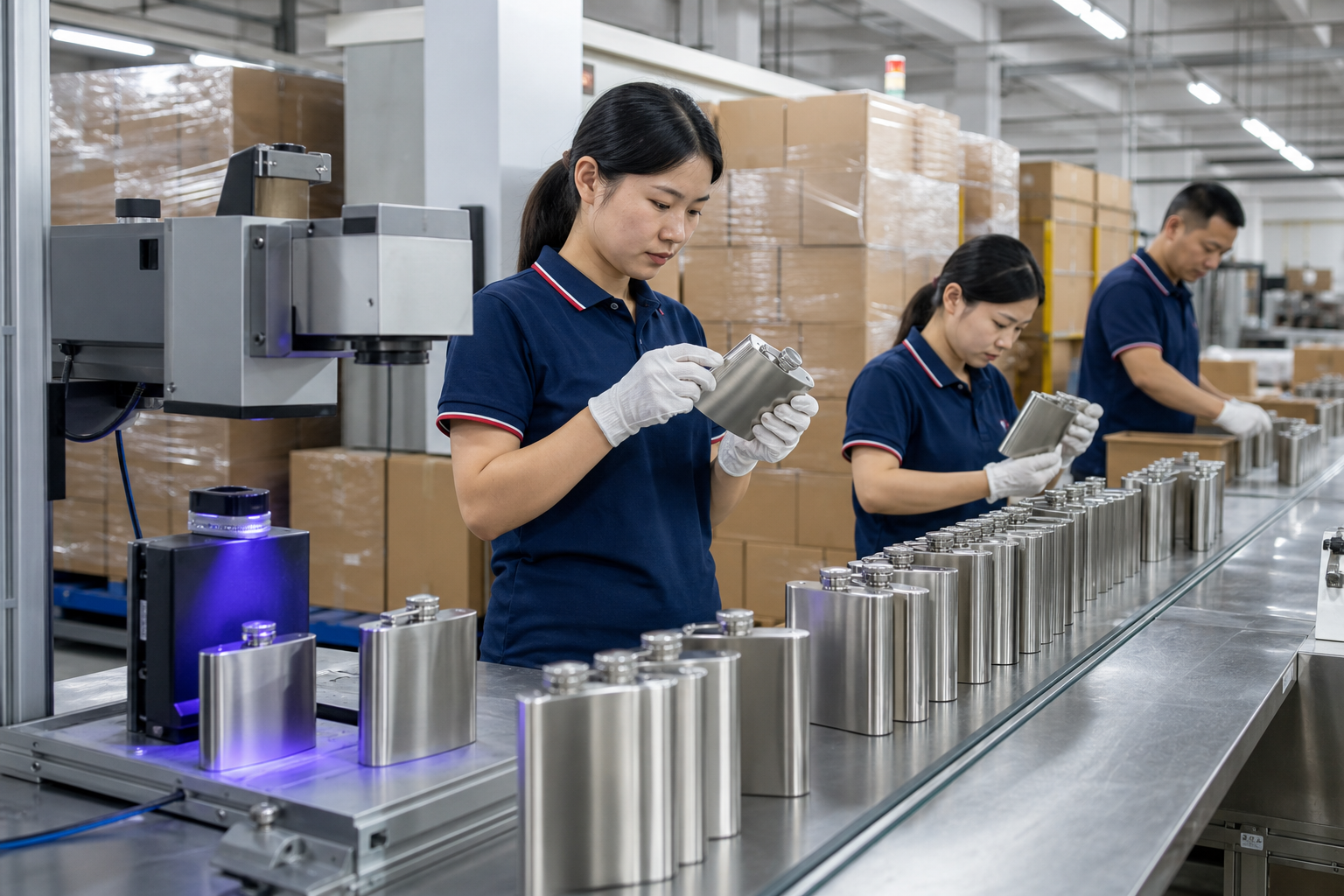
Key Takeaways
- Typical MOQ for alcohol flask custom made is 500-1,000 pcs per design, with sample lead time of 7-10 days
- A 6 oz or 8 oz flask usually uses 0.5 mm to 0.6 mm 304 stainless steel for a better balance of weight and durability
- FOB Zhejiang pricing for basic laser logo flasks often starts around USD 1.20-2.80 per pc at 1,000 pcs
- For export, ask for REACH-compliant coatings, leak testing, and AQL 2.5/4.0 on critical defects
If you are buying alcohol flask custom made for retail, promotions, or gifting, the hard part is not finding a supplier. It is choosing the right spec before you lock in a sample and find the decoration, leak test, or pack-out does not fit your market. A flask is small, but a bad one comes back fast.
At BottleForge in Zhejiang, we see this every week from brand owners and distributors who want custom drinkware that looks premium and still lands at a sane landed cost. Last week QC pulled a 200 ml sample with a 0.3 mm seam gap, and the buyer flagged the cap torque on the spot. The gap between a workable custom canteen or flask and a headache usually comes down to the right stainless grade, wall thickness, finish, closure quality, and a factory that can hold AQL 2.5 on mass production. We ship enough of these to know the math does not work if you fix mistakes after sampling.
What a good flask spec looks like
For alcohol flask custom made, start with the metal, not the logo. We run 304 stainless steel on most export orders, with 0.5 mm to 0.6 mm wall thickness and a screw cap that closes cleanly; if the buyer wants a captive hinge or tether, we build that in from the first drawing. That spec works because it keeps corrosion down and the flask light enough for pocket carry. One PO typo can ruin the batch, so we check the cap style code before the line starts.
316 stainless is available for premium programs, but it adds cost and the math does not work for every account. Most distributors stay with 304. For matte black, brushed steel, or color-coated finishes, ask for the coating system and an abrasion test report. We had one buyer flag a black sample after 200 rubs on a Scotch-Brite pad, so we changed the pack insert and rechecked the surface. The same rule applies on a custom canteen or customized canteen order: the finish has to survive carton friction, not just the photo shoot.
On size, the market usually buys 6 oz, 8 oz, and 12 oz. A 6 oz unit moves easier as canteen promotional stock; 8 oz feels more like a gift item; 12 oz suits a buyer who wants a custom growler-style giveaway, though it is still a flask. If you are a canteen distributor, define the use case first. Spirits flask, water canteen, beer growler: three different jobs. We’ve seen that go sideways when a buyer tried to share tooling across all three and then blamed the sample.
- 304 stainless steel: standard export choice
- 0.5-0.6 mm wall: common for durability and weight
- 7-10 days: typical sample turnaround from a Zhejiang canteen factory
MOQ, pricing, and lead time
Factories in China quote flasks by decoration and packout. A plain brushed flask with a laser logo often lands at USD 1.20-1.80 FOB Zhejiang at 1,000 pcs. Add full-color print, a gift box, or a leather wrap, and the same flask moves to USD 2.30-4.50. We ran one order last quarter where a 304 stainless body stayed cheap, but the EVA insert and 3-layer carton pushed the quote up by 38%. That is the math.
MOQ is where buyers burn time. A normal flask maker will usually ask for 500-1,000 pcs per design on a standard item, while a custom canteen with three decoration steps can go higher fast. If a canteen supplier says yes to 100 pcs, ask what got cut. QC pulled the sample apart on one such order and found the print register off by 1.5 mm, plus the inner box was plain white instead of the agreed kraft pack. The buyer flagged it. That is not a win.
Lead time is usually 25-35 days after sample approval for bulk production in Zhejiang, plus shipping. A repeat run can come down to 18-22 days if the line is open and the tooling is already set, but that depends on the calendar, not wishful thinking. We ship enough to know peak season eats slots fast. For a tight PO, plan 45 days from PO to port if the cartons need export testing and booking falls into August or November. One typo on a PO, like “5000 pcs” instead of “5,000 pcs,” can hold the whole schedule while the buyer checks with finance. In Hangzhou and the wider Zhejiang supply base, factories often run 200,000-500,000 units per month across several drinkware lines, so capacity is usually fine. Spec discipline is the real bottleneck.
Ask for a landed-cost worksheet, not only an ex-factory quote. A USD 0.40 gap at factory level can vanish once you add cartons, customs duty, and inland freight.
Decoration methods that hold up
The logo is where a flask order looks sharp or looks cheap. For alcohol flask custom made, laser engraving is the safest call on stainless steel. It holds up, reads clean, and survives transit better than ink. We run 304 stainless a lot, and QC pulled a sample after a 1,000-rub test; the engraving was still crisp. Brushed laser also gives a nicer retail feel if the buyer wants a premium shelf look. Silkscreen works for one- or two-color art, but check alcohol resistance and abrasion before you sign off. On a flask, weak ink shows fast.
For canteen customizable programs, the same problem shows up with powder coating and print registration. If the art sits near an edge or curve, ask the canteen factory for a decoration map before approval. A 2 mm shift on a curved body is enough to throw the logo off-center. We had a buyer flag a PO typo on a 5000-piece order once because the print sat 3 mm too far left. That kind of miss turns into scrap. If you are buying customizable canteen inventory for Europe or North America, laser on metal plus retail box branding is usually the cleaner route. Less decoration means fewer rejects, and the math works.
Some canteen distributors ask for UV print because the artwork is complex. Fine, but ask for a rub test and a dishwasher or alcohol-wipe test if the bottle will be handled every day. On a custom growler or customized growler, UV print can look strong on day one and still chip on the rim or neck during packing. We’ve seen that go sideways on a 12-day ship-out because the carton insert rubbed the coating. Better to test than guess. The better canteen manufacturers in Zhejiang send a sample with the exact method, not a paper mockup.
- Laser engraving: best for durability
- Silkscreen: best for simple logos and low cost
- UV print: good for complex color, but test abrasion
Compliance buyers should request
If your flask goes into the EU, UK, US, or Canada, do not treat compliance as a box to tick. For metal drinkware, ask for REACH compliance on coatings and inks, a food-contact declaration where needed, and factory quality records tied to your PO. We run this request on every order over 1,000 pcs. If you buy from a canteen factory in China, ask for material traceability by heat number or batch number. A good supplier has it on file. A careless one starts guessing.
For U.S. buyers, check whether the packaging and product claims create extra labeling exposure. If the item is sold as a novelty flask, the finish and seal materials still need to stay stable. We had a buyer flag a PO typo on “stianless” before the line started; that kind of slip turns into a customs headache fast. If you are importing through a distributor canteen channel, the retailer may also want carton barcodes, country-of-origin marking, and carton drop-test validation. Small item, same paperwork.
Quality control should include three checks: leak test, cap torque test, and visual inspection against AQL 2.5 for major defects and 4.0 for minor defects. If the product has a vacuum double-wall structure, add thermal retention verification. QC pulled the sample once and found the cap gasket off by 0.3 mm; the steel was fine, the gasket was the problem. This is the wrong question to ask if you only focus on stainless grade. A reliable canteen manufacturer knows the weak point is usually the closure. A weak canteen vendor hopes you do not find out until after shipment.
For buyers in Europe, REACH matters more often than people think, especially if there is paint, coating, or a decorative wrap. If your flask includes a funnel or pouch, those materials need their own check. Ask for the lab report before mass production, not after. We shipped one EU order where the buyer pushed back on a PU pouch with no test file, and the batch stopped at 5,000 pcs. Zhejiang factories that export regularly will understand this request on day one.
How to judge a supplier in China
Do not pick a canteen supplier from the catalog alone. Ask for production photos, the test setup, the packing line, and a lead time you can actually audit. A good canteen distributor relationship is built on repeatability, not one lucky sample. Ask where the flask body is formed, where the seam is controlled, and how the cap seal is checked. If the sales rep cannot answer, the factory is too loose for export work.
In Zhejiang, we run a lot of stainless drinkware because the metalworking base and packaging support are already there. That helps, but it does not replace due diligence. Ask for factory audit items such as BSCI if you need social compliance, and ask whether the line can handle your packing style: polybag, tuck box, blister, or gift box. We have seen a 300,000-unit monthly capacity look strong on paper, then the buyer flagged a 35 mm box insert that the line could not keep straight. That is the wrong question to skip.
If you are comparing a custom canteen program to a promotional canteen order, split the two jobs cleanly. Promotional orders chase price and print speed; retail orders need shelf consistency and clean carton packing. The math does not work if you mix them up. Ask for the same test conditions across sample, pre-production, and bulk. If QC pulled the sample at 48-hour salt spray and the bulk runs at 24 hours, the order is not controlled.
- Factory audit or third-party inspection: recommended
- Sample approval with signed artwork: mandatory
- Production photos before shipment: non-negotiable
Packaging and shipping details
Packaging often adds more cost than buyers expect. A plain OPP bag and white box usually adds USD 0.10-0.25 per unit, while a printed gift box with insert can add USD 0.45-1.20. We ran a 500-piece flask job last month, and the buyer flagged the box cost before he even asked about finish. If you are selling customized canteen or customized growler items in retail channels, the box pulls its weight on shelf. For an alcohol flask custom made for premium retail, a rigid gift box can support the margin, but only if your channel can pay for it.
Shipping needs carton count first, unit count second. A 1,000-piece flask order sounds small, but carton dimensions decide whether you ship LCL or wait for a full container. QC pulled the sample pack at 36 cartons and found one PO typo on the ship mark, and that kind of mistake burns time fast. For U.S. Amazon sellers and distributor drinkware programs, carton labeling and FNSKU placement must be locked before production. If the carton mark is wrong, the forwarder can stop loading. That is a coordination problem, not a factory defect.
For FOB terms, Zhejiang makes life easier because port access is straightforward and inland trucking from Hangzhou is efficient. Do not ignore carton strength. A 5-ply export carton may work for a local run, but an ocean route needs better compression resistance if the box holds glass, metal, or mixed accessories. We usually test at 12 kg stack load and ask for an ISTA-style drop test, or a practical equivalent, on the actual pack-out. If the supplier never mentions it, ask. If they push back, the math does not work.
For distributors carrying multiple drinkware lines, standardized master cartons cut warehouse errors. That matters whether you are moving a custom growler, a custom canteen, or a flask line. We ship faster when the carton spec stays the same across SKUs, and the line stops wasting time on re-labeling. Clean packaging saves labor on the back end. That is where your margin lives.
When a flask should not be a flask
Sometimes the buyer says “flask,” but the spec sheet points to a different item. If it has to hold water, coffee, or gym hydration, a flask is the wrong body shape and the wrong volume. We run into this on the line all the time. A canteen customizable or customizable drinkware product with a wider mouth, straw lid, or loop handle works better. If the program is for beer or cold brew at retail, a custom growler or customized growler makes more sense. If the channel is gifting or campus promo, a custom canteen or canteen promotional bottle is the better buy.
This is not a small detail. It saves cash and avoids back-and-forth. A canteen manufacturer can often keep the same tooling family across several shapes, but the product type still has to match the use case. A 500 ml insulated bottle with a sip lid is not a pocket flask, and QC pulled the sample to prove it. Capacity, closure, and what the consumer expects all change the result. We saw a PO once that mixed an 8 oz flask body with a 500 ml closure callout. The math does not work.
Start with channel fit. If the retailer wants shelf appeal and gifting, choose the body style that carries the story in one glance. If the distributor canteen order is price-led, keep the decoration simple and stay on standard spec. If your North American account wants an alcohol flask custom made with a premium feel, spend on cap quality, polish, and box presentation. Do not chase exotic materials that add cost but do not move sell-through. On a recent run, a 0.3 mm polish change got more buyer approval than a fancier alloy. The right custom drinkware choice is usually the plain one that ships on time and sells cleanly.
Send your flask spec for a factory quote
Give us capacity, finish, logo method, and target market. We will return pricing, MOQ, and lead time with no vague promises.
Frequently asked questions
What is the usual MOQ for alcohol flask custom made?
For a standard stainless flask, the usual MOQ is 500-1,000 pcs per design. If you use laser engraving on one logo position, 500 pcs is often realistic. Add multi-color print, leather wrap, or special box inserts, and some canteen manufacturers will move the MOQ to 2,000 pcs. For repeat orders from a Zhejiang factory, reorders can sometimes drop to 300-500 pcs if the tooling and decoration setup already exist. Always confirm MOQ by finish, not only by model.
How much should I pay for a custom flask from China?
For FOB Zhejiang, a basic 6 oz or 8 oz stainless flask with laser logo often lands around USD 1.20-2.80 per piece at 1,000 pcs. A coated or gift-boxed version can be USD 2.30-4.50. The biggest cost drivers are decoration, packaging, and cap style. If someone quotes far below that range, ask what steel grade, wall thickness, and inspection standard are being cut. Cheap quotes usually remove quality somewhere you cannot see at first.
Which material is best for a custom canteen or flask?
For most export orders, 304 stainless steel is the practical choice. It balances corrosion resistance, weight, and price. A wall thickness of 0.5-0.6 mm is common for a flask body, while some premium custom canteen or custom growler products use thicker gauge for a heavier feel. 316 stainless is stronger on corrosion resistance, but it usually costs more and is only worth it if your brand positioning justifies the premium. Ask for a material declaration and batch traceability.
What quality tests should my supplier provide?
At minimum, ask for leak testing, cap torque testing, and visual inspection under AQL 2.5 for major defects and 4.0 for minor defects. If the product has coating or print, request rub resistance testing. If it is insulated, request thermal retention data. A serious canteen factory in China should also provide pre-production samples, signed artwork approval, and shipment photos. If you are selling into Europe or North America, keep REACH and food-contact documents on file before bulk production starts.
Can I order mixed styles like flask, canteen, and growler in one shipment?
Yes, and many distributor drinkware buyers do that to reduce freight cost. The key is to keep each SKU controlled: one flask spec, one canteen customizable spec, one custom growler spec. Mixing too many decoration methods in one PO increases error risk. A factory in Zhejiang can usually combine products in one container, but each item still needs its own MOQ, carton label, and inspection record. If you want a mixed order, separate the art files and packing instructions by SKU.