Key Takeaways
- Most alcohol flask custom orders start at 1,000-3,000 pcs, with FOB China pricing often USD 1.20-3.80 depending on steel, finish, and lid.
- A reliable flask usually uses 304 stainless steel at 0.5-0.8 mm wall thickness; 201 steel is cheaper but weaker on corrosion.
- Ask for leak testing, REACH compliance, and AQL 2.5/4.0 inspection before you approve mass production.
- If you need canteen customizable branding or customized growler packaging, lock artwork and carton specs before tooling starts.
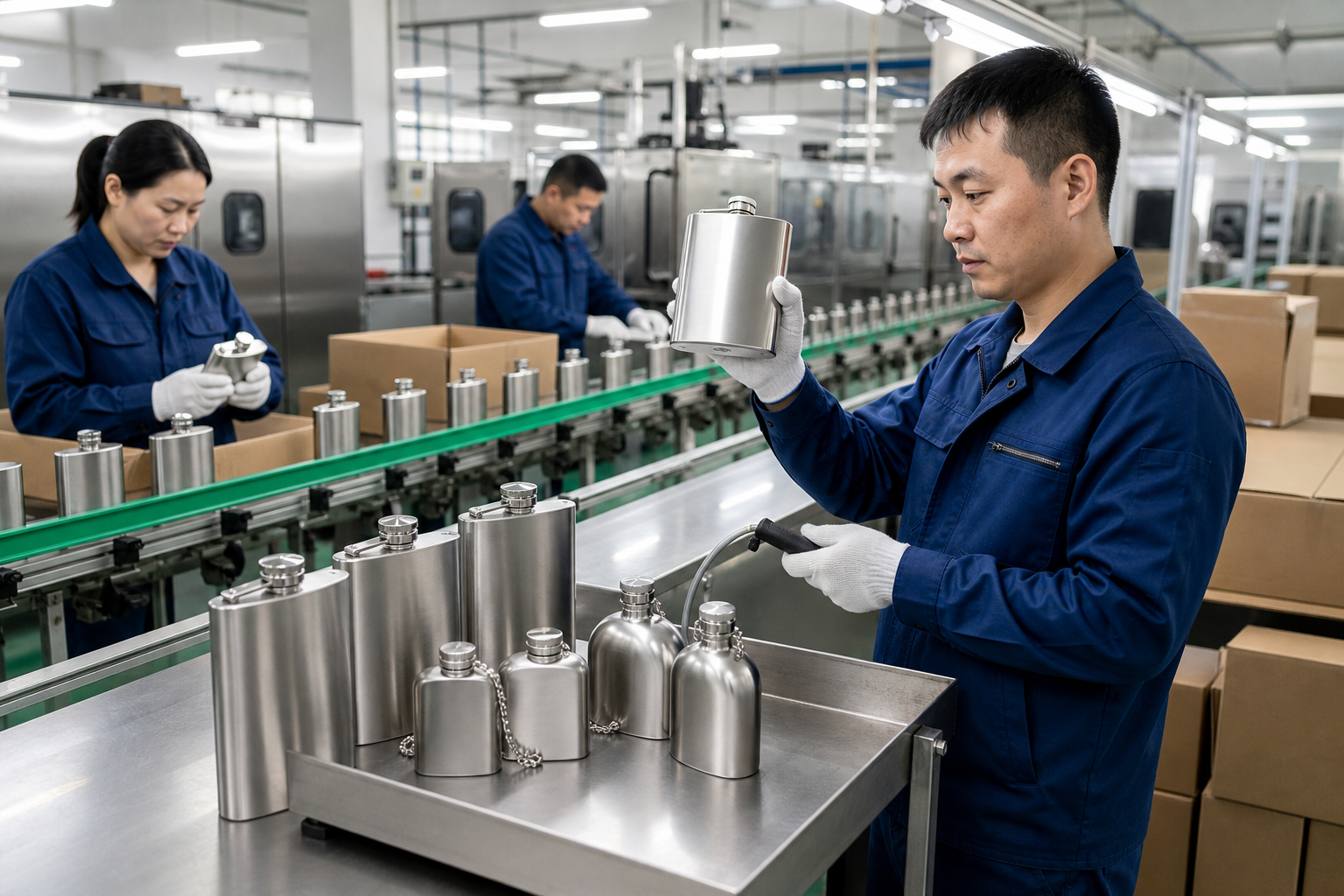
If you are buying alcohol flask custom for retail, promotions, or private label, the risk is not the artwork. It is the structure, finish, compliance, and whether the factory can hold tolerances on a product that looks simple but fails fast when rushed. We run 0.5 mm to 0.8 mm stainless steel flasks on the line, seam-welded cleanly, leak-tested, and packed so the polish does not arrive scratched. One buyer once flagged a 1.2 mm lid gap on a PO; that small miss turned into a return claim. In Zhejiang and across China, many suppliers can print a logo, but far fewer can deliver a consistent custom canteen-style product that survives export handling.
You should treat flask sourcing like any other serious custom drinkware project: define volume, steel grade, lid type, surface finish, and test standard before you ask for price. At BottleForge Industrial in Hangzhou, our canteen factory runs up to 300,000 units per month, but the same three failures keep showing up: vague specs, MOQ set at 500 when the buyer needs 5,000, and late artwork changes after QC pulled the sample. This is the wrong question to ask if you start with unit price only. If you want a canteen manufacturer that can act like a true canteen supplier, buy on data, not on samples alone.
What buyers mean by flask custom
When buyers say alcohol flask custom, they are usually not asking for a plain metal hip flask. They want a branded piece that can be gifted, sold at a bar, or packed for an event, with a set shape, laser logo, gift box, and a production plan that does not wobble. We see the same request on the line with a 304 stainless flask, a printed sleeve, or a tight MOQ of 500 pcs. In B2B sourcing, this can sit next to custom canteen, custom drinkware, or a small custom growler program for clubs and merch. First define the product family. The marketing words come later.
For a classic flask, the common capacities are 6 oz, 8 oz, and 8 oz with a captive cap. For a promotional bottle or canteen promotional program, buyers often move to 250 ml to 500 ml because the extra surface gives more room for decoration. We had one buyer flag a PO typo on 2500 ml instead of 250 ml, and that one line changed the whole quote. In China, some canteen manufacturers will call the same item “customizable drinkware” even when the body shape is fixed. That is fine if you know the limits. Shape changes mean tooling. Logo changes do not. If you need a truly customized canteen, ask for a 3D drawing, wall thickness, and cap compatibility before price talk starts.
Good buyers split the job into four parts: body material, surface treatment, closure, and packaging. If one part is fuzzy, the sample can pass and the mass run will drift. QC pulled the sample once with an uneven brushed finish at 180 grit, and the buyer caught it before shipment. This is where some canteen suppliers get sloppy because they subcontract polishing or mix lid batches. A serious canteen vendor in Zhejiang should state the exact steel grade, the default MOQ, and the lead time in days. If the answer sounds like “we will check,” the math does not work.
Steel grade and wall thickness
Material decides whether a flask passes or gets returned. For alcohol flask custom orders, 304 stainless steel is the safer default. It holds up better than 201 in salt, liquor residue, and long storage, and buyers in Europe or North America usually accept the price. We had one PO from a UK distributor that called for 201, then the buyer flagged rust marks after a 12-day humid transit test; that was the wrong spec from the start. If the target is premium retail, we run 304.
Wall thickness is where a lot of first-time buyers miss the math. A normal flask body sits at 0.5 mm to 0.8 mm; once you drop below 0.5 mm, dents show up fast and the seam can distort in packing. If you want a heavier hand feel, 0.7 mm or 0.8 mm works, but the press cycle slows and scrap goes up. On the line, QC pulled a 0.8 mm sample with calipers at 0.02 mm accuracy, then checked the shoulder after forming; if a factory cannot show that drawing callout, you are buying by look only.
- 304 stainless steel: better for retail stock, export shipping, and corrosion resistance
- 201 stainless steel: lower cost, workable for short-run promo canteens
- 0.5 mm: entry level, dent resistance needs close checking
- 0.7-0.8 mm: better hand feel, steadier for customized drinkware
For bottle-style projects, especially when the buyer also wants a custom growler or customizable growler line, ask whether the same steel coil source is used across SKUs. Mixed coil lots are where the trouble starts. After polishing, one body shows a warmer tone and the next looks colder under showroom lights; we saw that on a 500-piece sample run with a 2.1 kg coil split, and the buyer rejected the mismatch before packing.
Decoration that survives export
Decoration is where many canteen customizable programs go wrong. A logo that looks sharp on a sample can fade, scratch, or warp after packing and shipping. On one 5,000-piece run, QC pulled the sample after a 48-hour rub test and the pad print already looked tired. For alcohol flask custom work, the decoration method should match the target price and the color count. Laser engraving holds up well and stays clean. Silkscreen fits bold logos and one- or two-color branding. If you are building a gift SKU or a premium distributor drinkware line, laser usually brings fewer complaints. If you need a canteen promotional batch with strong shelf presence, silkscreen is often the cheaper route.
Do not ask the factory to “make it premium” without naming the finish. Mirror polish shows fingerprints but moves well in gift sets; brushed finish hides handling marks and looks more technical. Powder coating gives color depth, but we run adhesion tests and abrasion checks before we green-light it. On the line, a 0.3 mm edge nick can turn into a return if the buyer flagged it late. A factory in China should also tell you whether the coating is food-contact safe and whether it has passed REACH expectations for the target market. For North America, buyers often ask for FDA-relevant material declarations; for Europe, REACH and sometimes LFGB-related testing go into the file.
Buy the decoration you can reproduce 10,000 times, not the sample that won applause for 30 seconds.
If your brand portfolio includes canteen customized products across multiple sizes, keep the logo placement rules the same. That lets your canteen distributors reuse art and cartons, and it cuts setup errors on reorder PO files. We saw one PO with the logo shifted 8 mm left on a 500 ml bottle and 12 mm right on a 750 ml bottle. The math does not work.
MOQ, price, and lead time realities
Most buyers overestimate how flexible a canteen manufacturer can be on MOQ. For alcohol flask custom runs, a realistic starting point is 1,000 to 3,000 pcs per SKU if you want custom packaging or nonstandard decoration. Simple stock-shape branding may go lower, but once you change the cap, body curve, or carton insert, the math changes fast. We run that line in Zhejiang every week. A 500 pcs order with a new insert still eats setup time, film change, and carton proofing, so the unit price jumps instead of dropping.
As a rough market range from China, FOB pricing for a basic 6 oz to 8 oz flask can land around USD 1.20 to 3.80 depending on steel grade, finish, and print complexity. A boxed retail set with laser logo and color gift carton may run higher. Lead time is often 20 to 35 days after sample approval and deposit, with another 20 to 30 days for ocean freight depending on destination. A buyer once flagged a PO that said “matte black, gift box” but left out the insert size; we had to stop the line and recheck the dieline. If a canteen supplier promises 7-day mass production on a custom build, read the spec carefully; they are probably quoting a stock item with a logo, not true customization.
At BottleForge Industrial, typical export cycles are built around a 30-day production window for stable repeat orders, plus export packing and inspection. That is normal for a factory in China with real throughput, not a trading desk guessing at subcontractor schedules. QC pulled the sample on a 2 mm print shift last month, and we held the batch instead of shipping it blind. If you are a canteen distributor or distributor canteen buyer, insist on a written production calendar that includes printing, curing, assembly, carton drop test, and final inspection. It saves arguments later.
Compliance and test documents
Compliance is not a desk job. It clears customs, and it keeps the buyer from chasing a recall six months later. For alcohol flask custom shipments into Europe and North America, we ask for a pack with the material declaration, REACH confirmation, and the production inspection report. If the flask touches liquid, the factory should state the test method and the exact test area. On one run, QC pulled the sample at 3 points on the lid and the buyer flagged a missing gasket spec. No vague “safe material” wording.
For QC, we usually quote AQL 2.5 for critical defects and AQL 4.0 for minor visual issues, unless the brand wants tighter terms. Leak test is non-negotiable. A basic flask should stay dry at the lid gasket, hinge, and weld seam. If you are ordering customized drinkware for retail, ask whether the factory tests at room temperature and after one thermal cycle. We ship plenty of flasks that look fine on the line and fail only after 12 days of use, which is the wrong time to learn the seal was cut 0.5 mm short.
- Material declaration: 304 or 201, plus gasket material
- Inspection standard: AQL 2.5 / 4.0
- Leak test: 100% on critical lots or spot-tested by protocol
- Packing test: drop test on master carton and inner box
If your order includes a canteen manufacturer’s branded carton, check the printed claims line by line. Overstated insulation, a capacity claim that is off by 30 ml, or unsupported “BPA-free” wording creates importer risk fast. We once found a PO typo that changed “304 stainless” to “340 stainless”; the math does not work, and customs will not smile at that. Good canteen vendors know better. Weak ones improvise copy. Do not accept that.
Packaging for retail and distribution
Packaging is where a distributor drinkware project either runs clean or turns into a mess. A flask sold through retail needs more than a polybag. We look at three things: product protection, shelf presentation, and master carton efficiency. For one canteen order last month, QC pulled the sample and found the logo would rub if the inner tray had less than 3 mm clearance. That kind of miss slows the line. This matters on a canteen customizable or customized canteen program, because the box is part of the brand message.
Gift boxes are common for alcohol flask custom orders, especially for holidays, sports events, and corporate gifting. A normal set uses a 300-400 gsm paper box with an EVA insert or molded pulp tray. We shipped one bar-channel job with a custom growler and the buyer flagged a small scuff after 12 days in transit, so we switched the tray spec and added a dust sleeve. Same logic for a customized growler: protect the finish, stop abrasion, keep the cap and funnel from rattling. For North American distribution, you may need an FNSKU-ready retail label zone if the goods go into Amazon or a mixed fulfillment channel. Do not leave barcode placement until the end. That is the wrong question to ask after the die line is approved.
A canteen vendor should quote carton dimensions, pcs per master carton, and pallet count before tooling approval. If they cannot tell you how many units fit a 40HQ container, the math does not work. We run packaging around freight density first, then presentation. One PO typo on carton height cost us a full reprint because the stack pattern changed by 8 mm, and the buyer did not want loose pallets at destination. In Zhejiang, the better factories plan for the carton tester, the forklift, and the sea freight bill at the same time.
How to choose the right factory
You need a canteen factory that knows export work, not just a workshop that can polish metal. Ask how many units they ship per month, who signs off QC, and whether final inspection happens in-house or gets pushed to a third party. A solid canteen manufacturer in China should give a straight number, like 300,000 units monthly across its flask and canteen lines, and tell you whether the same production floor runs custom canteen, customizable canteen, and customized drinkware orders. We run these checks every week, and the buyer usually spots the gap fast.
Do not ignore reply speed. If a canteen supplier needs three days to answer a simple gasket-material question, expect the same delay when production slips. Good canteen suppliers send drawing revisions, sample photos, and inspection checkpoints without being chased. Last month, QC pulled the sample and found a 0.3 mm cap mismatch before packing, which saved us from a nasty PO dispute. For distributors, that matters more than shaving a few cents off unit price because your reorder cycle lives or dies on predictability.
What you should ask before paying deposit:
- What is the actual MOQ per SKU and per color?
- Which steel grade will be used, and what is the wall thickness?
- Can you provide REACH-related and material compliance documents?
- What is the lead time after sample approval?
- How do you handle AQL inspection and leak testing?
If the answers are vague, walk away. A real canteen distributor relationship should feel like engineering and logistics, not gambling. We saw one buyer flag a PO typo on the color code, and that tiny error would have wrecked a 12-day schedule and a 2,000-piece carton run. The best canteen promotional programs come from factories in Zhejiang that handle export paperwork every day, not just sample room talk. That is the difference between one order and a repeat program.
Source alcohol flask custom with real factory control
Tell us your target price, MOQ, and finish. We’ll quote a production-ready flask program from Zhejiang with compliance, packaging, and export QC built in.
Frequently asked questions
What is a realistic MOQ for alcohol flask custom orders?
For most export buyers, 1,000 to 3,000 pcs per SKU is realistic if you want custom printing, a custom box, or a nonstandard lid. If you only change the logo on a stock shape, some canteen suppliers may accept 500 pcs, but the unit price will rise fast. A small trial order often costs USD 2.50-4.50 FOB because setup and QC are spread over fewer pieces. If the order includes multiple colors or gift packaging, expect each variant to need its own MOQ.
Which material should I choose: 304 or 201 stainless steel?
Use 304 stainless steel if you want a safer default for retail, export, and longer storage. It typically costs more, but it resists corrosion better and gives you fewer complaints. 201 steel can work for short-run canteen promotional campaigns where price is the main driver, but it is not the material I would choose for a premium customized drinkware line. For most B2B buyers, 304 at 0.5-0.8 mm thickness is the right balance of performance and cost.
How do I know if the flask will leak after shipment?
Ask for a documented leak test before mass production. A good factory should test the lid seal, gasket fit, and seam weld. For export orders, I recommend 100% leak checks on the first production batch and spot checks after that, using AQL 2.5 for critical defects. Also confirm the closure type: captive cap designs usually reduce loss risk. If the canteen manufacturer cannot explain how they test after polishing and assembly, treat that as a warning sign.
Can I get custom branding and a gift box with the flask?
Yes, and you should define both together. Laser engraving, silkscreen, or pad print can be paired with a 300-400 gsm paper box, EVA insert, or molded pulp tray. A standard branded gift set usually adds USD 0.35-1.20 per unit depending on print complexity and insert material. If you are working with a canteen distributor or distributor growler channel, fix the carton dieline early so barcode placement, FNSKU labeling, and pallet loading do not become last-minute problems.
How long does production take for a custom flask from China?
After sample approval and deposit, most alcohol flask custom orders need 20 to 35 days for production. Add another 20 to 30 days for ocean freight to Europe or North America, depending on route and season. If your order includes new tooling, special coating, or multiple SKUs, add a little buffer. A reliable Zhejiang factory should give you a production calendar with printing, curing, assembly, inspection, and packing dates, not a single vague lead-time number.