Key Takeaways
- Typical MOQ for an alcohol flask customizable order starts at 500 units, with 30-45 days lead time after sample approval.
- 304 stainless steel is the safer default; 201 steel can save 8-12% but usually costs you on corrosion resistance and brand perception.
- Laser engraving holds up better than silk screen for long-term retail use, while full-color printing suits canteen promotional campaigns.
- For EU and North America, ask for REACH, food-contact declarations, and salt-spray or adhesion test data before mass production.
If you are buying an alcohol flask customizable for retail, promo, or private label, do not treat it like a simple gift item. It is not. The details that move the margin are metal grade, wall thickness, lid sealing, decoration durability, and whether the supplier can keep the same color and logo across 5,000 or 50,000 pieces without drift. On our line in Zhejiang, we have seen buyers lose 8% to 12% on rework because they started with artwork and ignored the structure.
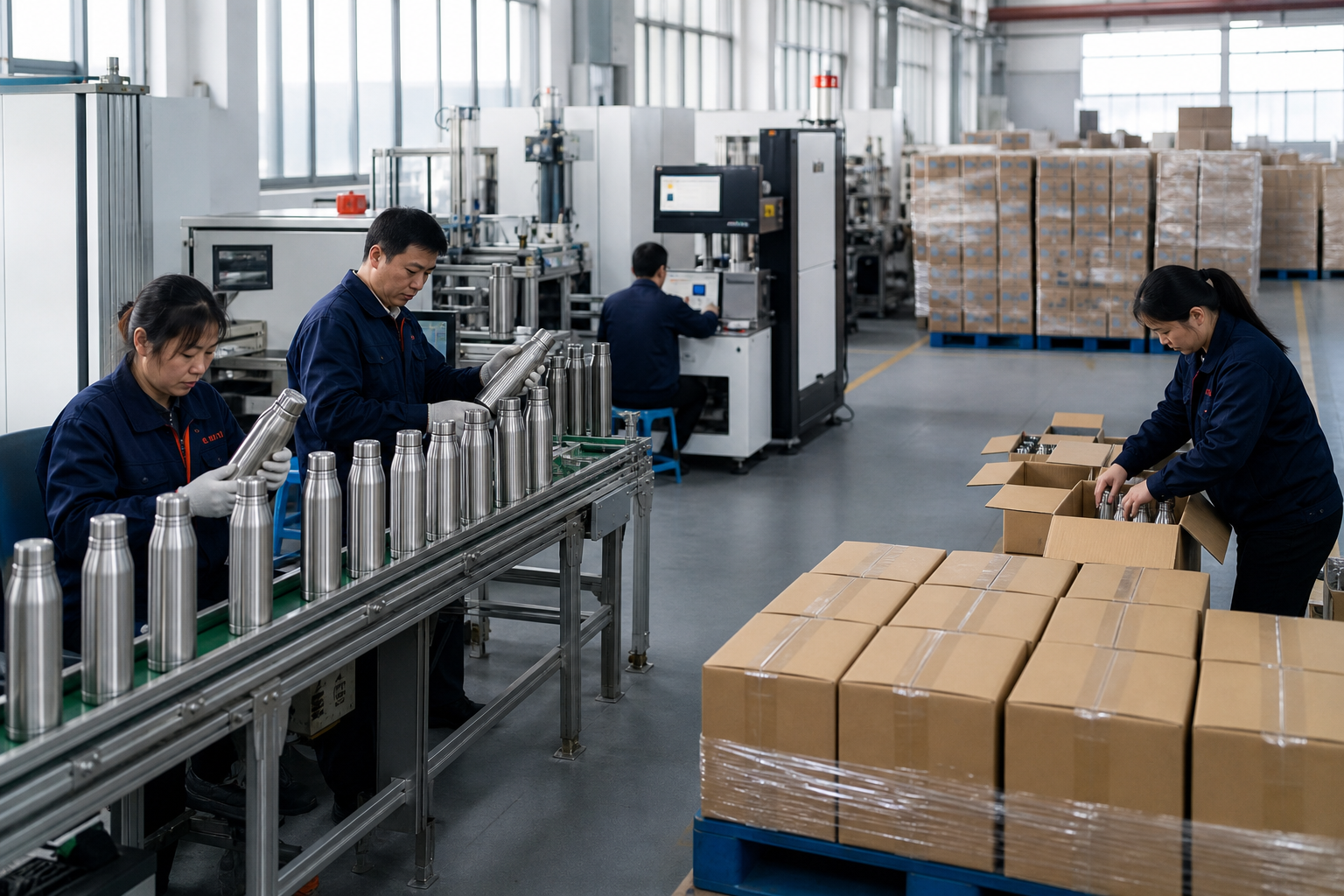
The better move is to source it like a proper custom drinkware program. You need a canteen manufacturer or canteen supplier that controls tooling, finish, and inspection in one factory. A good canteen factory in China should quote MOQ, lead time, and decoration method before sample approval; we once had a PO typo swap 500 for 5,000, and QC pulled the sample because the buyer flagged the lid torque at 1.2 N·m. If the vendor cannot give you those numbers, you are not buying a product yet. You are buying risk.
What buyers really mean by customization
When buyers say alcohol flask customizable, they usually mean more than a logo. They want the body shape, brushed or matte finish, cap style, and a box that can sit on a retail shelf. That is where a capable custom drinkware partner matters. We run this kind of job on the line every week. A solid canteen factory will change the surface, match a new cap, and keep the seal stable; we once saw a buyer flag a lid thread that drifted 2 mm, and the sample had already passed visual check.
For B2B sourcing, split the spec into four layers: structure, decoration, compliance, and packing. Structure means flask body, neck, and cap. Decoration means laser, silkscreen, UV print, embossing, or wrap label. Compliance means food-contact materials and market paperwork. Packing means polybag, tray, insert, retail box, and carton mark. If these are not written down, your custom canteen project turns into guesswork. In Zhejiang, factories that handle both customizable drinkware and customized drinkware usually ask for a drawing or a reference sample first, then they confirm tooling and unit price. That is the right order. The math does not work any other way.
- Simple flask: 180-220 ml, one-color logo, MOQ 500-1,000 units
- Retail flask: custom box, laser logo, MOQ 1,000-3,000 units
- Promotional set: flask + funnel + pouch, MOQ 3,000+ units
Materials that pass real buyer scrutiny
If you are buying for Europe or North America, material choice is not a styling issue. It is a margin and compliance issue. For an alcohol flask customizable order, 304 stainless steel is the usual call, with 0.4 mm to 0.6 mm wall thickness. We run 0.5 mm on a lot of orders because it keeps the flask stiff enough without killing the unit cost. 201 stainless steel can cut ex-factory price by 8-12%, but that is the wrong question if you need a premium shelf look or the product will sit wet in a warehouse for weeks. For a long-life customized canteen or customized growler program, 304 is the safer baseline.
Do not skip the cap liner and internal finish. A clean internal polish cuts odor retention, and that matters when the buyer wants the same flask for spirits, mixers, or water. Last month QC pulled a sample with a rough weld seam at the neck, and the buyer flagged it in 2 minutes. Ask the canteen manufacturer or canteen suppliers for the body steel grade, cap material, liner type, and whether any coating is BPA-free. For a custom growler or customizable growler, you also need the seal and pressure spec on paper. Growlers are not flasks, and we have seen shipments get mixed up because a PO said “drinkware” with no detail. A good canteen distributor gets those distinctions written down before placing a container order from China.
Ask for these numbers in writing:
- 304 stainless steel: 0.5 mm body thickness recommended
- Silicone or LDPE gasket: confirm food-grade compliance
- Internal finish: mirror or brushed, with odor-cleaning guidance
- Salt-spray or adhesion test: request report if you use colored coating
Decoration choices that survive shipping
Decoration is where a lot of orders fail. Buyers sign off on a cheap mockup, then the logo comes back scuffed after 48 hours in carton vibration tests. For a premium alcohol flask customizable order, laser engraving is the safest call. We run it on 304 stainless steel with a 0.2 mm focus spot, and the mark stays put. If you need color, silkscreen costs less, but on curved bodies it loses edge sharpness and wears faster. That matters on a canteen promotional run where the flask gets handled, washed, and handed out fast.
For custom canteen and canteen customized projects, ask the factory for the printing loss rate, not the brochure line. A solid canteen manufacturer should quote 96-98% decoration yield on stable artwork. If they dodge that number, the work is getting pushed out. We’ve seen a buyer flag a PO typo on the logo file code, and the whole batch had to be rechecked at the line. In Zhejiang, one reason buyers stay with a local canteen factory is control: engraving, printing, packing, and carton inspection all happen in one plant. That keeps mixed lots down. For customizable canteen programs sold through a canteen distributor network, consistency beats a fancy finish. One off-color lot can sink a wholesale account.
Practical rule: if the flask will resell under USD 12 retail, keep the decoration simple. If it is a corporate gift or premium set above USD 18 retail, spend on box design, insert trays, and a cleaner logo edge. We ship a lot of these, and the math is plain: a 0.3 mm misaligned print on a gift set gets noticed fast. That is where custom drinkware stops being commodity and starts being brand inventory.
MOQ, pricing, and lead time realities
Buyers often ask for a quote before they know the order structure. That slows the job down. A solid canteen supplier or canteen manufacturers team will ask for capacity, logo method, pack style, and destination market before it prices the job. For a standard 180-200 ml alcohol flask customizable project, MOQ is usually 500 units for a simple logo and 1,000 units if you want custom packaging. If you need color coating, mixed SKUs, or gift sets, plan on 3,000 units or more. We run this every week. The line does not like vague specs. On one order, the buyer sent a PO with the wrong cap color and then asked why the sample sheet did not match.
FOB prices depend on steel grade and decoration. A plain 304 stainless steel flask may start around USD 1.20-1.80 per unit at 1,000 pieces. Laser engraving can add USD 0.08-0.25 per unit. Custom box packaging may add USD 0.20-0.60. A full retail set can land in the USD 2.20-3.80 range before freight, depending on complexity. If someone throws out a much lower number, check wall thickness at 0.3 mm, check the cap for leaks, and check whether the finish will hold after transit. Cheap at quote stage often turns into claims later. QC pulled the sample, filled it with water, and the cap wept at the hinge.
Lead time from sample approval is usually 30-45 days for stable orders, and 50-60 days if you need new tooling or special coating. In our Zhejiang plant, monthly capacity reaches 300,000 units across stainless and related drinkware lines, which is enough for distributor programs and seasonal campaigns. That matters if you are a distributor canteen buyer or a distributor drinkware importer planning rolling replenishment. The factory should show how it handles repeat orders, carton labeling, and AQL inspection at 2.5 for major defects. A promise is cheap. A stamped carton sample and a real packing photo carry weight.
Compliance for EU and North America
If you sell into Europe or North America, compliance is not paperwork for the drawer. It keeps the cartons moving. For an alcohol flask customizable order, ask for food-contact declarations for the steel, cap liner, coatings, and inks. Europe buyers usually want REACH. For the US side, ask for a food-contact statement tied to applicable FDA expectations. If the flask has painted surfaces, ask for adhesion testing. If it uses a coated interior or a colored powder coat, ask whether the finish passed heavy-metal or odor-transfer checks. We had one buyer flag a 0.2 mm paint run on a lid edge, and QC pulled the sample before it hit packing.
A solid canteen factory should already have the export pack ready: commercial invoice, packing list, HS code suggestion, and carton marks. Put AQL 2.5 for major defects and 4.0 for minor defects in the purchase order, or tighten it if your brand sits in the premium tier. A competent canteen supplier or canteen vendor does not push back on that; we run to those numbers. If the project also includes a custom growler or customizable growler, pressure and seal tests matter more. This is the wrong question to ask if the buyer treats it like a gift item only. A 500 ml growler with a weak cap leaks in transit, and the math does not work.
Ask for compliance before you approve artwork. If the supplier cannot produce it, the sample is decoration, not a production promise.
For brand owners importing from China, compare the document date with the sample date. If the paperwork is older than the sample run, ask for a fresh set. We see this go sideways when a PO says “matte black” but the sample sheet says “gunmetal”; one typo like that can stall release. Good factories in Zhejiang do this as routine. The weaker ones wait until the booking is fixed and then scramble for revised files.
How to choose the right supplier type
You do not need the same supplier for every channel. A canteen manufacturer fits when you need 20,000 pcs a month, the same wall thickness on every lot, and tooling under one roof. A canteen distributor works better when you need 8 SKUs fast, but the unit price jumps. A direct canteen factory in China usually gives you tighter lead times and cleaner sampling. A trading canteen supplier can help with accessory bundling or smaller mixed orders, but they still need to own QC instead of tossing it back to the line.
For private label buyers, ask one blunt question: can this partner handle both customized canteen and customized drinkware without changing factories every season? If yes, you have a working partner. If they only show catalog stock, you are talking to a middleman. Fine, but price it that way. For a canteen promotional project, a vendor is often enough. For a retail launch where margin depends on repeat orders and clean packaging, you want factory control. Same story with canteen distributors and distributor growler programs: the seller must know carton count, pallet plan, and re-order timing, not just the print file. We had a buyer flag a PO typo on “144 pcs/carton” versus “164 pcs/carton”; that kind of mistake burns a week.
Short version: if you need engineering changes, go to the factory. If you need speed on a small mixed order, a distributor or vendor can work. If you need both, you need a Zhejiang team that already exports custom drinkware and can show actual monthly output, not a brochure. QC pulled the sample at AQL 2.5 and found a 1.2 mm cap mismatch once; that is the sort of detail that tells you who really runs the line.
Packaging and retail readiness
A flask can look clean in a sample photo and still get dinged on shelf if the pack is weak. For an alcohol flask customizable program, the box has to protect the finish, keep the cap from rattling, and show value fast. We run a 60 gsm polybag for internal fulfillment or a low-cost promo. For retail, use an insert tray or molded pulp, then a printed box. If your buyer sits in a distributor canteen channel or a chain of specialty stores, carton consistency matters because warehouse teams scan by case pack and barcode. QC pulled the sample on a 1.2 m drop, and the lid scuffed on the first corner hit.
On shelf, custom canteen packaging often beats customizable drinkware packaging by a small margin, and that margin decides the PO. A clean branded box can carry an extra USD 0.40-0.80 at retail. If the line is a customized growler or customizable growler with accessories, the insert has to stop movement during a 1-meter drop test. Gift set? Add a hang tag, barcode label, and printed care card. The buyer flagged it once on a PO typo: “carf card” instead of “care card,” and we had to reprint 5,000 outer boxes. That sort of mess costs time.
Good packaging is where a canteen manufacturer shows discipline. The carton needs product code, color, quantity, gross/net weight, and country of origin. Sounds basic. Still, some canteen vendors miss one field, and the math does not work when cartons hit customs. If you ship into Europe or North America, plain packaging beats clever packaging that triggers questions at the port. Keep the artwork clean, keep the case pack stable, and ship the same spec every time.
Request a factory quote with your specs
Send your logo, target MOQ, material choice, and packaging plan. We will quote from Zhejiang with clear lead time, test data, and FOB pricing.
Frequently asked questions
What is a normal MOQ for an alcohol flask customizable order?
For a standard stainless steel flask with one logo, 500 units is the most common MOQ. If you want custom packaging, mixed colors, or a gift set, expect 1,000 to 3,000 units. New tooling or a special cap can push it higher. In China, especially in Zhejiang, factories usually price better at 3,000+ units because setup cost is spread across volume. If a supplier says 100 units on a fully customized model, check whether it is stock item branding only, not true customization.
Should I choose 304 or 201 stainless steel?
For export B2B drinkware, 304 stainless steel is the safer choice. A typical flask uses 0.4-0.6 mm wall thickness, and 304 handles corrosion and odor better. 201 steel may save about 8-12% on cost, but it is weaker for premium positioning and long-term storage. If the product will be sold as customizable drinkware in North America or Europe, 304 is usually the cleaner commercial answer. Ask for material confirmation on the sample and on the proforma invoice.
Which decoration method lasts longest?
Laser engraving is the most durable option for an alcohol flask customizable project. It does not peel, and it usually holds up through handling and washing. Silkscreen is cheaper and can work for canteen promotional orders, but it is more vulnerable on curved metal surfaces. UV print gives more color but needs careful adhesion testing. If you want retail durability, use laser for the main logo and keep extra graphics limited. On a 1,000-piece order, laser often adds only USD 0.08-0.25 per unit.
What compliance documents should I ask for?
At minimum, ask for food-contact declarations for steel, cap liner, inks, and coatings. For Europe, request REACH-related confirmation. For the US market, ask for a food-contact statement aligned with applicable FDA expectations. If the flask has coating or printing, request adhesion or abrasion test data. For shipment, you should also receive commercial invoice, packing list, HS code suggestion, and carton marks. A good canteen factory in China will prepare these before the goods leave Zhejiang.
How long does production usually take?
After sample approval, standard production is usually 30-45 days. If you need new tooling, a special finish, or a complex box, plan for 50-60 days. Freight time is separate. Air is fast but expensive; sea is cheaper but adds transit time. If you are a canteen distributor or distributor drinkware buyer, ask the supplier to hold raw stock or semi-finished stock for repeat orders. That can cut replenishment by 7-10 days on the next PO.