Key Takeaways
- A stainless alcohol flask MOQ of 500 units is common, but 1,000 units usually cuts unit cost by 8% to 15%
- 304 stainless steel at 0.6 mm to 0.8 mm wall thickness is the practical baseline for most custom drinkware orders
- Lead time from approved sample to shipment is typically 25 to 40 days in a Zhejiang factory, plus 30 to 45 days ocean transit
- AQL 2.5 for major defects and 4.0 for minor defects is a realistic inspection standard for distributor drinkware
- Laser engraving, silk screen, and powder coating each behave differently on a customized canteen or customized growler
If you source as an alcohol flask distributor, do not treat every bottle supplier as the same shop. They are not. A stainless flask for liquor, a powder-coated custom canteen, and a promo growler sit in one category, but wall gauge, seal system, print wear, and packing spec can move landed cost by 12% to 25%.
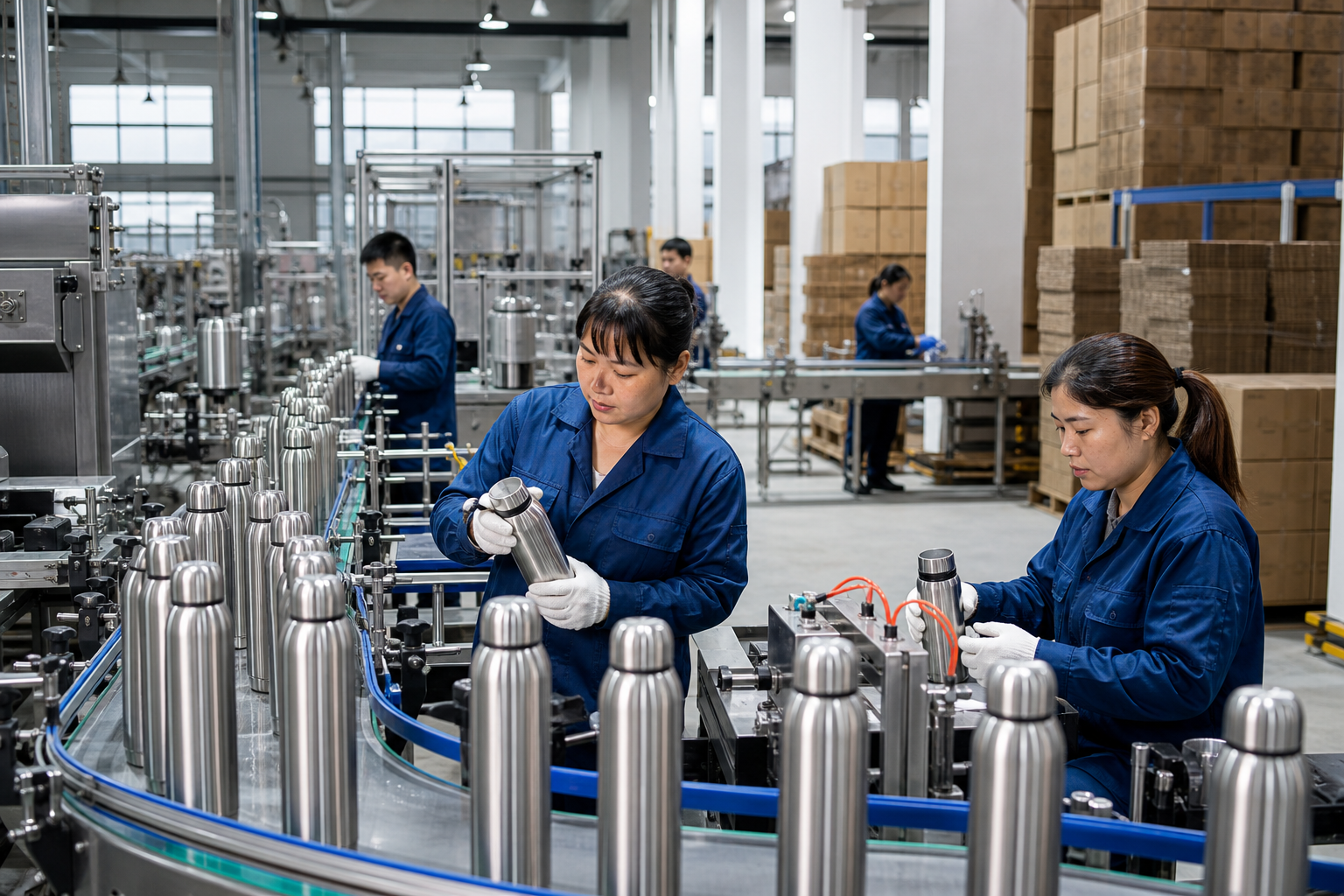
At BottleForge in Hangzhou, Zhejiang, we see buyers come in with a target price and no spec sheet, then lose a week because capacity, steel grade, lid style, and drop-test requirement were never fixed. QC pulled the sample at 1.2 mm wall thickness and the buyer flagged the cap thread after the first fit test. China has plenty of canteen makers. The gap between a cheap quote and a steady factory shows up in sampling, and the math does not work if the line cannot hold tolerance, pass REACH, and ship on time at MOQ 500 to 3,000 pieces.
What buyers really need to spec
If you work with an alcohol flask distributor model, you are not buying “one bottle.” You are buying a repeatable spec the factory can hold across cartons, lots, and reorders. Start with capacity, then lock the material, finish, lid, and decoration method. For stainless liquor flasks, common sizes are 6 oz, 8 oz, and 10 oz. For a distributor drinkware program, 18 oz to 32 oz is more common when the same supplier also runs a custom canteen or custom growler line.
Do not skip the boring details. Ask for steel grade, usually 304 or 201, and ask for wall thickness in mm, not “thick” or “premium.” We run 0.6 mm, 0.7 mm, and 0.8 mm on the line, and a real canteen manufacturer should tell you where the thickness changes after forming. The cap matters too: PP, stainless, bamboo-look, or TPE-sealed leakproof lids. If you want a canteen customized for retail, state the packaging: single box, egg-crate tray, or bulk pack. A buyer once flagged “5-6 pcs” on a PO typo, and the carton plan had to be redone. Packaging can move freight cost by 10% or more.
- Capacity: 6 oz, 8 oz, 10 oz, 18 oz, 24 oz, 32 oz
- Material: 304 stainless for better corrosion resistance
- Finish: brushed, matte powder coat, mirror polish, or painted
- Logo: laser, screen print, UV print, emboss, or deboss
In Zhejiang, a good canteen factory will ask these questions before quoting. If they do not, the math does not work. QC pulled the sample, checked the lid seal at 1.2 mm compression, and that is the kind of factory habit that tells you you are dealing with a canteen supplier built for repeat orders, not a canteen vendor chasing one PO.
Materials that protect your margin
For alcohol-related drinkware, material choice is about flavor neutrality, dent resistance, finish quality, and reject rate. 304 stainless is the standard for most custom drinkware because it keeps cost and performance in the same lane. On a 5,000 pcs run, 201 stainless can cut ex-factory price by 10% to 18%, but it is less forgiving in humid warehouses and on 18-day sea freight. If your buyers want a premium line, 304 is the safer call.
Wall thickness is where a lot of canteen distributors get caught. A flask can look fine in photos and still land with 0.4 mm walls and a soft body. We’ve seen that pass on a giveaway order, then fail the buyer’s retail check the next season. For liquor flasks, 0.6 mm works. For a stiffer hand feel, 0.7 mm to 0.8 mm is the better spec. If you are sourcing a customizable growler or customizable canteen for a brand program, ask the canteen manufacturer for a cross-section sample and pressure test results from the line.
“If a supplier cannot tell you the steel grade, wall thickness, and seal material in one reply, they are not ready for distributor volume.”
Look for REACH compliance if your cargo enters Europe, and ask for food-contact test reports if your market requires them. QC pulled one sample with a gasket typo on the PO last month, and that kind of miss is small but expensive. In China, the better canteen manufacturers also know BSCI, ISO 9001, and the paperwork your forwarder wants. That saves days when you reorder from a Zhejiang canteen supplier for the next season.
Branding methods that survive use
Branding on custom drinkware looks easy until the first abrasion test. Laser engraving is the toughest option for an alcohol flask distributor program because the mark sits in the steel and does not peel. It works best on brushed stainless steel and gives a clean premium look. Silk screen costs less and fits large logo areas, but it will wear if the flask gets tossed into bags or washed hard. UV print gives color range, while powder coating brings a strong retail look and adds process time. It can also bury fine detail.
For a canteen customizable line, pick the decoration method based on how the item will be sold. If the buyer wants corporate gifts or canteen promotional campaigns, a one-color screen print keeps cost down and still looks sharp. If you are building a custom canteen for outdoor retail, laser engraving or embossing usually brings higher shelf value. For a customized growler, check the print zone against the grip area and the handle weld. We had a buyer flag that on a sample once; the logo sat 8 mm too close to the weld. Basic mistake. It happens.
Choose decoration around use, not only cost
A canteen distributor should ask for a rub test, dishwasher assumption, and packaging test. If you need a reusable branded item that will move through distributor channels, spec the logo size in mm and request a pre-production sample. At BottleForge, our Hangzhou plant runs about 120,000 units per month across drinkware lines, so we keep repeat print placement tighter than a small workshop. QC pulled the sample on one run because the logo shift was 1.5 mm, and that is the kind of miss that turns into a claim later. The math does not work if the first carton from Zhejiang and the reorder do not match.
MOQ, pricing, and lead time reality
Most buyers ask for one clean unit price. That is the wrong question to ask first. At the line, we need the MOQ and pack spec before the number means anything. For an alcohol flask distributor, the normal MOQ is 500 pieces for a simple stainless flask and 1,000 pieces for a more customized canteen or customized drinkware run. If you want multi-color artwork, special lids, or retail boxes, MOQ usually moves to 3,000 units or more. We had a buyer flag a PO with “gift box” but no box size; the quote changed the next day because the carton die line had to be reset.
For reference, a basic 6 oz stainless flask in 304 steel can start around USD 1.20 to 1.80 FOB China at 1,000 units, depending on finish and logo. A powder-coated 18 oz canteen customized for retail often lands around USD 2.80 to 4.50 FOB at 1,000 units. A more premium customizable growler with thicker steel, a handle, and better lid hardware can run USD 5.50 to 9.00 FOB. These numbers shift with exchange rate, steel price, and carton spec, but they are good for budgeting. On our side, QC pulled the sample and checked weld seams at 0.2 mm tolerance before we even talked about final price.
Lead time matters as much as unit price. A sample usually takes 5 to 10 days. Mass production after sample approval is normally 25 to 40 days from a Zhejiang canteen factory. Add 30 to 45 days for ocean shipping to Europe or North America. If you sell seasonal stock, order before the selling window, not after. The cheapest quote is useless if it lands 20 days late. We shipped one 12,000-piece run to Rotterdam in 38 days on production, but the buyer missed summer sell-in because they signed off on the proof too late.
Testing, compliance, and defect control
Distributor drinkware is not complicated, but it fails in the same places every time: pinholes, loose seals, logo drift, coating chips, and crushed cartons. On one run last month, QC pulled three leakers from a 500-piece sample because the cap gasket was 0.3 mm off. A real canteen manufacturer should give you leak testing, salt spray checks on coated parts, and visual inspection against one signed standard. For export orders, ask for AQL references. AQL 2.5 for major defects and 4.0 for minor defects is common on consumer drinkware; if the buyer is retail-heavy, we run tighter numbers.
If your market is the EU, ask for REACH papers for coatings and inks. If you sell into the US through retail or e-commerce, lock down packaging and barcode rules before production starts. For Amazon-style distribution, the buyer flagged a wrong FNSKU on a PO before the line started, and that saved a messy relabel job at the warehouse. You may also need suffocation warnings and carton marks. For liquid-contact products, ask for material declarations and the test method used, not a generic “food safe” line.
- Leak test: 100% on finished units or a defined sampling plan
- Drop test: 1 meter, 3 faces, depending on channel
- Coating test: cross-hatch or rub test for printed finishes
- Carton standard: 5-layer outer box for export loads
In China, the gap between a canteen vendor and a real canteen factory shows up in the quality system. Ask for production photos, in-line QC checkpoints, and the final inspection report before you release balance payment. We’ve seen this go sideways when the supplier sent only a packing photo and skipped the 72-hour seal check. That’s the wrong question to ask if you want fewer claims later.
Building a repeat order program
If you want a distributor program that scales, do not treat each PO as a one-off. Build one product family and keep the parts moving. One body shape can cover a custom canteen, a canteen promotional item, and a custom growler, then you change only capacity, lid, and color. That gives you cleaner mold amortization and less dead stock on the shelf. A canteen manufacturer with solid tooling discipline can hold the same neck finish and thread standard across 3 SKUs, so the buyer does not come back later asking why the cap does not fit.
For seasonal buying, split the order into a test run and a replenishment run. We usually run 500 to 1,000 units first, enough to check print wear, carton drop results, and what the end customer says after launch. If sell-through is strong, lock the second PO fast so the same raw material batch stays in play. This matters more in Zhejiang and across China than some buyers expect; one powder coat lot at 1,000 pcs can shift shade by a half step, and QC pulled the sample if the color delta was off. Pick a canteen supplier that can handle custom drinkware and repackaging too, not just the lowest FOB quote. The math does not work if your distributor eats the rework.
Smart distributors keep one spec sheet for every reorder. Put the approved photos, exact PMS/ Pantone references, carton dimensions, and logo position on it, then stop editing the PO by email. We have seen a buyer flag a typo on a PO that changed the logo from 12 mm to 21 mm, and the whole carton had to be held back. Once that sheet is locked, a canteen distributor quotes faster, a canteen supplier ships cleaner, and your team spends less time fixing avoidable mistakes.
Send your flask spec for a fast factory quote
We will review your capacity, material, logo, MOQ, and lead time, then quote from our Hangzhou, Zhejiang production line without guessing.
Frequently asked questions
What MOQ should I expect from an alcohol flask distributor factory?
For a standard stainless flask, 500 pieces is a normal MOQ in China. If you want a customized canteen, special lid, or multi-color print, 1,000 to 3,000 pieces is more realistic. A Zhejiang canteen factory may quote lower, but setup costs still exist. At 1,000 units, unit pricing usually improves by 8% to 15% versus 500 units.
Is 304 stainless always better than 201 for custom drinkware?
For most alcohol flask and custom canteen programs, yes. 304 stainless gives better corrosion resistance and a more premium buyer perception. 201 can reduce FOB cost by 10% to 18%, but it is less forgiving in humid storage and long transit. If you sell into retail or export, 304 is the safer choice unless your margin target forces a budget line.
How long does production take in a canteen factory?
After sample approval, typical production takes 25 to 40 days in China, including printing and packing. If you need special coating, gift boxes, or multiple SKUs, plan closer to 35 to 50 days. Ocean freight to Europe or North America usually adds 30 to 45 days, so a reorder can take 2 to 3 months door to door.
Which logo method is best for a distributor growler or flask?
Laser engraving is the most durable and usually the best choice for stainless steel. Silk screen is cheaper and works for simple branding, but it can wear over time. UV print gives color flexibility, while powder coating creates a strong retail look. For a customized growler or canteen customizable order, choose based on how the product will be used, not just decoration cost.
What inspections should I request before shipment?
Ask for leak testing, carton drop testing, and visual QC against an agreed AQL standard. AQL 2.5 major and 4.0 minor is common for custom drinkware. For Europe, request REACH-related documents for coatings and inks. For retail or Amazon channels, also confirm barcode, carton marking, and packaging requirements before mass production starts.