Key Takeaways
- Typical MOQ for alcohol flask factory direct orders starts at 500-1,000 pcs, with 15-25 day lead time after sample approval.
- A 304 stainless flask with 0.5 mm wall thickness usually lands around USD 2.10-3.80 FOB China, depending on finish and packaging.
- For EU and North America, ask for REACH, LFGB, and traceability paperwork before you approve production.
- A good custom drinkware factory should quote AQL 2.5 for critical defects and 4.0 for minor defects, not vague “quality checked” language.
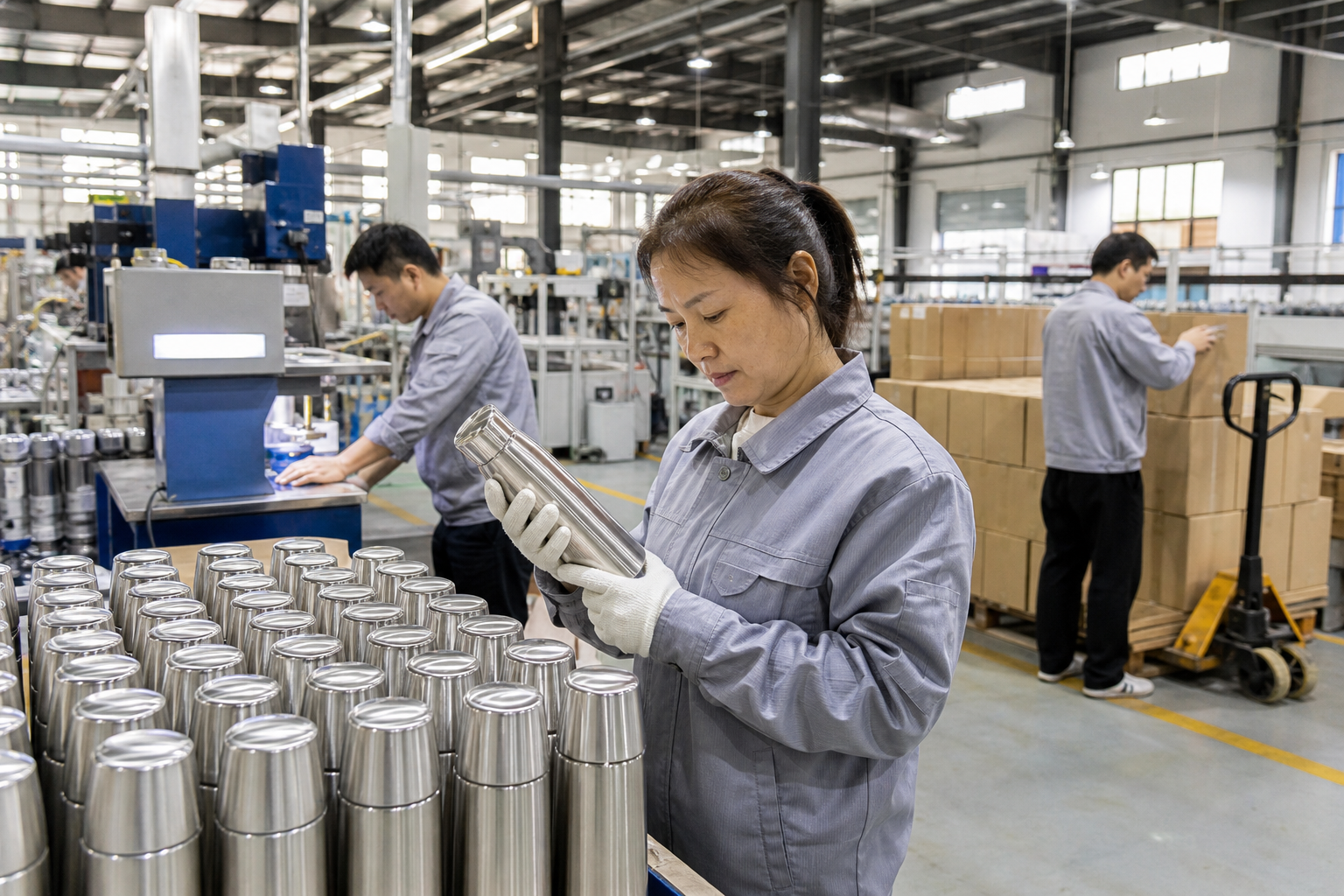
If you are buying alcohol flask factory direct, the real question is not “can they make it?” It is whether the factory can protect your margin, pass compliance, and still ship on time. We run a line here in Zhejiang, and the difference shows up fast in MOQ, finish quality, and carton packing. One buyer once sent a PO with the wrong cap code, and QC pulled the sample before we even started sampling.
You are likely comparing a canteen supplier, a canteen manufacturer, and a canteen vendor, while trying to decide whether a custom canteen or custom growler fits your channel. Fair enough. A factory that ships 2 million units per month sees the math differently from a trading desk that just forwards files. We have seen this go sideways when the buyer asked for 0.5 mm wall thickness, brushed finish, and gift box inserts at the same price. Buy once, and buy with a spec sheet that holds up.
Why factory direct changes your margin
Buying alcohol flask factory direct changes the math. Every hand in the chain takes margin and adds another round of email. We see it on the line all the time: a trader adds 12% to 18%, then the buyer still has to fix artwork, lid color, and carton wording with the actual maker. A real canteen factory or canteen manufacturer in China can quote in 24 hours, turn a proof in 1 to 2 days, and tell you if your logo will fail on the curved body. That matters for a launch, a holiday promo, or a distributor reorder.
For a standard 6 oz or 8 oz flask, a Zhejiang factory may quote USD 1.20-2.40 for basic 201 stainless, or USD 2.10-3.80 for 304 stainless with brushed finish and one-color logo. If you add gift boxes, laser engraving, or a velvet sleeve, the price jumps fast. That is the right question to ask: what is driving the number? Material grade, 0.6 mm wall thickness, seam method, polishing level, and decoration process. QC pulled the sample and checked the seam under a 10x loupe; if the weld line is ugly, the buyer flags it before we ship. A good custom drinkware supplier puts those cost items on the quote, not in the footnotes.
- Ask for FOB China pricing, not just EXW, so you can compare apples to apples.
- Confirm material grade: 201 for budget, 304 for better corrosion resistance, 316 if you need a premium story that holds up in salt-air markets.
- Check capacity: a stable Zhejiang factory should handle 500,000-2,000,000 units per month depending on product mix.
What a real spec sheet should show
If you are talking to a canteen supplier, do not accept a one-page brochure as a spec sheet. We need a production document that tells us what the factory will actually make on the line. For a customized canteen or customized drinkware program, the non-negotiables are capacity, dimensions, material, and test standard. If your buyer team in North America or Europe sees a gap, they will ask for it later anyway, and that pushes approval back.
A useful spec sheet should list capacity in ml and oz, body thickness, lid material, gasket material, finish type, and decoration area. On stainless flasks, 0.4-0.6 mm thickness is common; 0.5 mm is the practical middle point for mass-market orders. We had a buyer flag a PO once because “thick wall” was typed on the order, but no gauge was shown. That math does not work. The same goes for weld quality, cap thread tolerance, and odor control. If you are sourcing a customizable canteen for promotional retail, one bad seam can kill a channel launch before the first carton lands.
Minimum specs worth demanding
- 304 stainless steel for food-contact inner body on mainstream export orders
- Silicone or food-grade EVA gasket with leak test at 100% of production lot
- AQL 2.5 for major defects and AQL 4.0 for minor defects
- Drop test, odor test, and 24-hour leak test before shipment
Factories in Zhejiang that really know export work will put these numbers on the sheet without drama. QC pulled the sample, checked the gasket fit, and signed off on a 24-hour leak test at the bench. If a supplier cannot give you that level of detail, they are not ready for serious distributor canteen or distributor drinkware business.
MOQ, tooling, and realistic pricing
Every buyer asks about MOQ first, but the better question is what sits inside that MOQ. A real canteen manufacturer splits it three ways: product MOQ, logo MOQ, and packaging MOQ. For a basic flask run, 500 pcs per color is standard for stock-body custom print. If you want a new color or special packaging, 1,000 pcs is the number we usually see. QC pulled a sample last week with a 0.3 mm lid gap, and the buyer flagged it before we packed the line.
If you need a custom growler with a unique lid, budget tooling or mold fees of USD 300-1,500, depending on how many parts change. That is normal in China. The mold shop in Zhejiang may sit 20 minutes away, but the quote still changes fast once the buyer asks for a threaded cap or a nonstandard gasket. The wrong question to ask is, "Can you make it cheap?" Ask what the tool includes, or the math doesn't work.
Here is what buyers miss: a low unit price with weak packaging is not cheap if the return rate climbs. A flask sold into Europe may need an individual polybag, carton divider, and master carton test. For Amazon or retail distribution, barcode placement matters. If you need FNSKU labels, carton marks, and palletization, packaging adds USD 0.15-0.60 per unit. On a 1,000-unit order, that is real money. We once shipped cartons with a PO typo on the case count, and the buyer ate two extra days at the warehouse.
If you work with a canteen distributor or canteen distributors outside China, compare landed price against factory direct, not just the ex-factory number. A factory quote of USD 2.40 FOB can still beat a domestic distributor quote of USD 4.10 when the print is tighter and lead time is 10 days shorter. We run that comparison every week, and the buyer usually sees the gap only after freight, duty, and rework are added. That is why direct sourcing is the smarter model for custom canteen and distributor growler programs.
Do not chase the lowest quote unless the factory can name the thickness, test method, and packout standard in writing.
Decoration choices that survive export
Your decoration choice changes more than the look. It changes unit cost, scrap, and whether the logo still reads clean after 6 months in transit and on a store shelf. For custom drinkware, we usually quote screen print, laser engraving, heat transfer, and pad print. On stainless flasks, laser engraving lasts the longest, but it is not the cheapest line item. Screen print works for a 5,000-piece promo run if the art stays simple and you keep it to one or two Pantone colors. If the buyer wants shelf impact, we run a brushed body with a laser logo or a full-color wrap with a protective coat. The buyer flagged a 0.2 mm thin line on a PO once, and QC killed it before we started the line.
For a customizable growler or customized growler, the decoration area is larger, so registration matters. For a canteen promotional program, the math usually points to low unit cost and a 10-15 day turnaround, not a luxury finish. Fine text, thin lines, and gradient-heavy art give trouble. We see it on the first proof. A decent factory in China will tell you the art is too fine for the method instead of taking the order and hoping for the best. That saves rework, and it saves face on both sides. We had a buyer push back on this last quarter, then the sample came out blurry at 300 dpi.
Ask your canteen vendor how they control color. If they cannot show a sample under daylight or D65 lighting, you are guessing. Good export factories in Zhejiang keep a signed master sample and pull it during production. We run the same check on the bench before packing. The PO typo we see most is one wrong Pantone code, and that one digit can ruin a whole batch. That is the standard worth paying for.
- Laser engraving: durable, clean, usually +USD 0.10-0.40 per unit
- Screen print: cost-effective, but design complexity must stay low
- Full-color wrap: best for retail stories, higher reject risk if artwork is not controlled
Compliance for Europe and North America
If you sell into Europe or North America, compliance is part of the deal. Your customized drinkware order needs material declarations, migration tests where the product calls for them, and batch records you can trace back in 10 seconds. For Europe, buyers ask for REACH, LFGB food-contact confirmation, and SVHC screening when the cap liner, print ink, or gift box enters the spec. For North America, the common file set includes FDA-related food-contact statements, Prop 65 awareness, and test reports tied to ASTM or ISO methods, depending on the channel.
Do not assume the factory knows which market you are targeting. Spell it out on the PO. We have seen a buyer mark “EU” in the email and “US” on the carton label, and the whole file had to be redone. A serious canteen manufacturers or canteen suppliers team will ask whether you need carton drop tests, 24-hour salt spray checks for painted lids, or dishwasher resistance for retail packaging. If you are using a custom canteen as a premium gift, print rub test results matter. If it is a distributor item, lot code, production date, and inspection record matter even more.
In Zhejiang, better export factories run a clear QC flow: incoming material check, in-process leak check, final AQL inspection, and carton drop testing. We use a torque wrench on lid samples and log the result by lot. If you are comparing a distributor canteen program with a direct factory order, that paperwork often decides the deal. Low-price suppliers can look fine until customs or a retailer asks for the file. Then the math does not work.
Documents you should request before PO
- Material data sheet for 201/304/316 stainless steel
- Food-contact declaration and migration test report if needed
- QC report with AQL levels and inspection photos
- Commercial invoice, packing list, and carton count sheet
How to qualify the factory
There are plenty of canteen suppliers in China. Few are set up for export work that holds up after the second PO. When you qualify an alcohol flask factory direct partner, ask for real monthly output, not the website number. If they quote 50,000 pieces per month, ask whether that is one line or the full shop. In Hangzhou and the rest of Zhejiang, a solid factory usually runs stainless flasks, insulated bottles, and custom growler models on the same site, so mixed orders do not turn into a mess.
Visit if you can. If not, ask for a live video from the line: raw sheet, stamping, welding, polishing, leak test, packing. We ship that way all the time. A canteen distributor can talk around the process, but only a real canteen factory can show the forming press, the vacuum tester, and the carton drop test in one shot. Sample timing matters too. A standard structure should give you a pre-production sample in 5-7 days and a revised sample in 3-5 days. QC pulled the sample on a 10 mm lid gap before it left the shop.
Here is the practical filter: if the supplier cannot explain why one SKU needs a different lid gasket or why a 0.4 mm body is a bad call for your channel, they are not engineering your order. They are passing it along. The math does not work. For serious custom drinkware buyers, that is the line that separates a factory from a middleman. We saw one PO with “stainles” typed in the description, and the buyer flagged it before production.
- Request current capacity by line, not generic “factory strength” language
- Ask for in-house QC staff count and inspection frequency
- Confirm whether they handle OEM packaging and carton testing
Get a factory-direct flask quote today
Send your capacity, logo file, and target market. We will quote material, decoration, packaging, and FOB pricing with no vague numbers.
Frequently asked questions
What MOQ should I expect for alcohol flask factory direct orders?
For standard OEM flask orders, 500-1,000 pcs per design is common, with 500 pcs per color if the body is stock and only the logo changes. If you need new tooling, special lids, or a fully customized canteen shape, MOQ can move to 2,000 pcs. For premium packaging, the packaging MOQ may be separate. A serious Zhejiang factory should state all three: product MOQ, print MOQ, and carton MOQ. If they only say “flexible,” keep asking until you get numbers.
How much does a custom stainless flask cost FOB China?
A basic 201 stainless flask often starts around USD 1.20-2.40 FOB China. A better 304 stainless version with brushed finish and one-color logo usually lands around USD 2.10-3.80. Laser engraving, gift boxes, and specialty lids add cost. If you want a custom growler or a double-wall build, pricing is higher because the material and forming losses are higher. Always compare FOB, not EXW, so you can estimate actual landed cost for Europe or North America.
What compliance documents should I request for EU and US sales?
For Europe, ask for REACH documentation and food-contact declarations; LFGB test reports are often requested by buyers even when not strictly required for every channel. For North America, ask for food-contact support documents, traceability by lot, and any relevant migration or material test results. If your bottle is coated or printed, ask about ink and coating compliance too. A good canteen manufacturer in Zhejiang should be able to provide a material declaration, QC report, and batch identification before shipment.
How long does production usually take after sample approval?
For standard custom drinkware orders, 15-25 days after sample approval is normal. If the order is simple and the factory has raw materials in stock, 10-15 days is possible. If you need a special color, unique mold, or large packaging run, add time. In busy periods, Chinese factories in Zhejiang may need another 3-7 days just to secure packaging materials. A real supplier will tell you the difference between production time and packing time.
Should I use laser engraving or screen printing on flasks?
Use laser engraving if you want durability and a cleaner premium look. It usually costs about USD 0.10-0.40 more per unit, but it lasts better through handling and washing. Use screen printing if your design is simple, the order is promotional, and cost matters more than long-term wear. For a canteen promotional campaign or distributor canteen program, screen print is often fine. For retail or premium corporate gifts, laser engraving is usually the safer choice.