Key Takeaways
- Typical MOQ for a custom alcohol flask starts at 500-1,000 pcs, with 30-45 days lead time from approved sample.
- 304 stainless steel at 0.5-0.6 mm is the safest spec for most customized drinkware programs.
- Laser engraving usually survives 500+ rub cycles; silk screen is cheaper but less durable for canteen promotional orders.
- A good Zhejiang supplier will support AQL 2.5 inspection, REACH paperwork, and FOB pricing in USD for repeat distributor drinkware orders.
If you are sourcing an alcohol flask factory, you are not buying a shiny 6 oz container. You are buying a repeatable spec, stable quality, and a supplier who ships the same part on the next reorder without changing the cap, the weld, or the print. That is where a lot of B2B buyers get burned. The pre-production sample passes, then the 5,000 pcs run shows off-center logos, weak seams, or a finish that fails the rub test on the line.
In Zhejiang and across China, a decent factory knows the gap between a one-off promo piece and a distributor program. We run 304 stainless steel, 0.5 mm or 0.6 mm wall thickness, AQL 2.5 inspection, and 30-45 day lead times. If your PO says 6 oz but the buyer typed 8 oz by mistake, the math does not work, and QC will catch it before packing. For retail, gifting, or corporate campaigns, you need that same discipline in custom drinkware, and the right canteen factory should handle custom canteen, customizable canteen, and customized drinkware orders without turning every reorder into a new project.
What a flask factory really sells
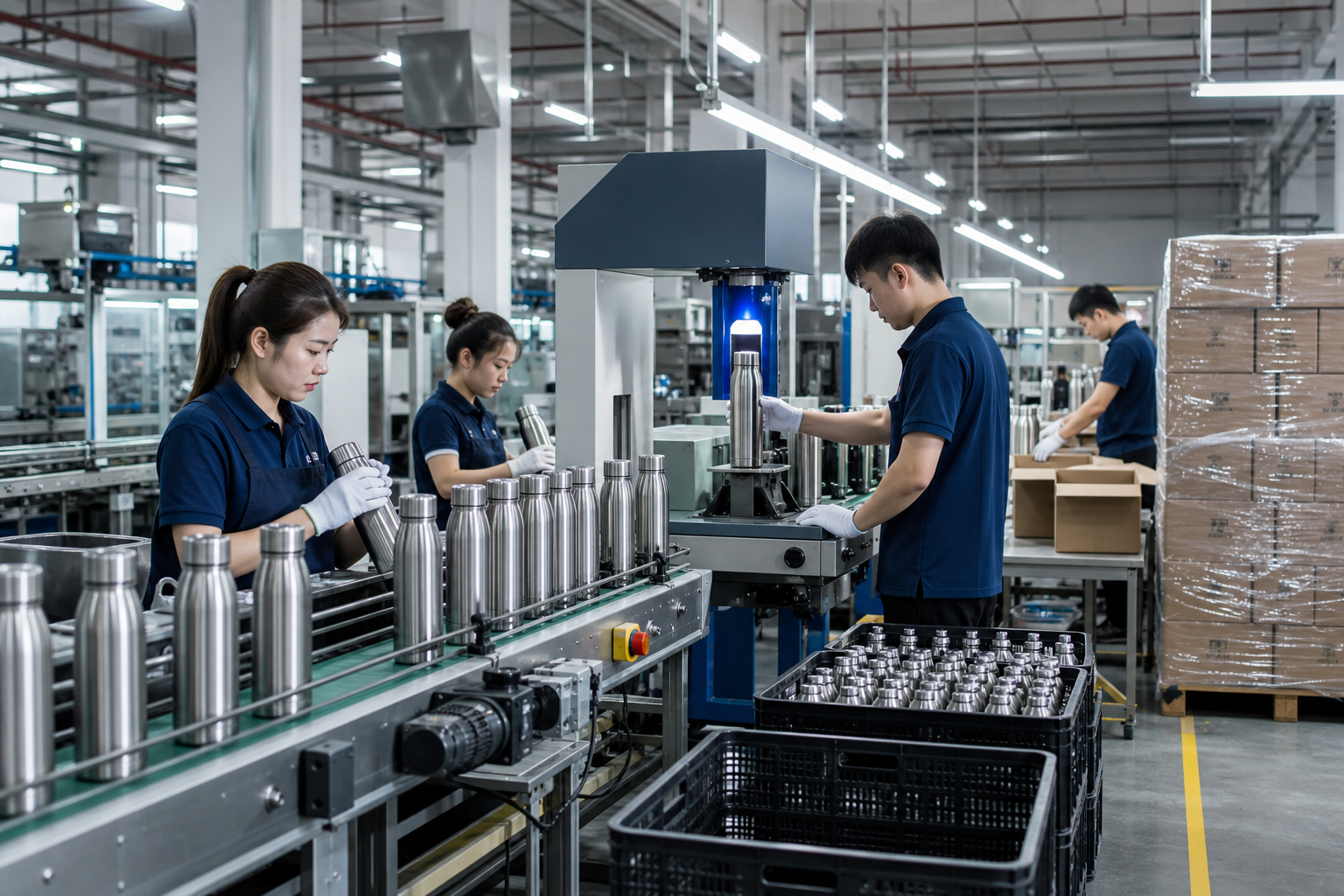
Buyers search for an alcohol flask factory and think they are buying the metal body and cap. They are not. What you are paying for is process control: stamping, seam welding, leak testing, surface finishing, logo application, packing, and export paperwork. A factory that runs those steps in-house is worth more than a cheap quote from a trading middle layer. We’ve seen that math fail fast when the buyer flags a leaking seam after shipment.
In Hangzhou and across the Zhejiang manufacturing belt, a solid canteen manufacturer usually runs several product lines: custom canteen, custom growler, and customizable drinkware for retail and promotion. The same shop may also ship for distributors who want the same SKU month after month. Ask for monthly output in units and ask how they keep food-contact lines separate; a 304 stainless run should not sit next to a coated line with dust on the bench. If the answer stays general, we know the line is not organized for B2B.
At BottleForge Industrial, we run 500,000 units a month across drinkware categories, and that scale matters when you need a clean reorder. A real canteen factory should give you a straight MOQ, usually 500 pcs for simple laser engraving and 1,000 pcs for full-color decoration. If they dodge the number, stop there. QC pulled the sample on one PO because the buyer typed the logo size wrong by 3 mm, and that kind of typo costs money. Ask for 3rd-party test reports, not a sales promise.
Pick the right metal and finish
For an alcohol flask, 304 stainless steel is the standard commercial spec. It holds up better against corrosion than lower-grade steel, and for export drinkware we treat it as the safe starting point. If the buyer pushes for premium retail or a wet market, 316 stainless steel comes up fast, but the math is simple: expect 8-15% more. Wall thickness matters too. We run a 0.5 mm body for lightweight promo SKUs, while 0.6 mm gives a firmer hand feel and cuts dent complaints when cartons get tossed around on the distributor side.
Do not let a canteen vendor sell “premium” based on brushed or mirror finish alone. Ask what the line looks like after stamping. If deburring is sloppy, the edge feels sharp or residue gets trapped under the cap, and QC pulled the sample for that exact issue last month. A proper canteen manufacturer will quote electro-polish, brush finish, matte powder coat, or color spray, then show adhesion test results. For canteen promotional orders, powder coating usually wins on shelf appeal, but it adds about USD 0.20-0.60 per unit depending on color and batch size—cheap-looking finish is the wrong place to save money.
- 304 stainless steel: best balance of cost and compliance for most custom drinkware
- 316 stainless steel: better for aggressive environments, higher price
- 0.5 mm wall: lighter, lower cost, more promo-focused
- 0.6 mm wall: stronger hand feel, better for distributor drinkware
If you are also sourcing a customized growler or canteen customizable line for the same account, keep the metal grade and finish logic aligned across SKUs. One PO typo we fixed had 304 on the flask and 201 on the growler, and that kind of mismatch burns time on re-quoting. Matching spec sheets makes freight planning and replenishment cleaner for canteen distributors.
Logo methods that survive use
Decoration is where a lot of distributor drinkware programs go off the rails. We see the sample get approved, then the print starts fading after 2 or 3 washes. No mystery there. The factory method matters. For an alcohol flask factory, the usual choices are laser engraving, silk screen, heat transfer, and UV print, and each one behaves differently on stainless steel.
Laser engraving is the cleanest option for metal flasks. It will not peel. On brushed stainless, the line looks sharp and stays put. For a one-color logo, we usually see the best value there. Silk screen works on larger flat graphics, but if the buyer plans heavy use, the ink can show wear after repeated washing. UV print gives more color, yet the surface has to be prepped right and the curing time has to be controlled. QC pulled the sample last week and the buyer flagged a faint edge lift after the tape test, so we do not ship that method blind. If you are selling custom canteen or customized canteen sets to retail, ask for rub test or tape test results before we run the order.
Here is the practical rule: if the flask sits in a gift box, color print is fine. If it goes into bars, outdoors, or a traveler’s backpack, laser engraving is the safer call. This is the wrong question to ask if someone says “can you make it nicer?” Ask what the flask will go through. A good canteen factory in Zhejiang will show you the decoration limit by surface shape, and that matters because a curved body can warp artwork by 2 or 3 mm. We had one PO with “logo 25cm” typed in by mistake; the buyer meant 25mm, and that kind of typo costs time. Ask for vector proof and final logo size in millimeters, not “around this size.” Precision saves rework.
MOQ, price, and lead time
Buyers often ask for price before they lock the spec. That usually gives you junk quotes. On our line, flask price comes down to volume, 304 or other steel grade, finish, logo method, and packing. A plain 6 oz 304 stainless flask with no logo usually lands around USD 1.10-1.60 FOB China at 1,000 pcs. Add laser engraving and a simple gift box, and the number moves to USD 1.50-2.40. Powder coating, custom insert cards, or a multi-piece gift set push it higher. We had one buyer flag a PO typo on "gift bx" and the carton plan was off by 8 mm, so the quote had to be redone.
MOQ is the real filter. A canteen distributor covering multiple retail doors may need 2,000-5,000 pcs per SKU, while a small brand can start at 500 pcs if the factory is running cleanly. This is the wrong question to ask if you have no artwork yet. Clean artwork and a clear carton spec get the order moving faster. Standard lead time is 30-45 days after sample approval and deposit. Mixed SKUs usually add 7-10 days because packing and QC slow down; QC pulled the sample last week and found one logo shift of 1.5 mm, so the rework ate half a day.
Ask for a quote in FOB Ningbo or FOB Shanghai, with carton size, gross weight, and HS code on the same sheet. If the sales rep cannot give that straight away, the export setup is not solid enough. We ship better when the basics are pinned down.
For canteen promo runs, lead time often matters more than chasing the lowest unit price. A Zhejiang factory should tell you where the bottleneck sits: raw tube stock, logo curing, or export carton supply. If they dodge that question, they are guessing. We run into this with 18-day promises that turn into 28 days once the tube mill slips, so the math does not work if you plan a store launch on paper only.
Compliance and quality checks
For North America and Europe, compliance is not optional. Your alcohol flask factory needs food-contact paperwork, REACH files for the metal body and coating stack, and a clean record on inks, lids, and silicone parts. If you sell into the US, ask about Proposition 65 before the shipment leaves the line. We have seen a buyer flag a listing because a cap insert had no test file. That mistake costs time.
QC has to be written into the order. We run incoming material checks, in-process inspection, final AQL 2.5 sampling, and random drop and leak tests. On flasks, a 3 psi leak test beats a glossy carton every time. A 1-meter drop test on a packed unit matters too; one carton spec we checked had a 72% pass rate in transit, not in use. The math does not lie.
Ask the canteen manufacturer for a defect map: dents, scratches, weak sealing, print offset, cap failure. Set the limit before production starts. Zero critical defects, 1.5 major defects, and 4.0 minor defects is a common AQL structure, but the PO needs the exact numbers and the test points in black and white. One order came in with “seal proof” typed as “sale proof”; QC pulled the sample, found a 0.6 mm gap at the neck, and we stopped the run. That is how a canteen factory in China protects both sides. In Zhejiang, good suppliers know this drill and usually do not push back unless the process is already shaky.
How to brief a factory
The cleanest orders are the ones with the fewest assumptions. For a customized growler or flask, we want one brief sheet with capacity, metal grade, body thickness, surface finish, logo method, logo size, packing method, carton spec, and delivery date. A missing line on the PO turns into a sample delay fast. Send the spec before sample making starts.
Use millimeters, ounces, or milliliters. Do not write “standard size.” If you need a canteen customizable style for promotions, spell out whether the cap is threaded, screw-on, or attached by chain. We had a buyer flag a cap note because the drawing said “top cap” and the line built the wrong one. For canteen custom artwork, send AI, EPS, or PDF files. QC pulled the sample, checked Pantone references, then marked the print position on the proof.
Good buyers ask for production photos at three stages: blank body, decorated sample, packed cartons. That keeps distributor growler and distributor canteen programs from going sideways. If you want a canteen factory to handle repeat orders, ask who your account handler is, who signs off on QC, and whether the factory stores tooling for the next run. We run into 12-day repeat jobs versus 18 days when tooling is missing, so this is the wrong question to skip. A real canteen supplier keeps the die, the jig, and the order file.
Choosing a partner in Zhejiang
There is a reason serious buyers source from Zhejiang. The metalworking base is deep, export docs are routine, and the factories here know how to run for overseas retail. But China is still a broad market, and not every supplier keeps the same discipline. You want a canteen manufacturer that can handle branded promo work and repeat distributor programs without changing the process every time you place an order. We had one buyer flag a PO typo on “500ml” versus “550ml”; the line caught it before packing, and that saved a week.
A solid partner will talk straight about sample cost, tooling if needed, and the gap between a trial order and a 12-month contract. They should also know how to support distributors with carton specs, barcodes, and shelf-ready packaging. If you also buy customized canteen, canteen promotional, or customizable canteen lines, ask whether the same QC team handles all of them. Shared control usually means fewer surprises. QC pulled the sample at 1.2 mm wall thickness once, and the buyer’s pushback on print rub was solved before mass run.
In practice, the best factory is the one that answers fast, writes things down, and refuses to overpromise. If a Zhejiang factory says yes to every finish, every capacity, and every deadline without checking the line load, that is not confidence. That is risk. We’ve seen this go sideways. The best alcohol flask factory is boring in the right way: 18-day lead times that stay 18 days, clean pricing, and repeatable quality on reorders. One order, one spec, no drama.
Request a flask quote with your exact spec
Send capacity, steel grade, logo file, and target MOQ. We will quote FOB China, sample lead time, and packing details without guessing.
Frequently asked questions
What is the usual MOQ for an alcohol flask factory in China?
For most custom flask orders, MOQ starts at 500 pcs for simple laser engraving and 1,000 pcs for printed or coated styles. If you need custom box inserts, mixed colors, or special caps, the MOQ often rises to 2,000 pcs because setup time and packing change. A Zhejiang factory with stable lines may accept lower trial quantities, but expect a higher unit price by 10-25%. If you are planning distributor drinkware replenishment, 1,000-3,000 pcs per SKU is the practical range for a clean FOB quote.
How much does a custom 6 oz flask cost from China?
A plain 6 oz 304 stainless flask with no logo usually sits around USD 1.10-1.60 FOB China at 1,000 pcs. Add laser engraving and simple packaging, and you may reach USD 1.50-2.40. Powder coating, gift boxes, or multi-piece sets can push the number higher. If you want 316 stainless steel, budget 8-15% more. Always ask for pricing with carton dimensions, because freight can change the real landed cost more than the factory price.
Which logo method lasts longest on metal flasks?
Laser engraving is usually the most durable choice for a metal flask because it does not peel or crack. It is especially good for distributor canteen programs, outdoor use, and gift items that will be handled often. Silk screen is cheaper, but it is more vulnerable to abrasion and washing. UV print gives more color flexibility, but it needs controlled surface prep. If you expect heavy use, ask the factory for a tape test or rub test result before mass production.
What compliance documents should I ask for?
For Europe and North America, ask for food-contact material declarations, REACH support, and any relevant coating or ink test reports. If you sell in the US, check whether Proposition 65 issues could apply to any accessory components or coatings. You should also ask for AQL 2.5 inspection records, leak test procedures, and if possible third-party test reports from a recognized lab. A serious alcohol flask factory in China will not treat paperwork as an afterthought.
Can one factory handle custom canteen and custom growler orders too?
Yes, many canteen manufacturers in Zhejiang can handle custom canteen, customizable canteen, customized growler, and related customized drinkware programs if they have the right forming and decoration lines. The key is whether the factory actually controls the process in-house or outsources half of it. Ask about monthly capacity, MOQ by SKU, and whether the same QC team checks all products. If you need a distributor growler line and a flask line together, a factory with 500,000 units per month can usually manage both if the specs are clearly separated.