Key Takeaways
- A practical flask program usually starts at 1,000-3,000 pcs MOQ, with 25-30 day lead time after sample approval.
- 18/8 stainless steel, 0.6-0.8 mm wall thickness, and food-grade silicone gaskets are the safest baseline for export orders.
- For Europe and North America, ask for REACH, FDA, LFGB, ISO 9001, and AQL 2.5 inspection data before you approve production.
- If you also buy canteen custom or custom growler SKUs, keep artwork, carton spec, and packaging rules separate for each product family.
Buying from an alcohol flask manufacturer is not the same as buying a generic gift item. You are balancing leak resistance, surface finish, branding quality, and export compliance, usually while trying to hit a price that still works in retail or distributor channels. We’ve seen a 0.3 mm cap gap pass a photo check and still come back with odor complaints, dented cartons, and returns.
If you source from Zhejiang or broader China, the real difference is whether the factory knows production discipline, not just sales talk. A serious canteen factory can run custom drinkware across flasks, canteen custom projects, and custom growler or customizable canteen programs, but only if the MOQ, decoration method, and packaging are set before the line starts. QC pulled the sample once and found a typo on the PO; the buyer flagged it, and the math did not work.
Define the Flask You Actually Need
Start with use case, not decoration. An alcohol flask manufacturer needs one clear answer first: liquor gifts, wedding sets, outdoor kits, or distributor drinkware programs. A 6 oz flask, an 8 oz flask, and a 12 oz flask are different builds. Body depth changes, the seam moves, the cap swings differently, carton size shifts, and pocket leakage risk changes too. If the buyer only sends a logo file, we guess. The line pays for that guess.
For export orders, our baseline is 18/8 stainless steel, 0.6-0.8 mm wall thickness, and a tight cap with a food-grade silicone gasket around 2.0 mm. We run those specs because thin walls save 3-8% on unit cost, but they dent fast and the flask feels light in hand. QC pulled a sample with a 0.5 mm wall once, and the buyer flagged it as “promo grade” on the spot. If you want a premium customized drinkware set, ask for a brushed finish and a cleaner weld line. That matters more than squeezing FOB by a few cents.
The same rule holds if you also handle canteen custom or customizable canteen programs. A canteen manufacturer that knows one drinkware family usually knows the next one, but each SKU still needs its own spec sheet. Do not mix a promotional flask with a custom growler order and expect the same tolerance, package, or margin structure. We have seen that go sideways on a PO that listed “same as sample” for two items with different caps and different carton counts.
Choose Steel, Cap, and Finish
Material choice drives the complaint rate, and the line shows it fast. For an alcohol flask, 304 stainless steel is the default that makes sense for most buyers. It holds up better against corrosion than 201 steel, and it gives you a cleaner path through EU and US checks without extra back-and-forth. 316 stainless is on the table, but for a flask it is usually overkill unless your spec calls for harsher cleaning chemicals or a premium price point.
Caps matter more than first-time buyers expect. A loose cap becomes evaporation, odor transfer, and bad feedback from the first carton. We ask for gasket hardness around 50-60 Shore A, a screw thread that still feels smooth after 50 open-close cycles, and a cap finish that will not chip in transit. If the factory offers a leather wrap, check the adhesive and edge trim with your own hands. QC pulled the sample once and found a 1.2 mm glue overflow at the seam; the buyer flagged it, and the whole lot had to be reworked.
Finish selection should follow the brand position. Brushed steel hides scuffs. Matte powder coat looks modern, but it needs stable cure control, usually 35-45 microns of coating thickness. High-gloss finishes show fingerprints and scratch faster in distributor growler and distributor canteen bundles. If you want a custom canteen or customized canteen line beside the flask, keep the color system locked across SKUs so the set looks intentional, not like leftovers from two different runs. We had a PO once with one Pantone code typed wrong by a digit, and the math did not work at all.
Branding That Survives Use
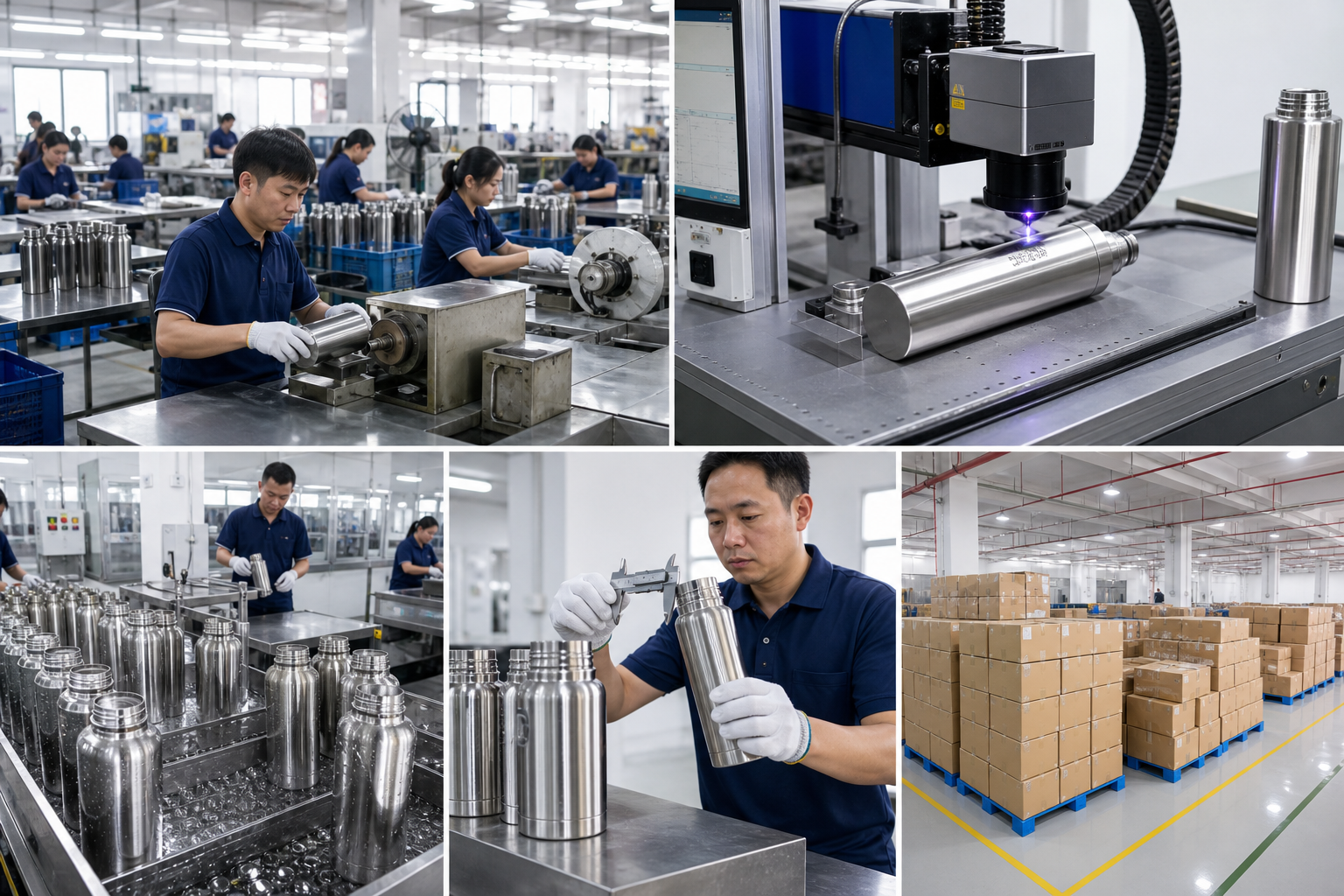
Decoration is where a lot of custom drinkware margin disappears. Laser engraving is the safer pick for an alcohol flask manufacturer because it does not rely on ink adhesion or color registration. It also holds up on brushed steel and tight curves. We run the laser at about 0.1-0.2 mm deep; shallower marks fade, deeper cuts start to chew into the finish. QC pulled a sample after 200 handlings and the mark was still clean. That is the standard buyers should ask for.
Silk screen printing works when the artwork needs 1-2 spot colors and the setup fee has to stay low. Pad print fits smaller logos and curved zones. Full-wrap graphics can be done, but the risk climbs fast on a small body, especially with fine lines, gradients, or tiny text. If you are also buying customizable drinkware for a retail launch, ask for a real production sample, not a PDF mock-up. We have seen a buyer flag a 1.5 mm alignment shift only after the first cartons were packed. Mock-ups never show that.
For canteen custom, custom canteen, or canteen customized orders, decoration changes MOQ too. A plain laser logo can stay at 1,000 pcs, while a 3-color print or gift box set usually pushes the order to 3,000-5,000 pcs. One PO typo on carton labels once turned a 2,000-piece run into a reprint, so the math does not work if you only look at the bottle price. If your channel is a canteen distributor or distributor drinkware buyer, price the whole program: artwork prep, Pantone matching, carton labeling, and packing labor all land on the invoice.
Check Compliance and QC Discipline
Export drinkware runs on QC, not talk. A solid alcohol flask manufacturer should show ISO 9001 procedures, BSCI or an equivalent social file if your retailer asks for it, plus material declarations that back REACH for Europe and FDA or LFGB for the US and EU. We had a buyer flag a PO typo on “304 stainless” once, and QC pulled the sample against the carton code before we even booked the line. Ask for the actual test report, the test date, and the sample ID tied to your PO. No report, no trust.
Inspection has to go past a quick look. For flask programs, we run leak tests, cap torque checks, odor checks, and a drop test on the packed carton. AQL 2.5 for major defects and 4.0 for minor defects is a normal start, but the factory should spell out what counts as major: leakage, sharp edge, wrong logo, or a dented body. One plant showed us a “pass” sheet with no sample count; the math doesn’t work. If a canteen manufacturer cannot explain defect grading, you are buying on hope.
For Europe, ask about nickel release and migration where it applies. For North America, make sure the packaging copy and product claims do not create compliance trouble. A factory in Zhejiang that ships every week should explain this in plain language, not hide behind sales talk. We’ve seen this go sideways with a carton claim that overpromised dishwasher safety. If they cannot answer straight, they are a trading desk, not a production partner.
Practical rule: no test report, no PO. A sample in your hand is not a compliance file.
Read the Factory, Not the Brochure
The best source partner is easy to measure. A mature canteen factory in Zhejiang should quote by SKU, hold repeat tooling, and keep the line moving without changing the story every week. Ask for a real monthly output figure, not a brochure line. One factory we run can hit 600,000 units per month across the wider drinkware range, keeps standard flask builds at 1,000-3,000 pcs MOQ, and ships 25-30 days after sample approval. That is a supplier. The middleman usually slips when the buyer asks for tooling photos.
Ask how many production lines are active, what the sample lead time is, and whether the plant handles stock bodies and true customized drinkware work. If the same factory can manage custom growler, customized growler, and distributor drinkware orders without mixing cartons, that tells you a lot. We had one buyer flag a PO typo on FNSKU labels, and QC pulled the sample before it hit packing. If the factory can keep pallet height control and master carton marks clean for Amazon or retail warehouse programs, the operation is on the right track.
Zhejiang has dense metal forming, coating, and packaging capacity, which is why buyers source there instead of stitching together five vendors in different provinces. Density does not mean quality. You still need to check process flow, in-line inspection, and whether the canteen vendors used for accessories are stable. We have seen this go sideways when a 0.2 mm cap gap was ignored and cartons failed a 1.0 m drop test on the outer corner. A strong canteen supplier shows up in the details: consistent cap feel, clean threads, and no loose liners.
Write a Useful RFQ
A clear RFQ saves days of back-and-forth and keeps unit cost honest. Start with capacity, target market, order volume, and artwork. Tell the alcohol flask manufacturer the exact volume, material, finish, decoration method, packaging style, and destination port. If you want FOB, name the port, usually Ningbo or Shanghai for China exports. If you want landed cost, say it straight and include your postal code or warehouse region. We run quotes off the packing list, not guesses, and the wrong port can swing freight by a few hundred dollars.
Put these points in the first message: product size, steel grade, logo file format, color count, packaging type, carton strength, target MOQ, and whether you need samples or a full pre-production run. If your program also includes a custom logo set for a canteen promotional campaign or a custom canteen bundle, split the SKUs instead of mixing them in one line. The same applies to canteen customizable and customizable canteen requests. One line item, one spec, one approval path. QC pulled the sample at 12 mm from spec once, and the buyer flagged it before we cut production.
Commercial terms need to be plain. Standard terms are often 30% deposit and 70% before shipment, but the order size and tooling change the math. If you need new tooling for a special cap, ask for the mold charge separately. If the quote includes shipping cartons, confirm the burst strength and whether the factory packs for retail or export master cartons. This is the wrong question to ask if the price looks low, because a quote without carton spec or mold cost is how projects go sideways. A solid supplier will show the jump from 3,000 to 10,000 pcs instead of hiding behind one flat number.
Request a flask quote built around your spec
Send your target size, logo file, MOQ, and market now. We will quote the right production path, not a generic catalog price.
Frequently asked questions
What MOQ should I expect from an alcohol flask manufacturer?
For standard stainless flasks, a realistic MOQ is usually 1,000-3,000 pcs per SKU. If you only need laser engraving, some factories can support 1,000 pcs. If you want silk screen, gift boxes, or mixed-color packaging, 3,000-5,000 pcs is more common. For a true custom canteen or customizable growler build, MOQ can climb because the factory needs separate setup, color matching, and packing steps. A factory in Zhejiang that offers 300 pcs for a fully custom metal flask is usually quoting a stock body with minor logo work, not a full production program. Ask for tiered pricing at 3,000 and 10,000 pcs so you can see the real break.
Is 304 stainless steel enough for export flasks?
Yes, for most alcohol flask programs, 304 or 18/8 stainless steel is the right baseline. It balances corrosion resistance, cost, and supply stability better than 201 steel. In practical terms, you want 0.6-0.8 mm wall thickness, a good seam weld, and a food-grade silicone gasket around 2.0 mm. For Europe and North America, 304 is much easier to defend in a compliance file than lower-grade steel. 316 is available if you want a premium spec, but it usually adds cost without changing the user experience enough to matter. If your buyer also wants canteen custom or customized drinkware SKUs, keep the same steel grade unless there is a documented reason to split specs.
What decoration method is best for a branded flask?
Laser engraving is usually the safest choice for a branded alcohol flask because it is durable, clean, and resistant to wear. It works well for 1-color logos and does not depend on ink, so the failure rate is lower. Silk screen is fine for simple artwork with 1-2 colors, but it needs tighter control on curve alignment and curing. Pad print is useful for smaller marks and irregular surfaces. For canteen promotional orders, the decoration method often changes the MOQ and the setup fee. If you want a premium custom drinkware set, ask the factory for a physical sample with the final print position, not just a render. A render cannot show edge distortion, line breakage, or gloss mismatch.
What quality documents should I request before paying?
Ask for ISO 9001, BSCI or equivalent social audit evidence if your customer requires it, plus material declarations for REACH and, when relevant, FDA or LFGB. For the actual product, request a leak test report, carton drop test results, and AQL inspection rules. A decent canteen manufacturer should be able to explain which defects are major and which are minor. For example, leakage, sharp edges, and wrong logo placement are major defects, while a small scuff might be minor depending on your retail standard. If the factory ships to distributor drinkware channels, also request carton labels, barcode format, and pallet specs. Missing paperwork at this stage usually means a larger problem later.
Can one factory handle flasks, canteens, and growlers together?
Yes, but only if the plant has real process discipline. A good canteen factory in China or Zhejiang can often manage alcohol flasks, canteen custom orders, and custom growler SKUs on the same production base. The key is whether the factory separates tooling, decoration, and packing by product family. If they can keep each SKU on its own BOM, artwork file, and carton spec, you can consolidate sourcing and reduce admin work. If they mix everything into one generic line, you will get delays and labeling errors. For distributors, that matters because distributor canteen and distributor growler programs often need different carton counts, barcode systems, and packaging inserts. Ask for a sample workflow before you place the first PO.