Key Takeaways
- Typical MOQ for a custom flask program is 1,000-3,000 pcs, with repeat lead time around 25-35 days
- 304 stainless steel flasks usually use 0.4-0.6 mm wall thickness; thinner saves cost, thicker improves feel and dent resistance
- For EU and US buyers, ask for REACH, food-contact declaration, and AQL 2.5 / 4.0 inspection terms before PO
- Decoration choice changes landed cost by 8-25%: laser engraving is durable, while multi-color printing raises setup and unit cost
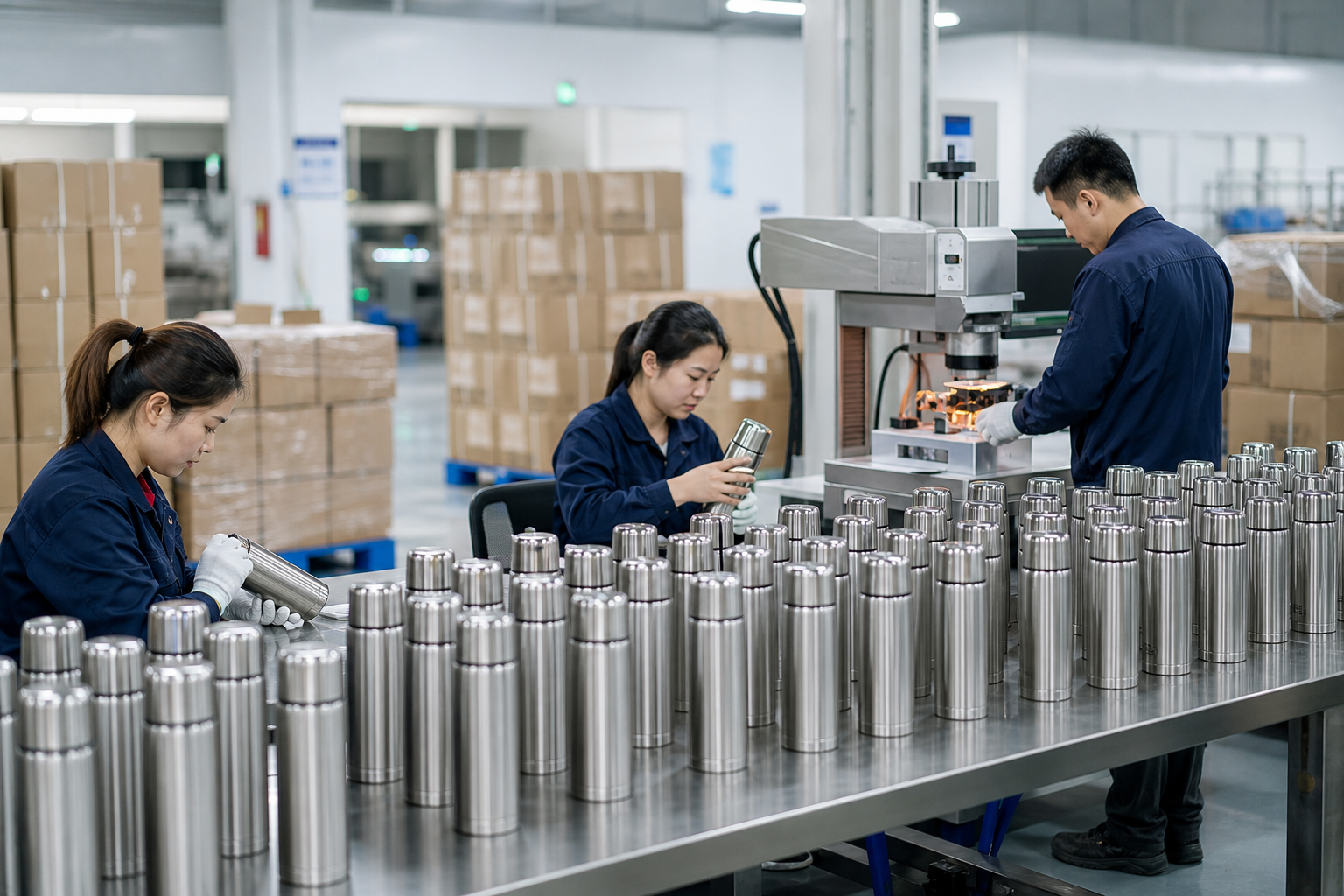
If you are sourcing from alcohol flask manufacturers, the job is not finding “a supplier.” It is finding a factory that can hold your volume, decoration, and compliance targets without turning a simple order into a six-week delay. A flask is not a generic bottle. Wall thickness, seal design, print wear, and leak performance decide whether the buyer reorders or sends a complaint after the first shipment. On our line, QC pulled the sample for a 24-hour upside-down leak test before anyone signed off.
In Zhejiang and across China, you will find plenty of canteen factory options, but the gap between a decent canteen manufacturer and a dependable export partner shows up in the numbers: MOQ, packaging spec, REACH documents, and whether the plant can hold a 3,000-unit repeat order with the same torque on every cap. If you buy custom drinkware for Europe or North America, you need measurements, not sales talk. We run that check with a torque wrench at 0.6 N·m, and the buyer flagged it fast when one cap drifted on the second carton. That is the standard BottleForge runs on.
What a flask buyer really needs
Talk to alcohol flask manufacturers about use case first. Decoration comes later. A flask for spirits in gift sets needs a different build from a promotional canteen order for events, and both differ from a customized growler program for retail. If you are a canteen distributor or a drinkware buyer, you need a piece that ships cleanly, stacks well, and survives carton drops. We run this test on the line with a 1.2 m drop, then check the cap for loosening before anyone talks logo size.
For most export programs, 304 stainless steel is the default for a metal flask, with 0.5 mm material as the middle ground. At 0.4 mm, cost drops, but the body feels soft in hand. At 0.6 mm, the flask holds shape better and dents less, yet the price usually moves up 6-12%. A buyer once flagged a PO typo on thickness as 0.05 mm instead of 0.5 mm; the math does not work, and we caught it before tooling. A solid canteen supplier says that on day one. A weak one sends a photo and hopes you do not ask.
- Ask for capacity tolerance: ±3% is normal on many custom drinkware lines.
- Check leak test method: upside-down hold for 30-60 seconds is not enough for export; pressure or shake testing is better.
- Confirm finish: matte, brushed, powder coat, or mirror polish all change scratch visibility and how the flask reads on shelf.
If you are sourcing canteen customized items for a retail shelf, ask the sample to match mass production on material, cap liner, and print method. QC pulled the sample with a 38 mm cap liner once, while the production cap was 36 mm, and the buyer rejected it on sight. A good canteen manufacturer in Zhejiang can explain the gap between a hand sample and production tooling without hiding behind “factory standard.” That is the wrong question to dodge.
Material and structure choices
The material call is where a lot of buyers overpay or under-spec. For alcoholic beverage flasks, 304 stainless steel is usually the safest commercial choice. It gives solid corrosion resistance, clean taste, and a fair landed cost. 316 stainless looks good on a spec sheet, but if you are not selling into a premium channel, the math rarely works. We have seen it add 20-35% to unit cost, and the end user does not feel that gap. For low-cost distributor canteen programs, some factories still quote 201 stainless steel, but QC pulled the sample and found a weak spot fast: lower nickel content means weaker corrosion resistance and a higher chance of odor retention after repeated wash cycles.
Structure matters just as much as grade. A single-wall flask keeps weight down and keeps the tooling simple. Double-wall construction adds insulation, but it also adds weld steps, a harder polish job, and longer lead time at the line. If you need a custom growler or customizable growler for beer or spirits, ask for a wider mouth and a stronger hinge or threaded lid. For a customizable canteen used as a promo item, a plain screw cap with an internal PP or silicone liner is usually enough. We run into buyer pushback on this point all the time, but this is the wrong question to ask: a canteen customizable product should not fail because of a 0.5 mm gasket ring. We once caught a PO typo that listed 5.0 mm, and the buyer flagged it only after tooling started.
What to specify in your RFQ
- Material grade: 304, 316, or 201
- Gauge or thickness: 0.4 mm, 0.5 mm, 0.6 mm
- Capacity: 6 oz, 8 oz, 12 oz, 500 ml, or custom
- Lid type: screw cap, captive cap, hinged cap, or custom closure
- Surface finish: brushed, polished, matte spray, powder coat
At BottleForge in Zhejiang, we see buyers improve their quoting accuracy by 30% just by stating these five items clearly. A clean RFQ saves us a back-and-forth round, and it keeps the sample set moving. That is the gap between a vague canteen custom request and a workable production brief. In China, factories move faster when the spec is complete; incomplete requests almost always turn into expensive revisions later, and we ship those headaches back to the buyer in the form of new samples, new mold notes, and lost days on schedule.
Decoration and branding costs
Decoration is where custom drinkware margin gets made or eaten. If you need a simple logo on a custom canteen, laser engraving is the cleanest option and usually adds only a small setup fee after tooling. Silk-screen printing costs less for one-color branding, but it scratches easier and needs tighter color control; we often see buyers push back on Delta E 2-3 after the first sample, then the PO arrives with no tolerance note. Full-wrap printing, embossing, or multi-color artwork can add 8-25% to unit cost, depending on surface area and color count.
If your program is for canteen distributors or a distributor growler line, repeatability matters more than the sample photo. A logo that looks fine on one piece but shifts 1.5 mm across a 10,000-unit order is a problem, not a minor defect. Ask the canteen vendor whether it runs jig fixtures, laser alignment, or automated pad printing. We checked one line last month with a 0.2 mm gauge block, and the buyer flagged a 1 mm drift before shipment. If the answer is vague, expect variation. For canteen promotional campaigns, print speed also matters: a factory with 40,000 units/month capacity can usually keep decoration bottlenecks under control better than a workshop that only sells small batches.
Practical rule: if the bottle surface is curved, raised, or powder-coated, get a physical print proof before mass production.
For branded flasks, we usually keep the first run simple: one logo, one placement, one Pantone reference. That is the right question to ask. Once the line is stable, you can move to customized drinkware with secondary artwork, serial numbers, or laser codes for traceability. A disciplined canteen supplier will tell you when a design is too busy for the actual production method. On our side, QC pulled the sample and caught a 3 mm misread on a laser code before we shipped the carton.
Compliance for Europe and North America
If you sell into Europe or North America, compliance is not optional and it is not a paperwork afterthought. Your alcohol flask manufacturers should provide food-contact declarations, REACH files for EU-bound goods, and traceability records for stainless steel and coatings. If the flask uses paint, powder coat, silicone seals, or plastic caps, ask for the matching test reports before you place the order. On our line, QC pulled a sample with a 0.3 mm coating chip at the rim, and that is the kind of defect that turns into a border issue fast. For the US market, buyers often ask for FDA-related food-contact support, even when the real risk sits in the liner, ink, or gasket.
Quality terms should be written into the PO. AQL 2.5 for major defects and 4.0 for minor defects is common for export drinkware, though some brand owners tighten packaging checks separately. A canteen manufacturers network in Zhejiang may say “export standard,” but the number on the inspection sheet matters more than the slogan. We run signed inspection sheets, carton drop tests, and leakage sample retention on every export lot. The wrong question is whether the factory sounds polished; the real question is whether the PO still makes sense after a 1,000-piece recheck and a typo on the carton mark gets caught before shipping.
- Food-contact docs: request declarations for steel, coating, ink, and silicone.
- Traceability: keep production lot numbers and carton labels linked.
- Packaging spec: confirm polybag thickness, insert cards, and master carton ECT rating.
For high-volume distributor canteen or distributor drinkware orders, a factory in Zhejiang that can show a mature QA file is usually the safer bet. We have seen 5,000-piece jobs stall because the outer carton missed the lot code, and that is a waste of four days on the calendar. Compliance costs money, but failed customs clearance costs more.
MOQ, pricing, and lead time
Most buyers ask for price first, but MOQ and lead time tell you more about the factory than a quoted USD 1.85 or USD 3.20 ever will. For a standard custom drinkware flask, a realistic MOQ is often 1,000 pcs for a simple logo item and 3,000 pcs for a fully customized canteen or customized growler with special tooling. If a canteen factory offers 300 pcs with deep customization, check whether it is truly manufacturing or only assembling stock parts. We have seen buyers get burned by a “300 pcs” promise, then QC pulled the sample and found mixed neck finishes on the same carton.
Lead time depends on tooling and decoration. A straightforward repeat order can ship in 20-25 days. A new mold, new lid, or new finish may take 30-45 days. If you need a canteen customizable product for a seasonal promotion, build in buffer time for pre-production approval and carton artwork review. In practice, a lot of canteen distributor programs fail because the buyer leaves only 15 days between approval and ship date. That is the wrong question to ask if you want a clean launch.
Here is the buying reality: a good canteen manufacturer in China will quote ex-works and FOB separately, explain carton load counts, and give you a production calendar. In Zhejiang, factories that run 40,000-80,000 units/month tend to be more stable on repeat orders because they already manage multiple lines and supplier inputs. BottleForge’s own export workflow is built around that kind of volume discipline, which matters when you need a distributor canteen or canteen promotional restock without surprises. We run one line for laser marking and one for silk screen, and that split keeps the schedule from slipping when the buyer flags a last-minute PO typo.
Do not let a low unit price hide expensive extras: custom inserts, individual boxes, barcode labels, and split shipments can add 10-18% to your landed cost. Ask for a complete quote, not a teaser. We once saw a USD 0.12 carton upgrade turn into a USD 0.41 landed hit after the buyer added 2 barcode stickers per flask and a 2 kg master carton limit.
How to choose the right factory
Choosing between alcohol flask manufacturers comes down to one thing: does the factory act like a partner, or just fire back a quote. A proper canteen supplier should ask about target market, retail channel, drop-test requirements, and logo format before they price the job. If they skip those questions, they are not thinking about your risk. A solid canteen vendor will also tell you which parts stay in-house and which are outsourced, because outsourced caps and seals are where we see leaks, fit issues, and returns. Last month QC pulled a sample with a cap off by 2 degrees; the buyer flagged it before shipment, which saved a headache.
Use this checklist when you compare canteen suppliers or canteen vendors:
- Can they show ISO 9001 or equivalent process control?
- Do they provide pre-production samples within 7-10 days?
- Can they support one-stop custom canteen development, including artwork and packaging?
- Do they have experience with customs paperwork for EU and US shipments?
- Can they handle both small pilot runs and repeat distributor canteen reorders?
If you are a brand owner, you need a factory that can run from 1,000 pcs to 20,000 pcs without changing print quality. If you are a canteen distributor, stable SKUs and carton consistency matter more than fancy add-ons. For canteen customizable or canteen customized programs, ask for sample retention, batch records, and a clear claim process. We had one PO with a typo on the carton mark, and the buyer caught it during pre-shipment review; that is why we push for written checks. A factory in China that answers those questions cleanly is usually worth keeping.
In Zhejiang, the strongest suppliers are not the loudest ones. They can tell you exactly where a 1.2 mm seam, a 0.3 mm gasket shift, or a 2-degree cap misalignment will show up on the line. That is the right level of detail. We once held a batch because the seam gauge showed 1.4 mm on two samples, and the math did not work for export risk. That is the factory you want.
Request a factory quote with real specs
Send your capacity, material, logo, and packaging needs. We’ll turn it into a production-ready quotation from Zhejiang, China.
Frequently asked questions
What MOQ should I expect from alcohol flask manufacturers?
For standard custom drinkware flasks, expect 1,000 pcs MOQ for simple logo work and 3,000 pcs for full customization. If you want a new lid, special finish, or custom packaging, some factories will raise it to 5,000 pcs. Small pilot runs below 500 pcs are possible, but pricing usually jumps 20-40% and lead time is less predictable. For a dependable canteen manufacturer in China, MOQ should match the complexity of the job, not just the factory’s sales pitch.
Which material is best for a custom canteen or flask?
For most export buyers, 304 stainless steel is the practical default. It offers good corrosion resistance, neutral taste, and a workable cost base. Use 0.5 mm thickness for a balanced feel, or 0.6 mm if you want better dent resistance and a more premium hand feel. 316 stainless is only worth the extra cost in niche premium applications. If a canteen supplier offers 201 stainless for a food-use flask, ask for a reason and demand full testing before approval.
How much does branding add to unit price?
Decoration can add very little or quite a lot. Laser engraving may add under USD 0.20 per unit after setup on repeat runs, while one-color silk screen is often similar or slightly higher depending on order size. Multi-color print, embossed tooling, or special coatings can raise cost by 8-25%. For a canteen promotional order, keep the design simple if you want the best landed cost. Complex artwork also increases the chance of rejection in AQL inspection.
What compliance documents should I request for Europe?
Ask for REACH support, food-contact declarations, and traceability for every material that touches the contents: stainless steel, coating, silicone gasket, ink, and plastic cap parts. For packaged export goods, confirm carton specs and labeling too. A good Zhejiang factory should provide sample test reports, batch numbers, and production records. If your product is a customized growler or custom canteen for EU retail, get these documents before mass production, not after shipment.
How do I reduce leakage risk in a flask program?
Specify the cap type, liner material, and torque test in your PO. Ask the factory to do 100% leak checks or at least a documented sampling plan with AQL 2.5 for major defects. A proper test includes upside-down retention, shake testing, and packaging drop checks. If the product is a canteen customized for travel or retail, insist on pre-production samples that use the actual gasket and cap from mass production, not a hand-built prototype.