Key Takeaways
- A typical OEM flask order starts at 3,000-5,000 pcs, with 25-35 days lead time after sample approval
- 18/8 stainless steel is the safest default; 0.5-0.6 mm wall thickness is common for premium flasks
- For EU and US sales, ask for REACH, LFGB, FDA-related material declarations, and leak testing at 100% or AQL 2.5
- Laser engraving usually adds USD 0.15-0.35 per unit; full-color print is more sensitive to abrasion and MOQ
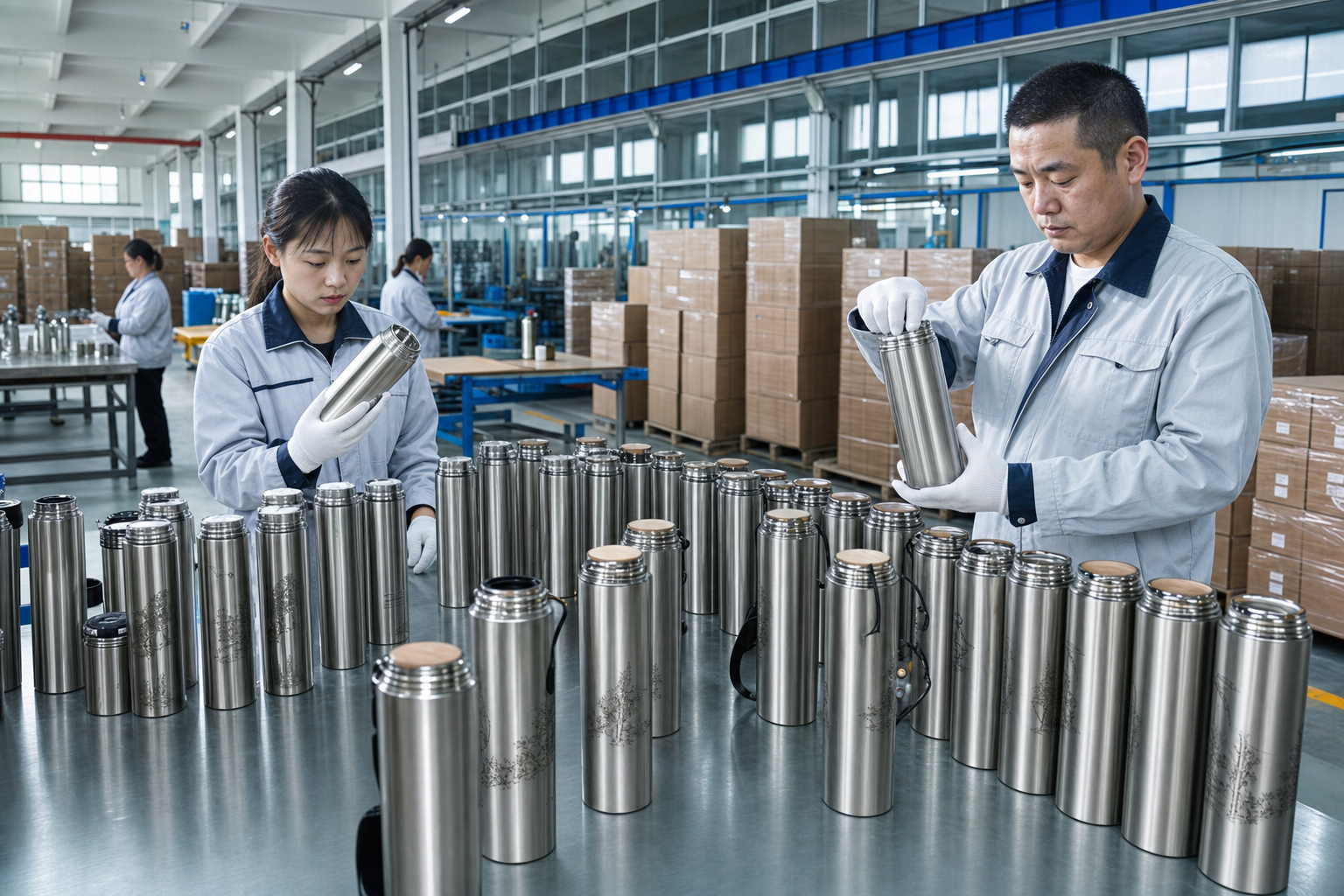
If you are sourcing from an alcohol flask OEM manufacturer, treat the flask as a packaging part with pressure, coating, and decoration risks. It has to pass leakage tests, coating and migration checks, then still look clean after laser engraving, printing, or powder coating. We run these checks on the line with a simple 30-second tilt test and a gasket check, because a sample that looks fine on day one can turn into a return pile by week three in Europe or North America.
At BottleForge in Hangzhou, Zhejiang, we see this every month: brand owners want a custom drinkware item that feels premium, while the distributor only signs off if MOQ, lead time, and decoration cost stay in range. That is the wrong question to ask if the factory cannot hold the line. You need a partner that can ship 120,000 units per month, keep a 5,000-piece MOQ where possible, and flag the trade-offs before the PO goes in, especially when QC pulled a 304 stainless sample and the buyer caught a 2 mm logo shift on the proof.
What a real OEM flask program needs
Buyers looking for an alcohol flask oem manufacturer usually mean one of three items: a pocket flask, a narrow stainless canteen custom piece, or a branded bar gift for promo packs. The name is not the point. The build is. You need a factory that runs forming, welding, polishing, decoration, packing, and export paperwork in one line, not five handoffs.
A good canteen factory in Zhejiang should send one quote with material grade, wall thickness, finish, and MOQ in the same email. If they cannot tell you whether the shell is 201 or 304/18-8 stainless steel, or whether the lid seal is silicone or TPE, we stop the talk there. We had a buyer flag a PO typo on a 500 ml flask last month; that kind of miss starts with weak spec control. For North American and European orders, missing material detail turns into a claim later. A serious canteen manufacturer will also give the real capacity tolerance, often ±3% for metal flasks, and the defect target under AQL 2.5 for major defects.
Do not let the product name confuse the sourcing logic. A custom canteen, customizable canteen, or customized canteen can come from the same shop as a pocket flask if the factory handles deep drawing and sealing the right way. The wrong question is which label sounds better. The real question is whether the canteen supplier can repeat the same result at scale without the finish drifting from sample to bulk. QC pulled the sample on a 100 mm neck flask last week because the brushed grain shifted after polishing; that is where bad programs start.
Materials and structure that actually matter
For an alcohol flask OEM program, material choice is risk control. 18/8 stainless steel, usually called 304, is the floor you should expect for food-contact drinkware. If a vendor pushes 201 stainless to save a few cents, run the numbers first. We’ve seen 201 pass on the first carton and then draw rust complaints after 3 months in a humid port warehouse. It is fine for decorative parts. It is the wrong call for premium export flasks.
The common spec for a pocket flask is 0.5 mm to 0.6 mm wall thickness. Under 0.5 mm, dents show up fast and the side wall starts oil-canning in transit. Over 0.6 mm, the unit gets heavier and forming cost climbs, which the buyer flagged on a 20,000 pcs PO because freight was already tight. For a custom growler or customizable growler, the structure changes. We often run 0.6-0.8 mm, depending on capacity and whether it is vacuum insulated. This is the wrong question to ask if someone only wants the cheapest sample; the math does not work once you load cartons, pallets, and ocean freight.
- Lid seal: silicone gasket is the safer choice for alcohol contact and repeated opening
- Finish: brushed, mirror polished, matte powder coat, or soft-touch varnish
- Printing: laser, silk screen, or full-wrap UV depending on artwork and abrasion risk
- Packing: individual box plus master carton, with carton drop-test standard agreed in advance
If you are buying from a canteen manufacturer in China, ask for cross-section photos and thickness confirmation, not just a glossy render. QC pulled the sample and checked the wall with a micrometer, and that 0.03 mm gap was enough to kill the PO. Zhejiang factories that export regularly should be able to send both without drama.
Decoration choices change the economics
Decoration is where a lot of canteen distributors spend too much or ask for too little. Laser engraving is usually the safer pick for a premium flask. It holds up, stays sharp, and we can run it fast. On a 5,000 pcs order, engraving usually adds USD 0.15-0.35 per unit, depending on logo size and setup. We checked this on the laser marking machine last week: a 28 mm logo tracked cleanly, while a full-wrap mark slowed the line and pushed the cost up.
For canteen promotional projects, the low-price trap shows up fast. The math does not work if the logo area is flat, the artwork stays to one or two colors, and the box is plain. Once the buyer flags gradient art, wraparound graphics, or metallic effects, the quote moves up. We had a PO typo on a 3,000 pcs silk-screen job where the buyer wrote Pantone 186 C but sent a JPG with no vector file; QC pulled the sample, and the rework cost more than the printing. Ask whether the decoration runs in-house or goes out. In-house work gives tighter color control and faster fixes when the first batch misses the approved sample.
Some buyers want a custom drinkware finish that looks premium on Amazon or retail shelves. Fair request. You still need a surface spec. Matte powder coating on stainless should be checked for adhesion, scratch resistance, and tape test results before mass production. We test this with a cross-hatch cutter and 3M tape, then compare the pull-off after 24 hours. If your canteen supplier cannot talk through those points, the problem is not the price.
Practical rule: if the design has to survive distribution, choose the decoration that fails least visibly, not the one that looks flashiest in a render.
MOQ, lead time, and factory reality
MOQ is where a lot of distributor canteen projects die. A real canteen factory in Zhejiang will usually quote 3,000-5,000 pcs for a custom flask with standard tooling and an existing body shape. If you need new tooling, embossed artwork, or a non-standard cap, the MOQ moves to 8,000 pcs or more. That is normal. The mold shop still has to open the jig, run the press, and scrap the first few shots before QC signs off. Tooling and setup are real costs, not negotiation theater.
Typical lead time is 25-35 days after sample confirmation and deposit, assuming the artwork is locked and the packaging is standard. Add 7-10 days if you need custom boxes, new color matching, or third-party testing. A canteen manufacturer that promises 10-day bulk production for a fully customized order is usually skipping either testing or finishing. In our Hangzhou factory, the realistic monthly output is about 120,000 units across multiple drinkware lines, but that number only matters if your spec is stable and the PO is clean. We have seen a buyer lose two days because the carton mark had one wrong digit.
For canteen distributors, a split shipment plan often works better than chasing the cheapest unit price. Order 3,000 pcs for the first release, then lock a second 5,000 pcs at the same decoration and packaging spec. That keeps inventory risk manageable and gives the factory enough volume to hold setup costs. On the line, we keep the same screen plate and cap gasket spec, so repeat work does not turn into a new trial run. If you are sourcing a customizable canteen or customized canteen for seasonal retail, ask the supplier how they handle repeat orders. Reorder stability is usually the right question, not the first quote.
Compliance for Europe and North America
Export compliance is not optional if your canteen distributor network includes retail chains, marketplaces, or corporate gifting programs. For Europe, ask for material declarations and food-contact test reports that match REACH and local rules such as LFGB where the product needs it. For North America, buyers usually ask for FDA-related material confirmation. The exact path still depends on the material mix and the final build. We had a buyer flag a PO because the cap was listed as 304 stainless on one line and “SS304” on another, so the paperwork never matched the goods.
Leak testing belongs in the incoming check or the factory inspection plan. For metal flasks and custom canteen products, a 100% leak test is the safest call before packing, especially when the order ships in mixed cartons to distributor drinkware channels. If 100% testing is not practical, agree on AQL 2.5 for major defects and write down the failure points: seepage at the neck, cap thread mismatch, gasket deformation, or coating peel after a drop test. We run a pressure jig on the line and QC pulled two samples from a 500-piece lot that failed at the seam after 18 seconds under water.
Do not skip packaging compliance. A canteen promotional order going into the EU may need carton marks, item labels, and retailer barcodes. If you sell through Amazon, you may also need FNSKU labels and carton dimensions that keep dimensional weight under control. A decent canteen vendor asks for these details before quoting, not after the cargo is ready. We’ve seen this go sideways on a 72x42x38 cm master carton because the buyer approved the artwork first and only checked the barcode layout after print.
How to evaluate a factory in China
When you visit or audit an alcohol flask OEM manufacturer in China, you are checking more than machinery. You are checking export discipline. In Zhejiang, the better factories keep separate people on forming, polishing, decoration, QC, and export paperwork. That split matters because a clean sample from one technician is not the same thing as stable mass production on the line.
Ask for three things: a recent production record, a defect report, and the inspection method. A serious canteen supplier can show in-process checks on thickness, weld seam, cap torque, and carton drop testing. We run thickness checks at 0.8 mm or 1.0 mm, not “looks fine.” If they cannot talk in numbers, they are probably acting as a trading layer rather than a true canteen manufacturer. That is the wrong question to dodge. A trading company is fine if they say so, but your risk changes fast.
Ask who owns the tooling. If you pay for tooling on a custom growler or customized growler shape, the contract should say whether the tool is exclusive, shared, or held for repeat orders. We have seen buyers lose a reorder because the PO missed one word on tool ownership. The buyer flagged a typo on the paperwork, and the factory still tried to treat the mold as shared. Good China sourcing is not about taking the lowest quote from the first canteen vendor who replies. It is about checking whether the factory can repeat quality at scale, with records, not promises.
Buying for distributors and brand owners
I’m rewriting the three paragraphs to sound like an experienced factory-side sales engineer, keeping the HTML structure intact and tightening the language around channel-specific specs, packaging, and order risk.If you are a brand owner, shelf appeal, margin, and repeat orders drive the spec. If you are a canteen distributor, you care about carton fit, pallet count, and how clean the reorder looks on paper. Same flask, different job. We run a brushed 304 body with laser logo and a rigid gift box for brand owners. For distributors, a simpler canteen customizable option with one-color print and a lower landed cost usually wins. On the line, a 12 mm laser mark and a 3,000 pcs MOQ change the math fast.
For promo work, canteen promotional packaging can lift perceived value by 15-25% in retail testing, but only when the print, insert, and box corners hold up. If the logo drifts 2 mm or the carton rubs through in transit, that gain is gone. QC pulled the sample after a corner crush test at 18 kg; the buyer flagged it immediately. A canteen supplier should push you toward either a higher-margin premium item or a value-driven bulk item. Trying to force both into one build is the wrong question.
A proper custom drinkware buyer guide keeps coming back to channel first. A distributor drinkware order for wholesale chain retail needs different carton counts, barcode placement, and defect tolerance than a DTC launch. We have seen a PO typo on carton quantity turn a clean order into a week of emails, and that is where the margin leaks out. The best canteen distributors know the line can ship fast only when the spec is fixed, often with 48 pcs per carton and a clear AQL 2.5 callout. New buyers should lock that down before sample approval.
Request a flask quote with real specs
Send your target MOQ, artwork, and market. We will quote material, decoration, lead time, and packing clearly from our Zhejiang factory.
Frequently asked questions
What is the usual MOQ for an alcohol flask OEM order?
For a standard stainless flask with existing tooling, MOQ is usually 3,000-5,000 pcs. If you need new tooling, special lid shapes, embossing, or custom packaging, expect 8,000 pcs or higher. A factory in Zhejiang with stable production can sometimes support a mixed order, but the unit price will rise if you split colors or artwork. Always confirm whether the MOQ applies per design, per color, or per SKU, because many disputes start there.
Which material should I choose for custom drinkware exports?
For export drinkware, 18/8 stainless steel is the safest default for an alcohol flask or custom canteen. It is the common choice for food-contact metal drinkware and gives you a good balance of corrosion resistance and cost. Wall thickness of 0.5-0.6 mm is typical for flasks, while heavier structures may need 0.6-0.8 mm. If a supplier suggests 201 stainless to cut cost, ask for a full material declaration and think carefully about long-term durability.
How much does logo decoration add to unit cost?
Laser engraving usually adds about USD 0.15-0.35 per unit, depending on logo size and complexity. Silk screen printing can be cheaper for simple one-color logos, often around USD 0.08-0.20, but it is less durable under heavy handling. Full-color print or special coating effects can raise the cost further, especially when the MOQ is low. For canteen promotional items, the cheapest decoration is not always the best if you need retail shelf life and abrasion resistance.
What compliance documents should I request from a Chinese supplier?
For Europe and North America, ask for material declarations, food-contact test support, and any relevant REACH or LFGB-related paperwork where applicable. For North America, buyers often request FDA-related material confirmations, depending on the product and market. Also ask for leak test records, carton drop-test results, and QC reports based on AQL 2.5 or your own agreed standard. If the supplier cannot show recent test documents, do not treat their sample as production-ready.
How do I judge whether a canteen factory is reliable?
Look for three things: stable monthly output, clear QC records, and honest lead times. A strong canteen factory in China should tell you if its output is 120,000 units per month, whether the lead time is 25-35 days after sample approval, and how it handles reorders. Ask who does forming, polishing, printing, and final inspection. If one person answers everything vaguely, you may be dealing with a trading layer rather than a real manufacturer.