Key Takeaways
- Typical MOQ for private label flasks starts at 500 units per design, with 25-35 day lead times after sample approval.
- 304 stainless steel is the common baseline; 18/8 material, 0.6 mm wall thickness, and leak testing matter more than glossy marketing.
- FOB China pricing for a basic custom flask often lands around USD 1.80-4.20 depending on capacity, finish, and decoration.
- For export to Europe and North America, ask for REACH, food-contact statements, AQL 2.5 inspection, and packaging built for FNSKU or retail barcode labeling.
If you are buying alcohol flask private labeling for retail, hospitality, or promotional programs, the hard part is not finding a product. It is finding a 7 oz stainless flask that prints cleanly, passes compliance, and still leaves margin your finance team can sign off on. We have seen a logo look perfect on a desk sample and then start scratching after 200 opens on the line. Scale it to 5,000 units and the weak points show fast: a loose cap, a thin finish, or a REACH miss that stops the shipment.
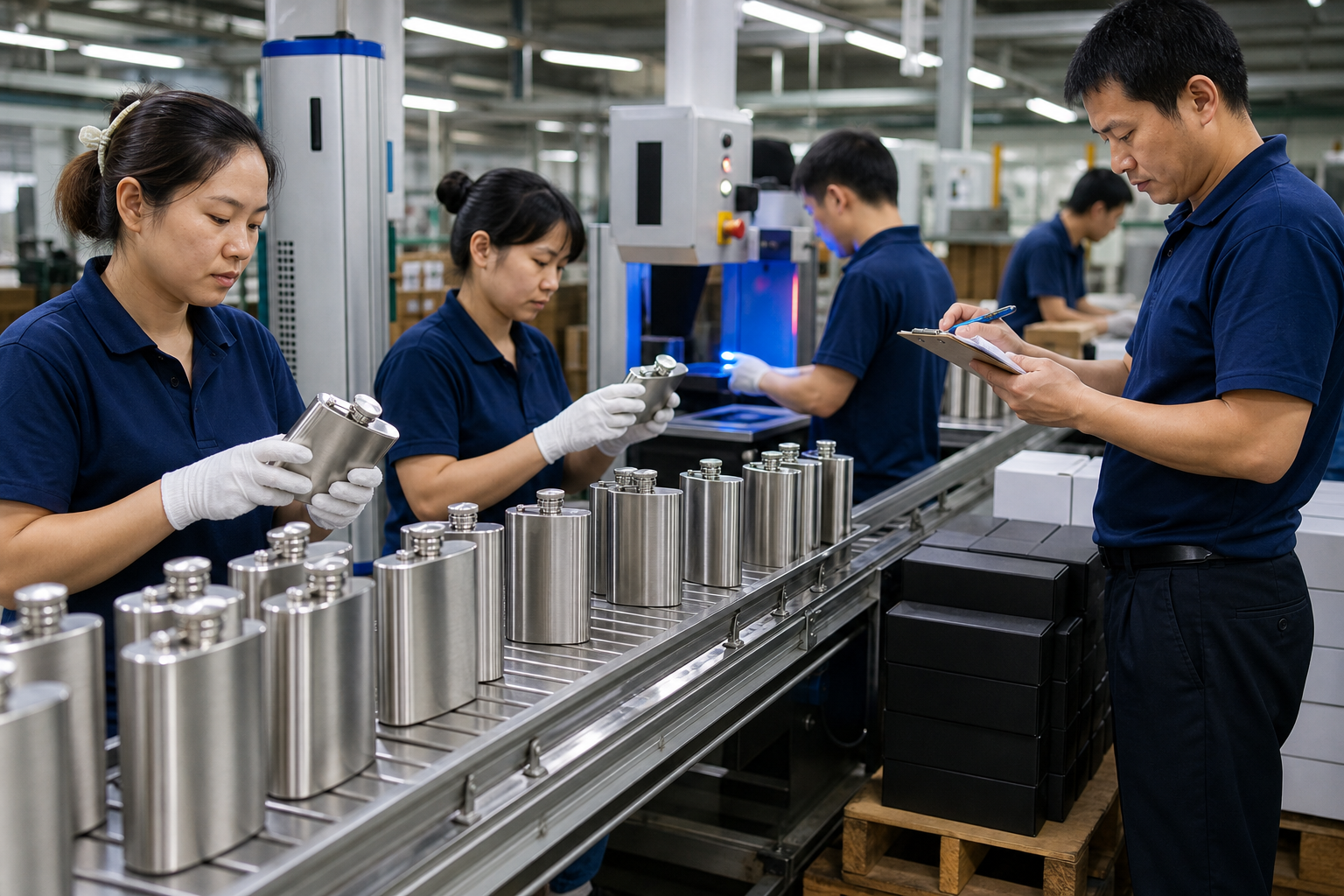
That is why serious buyers treat this as an engineering purchase, not a branding exercise. In Zhejiang and across China, the better canteen factory runs steel grade checks, weld inspection, coating thickness control, and carton drop tests before your artwork goes anywhere near the flask. QC pulled the sample and measured the finish at 18 microns; that is the kind of number that tells you whether the batch will hold up or get the buyer flagged on first inspection. If you are a canteen distributor, canteen supplier, or brand owner, ask the right questions up front: what to specify, what to test, and where the hidden cost sits.
What private labeling really means
Alcohol flask private labeling is not just a logo on a metal bottle. You are buying the spec, the decoration method, the pack-out, and the compliance file. Skip one, and the bill shows up later as returns, chargebacks, or a customs hold. We see this a lot. A custom canteen or custom drinkware program should start with the use case: gift shop, outdoor retail, promotional event, liquor brand giveaway, or distributor pack. Each one pushes a different box size, price target, and print layout.
For a canteen customizable program, the logo is only one line item. Capacity comes first: 6 oz, 7 oz, 8 oz, or 12 oz. Then we lock the body shape, steel grade, and surface. A brushed finish hides fingerprints better than mirror polish, and powder coating gives the flask more of a promo look when the buyer wants it handled at a booth all day. QC pulled a sample with a 0.3 mm print shift last week, and the buyer flagged it before we ran the order. If you are a canteen distributor working across North America, shelf appeal and barcode placement need to be set before the first carton is packed.
The practical rule is simple: if the canteen manufacturer cannot tell you the steel thickness, decoration tolerance, and carton count without checking three different people, you are not dealing with a line that can scale. Good canteen manufacturers in Zhejiang quote from a controlled spec sheet, not from memory. We ship from those sheets. If the PO says “8oz flask” but the carton note says 12 pcs and the artwork file says 24 pcs, the math does not work.
Choose the right flask structure
For alcohol flask private labeling, the structure decides whether the piece feels like a gift item or a cheap promo. We run 304 stainless steel on most export orders because it holds up on corrosion and still keeps the landed cost under control. For Europe, ask for food-contact declarations and material traceability; QC pulled one batch where the heat number was missing on the mill cert, and that shipment stopped cold. On entry-level SKUs, 0.5 mm wall thickness can work, but 0.6 mm is the safer commercial standard because it keeps the body stiff and cuts dent complaints. We’ve seen buyers push for 0.7 mm on premium programs, then the math gets ugly fast.
Capacity drives sell-through more than buyers expect. A 6 oz customized canteen fits pocket retail and gifting. An 8 oz distributor drinkware item sits in the middle. A 12 oz custom growler or customized growler format is narrower, but it moves better in outdoor and travel channels where the buyer wants a broader use story. If you want the growler look without the bulk, use a narrow-neck silhouette and keep the flask pocket-friendly. One buyer once sent a PO with “12oZ” typed as “120Z”; we caught it before the line opened the tooling file.
- 304 stainless steel: standard for most export programs
- 316 stainless steel: higher corrosion resistance, usually reserved for premium or special-use drinkware
- 0.6 mm wall: a practical baseline for strength and feel
- Leak test: 100% of production should be pressure or inversion tested before packing
A good canteen supplier will also tell you whether the cap uses a captive hinge, screw plug, or threaded cap with a seal. That choice decides if your customized drinkware line gets clean reviews or complaints about smell transfer and leakage. On our bench, the torque gauge set to 0.8 N·m usually catches loose plugs before cartons close. This is the wrong question to ask: don’t start with decoration first, start with closure style, then build the flask around it.
Decoration that survives handling
Private labeling fails when the decoration method does not match the flask surface. Silkscreen works for a one-color or two-color logo on a flat panel, but daily carry will wear it down. We’ve had buyers flag this after 6 months of pocket carry. Laser engraving stays cleaner and holds up better on brushed steel, while UV printing gives more color freedom and needs solid surface prep; if the coating is soft, abrasion shows up fast. For canteen customized projects aimed at a premium shelf price, we run laser on the steel body and print the gift box, then keep the unit cost in line.
Ask the canteen vendor how they place the logo on curved bodies. A mark that looks centered on CAD can drift during transfer if the jig is sloppy. On our Hangzhou line, we keep repeat-run registration at 0.3-0.5 mm when the artwork and fixture are locked. That is the standard you should push for from any canteen supplier in China or Zhejiang if you are building a branded range. The math does not work if the supplier shrugs at alignment.
Do not approve artwork from a flat mockup alone. Request a physical pre-production sample, because the curve, coating, and logo contrast can change the perceived size by 10-15%.
For alcohol flask private labeling, the best choice is often the plain one: a single-color logo, a controlled finish, and a box that will not crush in transit. A canteen promotional project is not the place to stack effects. We’ve seen this go sideways when a buyer asked for foil, embossing, and a matte spray all on one SKU. If your target is a canteen distributor program, clear branding sells better than decoration tricks.
MOQ, pricing, and margin math
Buyers ask for price first. Wrong question. The real issue is what eats margin on the line. A basic custom drinkware flask from a China factory usually starts around USD 1.80-2.40 FOB for a plain stainless model at 500-1,000 units, depending on capacity and finish. Laser engraving adds USD 0.12-0.35 per piece. Full-color print, a matte powder coat, or gift packaging can lift it to USD 3.20-4.20 or more. On our laser machine, a 500-piece run with a 50mm logo is fast; the surprise comes from inserts, not the cup. If you want a custom canteen with a premium box and insert, the box alone can add USD 0.25-0.80.
MOQ changes with the build. A standard customized canteen can start at 500 units per color or per design. Once you split into three SKUs, each variant gets its own MOQ and its own carton label check. We ship mixed orders only when the base body stays the same and the decoration changes. QC pulled a sample from the packing table last week and flagged a 2 mm gap in the insert tray, so we stopped the batch before it became a claim. That setup lets a distributor test three artwork versions without tying up cash in dead stock.
Lead time is usually 25-35 days after sample approval for a normal run, plus ocean freight. If the body mold is new or the box is custom, add 10-15 days. A Zhejiang factory should give you a daily output number and name the bottleneck, usually the polishing wheel, the laser room, or the final pack-out table. We run one standard line at 120,000 units a month, and that number matters when a buyer drops a 30,000-piece PO after the first test order. If the PO has a typo on the carton count, the line loses a day fixing labels.
If you are comparing suppliers, do not stop at unit price. Compare landed cost, carton count, breakage rate, and whether the supplier can handle FBA labeling, retail stickers, or barcode application before export. We ship some cartons at 24 pcs, others at 48 pcs, and that changes freight math more than buyers expect. The math does not work if a USD 0.18 saving turns into a 3 percent breakage claim or a relabel fee at the warehouse. That is where cheap quotes get expensive.
Compliance for EU and US imports
Alcohol flask private labeling for Europe and North America needs more than a nice sample. Ask for material documents, food-contact declarations, and test reports tied to the exact item number. REACH is often requested for EU-bound shipments, while US buyers may ask for food-contact compliance, Proposition 65 screening where relevant, and migration testing depending on channel requirements. If your flask includes paint, coating, or silicone seals, QC has to check those parts too. We once had a buyer flag a 0.3 mm print shift on the logo ring, and that turned into a full document recheck.
For B2B drinkware, inspection discipline matters. AQL 2.5 is a common commercial standard for general defects, but a leak or a sharp edge is not a “minor issue.” Set carton drop testing and transit packaging tests if the product ships through Amazon or wholesale distribution. We run pre-production sample, inline inspection, and final random inspection on the line; that is the basic flow. A canteen manufacturer that knows export already has that rhythm. If they cannot name the gauge or the pressure test tool, the math does not work.
One point buyers miss: compliance and labeling are not the same thing. A canteen customized for a liquor brand may still need country-of-origin marking, care instructions, batch identification, and retail barcode placement. If you are buying from China, make sure the artwork approval stage includes these labels. We have seen a PO typo on the barcode number force a reprint after packing, and that is money down the drain.
When you speak with canteen suppliers, ask for the exact test lab used, the report date, and whether the certificate applies to the finished product or only the raw material. That difference matters in customs and retail audits. One lab report for resin does not cover a finished flask with a coated cap, and the buyer can get stuck at clearance if the paperwork is loose.
How to vet a factory in China
There are plenty of canteen vendors in the market, but only some run like a real export partner. You want a canteen factory that will open the line, show the leak tester, pull up inspection records, and walk you through packing without dodging the question. In Zhejiang, we see this split every week: one plant can stamp logos fast, another holds the body shape but misses coating defects or retail carton details. You need the balance, not a nice brochure.
Ask straight numbers. How many pieces per month? What is the reject rate on leak testing? What carton count do they use? Can they handle customized drinkware with mixed decoration types? Do they have BSCI or the compliance file your retailer asked for? A real canteen manufacturer answers with data, not slogans. If they say they can make anything but cannot name an MOQ for a custom growler or customizable canteen, the math does not work. We had one buyer flag a PO typo on the cap color code, and that saved a bigger headache later.
Sample discipline tells you a lot. If a supplier sends a pre-production sample with the wrong cap, wrong finish, or missing packaging detail, they are already slipping. The better canteen suppliers in China treat private label work as repeat business, so they match artwork files, approval sheets, and packing specs line by line. QC pulled the sample on one 750 ml flask order because the silicone ring sat 1.5 mm off center. That is the kind of miss that turns into a claim.
For distributor canteen programs, I use a short qualification list: factory audit, sample approval, compliance file, QC standard, and lead time commitment. We run the same check on every new factory. Ask for the audit photos, ask who signs off the AQL 2.5 report, and ask for a real ship date in writing. This is the wrong question to ask: “Can you do it?” The better question is whether they can do it 12 days versus 18 days and keep the packing clean. That is how you separate a true canteen supplier from a middleman with a glossy catalog.
Packaging and channel fit
The flask is only half the order. Packaging decides whether your custom drinkware fits the channel. For retail, we run printed boxes with a clear barcode panel and crush resistance that holds up on pallet wrap and forklift corners. For promotions, a simple tuck box works if the target price is tight. For Amazon and other e-commerce channels, carton labels, FNSKU placement, and polybag rules can change the packing line fast. We had a buyer flag a PO because the barcode panel was 8 mm too narrow. Define the sales channel before the PO goes out, not after.
A canteen promotional item can take a lower perceived finish if the print is bold and the message is short. A premium distributor drinkware line needs tighter color control, cleaner edge finishing, and a better hand feel. If you are building a custom canteen series for a brand launch, ask whether the supplier can keep version control across 3 SKUs or 5 SKUs without mixing sleeves. One bad master spec can sink the rollout. We saw that go sideways on a 12,000-piece run when the lid color code changed by mistake.
For wider assortments, some buyers pair an alcohol flask private labeling program with a custom growler or customized growler line for outdoor or bar channels. That gives you a broader custom drinkware portfolio without moving to a second factory. If you already work with a Zhejiang canteen manufacturer, it is usually easier to add 2 sizes and a brushed finish than to source another plant for the same market. We ship both from the same line when the MOQ lines up. The buyer once asked for a 304 stainless flask and a growler in one carton spec; the math did not work.
The best packaging decision is the one that keeps labor low. Manual packing adds cost and drifts from one shift to the next. Semi-automatic carton lines, if available, can cut packing defects by 20-30% on larger runs. QC pulled the sample and found 4 loose sleeves in a 500-piece check, all from hand packing. That is why we push buyers to lock the packing method early.
Source your private label flask with control
Send your target capacity, logo file, and channel requirements. We will quote MOQ, lead time, and FOB China pricing with clear compliance support.
Frequently asked questions
What is a realistic MOQ for alcohol flask private labeling?
For a standard stainless flask, 500 units per design is a realistic starting point at a serious China factory. If you want different colors or different logos, each variant may need its own MOQ unless the body and packaging stay identical. For complex finishes or new packaging, 1,000 units is more common. Lead time is usually 25-35 days after sample approval. If your supplier cannot tell you daily output, ask again; a proper canteen factory should know whether it can produce 8,000 or 120,000 units per month.
Which material should I choose for export drinkware?
304 stainless steel is the usual commercial choice for alcohol flask private labeling. It gives good corrosion resistance and keeps cost under control. If your buyer is very price-sensitive, 201 stainless may be offered, but it is not the best choice for a premium custom drinkware line. For the cap, check whether the seal is silicone or food-grade rubber and ask for the exact material declaration. For Europe, request REACH-related documentation; for the US, ask for food-contact compliance and any channel-specific testing your customer requires.
How much should I budget per unit FOB China?
A plain 6-8 oz flask often lands around USD 1.80-2.40 FOB at moderate volume. Add USD 0.12-0.35 for laser engraving, more for full-color printing or special coating. A retail-ready box can add USD 0.25-0.80 depending on structure and print. If you are building a customized canteen or custom growler look with premium packaging, USD 3.20-4.20 is a more realistic planning range. Freight, duties, and destination charges are extra, so always calculate landed cost before comparing canteen suppliers.
What quality checks should I require before shipment?
At minimum, require pre-production sample approval, inline inspection, final random inspection, and 100% leak testing on finished flasks. AQL 2.5 is common for general defects, but critical issues such as leaks, sharp edges, and contamination should be controlled more strictly. Ask for carton drop tests if the order is retail-bound or e-commerce bound. A reliable canteen manufacturer should also provide batch codes and photos of packed cartons, especially for distributor canteen programs.
Can I order multiple styles in one program?
Yes, if the base structure is similar. Many canteen distributors start with one body and 3-4 decoration variants to test market response. You can mix a brushed version, a powder-coated version, and a laser-engraved version if the factory line is set up properly. The challenge is packing and labeling, not just production. A good canteen supplier in Zhejiang will help you lock a master specification so your custom canteen, customized drinkware, and canteen promotional variants stay consistent across SKUs.