Key Takeaways
- Typical MOQ for alcohol flask promotional products is 500 pcs per design; for complex gift sets, expect 1,000 pcs.
- FOB China pricing usually starts around USD 1.20-3.80 per piece depending on 304 steel, finish, and decoration.
- Standard lead time is 25-35 days after sample approval; urgent orders can drop to 18-22 days with fewer options.
- For EU and North America, ask for REACH, LFGB, FDA, and AQL 2.5 inspection records before you approve shipment.
If you are buying alcohol flask promotional products for a brand launch, event, or retail program, the logo is the easy part. The real work is choosing the steel grade, finish, lid seal, and compliance papers before you cut the first PO. We see it on the line in Hangzhou all the time: a buyer sends a mood board, then QC pulls the sample because the artwork file, coating spec, and cap structure were never nailed down.
The product looks simple from the outside: a flat stainless steel flask with a logo. On the shop floor, it is a stack of decisions. 304 or 201 stainless. 6 oz, 8 oz, or 12 oz. Laser engraving or silk screen. Food-contact testing. Packaging that survives Amazon drops and wholesale cartons. If you also need canteen custom work, a custom canteen program, or a custom growler line, the same rule applies: lock the spec first, then ask for price. A canteen factory in China will push back on a vague RFQ, because the math does not work and the revision count goes up fast.
What buyers actually need
Most buyers do not need a luxury piece. They need a repeatable gift item, low return risk, clean print, and cartons that hold up in transit. Alcohol flask promotional products work because the unit cost stays low, the shape is easy to brand, and the perceived value sits above the invoice price. We ship these for liquor brands, corporate gifting, wedding merch, outdoor retailers, and distributor drinkware programs.
First decide the job. Premium giveaway, retail insert, or a distributor canteen item bundled into a larger campaign? That choice changes the spec. A 6 oz flask at 0.5 mm wall thickness in 304 stainless with a brushed finish is a different order from a 12 oz black powder-coated piece packed in a gift box. QC pulled the sample on one 12 oz run and the buyer flagged the box size because the insert rattled. If you want canteen promotional items for a campaign, or a canteen customized to match a brand palette, write the use case on the PO before anything else.
- Capacity: 4 oz, 6 oz, 8 oz, 10 oz, or 12 oz
- Material: 201 stainless for budget, 304 stainless for export-grade use
- Finish: mirror, brushed, matte, powder coat
- Decoration: laser, silk screen, UV print, emboss/deboss
A good canteen manufacturer will not force one default spec. We run the line differently when a buyer wants retail shelves versus a promo giveaway, and the math does not work the same. A better one in Zhejiang will ask how the product will be sold, packed, and tested before recommending a structure; last month we caught a PO typo where “10 oz” was typed as “100 oz,” and that saved a headache at inspection.
Materials, gauge, and seal quality
For alcohol flask promotional products, the steel specification matters more than most first-time buyers expect. 304 stainless is the safer export pick because it holds up better against corrosion and repeated washing than 201. If your buyer only wants a low-cost giveaway and the flask is not meant for long use, 201 can work, but the tradeoff is real. On our Hangzhou line, QC pulled a 24-hour salt-spray coupon from both grades last week, and the 201 piece showed surface spots first. We quote both, but we do not pretend they behave the same.
Wall thickness is usually 0.4 mm to 0.6 mm for standard flasks. At 0.4 mm, the flask feels lighter and helps on target price. At 0.6 mm, it feels stiffer in hand, takes dents better, and supports a more premium position. Cap structure matters too. A loose captive screw cap will kill repeat orders fast. Ask for leak testing on every batch, and spell out whether you need a silicone gasket, threaded metal cap, or plated cap. We run a 0.8 N·m torque check on the cap station, and that catches weak threads before the cartons leave. If you are also sourcing a customized growler or customizable growler line, use the same rule: material, seal, finish, and test method must all be written down.
Do not accept “stainless steel” as a specification. For export, you need the grade, thickness, finish, and test standard in writing.
Six out of ten canteen suppliers will sell you a shiny sample and stay vague on sealing. That is the wrong question to ask. A qualified canteen vendor should show pressure or leak test data, not just sample photos, because photos do not catch a cap that fails at 30 kPa. We had a buyer flag a PO once because the word “stainless” was typed in without the grade, and the carton did not leave until the spec sheet was fixed.
Decoration that survives shipping
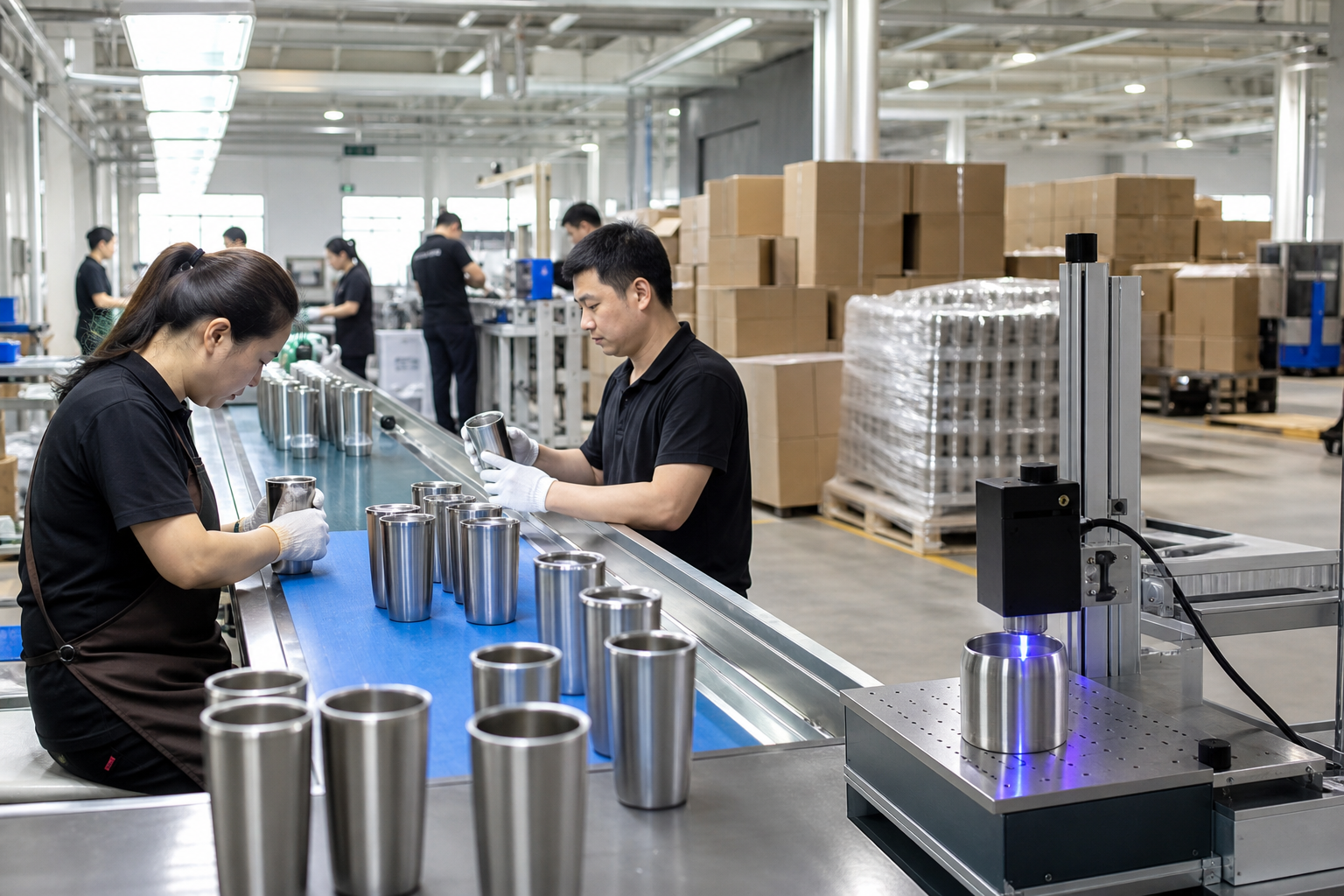
Decoration is where margin disappears if you pick the wrong method. Laser engraving is the safest choice for alcohol flask promotional products because it burns off the top layer instead of laying down ink that can scuff in transit. We ran a 500-piece order last month, and QC pulled the sample after a carton-drop test because the silk screen edge started lifting on the cap. That kind of problem shows up fast.
Silk screen is cheaper and works for one-color logos, but it only makes sense when the flask stays in a gift box or sits on a desk. UV print gives you color, though on curved metal you need to watch rub resistance and curing time; 8 seconds under the lamp is not the same as a full cure. If the buyer says the logo is "small enough" to survive shipping, the math does not work. For branded programs, we split the decoration by use case: one method for the main SKU, another for lower-budget distributor canteen orders. A canteen factory in China can do that without changing the mold.
- Laser engraving: best durability, mid-cost, no color
- Silk screen: lowest setup cost for simple logos
- UV print: color-rich, higher risk on abrasion
- Heat transfer: useful for complex graphics on coated surfaces
If you are building a custom drinkware line, ask the canteen manufacturer to quote decoration separately from body cost. We see buyers miss a 0.15 USD setup charge on the PO, then the sample sign-off gets delayed. Quote it cleanly, and you can compare canteen distributors without chasing hidden fees later.
Pricing and MOQ in China
For alcohol flask promotional products, FOB pricing from China sits in a tight band when the spec is clean. A basic 6 oz 201 stainless flask with laser logo and polybag packaging usually lands around USD 1.20-1.60 at 500 pcs. Move to 304 stainless, brushed finish, and a gift box, and you are more likely looking at USD 2.20-3.80. Add a custom shape, premium coating, or a two-piece gift set, and the quote jumps fast. We run this every week on the line, and the buyer always asks the same thing: why did the price move for 0.3 mm of wall thickness? That is the wrong question to ask.
MOQ is usually 500 pcs per design for standard flasks, though some canteen manufacturers will ask for 1,000 pcs if you need special packaging or mixed finishes. If you are a distributor canteen buyer, lower MOQs usually come with a higher unit price, not better economics. A sample run with a matte black coating and kraft gift box can take 12 days instead of 18 days once the spec is locked, but if the buyer changes the logo after approval, QC pulls the sample again and the schedule slips. Our Zhejiang line runs about 120,000 units per month across flask and canteen programs, so we can hold lead times when the drawing does not move. Once the PO has a typo in the logo size or finish code, the math stops working.
Be careful with “cheap” quotes from a canteen supplier that leave out testing, packaging, or freight cartons. We have seen that go sideways on AQL 2.5 checks when the box spec was never written down. A real custom canteen quote should break out body cost, decoration, packaging, and inspection on separate lines. That is the only clean way to compare canteen suppliers. Ask for the carton count too. If the supplier will not show it, the quote is not real.
Compliance for EU and North America
I’m rewriting the section to keep the same HTML structure while making the wording sound like a factory-side sales engineer wrote it, with tighter compliance language and more concrete production detail.Alcohol flask promotional products look simple on paper. On the line, compliance is where orders get stuck. For Europe, ask for REACH and, when the flask touches food or is sold that way, LFGB migration testing. For the United States, request FDA food-contact declarations and a written check on the inks or coatings for indirect food contact. If the buyer wants a retail-ready program, ask for AQL records, usually AQL 2.5 for major defects and AQL 4.0 for minor defects. QC pulled the sample at 10:20 a.m., and the seal line was the first thing we checked.
Packaging also matters. If the flask ships through retail or e-commerce, barcode labels, country-of-origin marks, and carton marks have to match the warehouse scan flow. We have seen a buyer flag a PO because the carton label carried the wrong 3-digit item code. For multi-SKU drinkware or a canteen bundle, ask for a drop test on the master carton. 1.2 m is a common baseline, and we run it with a 5 kg loaded carton. Broken cartons trigger chargebacks faster than a bad logo, so this is the wrong question to argue over after shipment.
In China, a good factory will provide sample retention, batch records, and photo reports before shipment. In Zhejiang, the better canteen vendors have that routine built in, with one sealed sample kept for each batch and the packing photos tied to the lot number. If a supplier cannot show you the test plan, treat that as a warning, not a negotiation point.
- Europe: REACH, LFGB if needed, carton labeling, traceability
- North America: FDA food-contact support, barcode readiness
- Factory control: AQL 2.5, leak test, sample seal retention
Choosing the right factory partner
There are more than 40 canteen vendors in China, but only a few are set up for promotional flask work. The right partner is not just a canteen supplier; it is a factory that keeps print registration tight, checks packaging on the line, and knows export docs without guessing. If you want custom drinkware that ships on time and matches the brand card, ask hard questions about capacity, sample turnaround, and how they handle defects. We have seen this go sideways on a 304 stainless run when the carton mark was 2 mm off and the buyer flagged it at booking.
Useful factory questions are simple: How many pieces per month do you run? What is your normal lead time after sample approval? Can you support a 500 pcs MOQ with mixed logo positions? Can you make a canteen customized to my color target? On our side, the standard flask sample cycle stays at 7-10 days, and production usually lands in 25-35 days after approval, depending on finish and packaging. That clock only works when the buyer signs off the spec sheet, not “something close.” QC pulled the sample twice on a matte black job because the logo sat 1.5 mm low.
You should also look for a canteen distributor or canteen manufacturer that can handle adjacent products. If your program later adds a custom growler or a customizable canteen for another campaign, it is easier when the factory already runs stainless forming, coating, and decoration in-house. One line, fewer handoffs. That matters. Handoffs are where wrong lids, wrong sleeves, and wrong cartons creep in; we once caught a PO typo that turned 6,000 gift boxes into the wrong Pantone call before shipment.
If you need one phrase to remember, use the quote process to test the supplier, not the sample room to discover the spec. That is the wrong question to ask after the sample arrives. Ask it at the RFQ stage, when the vendor still has room to say no, change the tooling, or admit the finish will miss your target by 0.3 mm.
How to brief your first order
Your purchase order needs more detail than a mood board. For alcohol flask promotional products, write down capacity, steel grade, wall thickness, finish, cap type, logo position, artwork file format, packaging, carton spec, and shipping terms. We run into trouble when a buyer sends “nice matte flask” and expects the line to guess the rest. One typo on the PO, like 6oz written as 60z, can stop the sample room for a day.
A clean briefing set looks like this:
- Product: 6 oz stainless flask
- Material: 304 stainless, 0.5 mm wall
- Finish: brushed body, laser logo, matte black cap
- Pack: white box, 50 pcs per carton
- Target: FOB Ningbo or FOB Shanghai, depending on route
If you are comparing a canteen manufacturer, a canteen supplier, and several canteen distributors, use the same written brief for all three. That is the right way to compare price. The math does not work any other way. We have seen a quote look 8% lower, then the buyer flagged artwork, tooling, and carton printing as extra charges after QC pulled the sample with the wrong logo placement.
For buyers who also manage broader custom drinkware programs, the same brief format works for a canteen customizable line, a customized canteen retail SKU, or a distributor canteen bundle. A 12-day sample cycle beats an 18-day back-and-forth every time. Give us the specs once, and we ship cleaner samples.
Get a factory quote with real specs
Send your target capacity, steel grade, logo file, and packaging needs. We will quote MOQ, FOB price, and lead time without guesswork.
Frequently asked questions
What is the usual MOQ for alcohol flask promotional products?
For standard alcohol flask promotional products, MOQ is usually 500 pcs per design. If you want special packaging, mixed finishes, or a custom shape, 1,000 pcs is more realistic. In Zhejiang and other export-focused regions of China, some factories can test 300 pcs, but the unit price often rises 15% to 30%. If you need multiple logo versions, ask whether the MOQ applies per artwork or per body color. That detail changes the budget fast.
Should I choose 304 or 201 stainless steel?
Choose 304 stainless if the flask is going to North America or Europe, or if you want a better resale story. 304 handles corrosion and repeated washing better. 201 is acceptable for low-cost promotional use, but it is not the same product. A typical 6 oz 304 flask might cost USD 0.25 to 0.60 more than 201 at factory level, depending on thickness and finish. If your customer will actually use the product more than once, 304 is usually the safer call.
How long does production take in China?
For a standard flask with a clear spec and approved sample, production usually takes 25-35 days. If the coating is simple and packaging is basic, 18-22 days is possible on a tight schedule. If you add custom boxes, gift sets, or special plating, allow extra time. A canteen factory in China should give you a sample lead time of about 7-10 days for straightforward work, which is a good benchmark before you place the order.
What tests should I request before shipment?
Ask for leak testing, visual inspection, and AQL reports. For Europe, request REACH or LFGB support depending on your market and product claim. For the U.S., ask for FDA food-contact documentation. For export shipments, I recommend AQL 2.5 for major defects and AQL 4.0 for minor defects. If your flask has coated decoration or printed packaging, also ask for rub testing or adhesion checks. That is especially important for customized drinkware sold through retail channels.
Can you make a custom canteen or custom growler alongside flasks?
Yes. Many buyers combine alcohol flask promotional products with a custom canteen or custom growler program so they can consolidate sourcing and artwork. A good canteen manufacturer can usually align capacity, finish, and decoration across product types, but each item still needs its own technical spec. For example, a customized growler may need thicker walls, different cap structure, and different carton protection than a small flask. Keep the briefs separate even if the supplier is the same.