Key Takeaways
- A real alcohol flask supplier should state MOQ, lead time, and monthly output; a useful benchmark is 500 pcs MOQ and 300,000 units/month.
- For most export orders, 304 stainless at 0.4 to 0.6 mm is the practical spec; thin 0.3 mm shells raise dent and return risk.
- For EU and US buyers, ask for exact-sku REACH, LFGB, or material reports, plus AQL 2.5 inspection targets.
- FOB price on a 250 ml custom flask usually changes with logo method, cap build, and packaging, not just the steel body.
An alcohol flask supplier list only matters if it shows who can build to spec, not who replies fastest. For buyers in Europe and North America, the real test is simple: can the supplier hold a 0.5 mm body, pass REACH or LFGB as needed, and ship in 20 to 30 days without turning every drawing change into a new sample round. We had one buyer flag a PO typo on “0.05 mm” versus “0.5 mm,” and the whole order nearly went off the rails.
The better factories in Zhejiang, China put capacity, MOQ, and test data on the table from the start. The weak ones hide behind generic canteen supplier wording and loose promises about customized drinkware. If you buy custom canteen, custom growler, or a small alcohol flask run for retail or distributor drinkware, you need a list that filters for production discipline, not a long name list. QC pulled the sample, checked the seam at 0.3 mm, and that told us more than any sales pitch.
What A Supplier List Should Tell You
A useful alcohol flask supplier list is not a phonebook. It should tell you which factories in China or Zhejiang are real canteen manufacturer operations, which ones are trading houses, and which ones can actually hold tolerance when you move from stock to custom canteen or custom drinkware. For a procurement team, the first filter is simple: product scope, MOQ, monthly capacity, and export history.
Ask for the basics in the first reply. A serious canteen factory will state whether it is a canteen supplier, canteen manufacturer, or canteen vendor; whether it handles canteen custom, canteen customizable, or canteen customized programs; and whether it supports related lines such as custom growler, customizable growler, and distributor drinkware. If it only gives you a glossy catalog, that is not enough. You want a list that shows the production path: stainless grade, decoration method, sample time, and whether the same line can handle canteen promotional runs for canteen distributors. We run a 300,000-unit line, but if the MOQ is 5,000 pcs and your launch needs 500, the math does not work. The list should help you cut bad fits before you pay the sample fee. QC pulled a random cup and measured the seam at 0.3 mm; that is the sort of detail a real factory will mention without being asked.
Check Materials, Gauge, And Seals
For alcohol flasks, material choice drives most defects. 304 stainless is the default for export runs. We only push 316 when the buyer has a real corrosion spec or a premium shelf plan. If a supplier cannot state the steel grade, wall thickness, and gasket material, stop the quote there. A 0.3 mm shell can look clean in photos, but one carton drop and the dent shows up. On the line, we run 0.4 to 0.6 mm for retail flasks, checked with a caliper before packing.
- Body: 304 stainless, 0.4 to 0.6 mm, brushed or mirror finish.
- Cap: stainless outer with food-grade PP or silicone contact parts.
- Seal: leak-tested gasket, not a decorative washer.
- Finish: passivated after welding, then cleaned before packing.
Ask for a 24-hour inverted leak test and a drop test on master cartons. QC pulled a sample with a loose cap after the first round, which is why we insist on the gasket callout, not a decorative washer. If your range also includes customizable canteen or customized growler items, the same rule applies: shell, seam, and closure beat the sales copy. Good canteen manufacturers in Zhejiang speak in numbers, not adjectives. The buyer flagged a typo on a PO once, and the wrong cap spec would have slipped through. That is how returns start.
Compliance Docs You Should Ask For
Weak alcohol flask suppliers usually fall apart on compliance first. Strong factories ship this paperwork every week. For Europe, ask for REACH and, if the flask touches food contact in a stricter channel, LFGB or a migration report with the test limits listed. For the US, ask for FDA-relevant material statements and a named lab report. We run into suppliers waving a generic PDF from 2022; that does not pass. If the factory is clean, it can show BSCI or ISO 9001 audit records, and that tells you the line has a real control system, not just a sales desk.
Ask for the full file: test scope, report date, sample reference, and the exact build tested. Lid, coating, alloy—each one matters. A 304 stainless flask with a different cap can fail a buyer check even if the body is the same 180 ml SKU. We had a PO once with the cap code mistyped by one digit, and QC pulled the sample before packing; that saved a useless shipment. For a canteen distributor or distributor drinkware buyer, this is the wrong question to ask: “Can you send a certificate?” Ask, “Does this PDF match my SKU?” In Zhejiang, the better factories will send full PDFs, carton specs, and AQL targets in one reply. The standard we ship against is AQL 2.5 for major defects, 4.0 for minor defects, and zero critical defects on a leaking flask. Hold that line before you discuss logo placement.
Paperwork should match the exact SKU, not a similar one from last season.
MOQ, Pricing, And Lead Times
Pricing on an alcohol flask is driven by steel grade, decoration, cap build, and packaging more than by the shell itself. For a 250 ml stainless flask with one-color laser or silk logo, FOB China pricing usually lands around USD 0.95 to 1.80 at 1,000 pcs. If you want gift-box packaging, colored coating, or a mixed-material cap, the range moves to USD 1.80 to 3.20. We have seen buyers fixate on the shell price and miss the carton spec. That is the wrong question to ask. A supplier quoting a flat price without asking about artwork, carton count, or export port is guessing.
MOQ depends on whether you are buying stock bodies or a fully customized run. A practical floor is 500 pcs for a simple stock flask with logo, 1,000 pcs for custom color, and 3,000 pcs or more for a new mold or nonstandard profile. Sampling usually takes 5 to 7 days, and production is often 20 to 30 days after sample approval. Last week QC pulled the sample on a 0.3 mm cap gap, and the buyer flagged it before we ran the line. A strong canteen factory in Zhejiang can run 300,000 units per month across multiple drinkware lines, so repeat orders and distributor programs are manageable. If the lead time is vague, or the supplier refuses to separate tooling cost from unit price, the math does not work. You are looking at a quote built to win the PO, not the program.
Custom Branding That Actually Ships
Custom branding on flasks goes bad fast if you pick the wrong decoration. On brushed stainless, laser engraving is the cleanest call because it cuts the surface instead of depending on ink. We run 40W fiber lasers at about 0.12 mm depth, and the mark still reads after 50 dishwasher cycles. Silkscreen still works for a simple one-color logo on a promo canteen, but it needs a controlled cure and abrasion testing on the line. If you are building premium custom drinkware, match the decoration to the base finish. One method for every SKU is the wrong question to ask. That is how you keep a customizable canteen or customizable growler line stable from the first PO to the next reorder.
The same applies to packaging. A distributor can ship a customized canteen or custom growler in a plain polybag, but retail buyers usually want an insert, a color box, and a master carton that passes export drop tests. If you need FNSKU labels, Amazon prep, or retail barcodes, say that before sampling. It costs less to lock the label panel before sampling than to rework 10,000 units in a warehouse. We had one buyer flag a 3 mm barcode shift on a 24-pack tray, and that kind of miss burns time fast. For canteen vendors and canteen distributors, the best factories usually ask for artwork size, Pantone references, carton quantity, and whether the logo has to survive 30 hand washes. That is a good sign. A canteen manufacturer that says yes to everything without asking for details is not helping you; it is guessing. We have seen that go sideways more than once.
When you compare canteen custom and canteen customized programs against a flask line, look for the same control points: artwork proof, seal check, and packing method. On one flask run, QC pulled the sample and found a 1.5 mm lid gap, so the lot stopped before packing. The decoration may change, but the export discipline should not. That same factory mindset also holds when you source customizable drinkware across several SKUs.
How To Audit A Factory Fast
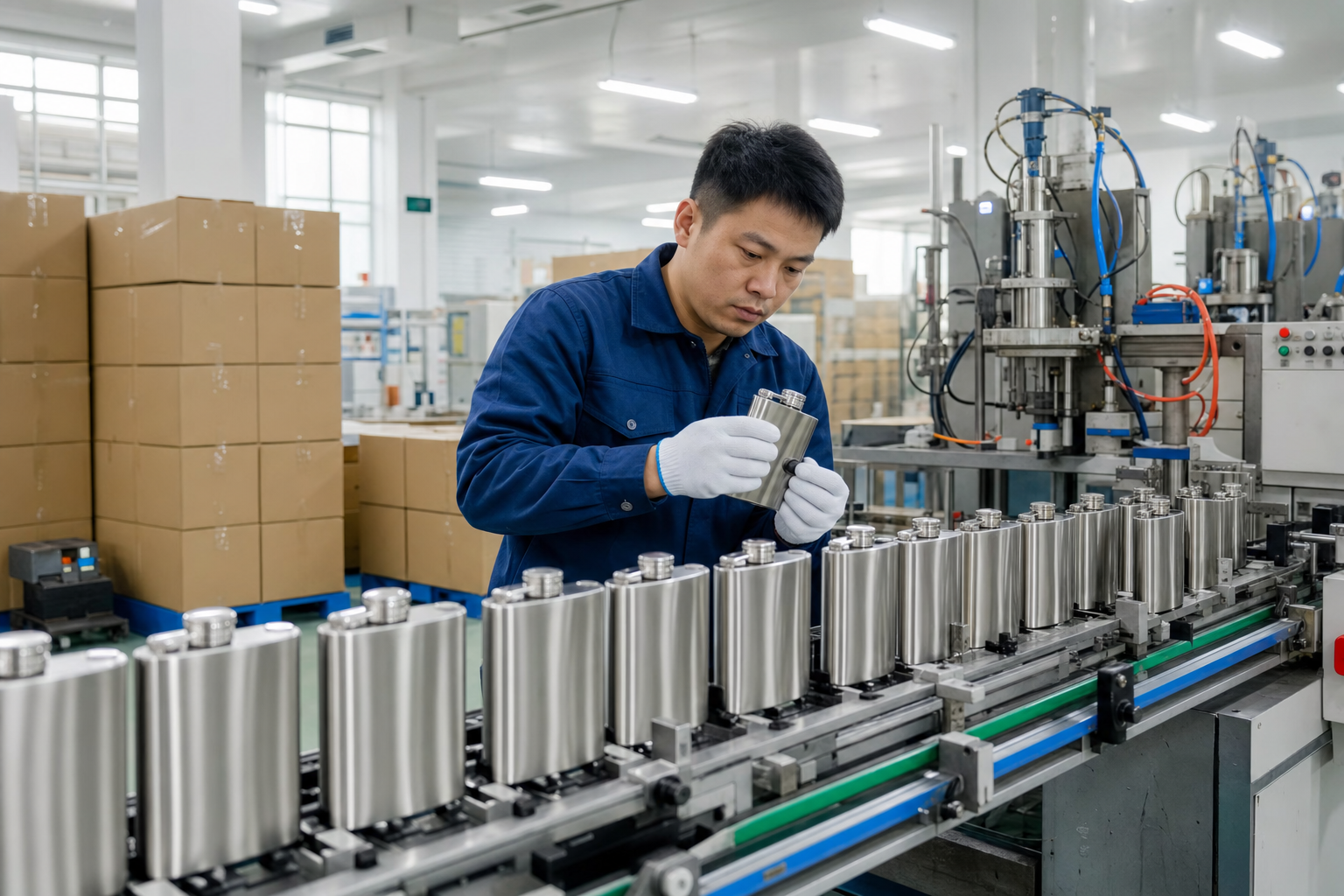
If you are building an alcohol flask supplier list from scratch, the fastest way to separate a real factory from a sales desk is a live audit call. Ask for one continuous video: raw tube cutting, welding, polishing, leak testing, then final packing. A real canteen factory in Zhejiang can show that in one take. A weak one only has finished samples and a clean office. We run that check all the time.
Use a short checklist. First, confirm whether the plant is a canteen manufacturer or just a canteen supplier. Second, ask how it handles inspection: incoming materials, in-process checks, final AQL sampling. Third, ask who signs off on artwork, because a PO typo on the logo line can turn into a 300 pcs reprint. Fourth, ask about repeat orders: can the factory hold your cap, carton, and print settings for 12 months? Fifth, ask what happens if your first 300 pcs fail leak testing. A disciplined supplier will show a rework path and a replacement policy. The math does not work if the price is low and the line is sloppy. For custom drinkware buyers, the goal is not the cheapest bottle. It is a China partner that can repeat the same result on the second, third, and tenth order. That is the real value of a short alcohol flask supplier list.
If the answers stay specific, move from shortlist to sampling. No need to waste 30 days chasing bad quotes.
Shortlist your flask factory with real specs
Send your target MOQ, logo method, and compliance needs. We will quote from China with the right steel grade, packaging, and lead time.
Frequently asked questions
What MOQ should I expect for a custom alcohol flask?
For a standard 6 oz or 8 oz stainless flask, 500 pcs is realistic for a stock shape with a laser logo. 1,000 pcs is more common once you add custom color, gift box, or a special cap. If a supplier quotes 100 pcs for a fully customized run, check whether it is a trading sample quote rather than production pricing. In Zhejiang, strong factories often keep MOQ low on repeat bodies because they run 300,000 units per month across multiple drinkware lines. Ask whether MOQ is per design, per color, or per carton spec. Those three are not the same, and confusing them is how buyers overpay.
304 or 316 stainless for alcohol flasks?
For most alcohol flasks, 304 stainless is enough and is the normal choice for custom drinkware export programs. It balances cost and corrosion resistance. 316 only makes sense if you need a higher-end position, a stricter corrosion requirement, or you are matching a premium line. The price difference is usually 15% to 30% depending on market conditions. Do not pay for 316 if the supplier cannot prove the grade with material traceability. Also ask for wall thickness, ideally 0.4 to 0.6 mm, because a thicker 304 flask often outperforms a thin 316 one in real use.
What documents do EU and US buyers need?
For Europe, ask for REACH and, where relevant, LFGB or migration testing from a named lab. For the US, ask for material declarations and test reports tied to the exact SKU. If you sell through retail or marketplaces, ask for carton specs, barcode placement, and a packing list format that matches your warehouse rules. BSCI or ISO 9001 audit records help, but they do not replace product testing. For a real China factory, the clean answer is a PDF package with report number, test date, sample photo, and product dimensions. If they only send screenshots, keep looking.
How should I compare FOB quotes?
Compare more than unit price. A quote on a 250 ml flask should show steel grade, wall thickness, cap material, decoration method, packaging, carton quantity, and production lead time. A USD 1.20 quote with a plain polybag is not equal to a USD 1.55 quote with a color box and barcode. In China, two suppliers can both write FOB Ningbo, but one may be quoting from stock and the other from a new production run. Ask for sample cost, tooling cost, and whether the price holds at 500 pcs, 1,000 pcs, and 3,000 pcs. That is how you find the real break point.
Can one factory handle custom logo and packaging?
Yes, if it is a real canteen manufacturer or drinkware factory with in-house printing and packaging control. A good plant can usually handle laser engraving, silkscreen, gift boxes, barcode labels, and carton marks in one workflow. The key is to lock artwork early and confirm the packing sequence before mass production. For Amazon or distributor drinkware programs, ask for FNSKU or SKU labeling, carton inner count, and master carton dimensions. A factory that handles these details well will reduce warehouse rework. A factory that says yes to every request without asking for specs usually does not control the line tightly enough.