Key Takeaways
- A capable Zhejiang alcohol flask supplier should quote MOQ, lead time, and monthly capacity clearly, such as 120,000 units/month.
- For alcohol flasks, 304 stainless steel is the default; 316 is better for saltier environments and higher corrosion resistance.
- Custom branding changes cost structure fast: laser engraving, silkscreen, and full-color packaging each affect MOQ and unit price.
- Compliance matters: REACH, LFGB, food-contact testing, and AQL inspection are standard checks for Europe and North America.
If you are sourcing from an alcohol flask supplier, price is not the main risk. The real problem is a flask that looks fine in photos and then shows a hairline leak after the pressure test, or arrives with missing compliance papers for your market. We run those checks on the line with a torque cap tester and a 24-hour water soak, because a buyer will flag a bad lid before they ever care about your margin.
The suppliers worth working with in China and Zhejiang speak in numbers, not adjectives: 304 or 316 stainless steel, 0.4 mm to 0.7 mm wall thickness, 1,000 to 3,000 pcs MOQ, and 25 to 35 days lead time for standard customization. If a factory cannot quote those figures and back them with a sample report, the math does not work. QC pulled the sample, checked the weld seam at 0.2 mm, and still caught a PO typo on the finish code. That is the level you want.
What Buyers Should Verify First
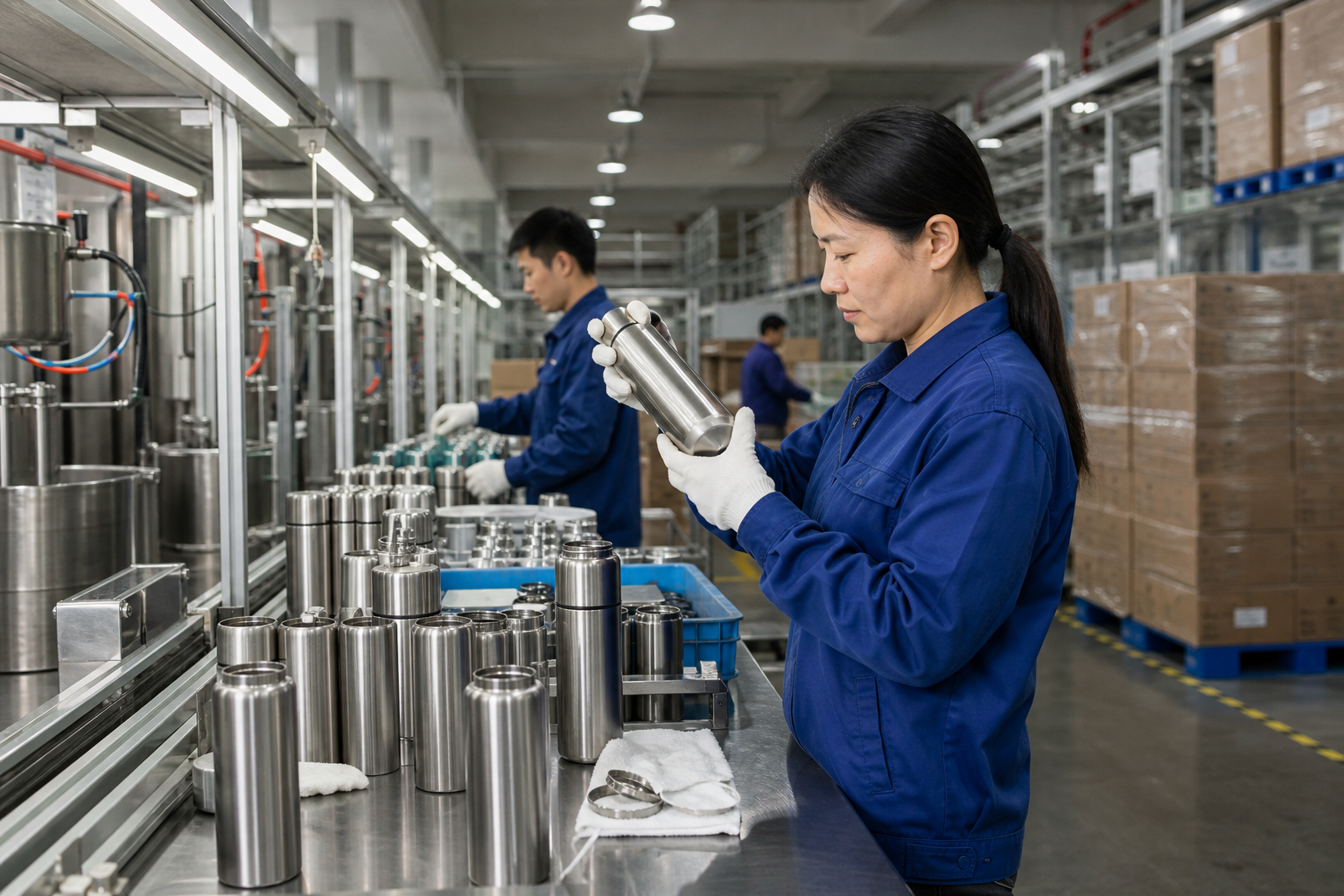
Start with a simple check: is this an actual alcohol flask supplier, or just a trading desk with a catalogue? We ask for factory photos, a live production video, audit reports, and a plain list of in-house steps. A real canteen manufacturer can show forming, welding, polishing, leak testing, and packing in one site, or tell you exactly which step moves out. If they dodge that, the line is already telling you something.
For a B2B order, numbers beat slogans. A solid canteen supplier should state monthly output, sample turnaround, and inspection method without stalling. One Zhejiang factory we know runs 120,000 units/month, and the QC bench uses an air-pressure leak tester before packing; that kind of setup matters when you are planning replenishment as a canteen distributor or a distributor drinkware buyer. If the seller cannot say whether they are a canteen vendor, part of a canteen vendors network, or a direct producer, the math does not work.
- Ask for MOQ by style and decoration method.
- Confirm lead time for blank, printed, and boxed units separately.
- Request samples with the same finish as mass production.
- Check if they support OEM, ODM, and private label packaging.
We also check the small stuff. A buyer once flagged a PO typo on carton size, 48 pcs instead of 24 pcs, and that would have blown the packing plan; this is why we want the sample finish to match the line, not a hand-picked demo piece. The best suppliers in China are blunt about what they control and what they outsource. That honesty usually saves more money than chasing the lowest quote.
Materials Decide Margin
Most buyers start with decoration. That is the wrong question to ask. Material choice drives unit cost and the complaint rate, and we see it on the line every week. For an alcohol flask supplier, food-grade 304 stainless steel is the standard base material. If the flask will go into harsher use, 316 earns its keep on premium export lines where corrosion resistance is part of the sales pitch. Wall thickness usually sits between 0.4 mm and 0.7 mm; go thinner and you save weight, but dents show faster and weld marks are easier to spot under QC light.
There is no magic in a custom canteen or custom growler program if the steel grade is wrong. A customizable canteen for outdoor promo sets has to hit cost, weight, and drop resistance at the same time. A customizable growler for beer or mixed beverage gifting often needs a wider mouth, a tighter cap system, and cleaner internal polishing. For a distributor canteen program, we ask for the exact steel grade, surface finish, and gasket material. Silicone gaskets are common, but the buyer flagged one PO typo last month because the temperature range was missing, and that sort of miss turns into a claim fast. Check the food-contact certification too.
Good sourcing is not asking whether the sample looks nice. It is asking how the flask behaves after 20 leak tests, 24 hours of transport vibration, and one season of real use.
That is why a canteen manufacturer in Zhejiang should talk about material traceability and batch consistency, not just shine. We run lot checks on every coil, and the traceability sheet needs to match the carton mark. The right alloy protects margin because it cuts returns, replacements, and bad reviews after the first shipment lands in North America or Europe. The math does not work any other way.
Customization That Sells
Branding is where custom drinkware stops being a commodity and starts pulling orders. For an alcohol flask supplier, we run four common methods: laser engraving, silkscreen printing, pad printing, and full-wrap packaging. Each one changes unit price, setup cost, and lead time. Laser engraving gives a clean mark on a premium custom canteen or customized canteen line. Silkscreen works better for bold logos on a 1,000-piece run. If you need a canteen promotional program, screen print plus a simple gift box is usually the fastest route to market.
Be exact about what the decoration has to survive. If your customer base includes distributor drinkware chains or canteen distributors moving into gifting, the print needs to hold up against abrasion, hand-washing, and carton rubbing in transit. Ask the supplier for decoration loss rate, color matching tolerance, and sample approval rules. On our line, QC pulled the sample after a 0.3 mm logo shift, and the buyer flagged it before mass production. A real canteen customizable workflow should include artwork file checks, Pantone references, and a pre-production proof. Skip that, and the artwork problem lands on your desk after the PO is signed.
Some buyers want a customized growler or custom growler for beverage promotions, but the sourcing logic stays the same. Decide whether you are buying for shelf appeal, resale margin, or repeat corporate gifting. That answer tells you whether you need matte coating, brushed metal, leather wrap, or a simple polished finish. A customized drinkware program that tries to do too much can hurt the sell-through. We saw a 500-piece order stall because the logo, matte body, and gift sleeve all fought each other. Clarity sells better than decoration overload.
Compliance Is Not Optional
If your market is Europe or North America, compliance is part of the product, not a back-office file. A qualified alcohol flask supplier should be ready for REACH, LFGB, FDA food-contact expectations, and third-party testing when the buyer asks for it. On our line, QC checks the steel gauge at 0.6 mm before packing, because a thin wall is where complaints start. For retail programs or marketplace fulfillment, ASTM test references for material performance or carton crush strength can matter too.
Ask for the exact test scope, not a certificate screenshot. You want to see whether the report covers the steel body, the cap, the gasket, and the print. You also want the issue date, the lab name, and the sample code. If the supplier cannot explain those points, the paper is there for show. We have seen buyers get held up because a PO said matte black while the test was run on brushed silver, and the math does not work. For customized drinkware entering regulated markets, this check saves time at customs and keeps retailers from kicking the carton back.
- Check whether the report matches the same SKU and decoration method you are ordering.
- Confirm whether packaging inks and adhesives are covered.
- Ask if the factory supports BSCI or similar social compliance audits.
- Request AQL inspection standards before production starts.
A serious canteen factory in China treats compliance as routine export work. We run this every week, and the best suppliers in Zhejiang keep the file ready before the buyer flags it. That is how repeat orders move.
MOQ, Lead Time, and Cost
MOQ is where buyer expectations break first. A workable canteen supplier usually starts at 1,000 to 3,000 pcs for a standard flask, but the number moves with decoration, tooling, and pack-out. Laser engraving can drop the MOQ to 500 pcs on a repeat SKU; four-color printing on a curved body is a different job. If you want a custom canteen or canteen customized in special colors, the MOQ climbs fast because the coating line needs a clean changeover and QC will hold the first 30 pcs for rub-test checks.
Lead time needs a hard number, not sales talk. For a normal order, 25 to 35 days after sample approval and deposit is workable. New mold work or a custom cap design can stretch that to 45 days or more. We shipped one PO with a typo on the cap color code, and the buyer flagged it before production; that kind of fix adds 3 to 5 days on the line. If someone promises 7 days on a factory-made metal flask with custom branding, they are selling stock or skipping process control. This is the wrong question to ask.
Pricing should be split into body cost, decoration, packaging, and carton spec for export. Ask for FOB China and compare landed cost, not the ex-factory teaser. On one 12,000 pcs order, a lower quote looked good until we saw 0.3 mm thinner steel and a looser AQL 2.5 check at packing. In Zhejiang, a straight supplier will tell you where the number comes from. That candor matters more than a one-off savings of $0.08 per piece. Protect gross margin across the full order cycle, not just the first invoice.
How to Choose The Supplier
The best alcohol flask supplier is the one that cuts your risk, not the one with the nicest sales deck. Start with three checks: production depth, export paperwork, and response speed. A solid canteen manufacturer answers a technical question in one email and gives a sample lead time without dancing around it. We run into the opposite all the time. One buyer flagged a 2 mm logo shift on a 500 pcs PO, and the weak factory said, “let us confirm after the next meeting.” That is not a supplier, that is a delay machine.
Pick a factory that knows the buyer type in front of them. If you need a canteen promotional campaign, they should know how to pack for retail display and keep the carton count clean. If you are building a custom drinkware assortment, they should hold logo placement steady across SKUs, even when the body size changes from 6 oz to 8 oz. If you are a canteen distributors team, you need steady reorders, not a one-time novelty. Same for canteen vendors handling private-label beverage programs. We have seen this go sideways when a PO typo changed “matte black” to “metal black” and QC pulled the sample before it hit the line.
Practical checks are simple:
- Can they support repeat color matching on reorder?
- Do they share inspection photos before balance payment?
- Can they produce a sample in 7 to 10 days?
- Do they have export packing experience for North America and Europe?
China has plenty of suppliers, but only a few can hold consistency, speed, and export docs together. In Zhejiang, the better factories treat each order like a production schedule, not a sales lead. We ship that way too. That is the difference between a supplier you test once and one you can keep on reorder. The math works only if the factory can run the line without excuses.
Request a factory quote and sample today
Send your target MOQ, artwork, and market standard. We will quote the right spec, not just the lowest number.
Frequently asked questions
What MOQ should I expect from an alcohol flask supplier?
For a standard custom flask, a realistic MOQ is 1,000 to 3,000 pcs. Laser engraving can sometimes stay near the low end, while multi-color printing, special coating, or gift-box sets may push MOQ higher. If you need a custom canteen or customized drinkware program with mixed SKUs, ask the supplier to quote MOQ per decoration method, not just per body style. A serious factory in China will separate blank stock, printed units, and boxed retail units so you can see where the cost changes. That level of detail usually signals a real production operation, not a reseller.
Which material is better for export drinkware orders?
For most buyers, 304 stainless steel is the default choice because it balances cost, corrosion resistance, and availability. If your customer wants a premium line or the flask will be used in tougher conditions, 316 is better. Wall thickness usually sits between 0.4 mm and 0.7 mm, and that range affects dent resistance and perceived quality. For a customized growler or custom drinkware program, also check the gasket material and the inside polish. Material choice is not just technical; it affects freight damage, customer complaints, and long-term margin.
How long does production usually take?
For a standard order with approved artwork, 25 to 35 days is a normal lead time. If you need new tooling, a special cap, or more complex packaging, plan for 45 days or more. The key is to separate sample time from mass-production time. A good canteen factory in Zhejiang should be able to provide a sample in 7 to 10 days for existing styles. If the supplier is vague about deadlines, expect delays later. In export work, the calendar matters as much as unit price.
What compliance documents should I request?
Ask for the test report that matches your exact SKU, including body material, cap, and gasket if applicable. For Europe, REACH and LFGB are common references; for North America, food-contact expectations and retailer-specific requirements matter. You should also ask whether the factory supports BSCI or similar social audit requirements, and whether AQL inspection is part of the standard QC process. If the supplier uses printed packaging, ask whether inks and adhesives are included in the testing scope. A useful report has the lab name, date, sample reference, and clear pass criteria.
Can I use the same supplier for custom canteen and growler programs?
Yes, if the factory has the right tooling, finishing lines, and quality control. Many buyers source a custom canteen, custom growler, and promotional flask from the same China supplier because it simplifies artwork approval and replenishment. The important thing is not the product label but whether the factory can handle different neck sizes, cap systems, and finishing standards without quality drift. A good partner can also support distributor canteen and distributor drinkware orders with stable reorders and consistent packaging. That is especially useful if you run mixed retail and corporate programs.