Key Takeaways
- A workable MOQ is usually 500-1,000 pcs per SKU, while a serious factory in Zhejiang should still handle 30,000+ units/month across flask and canteen lines.
- For stainless alcohol flasks, 0.6-0.8 mm wall thickness and a leak test on every lot matter more than a glossy sample.
- FOB pricing for a basic custom flask can start around USD 1.20-2.80, but decoration, packaging, and compliance can move the number fast.
- A realistic lead time is 25-35 days after sample approval; if a canteen vendor promises much less, ask what they are skipping.
If you are sourcing from an alcohol flask vendor, the real risk is not a low price. The real risk is a flask that looks fine in product photos, then comes back after one season, three dishwasher cycles, or one export inspection with seam cracks or a leaking cap. We run wall thickness checks at 0.6 mm and 0.8 mm on the line for a reason. Margin disappears fast when the first 500 pcs hit returns.
In Zhejiang and across China, plenty of canteen manufacturers and canteen suppliers can quote in an hour. Fewer can hold custom drinkware production at scale without drift in the weld, the polish, or the print position. If you need a customized canteen, a custom growler, or a canteen promotional run for retail or distribution, ask for material traceability, test reports, and a decoration method the shop can repeat batch after batch. We’ve seen the math fail when a buyer accepts “same as sample” without a spec sheet.
What a real vendor must prove
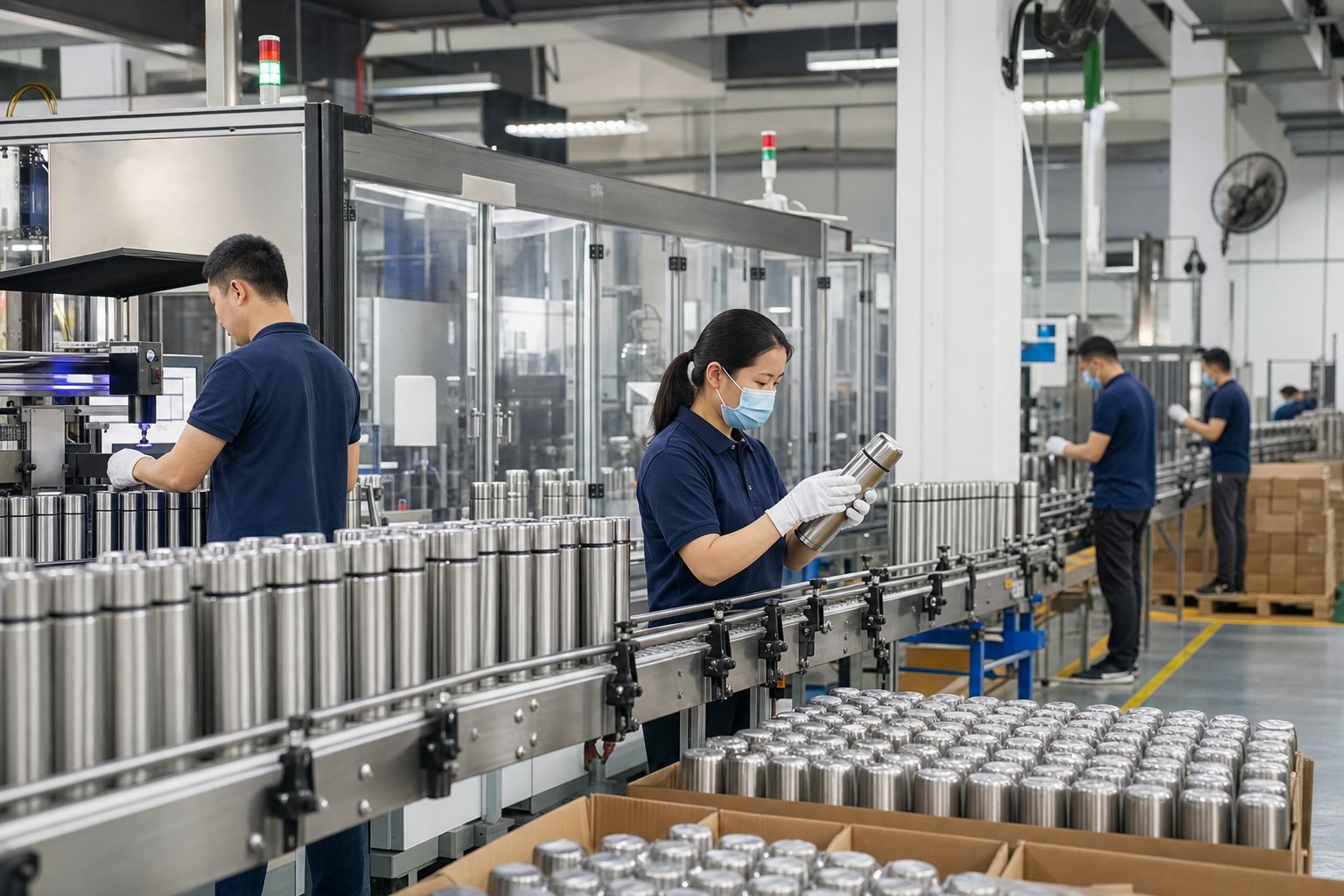
When you check an alcohol flask vendor, start with proof, not promises. A proper canteen factory should show the production route: cutting, forming, welding, polishing, cleaning, printing, packing. If they cannot point to where the leak risk sits, they are not a manufacturing partner, they are a quoting desk. For a stainless steel flask, the weld seam and cap interface are where bad workmanship shows up first.
Ask for batch-level data, not a hand-picked sample. Good vendors in Zhejiang can show incoming material records, in-process checks, and final inspection reports under AQL 2.5 for critical defects, sometimes tighter if your brand asks for it. We run QC on the line with a caliper and a leak tester, and that matters because one bad carton can kill repeat orders. A canteen distributor should also tell you which lines are reserved for custom canteen jobs and which ones run stock items, because shared tooling creates drift.
One practical test: request three identical samples from the same lot. If weight, lid fit, or print alignment changes from one sample to the next, you have process drift. The buyer flagged this once on a 200 ml flask run when the cap torque varied by 0.4 N·m, and the math does not work. That problem usually shows up after the order ships.
Materials that survive export use
For alcohol flasks, 304 stainless steel is the default on most export runs. It gives the right mix of cost, corrosion resistance, and drawing performance on the line. We have seen 316 work for premium sets or harsh cleaning routines, but the price jump is hard to defend unless the buyer has a clear end-market reason. For a canteen custom project, write the material spec on the PO. Do not leave it as a verbal agreement, or the buyer will flag it later.
Do not ignore thickness. A 0.5 mm body can look fine in photos, then dent on a 1.2 meter drop during warehouse handling. For a customized canteen or customized growler, 0.6 mm is the safer floor; 0.8 mm feels heavier in hand and usually supports a better brand read. Caps matter too. PP, ABS, and stainless caps each change weight, odor, and unit cost. If you are sourcing a custom drinkware assortment for North America or Europe, ask for food-contact compliance on every part, including the gasket. We have seen a gasket spec get missed because the PO typo only listed the cup body.
Finishes are not cosmetic only. Matte powder coat hides scuffs better than mirror polish, while brushed stainless masks light scratches but shows oil marks faster. QC pulled the sample after a rub test because the brushed surface picked up fingerprints in 30 seconds, and that is the wrong finish for a retail shelf. A canteen manufacturer that has shipped into retail for years knows these tradeoffs. A canteen vendor with only broker experience usually does not.
MOQ, pricing, and lead time
MOQ is where a lot of buyers lose a week. A solid alcohol flask vendor will give a minimum based on tool change, decoration setup, and packout. For a simple laser mark or one-color print, 500 pcs per SKU is normal. For a custom canteen with a special shape, molded lid, or multi-color carton, 1,000-3,000 pcs makes more sense. If you split colors, the factory will usually split MOQ by color or by decoration method too. We had one buyer flag a PO that mixed 3 colors under one line item; the line had to stop and recheck the pick list.
Pricing works in layers. A plain stainless flask from a China factory may land around USD 1.20-1.80 FOB. Add laser engraving, powder coating, or a custom box, and the quote moves into USD 2.20-4.00 fast. That is normal. The wrong question is, "Who is cheapest?" We run the math by scrap rate, and a supplier that fails 8 percent of inspection costs more than one that is 12 cents higher but holds AQL 2.5. In Zhejiang, the better canteen suppliers usually quote higher because they build in process checks, not because they like to talk big. QC pulled the sample; one matte black finish showed a 0.3 mm scratch right under the logo.
Lead time starts after sample approval. A standard order is often 25-35 days after pre-production sample signoff. If you need a distributor canteen program for a trade campaign, add 7-10 days for sea freight consolidation and carton labeling. Fast quoting is easy. Stable delivery is the part that matters. We once saw a 12-day rush promise turn into 18 days because the buyer changed the gift box typo from "stailess" to "stainless" after proof approval.
Testing and export compliance
If you sell into Europe or North America, compliance is not decoration. A serious canteen factory should know REACH, food-contact migration limits, and the export docs buyers actually check. On stainless orders, we get asked for LFGB, FDA-style declarations, or third-party lab reports depending on the market. If the flask has a coating, ink, or plastic lid, QC has to check each part, not just the body. We run this as a full BOM review on the line, and the buyer usually notices the weak link fast.
Ask the alcohol flask vendor which tests are standard and which only happen on request. At minimum, you want leak testing, dishwasher resistance if that claim is on the carton, and coating adhesion for painted work. For a canteen promotional order, cheap decoration is often the first thing to fail, so check rub resistance and alcohol resistance if the flask will hold spirits. This is the wrong question to skip, because the math does not work when a 1,000-piece order starts peeling after 72 hours. We have seen a bad screen print smear, peel, or go soft after sanitizer and detergent.
Packaging matters too. For distributor drinkware, carton strength, barcode accuracy, and inner protection count just as much as the flask. A carton drop test at 1.0 m will tell you more than a sales promise. A factory in China that exports every week will know outer carton crush risk, pallet loading, and how to keep caps from getting flattened on a 30-day ocean trip. Zhejiang suppliers that run this routine usually beat a general trading desk on consistency, and we ship the same way every week.
Branding options that hold up
Branding decides whether custom drinkware looks like a serious buy or a cheap giveaway. Laser engraving gives a clean, permanent mark, and it is usually the safest call for a customized canteen or custom growler. Silkscreen printing works for simple logos and tighter budgets, but the ink system and curing time matter. If the logo wraps a curved body, ask for a print jig or alignment fixture; without it, we see the artwork walk from carton to carton. We had one buyer flag a PO because the logo sat 3 mm off center.
For a canteen customizable program, pick the decoration method around the use case. Retail buyers want subtle, durable branding. Canteen promotional projects usually need a lower unit price and stronger color impact. If your market wants a premium finish, powder coating plus laser logo works well on the line. If you need a distributor canteen for volume channels, one-color print and standard packaging are often the better commercial choice. We run those as different setups because the math does not work any other way.
Keep artwork rules simple. Fine lines under 0.25 mm can fill in on powder-coated surfaces. Small text below 5 pt turns muddy once the body curves and takes wear. Chasing tiny copy is the wrong question to ask. A canteen supplier with real production experience will warn you before QC pulls the first-off sample, not after printing 5,000 units. One typo in the art file can waste a full shift. That is why buyers in Europe and North America stick with a vendor that can balance branding against the limits of the process instead of saying yes to everything.
Factory or trader: choose carefully
Some buyers only want a quote. If you place repeat orders, you need to know whether you are talking to a factory or a middleman. A canteen manufacturer can usually tell you machine capacity, tool ownership, and line scheduling without checking with someone else. A trader may still help on sourcing, but if the 24 oz flask line starts printing off-center, they cannot move the screen room or fix the jig at 6 p.m. That matters when your SKU is seasonal and the retailer wants restock in 30 days.
Ask direct questions. How many units per month do you ship from this plant? Which products run on the same line? What is the maximum order size without subcontracting? We once had a buyer flag a PO typo that changed 5,000 pcs to 50,000 pcs, and the trader still could not say which workshop would take it. A real Zhejiang factory should answer with numbers, not fog: 30,000-50,000 units/month across canteen and flask programs, with MOQ starting at 500-1,000 pcs for stock shapes. If they dodge the answer, you are probably not talking to the source.
There is a place for canteen vendors and canteen distributors when you need mixed SKUs or one full container built from three factories. For a custom canteen or customized drinkware program, direct factory control gives tighter lead time, testing, and packaging. QC pulled the sample, checked the cap torque at 1.2 N·m, and caught the leak before we shipped 8,000 pcs. In China, the better suppliers know when to be the source and when to be the coordinator. You want the source when your brand is on the carton.
Source your next flask run with less risk
Send your target MOQ, artwork, and packing spec. We will quote the right factory path, not just the cheapest line item.
Frequently asked questions
What MOQ should I expect from an alcohol flask vendor?
For a standard stainless flask, 500-1,000 pcs per SKU is a normal MOQ if the shape already exists. If you want a new mold, a special cap, or multi-color packaging, expect 1,000-3,000 pcs. A factory in Zhejiang with stable export work should still be able to handle smaller trial orders, but the unit price will rise. For branded custom drinkware, always ask whether MOQ is per color, per artwork, or per carton spec. That detail changes the real cost more than the headline minimum.
Which material is better for a custom flask: 304 or 316?
For most alcohol flask and canteen custom projects, 304 stainless steel is the practical choice. It is widely accepted for food contact, easier to form, and cheaper than 316. Use 316 only when you have a clear reason, such as a premium program, harsher cleaning conditions, or a special market requirement. In many cases, the quality gap is smaller than the price gap. What matters more is thickness, welding, and surface finishing. A 0.6-0.8 mm body made well will outperform a thicker body made badly.
What logo method lasts longest on a flask?
Laser engraving is usually the most durable because the mark is physically removed into the metal, not sitting on top of it. For a customized canteen or custom growler that will be washed often, laser is the safest option. Silkscreen works for simpler branding and lower budgets, but ink durability depends on curing, surface prep, and whether the coating is powder, paint, or bare stainless. If you need a canteen promotional order, ask for rub and alcohol resistance tests. A vendor who cannot explain those tests is guessing.
How long does production usually take in China?
After sample approval, a standard production cycle is often 25-35 days for a simple flask or canteen order. Add time if you need a new mold, custom packaging, or third-party testing. In Zhejiang, a capable factory can move faster on stock shapes, but lead time should never be promised without confirming materials and decoration. If a canteen supplier says 10-15 days for a customized drinkware order, ask what quality checks are being skipped. Fast production is only useful if the lot passes inspection and ships clean.
What compliance documents should I ask for?
For Europe and North America, ask for material declarations, food-contact compliance evidence, and if needed REACH-related testing or migration reports. If the product has coating, print, plastic caps, or gaskets, each component should be covered. For a canteen manufacturer, you should also request an inspection standard, usually AQL 2.5 for general defects and tighter rules for leakage or cosmetic issues. If you are importing distributor drinkware, packaging specs and carton tests matter too. The best factories in China treat compliance as part of production, not as an afterthought.