Key Takeaways
- A real canteen factory in Zhejiang can often support 300,000 to 500,000 units per month, with 3,000 pcs MOQ and 25 to 35 day lead time for standard custom flask orders.
- 304 stainless, 0.5 mm wall thickness, and a silicone-sealed cap are the baseline spec you should expect for most custom drinkware programs.
- Laser engraving is cleaner for premium retail, while 1-color silkscreen usually gives the lowest unit cost at higher volume.
- For Europe, ask for LFGB or REACH reports on the exact flask, print, and gasket; for the US, confirm food-contact compliance and traceability by lot.
If you source alcohol flask vendors for retail, gifting, or distributor programs, the hard part is not getting a sample in 3 days. It is finding a factory that holds tolerances, keeps artwork clean after 10,000 units, and still ships on schedule. We run into this all the time in Zhejiang. Plenty of suppliers call themselves a canteen manufacturer, canteen vendor, or custom drinkware partner, but only a smaller group can support repeat orders without QC drift.
The buyers who do best treat a flask order like an engineering brief. They ask about stainless grade, wall thickness, cap seal, decoration method, carton packing, and the inspection standard behind the quote. On the line, a 0.2 mm wall gap or a bad laser mark shows up fast, and the buyer flags it before shipment. If you are buying custom canteen, customized growler, or distributor drinkware for North America or Europe, the math does not work if the vendor only gives you a low FOB number from China.
Separate Factories From Middlemen
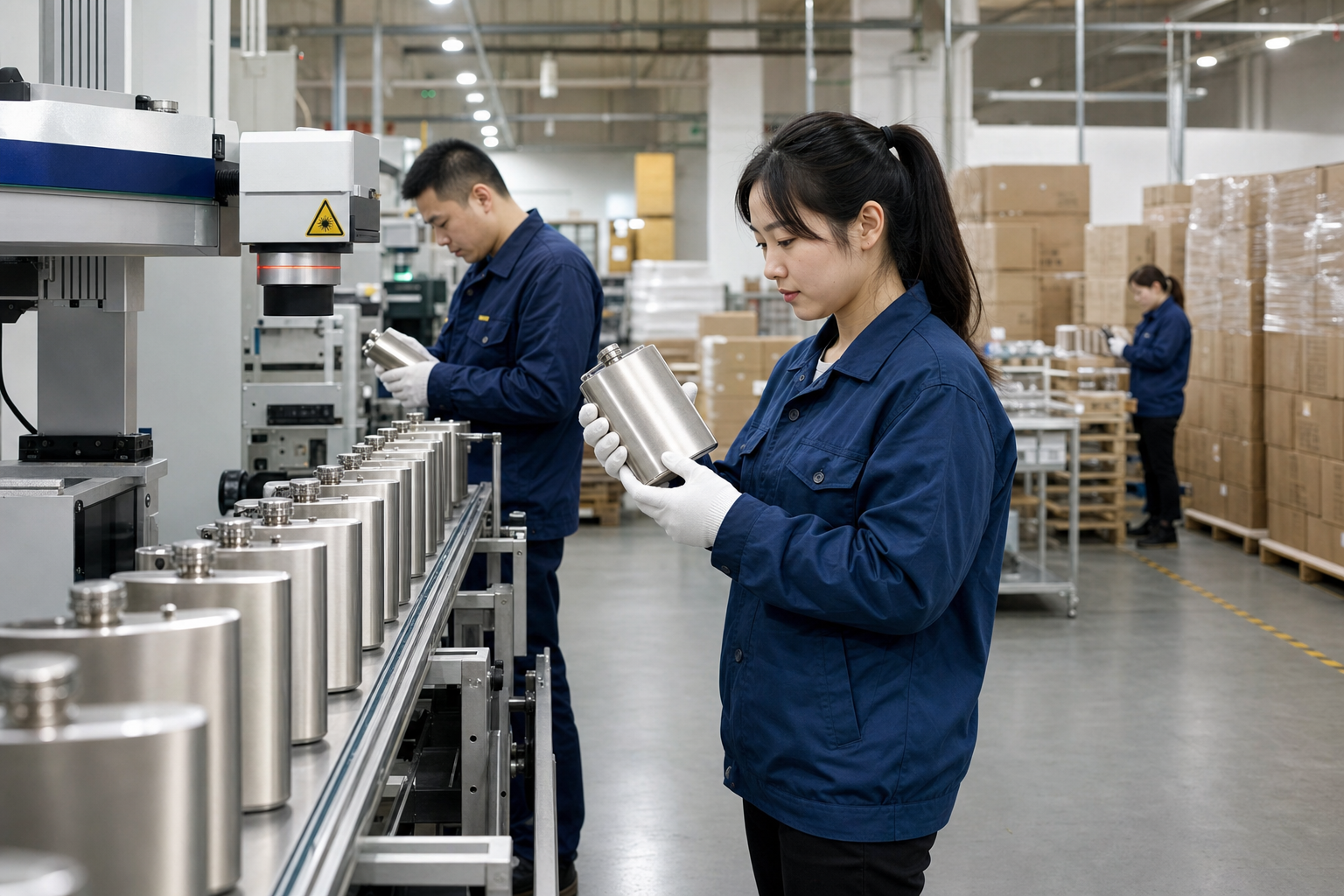
The first filter is simple: are you talking to a canteen factory, or a trading desk that buys from one? Both can send a quote. Only a real plant keeps stamping, polishing, TIG welding, packing, and final inspection under one roof. We run this check fast: ask where the tooling sits, who owns the QC records, and how many lines are on flask production. In Hangzhou, a real canteen supplier should answer straight, no spin.
Look for production facts, not marketing copy. A useful vendor profile shows monthly output, model count, the number of polishing stations, and lead time by decoration type. On our line, a plain brushed flask usually runs 25 to 35 days after sample approval. A multi-color customized canteen or a canteen promotional set with gift packaging needs 35 to 45 days. If the answer is only “fast delivery” and no capacity number, the math doesn’t work. That is a middleman talking.
- Ask for a factory address and recent export photos.
- Request a sample from the same production line, not a hand-finished prototype.
- Check whether the canteen manufacturer can support reorders with the same finish and carton spec.
For a canteen distributor or distributor drinkware buyer, repeatability beats a cheap first sample. QC pulled the sample with a color chip at 0.5 mm off and the buyer flagged it on the spot. A supplier that misses color, polish, or print placement will eat your margin later. We've seen that go sideways on the second PO.
Specify The Flask, Not The Idea
A solid order starts with a real spec, not the word “flask.” Give us the capacity, steel grade, wall thickness, finish, closure type, and whether you want a pocket flask, a larger canteen custom format, or a custom growler for premium gifting. We run the same stainless base on the line, but the details move cost and scrap rate fast. 304 stainless is the default we quote. 316 buys more corrosion resistance, but if the buyer is not using it for a harsh fill or long storage, the math does not work.
Wall thickness needs a hard call. A 0.4 mm body can pass on low-cost promo runs, but 0.5 mm to 0.6 mm feels better in hand and takes dents better in carton drop tests. The cap is where buyers get caught. We ask for a leak-proof cap with a food-grade silicone gasket as the floor, then we check closure torque and do a leak test on the bench, not just “tight lid” in the PO. QC pulled the sample last week and the cap held at 12 turns before the first seep.
What to lock in on the PO
- Capacity in ounces or milliliters, not “standard size.”
- Material grade: 304 or 316.
- Finish: brushed, mirror, powder coat, or printed.
- Seal: silicone or TPE, with lot traceability.
This is where a canteen customizable program turns into a clean repeat order or a mess. If the spec sheet is loose, the factory fills the blanks for you, and that usually shows up later as a PO typo, a mismatched lid, or a buyer flag on inspection. We have seen that go sideways on a 5,000-piece run before.
Compliance Is Not A Checkbox
For Europe and North America, compliance has to match the exact factory run, not just the product name on the quote. We ask for test reports on the same stainless steel, coating, cap, and ink used in the order. If the flask goes into the EU, REACH and LFGB are the first papers buyers ask for. For the US, check food-contact materials, relevant FDA declarations, and packaging rules tied to the sales channel. Amazon and big retailers will also ask for traceability. We shipped one 12,000-piece lot where the buyer flagged a batch code typo on the PO, and that tiny mistake turned into a week of back-and-forth.
A credible canteen manufacturer should be able to walk you through internal quality control without reading from a script. The usual line is incoming material inspection, in-process checks, final inspection, then pre-shipment sampling against an AQL table. For branded orders, AQL 2.5 for major defects and 4.0 for minor defects is common. If the vendor cannot tell you the inspection lot size, reject rate, or leak-test method, they are not running export work. QC pulled the sample on a 500 ml flask line here last month and found a cap torque issue at 18 N·cm, so this is the wrong question to dodge.
- Leak test each lot with a 30-minute hold.
- Check print adhesion and abrasion resistance.
- Confirm carton drop resistance for export lanes.
- Keep batch codes for complaints and reorders.
Buyers who work with a real China exporter ask for these records before the first container leaves, not after a claim lands. We ship that way because the math does not work any other way. One weak record can sink a repeat order fast.
Price The Program, Not The Sample
Sample price tells you almost nothing. We price production by volume, decoration, packing, freight terms, and the setup work the line must absorb. A plain stainless flask from a canteen supplier may sit at one price for 3,000 pcs and ease down at 10,000 pcs, but the math changes fast once you add gift boxes, inserts, barcode labels, or a second print pass. We run this every week in Zhejiang: if the carton spec is 300 mm and the buyer wants a last-minute logo tweak after QC pulled the sample, the cost jumps. The lowest sample quote is usually the wrong question to ask.
For budgeting, a custom canteen or custom growler program usually breaks into four blocks: body, decoration, packing, and freight. On a simple 8 oz flask, a realistic FOB range often lands around USD 1.20 to USD 3.80 depending on material, finish, and print method. Laser engraving is usually cheaper than full-color wrap printing, but it still costs more than a single silkscreen pass once you are past a few thousand pieces. Ask for the price at 3,000 pcs, 5,000 pcs, and 10,000 pcs; otherwise you are just looking at a sample sheet, not a real program. We have seen this go sideways when the buyer flagged a PO typo on the packing line and the factory quietly added a rework fee.
Payment terms are usually 30/70 for new buyers, sometimes 40/60 on tighter programs. A vendor that asks for 100 percent upfront on a standard export order is waving a risk flag. The only time we see that make sense is a small trial run, maybe 500 pcs with a custom cap or odd carton spec, and even then the paperwork should be clean. If the terms are loose but the QC report has gaps, the line will punish you later.
Build A Product Mix That Sells Again
I’m rewriting the section in place and keeping the HTML structure intact. I’m also folding in concrete factory details and tighter sales-language so it reads like someone who ships these programs, not a generic content draft.If you are a canteen distributor or a brand owner building repeat orders, do not let the flask turn into a one-SKU dead end. We run the same body across a custom canteen, a customizable growler, and a travel tumbler when the lid thread and decoration window are planned together. That keeps freight lower, carton planning cleaner, and artwork changes under control. It also gives you room when one channel wants promo pricing and another asks for premium retail pack.
For distributor canteen programs, the cleanest setup is a core body with a tight variant set: one brushed finish with a visible grain, one black powder coat at 60-70 microns, one laser mark, and one silkscreen pass. That keeps the MOQ at a level your team can actually move, not a number that sits in the warehouse. If you need canteen distributors across several territories, give each market the same spec sheet, the same carton size, the same barcode position, and the same master carton count. We have seen a PO typo on carton count eat half a day at the packing table, so this is not a small point.
There is a plain reason this works: custom drinkware programs go sideways when the buyer piles on variants before the first sale lands. Start with one validated flask, then add adjacent SKUs only after the decoration, leak rate, and pack-out hold up in real shipping. QC pulled the sample after the 24-hour leak test, and that is where the weak caps usually show up. If you want to compare logo methods or ask for a wider factory scope, put custom-logo options, quality controls, and new product capability in the same call. The math does not work if you ask for six colors, two lids, and gift boxes before the line has one stable spec.
Source custom flasks from a factory that ships
Send your target capacity, artwork, and compliance needs. We will quote the right spec, not a vague sample price.
Frequently asked questions
What MOQ should I expect from alcohol flask vendors?
For standard custom flask orders, 3,000 pcs is a common MOQ from a real factory in China. Some canteen manufacturers will accept 1,000 to 2,000 pcs if you use an existing body, one-color print, and standard carton packing. Once you ask for custom tooling, special finishes, or a mixed set with a custom growler or custom canteen variant, the MOQ usually rises. The useful question is not just the minimum number. Ask whether the MOQ changes by decoration method, whether sample units come from the same line, and whether repeat orders can keep the same unit cost at 5,000 pcs and 10,000 pcs. That tells you if the vendor is built for export, not only for one-off sampling.
Can I get REACH or LFGB for a custom flask order?
Yes, but only if the report matches the exact materials in your order. For Europe, REACH and LFGB are standard asks for a customized canteen or customized drinkware program. You should confirm the stainless grade, gasket material, ink, and coating, because a report on one version does not automatically cover another. A good canteen factory in Zhejiang or elsewhere in China will provide test reports tied to the production batch or at least the exact BOM. Typical test lead time is 7 to 10 days if the lab is not overloaded. If the vendor is vague about which parts were tested, treat that as a warning. The report is only useful when it tracks the real production spec.
Which decoration method lasts longest on stainless flasks?
Laser engraving is usually the most durable choice because the mark is etched into the surface instead of sitting on top of it. For a premium custom drinkware line, that matters if the product will be handled daily, carried in bags, or washed often. Silkscreen is still a strong option for a canteen promotional order because it is cost-effective and can look sharp at scale, but the ink layer can wear faster than laser. Full-color printing gives you more design freedom, yet it needs stricter QC on adhesion and abrasion. If you are buying for distributor drinkware, ask the canteen vendor for a rub test or wash test sample so you can see how the finish holds up before you place a larger PO.
How do I compare canteen suppliers in China?
Start with three facts: factory capacity, compliance documents, and reorder stability. A real canteen supplier should tell you monthly output, typical lead time, and whether they work under ISO 9001 or BSCI-managed processes. Then compare the sample against the production spec, not against the sales sample alone. Look for leak testing, AQL inspection records, and packaging details such as inner box strength and carton count. If you are sourcing from China for the first time, ask for photos of the same production line making your order, not unrelated warehouse shots. A strong vendor will answer technical questions directly. A weak one will keep steering you back to price without discussing materials, defect limits, or shipping terms.
Can one factory handle flask, canteen, and growler orders?
Yes, many export factories can cover a flask, a custom canteen, and a custom growler under the same relationship, but not every product should share the same tooling or packing. The smarter setup is to use one canteen manufacturer for a core body platform, then separate the decoration and carton spec by channel. That keeps inventory under control and reduces QA risk. For a canteen distributor, this is often the best way to build a line that works in retail, corporate gifts, and distributor canteen sales. The factory can usually manage 3,000 pcs MOQ per SKU, but your planning should avoid too many variants at launch. One validated body, two finishes, and two logo methods are usually enough to test the market without overcommitting cash.