Key Takeaways
- A realistic beer growler bulk MOQ is often 500 pcs for existing shapes and 1,000 pcs for custom packaging, with 25-35 day lead times after sample approval.
- For most export orders, 304 stainless at 0.6 mm or thicker is the safer choice; 201 stainless cuts price but raises corrosion risk in humid storage.
- LFGB, REACH, FDA food-contact declarations, ISO 9001, and BSCI should be in the file before you approve production.
- FOB Ningbo pricing for a plain 64 oz growler can start around USD 2.80-4.80, while decorated retail versions often land at USD 4.50-7.80.
If you are buying beer growler bulk for a brewery, retail chain, or promotional program, unit price is the wrong first filter. QC pulled the sample with a torque wrench, and we have seen a 0.5 mm wall test piece look fine in photos, then fail after a 12-cycle wash test because the buyer flagged a PO typo on the gasket spec. The real risk is a container that looks right on paper but leaks, chips the coating, or misses your market's compliance rules. On the line, the difference between 304 and 201 stainless, 0.5 mm and 0.8 mm wall thickness, the gasket compound, and cap retention after repeated washing decides whether the order moves or gets held.
We build this product line in Zhejiang, China, and the same rule applies across China factory sourcing: the cheapest sample is usually the one that gets you into trouble. If you want beer growler wholesale bulk that ships on time and passes inspection, you need a spec the factory can repeat at scale, with an MOQ that fits the line, AQL limits the QC team can test, and cartons that survive export freight. We have seen this go sideways when a buyer pushed for 3,000 pcs, then asked for 500 ml fill line tolerance after approval; the math does not work. Give us a clean spec, and the line can hold it.
Start With The Right Specification
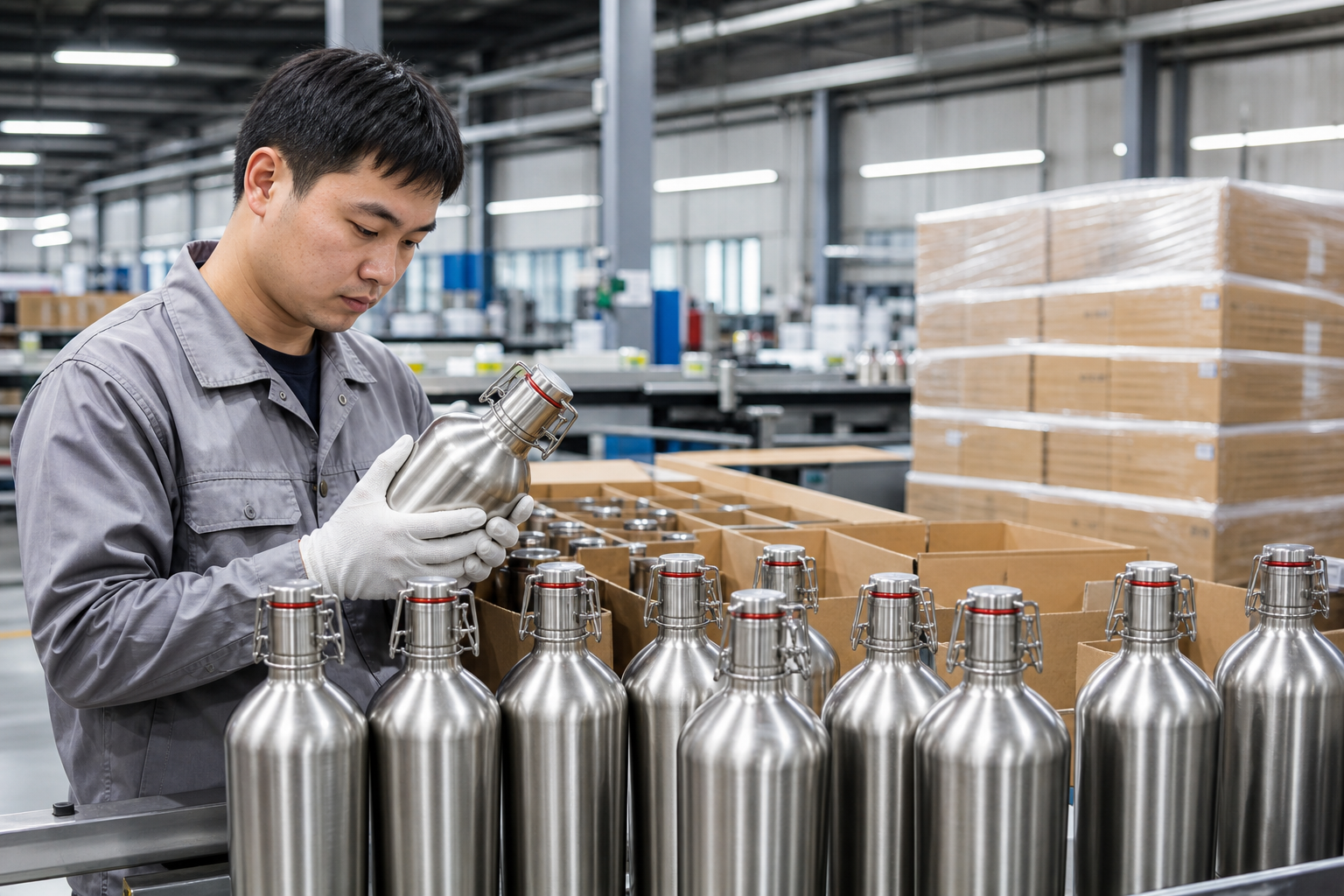
Start with a tight spec. For most B2B programs, 64 oz is the safest SKU, 32 oz fits taprooms, and 1 L works for export sets. We run 304 stainless on most orders because it gives better corrosion resistance and a cleaner food-contact story; 201 stainless can shave cost, but we’ve seen it go sideways in humid storage and after repeated washing. Wall thickness changes the feel in hand: 0.5 mm is common at entry level, 0.6 mm gives the best balance, and 0.8 mm feels more rigid on the line.
Pick the closure for the beer, not for the catalog photo. A screw cap with a silicone or EPDM gasket is the standard answer for non-pressurized storage. If the buyer wants temperature retention, call out double-wall vacuum construction and ask for a vacuum decay leak test, not just a visual check. On one PO, the buyer flagged a missing space in “matte black” and the finish note caused a round of back-and-forth; that is why the finish must be written down as brushed steel, matte powder coat, or a painted body with a Pantone match. If your program includes bulk growler, bulk canteen, and wholesale drinkware, split the performance spec from the decoration spec so the quote is clean.
- Body material: 304 stainless for most export orders
- Wall thickness: 0.6 mm minimum for repeat use
- Capacity: 32 oz, 64 oz, or 1 L
- Seal: food-grade silicone or EPDM
- Optional build: double-wall vacuum for temperature retention
Do not overcomplicate the first order. A simple, repeatable spec usually beats an ambitious one that the factory cannot hold across 10,000 units, and the math does not work if QC has to rework half the batch.
Know Your MOQ And Pricing
Pricing for beer growler wholesale bulk comes down to three things: steel grade, finish, and logo method. On our line in Zhejiang, we can hold a 500 pcs MOQ for an existing shape when the die is already there, but custom packaging or new tooling usually starts at 1,000 pcs. For a plain 64 oz 304 stainless growler, FOB Ningbo often lands at USD 2.80-4.80 depending on wall thickness and cap spec. Add powder coating, laser logo, and a retail box, and the factory price moves to USD 4.50-7.80. QC will check the wall with a caliper, and that 0.2 mm gap is enough to change the quote.
Lead time is usually 25-35 days after sample approval. If a supplier says 10 days for a custom beer growler in bulk, ask what is already in stock and what is actually new. We have seen this go sideways when the buyer flagged a PO that mixed up 500 pcs and 5,000 pcs, then nobody noticed until carton labels were printed. A serious RFQ asks for separate pricing on sample fee, logo setup, carton artwork, and master carton count. That is how you compare drinkware bulk offers without guessing. The same logic applies if you also source bulk drinkware, canteen wholesale, or beer tumbler bulk from the same China supplier.
Expect sample fees to be creditable on larger orders, but do not assume they always are. A factory may charge USD 30-80 for a decorated sample and more if you need a custom Pantone coat or new cap color. Our spray booth operator will not guess on a Pantone match; if the buyer wants a tight color hit, we need the code and a physical swatch. If tooling is required, ask for the mold cost, expected amortization, and whether the mold stays with the factory or transfers with the project. The math does not work if a supplier says the sample is free but hides the charge in the unit price.
Compliance Is Not Optional
Europe and North America do not buy on photos. They buy on paper. For stainless beer growler in bulk orders, we ask for LFGB and REACH for the EU, FDA food-contact declaration for the US, plus a material statement for 304 or 316 stainless steel. If the cap is plastic, name the polymer grade and back up any BPA-free claim on the pack. If the finish is colored, we want a migration statement and an adhesion test report. QC pulled a scratched sample last week; the buyer flagged it, and that saved a claim.
Put inspection terms into the PO. AQL 2.5 is a normal start for major defects, and 4.0 for minor cosmetic issues if the buyer accepts some variation. Leak testing should run 100 percent on the line, not as a random sample. For export cartons, ask for drop tests and compression checks before the first production run. We’ve seen this go sideways when the carton spec looked fine on email but failed at 45 kg stacking load. If you want a wholesale growler program that ships clean, ask for an ASTM D5276-style drop test or an equivalent internal protocol. That is the right question to ask.
A factory in China that ships to Europe and North America should show ISO 9001, BSCI, and recent test files without delay. If the buyer asks for the report date and the lab number, the line should have it in the first reply. If you are buying alcohol flask wholesale bulk alongside growlers, use the same file discipline. The product changes; the compliance logic does not. A PO typo on a 500 ml artwork file can stall a whole order, so keep one set of documents for every SKU.
Branding Choices That Sell
Logo work is where a lot of bulk growler programs lose margin. We see it on the line all the time. Laser engraving looks clean on brushed steel and it will not peel, but if the buyer wants color, it is the wrong call. Silk screen is cheaper for one or two colors. Heat transfer or UV print suits coated bodies better. For a premium gift set, we usually run a laser mark on the metal and a second print on the carton. A five-color body design looks busy, adds cost, and QC will pull the sample for repeatability issues.
Be strict on artwork setup. Send vector files, set the logo height in millimeters, and confirm the Pantone code before sampling. We had one PO where the buyer wrote 18 mm on the drawing and 28 mm on the order sheet; the math did not work, and the proof had to be redone. For wholesale drinkware sold in retail or ecommerce, packaging matters as much as the cup. If you need FNSKU labels, barcode placement, or a hangtag for Amazon, lock that before mass production. A growler that looks good on a sample table but forces rework on 5,000 pieces is a bad program.
If you also plan to source beer tumbler wholesale, canteen bulk, or canteen wholesale in the same season, keep one artwork file name format and one approval flow. That saves real time when one buyer is running 3 SKU families from the same Zhejiang supplier. We ship that way for a few accounts already, and the buyer flagged it once when a typo landed on the carton proof. Same folder, same sign-off, fewer mistakes.
Packaging And Freight Control
Packaging is not an afterthought. A 64 oz stainless growler can ship in an individual box, inner polybag, and a 12-piece master carton, but the count shifts with body diameter, cap height, and whether we add 3 mm foam or molded pulp. We run a tape check on the line before carton approval, because 2 cm of dead space can turn a good unit price into a bad landed cost. Ask the supplier for carton dimensions, gross weight, and loaded pallet count before you sign the PO.
For ocean freight from China, FOB Ningbo or FOB Shanghai is the normal starting point. If the order is small, LCL can work, but the risk goes up because cartons get re-handled at the CFS and the corners take the hit. We have seen a pallet come out at 1.78 m and blow past the warehouse limit by 80 mm, so this is the wrong question to leave for later. Ask the supplier to show how many cartons fit on one pallet and whether the pallet height stays within your destination warehouse limit.
If you sell through Amazon, ask for FNSKU on the unit and carton labels before the production run. If you do not, you will pay for relabeling later, and that bill is always higher than the original print. QC pulled one sample after a buyer flagged a PO typo on the carton count, and the rework burned a full shift. The same discipline applies if you manage wholesale canteen or bulk canteen orders: protect the carton, reduce voids, and keep the pack readable from receiving to final shelf.
How To Vet The Factory
The supplier checklist should be blunt. Ask if they are a real Zhejiang manufacturer or a trading company, how many units they ship each month, and whether they can show the same model in stock, on the line, or only in photos. We run 200,000 units/month in some drinkware programs, and that still means they should send three items: a pre-production sample, a full QC report, and line photos with your logo setup. If they dodge that, the math does not work.
For final approval, ask for a golden sample, a mass production sample, and a shipment sample. QC pulled the sample with a caliper at 1 mm, and we check the usual failures: leak paths, cap cross-threading, coating scratches, carton crush. Put the acceptance criteria in writing: dimensions within plus or minus 1 mm, logo position within 2 mm, and leak-free after 24 hours under normal filling conditions. We have seen buyers get burned by “close enough”; that is the wrong question to ask.
Payment terms usually start at 30 percent deposit and 70 percent before shipment, but do not treat that as fixed. On repeat orders above 5,000 pcs, we have moved some buyers to 20 percent deposit when the payment record is clean and the factory can see real reorder volume. If the supplier refuses inspection, will not share a factory audit, or cannot explain defect handling, the price is not lower. It is just a problem with a nice quote on top. One PO typo on a logo spec once cost a buyer 12 days, and the buyer flagged it only after the cartons were printed.
Request a beer growler quote today
Send your target capacity, logo file, and market requirements. We will price the right spec, not a vague sample that cannot scale.
Frequently asked questions
What is a realistic MOQ for beer growler bulk?
For an existing 64 oz shape, a realistic MOQ is often 500 pcs if the supplier already has the tooling and cap components ready. If you want custom packaging, special coating, or a new cap color, 1,000 pcs is more typical. For a fully custom shape, the MOQ can move to 3,000-5,000 pcs because the factory must recover mold cost and setup time. In Zhejiang, a factory with 200,000 units/month can handle this without strain, but only if the spec is clear. Ask for the MOQ by version: plain body, coated body, laser logo, gift box, and pallet pack are not the same order.
Is 304 stainless enough for a beer growler?
For most export drinkware programs, yes. 304 stainless is the standard choice because it gives a strong balance of corrosion resistance, cost, and food-contact acceptance. If the growler will sit in humid storage, be washed often, or be sold into premium retail channels, 304 is usually the safest default. 316 stainless is better for harsher environments, but it raises the cost and is rarely necessary for standard beer growler bulk orders. Avoid 201 stainless unless the buyer has a very tight budget and understands the trade-off. If you use 304, ask the supplier for a material declaration and, if needed, a third-party test report for your target market.
Can you add a logo that survives dishwasher use?
Yes, but the decoration method matters. Laser engraving is the most durable on bare stainless because there is no ink layer to peel. For colored bodies, powder coating with laser on the base metal is more durable than printed ink. Silk screen can work, but you should not assume it will survive unlimited dishwasher cycles unless the factory has tested it. If dishwasher resistance is a selling point, ask for a test plan of 50 or 100 cycles and define what failure means: fading, edge lift, or loss of legibility. Put that requirement into the PO so the sample result becomes the production standard.
What compliance documents should I ask for?
For Europe, ask for LFGB and REACH related documents, plus a food-contact declaration that names the materials used in the body, cap, gasket, and coating. For the US, ask for FDA food-contact compliance statements. If the cap or accessory is plastic, request the polymer grade and confirm any BPA-free claim is supported. For the factory itself, ISO 9001 and BSCI are useful indicators that the operation is organized enough for export. If the product is coated, request migration and adhesion data. If the order is large, request a pre-shipment inspection report and make AQL 2.5 your baseline for major defects.
How long does production and shipping take?
A normal beer growler wholesale bulk order takes 25-35 days after sample approval for production, assuming the shape already exists and the artwork is confirmed. Sampling usually takes 5-10 days, depending on coating and logo method. Ocean freight from Ningbo or Shanghai to Europe or North America depends on the lane, but you should plan for a transit window rather than a fixed day count because port congestion changes. If the order is urgent, ask whether the factory has stock bodies that can be decorated faster. If not, do not expect a true custom run to ship in less than three weeks from approval.