Key Takeaways
- Typical MOQ for a beer growler custom made order is 500-1,000 pcs; sampling usually adds 7-15 days.
- Stainless 304 with 0.5-0.6 mm wall thickness is the common commercial spec for reusable growlers.
- FOB China pricing for a 64 oz printed growler often starts around USD 3.80-6.20 depending on finish and cap.
- A factory with 300,000 units/month can handle mixed custom drinkware programs, but only if you lock artwork and packaging early.
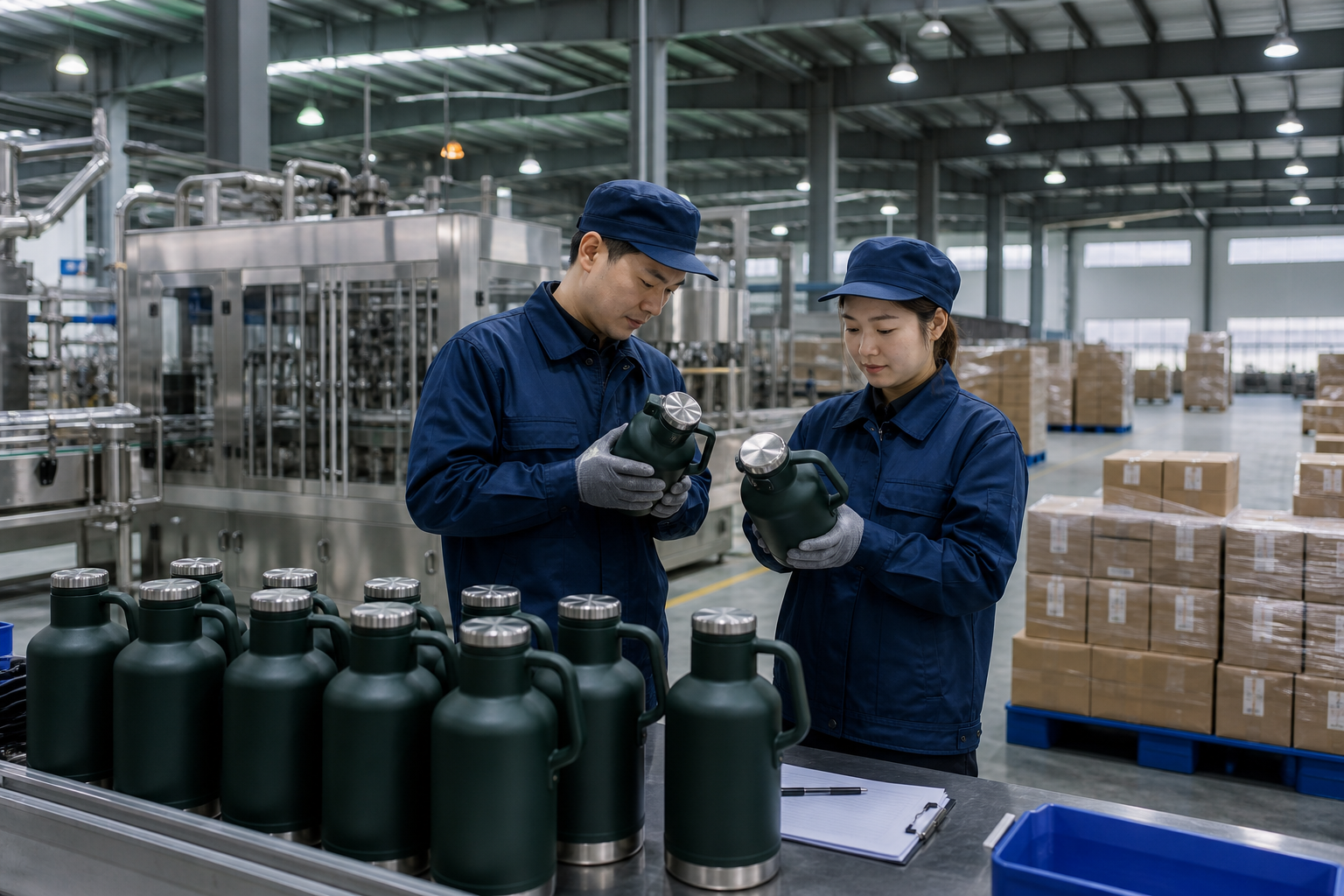
If you are buying a beer growler custom made for retail, promotion, or taproom resale, the hard part is not finding a supplier. The hard part is separating a real production spec from sales talk. A growler has to hold carbonation pressure, keep seals tight, print cleanly, and still land at a cost that leaves margin. In our Zhejiang factory, we have seen buyers lose money because they start with artwork before they lock bottle material, cap type, and carton size. QC pulled a sample last week with a 2 mm cap gap, and the buyer flagged it before we ran 5,000 pcs.
Start with the use case, then the format. A 64 oz stainless growler for a brewery is a different job from a 32 oz custom drinkware item for a distributor canteen program or a promo pack. If you source from China, ask for the real MOQ, the sampling time, and the compliance file for Europe or North America. This is the wrong question to ask if you only want a pretty mockup. We ship enough first orders to know the math does not work when the carton is 10 mm too tall or the PO has a typo in the cap color.
What a growler is really for
A beer growler custom made order starts with use, not decoration. A growler is a refillable transport container for draft beer, so the spec has to hold carbonation, take a few knocks, and seal the same way every time. We run a leak check on the line with water upside down for 30 seconds, and that test catches weak lids fast. For most B2B programs, stainless steel is the practical choice because it handles repeated use better than glass and gives you a wider margin on freight damage. If you are selling through taprooms, bottle shops, or as distributor drinkware, the buyer cares less about branding talk and more about whether the lid leaks in a backpack.
For commercial specs, the common capacities are 32 oz, 64 oz, and 128 oz. In North America, 64 oz still sells best. In Europe, smaller sizes move faster in gift and outdoor channels. If your program includes a custom canteen or canteen customized line, keep the body geometry close across SKUs so packaging and tooling stay efficient. We cut one family mold at 1.2 mm wall thickness for three sizes, and that kept the MOQ from ballooning. That is how canteen factory planning works in China and Zhejiang: fewer shape changes, lower scrap, better lead times. The math does not work any other way.
Commercial use case first
Ask whether the growler is for brewery retail, wholesale gifting, event merch, or subscription replenishment. The answer changes print method, carton count, and whether you need a matte powder coat or polished metal finish. A canteen promotional item usually tolerates simpler specs; a retail growler does not. QC pulled the sample when the buyer flagged a 2 mm lid gap on the PO, and that kind of miss gets expensive fast.
Pick the right material and thickness
Material choice drives your scrap rate. For a beer growler custom made for resale, 304 stainless steel is the safe default. It holds up against corrosion, passes food-contact checks, and takes dents better than thin aluminum. We ship a lot of these. If you choose glass, plan for thicker cartons, a higher breakage allowance, and a stricter drop-test on the outer case. For distributor canteen channels, stainless is usually the cleaner commercial call. The buyer asked for glass once, then the carton test failed at 60 cm. That was the end of it.
Wall thickness is where a lot of quotes go off track. A 0.4 mm shell feels thin in the hand and bends too easily in freight. We normally push 0.5 mm to 0.6 mm for a serious custom growler. For an insulated version, look at vacuum retention and weld quality first, then the outside finish. A 0.3 mm change sounds small, but across 10,000 units it shifts dent rates, rework, and the way the product lands on shelf. QC pulled the sample last week and the seam showed heat marks, so we sent it back to the line. That is why experienced canteen suppliers ask for gauge before they quote the print.
- 304 stainless: best all-around choice for reusable drinkware
- 0.5-0.6 mm wall thickness: practical balance of cost and durability
- PP or stainless cap: choose based on sealing and branding needs
- Powder coat: better grip and logo contrast than bare steel
If you are also building a customizable canteen line, keep the same material family across products. That lets you combine orders and makes supplier qualification simpler. The math works.
Decoration methods that survive use
Logo work is where a lot of canteen custom projects fail. A beer growler custom made for daily handling needs decoration that still looks clean after 50 dishwasher cycles, ice-water shock, and rubbing against crates. We run screen printing for 1 to 2 colors when the buyer wants a sharp mark at lower cost. Laser engraving wins on stainless steel because the mark sits in the metal, not on top. UV printing gives more color range, but the line needs tighter surface prep and the unit cost goes up.
For bulk orders, ask for print area in millimeters, not a mockup. A common wrap is 180 mm x 80 mm, but the real window changes once the shoulder curve and handle sit on the same mold. On one 5,000-piece PO, the buyer flagged a 2 mm shift because the artwork sat too close to the handle. If you need a canteen customized for retail shelves, talk about embossing, debossing, or a custom pantone powder coat. Keep the art clean. Tiny text below 4 pt usually turns into a blur after curing.
“If the artwork cannot survive a dishwasher cycle, it is not a serious drinkware decoration spec.”
That sounds blunt because it is. Ask for a sample with the same print process, not a blank body that only looks right under showroom lights. Blank samples are the wrong question to ask. QC pulled the sample before packing on the last round because the logo edge lifted after a 24-hour soak, and that is the kind of failure that shows up too late if you skip testing. The better canteen manufacturer teams in Zhejiang will show you the pre-production sample with the logo in the right position before mass production.
MOQ, pricing, and lead time
You need the commercial numbers before you commit. For a typical beer growler custom made order, MOQ is usually 500 pcs for standard finishes and 1,000 pcs if you want a full custom color or special cap. Sample lead time runs 7-15 days. Bulk production from a seasoned canteen factory in China or Zhejiang is usually 30-45 days after sample approval and deposit, depending on season and packaging complexity.
FOB China pricing for a 64 oz stainless growler can start around USD 3.80-4.50 for simple single-color printing and move to USD 5.50-6.20 or higher for powder coat, laser engraving, or upgraded packaging. If you need a gift box, add roughly USD 0.35-0.90. Freight can add more than the product delta on smaller runs, so compare landed cost, not unit price. We had one buyer focus on the ex-works quote, then the carton size pushed the shipping bill up by 18%. The math does not work if you stop at factory price.
We run mixed custom drinkware production at about 300,000 units per month, but that does not mean every project is fast. A late artwork change, a carton spec update, or a packaging typo on the PO can add 5-10 days. QC pulled the sample on a 0.8 mm wall-thickness check before we signed off. The cleanest purchase order is the one with no guesswork.
Compliance for Europe and North America
Compliance is a gate, not a checkbox. For North America, buyers ask for food-contact documentation, CPSIA for youth products where it applies, and lab reports showing the growler is clear of banned heavy metals or unsafe coatings. For Europe, REACH declarations and food-contact suitability papers come up fast. If the growler has a painted body or printed cap, the coating and ink need to sit inside the test scope. We had a buyer flag a PO because the cap print was left off the report.
Ask the supplier for material declarations, factory audit options, and batch traceability. BSCI still shows up often in European sourcing files, and ISO-based process control helps when you need the same result on a reorder 6 months later. Our line keeps batch cards at the sealing station, so if a lot number is off by one digit, QC pulls it before packing. If the product is sold as reusable drinkware, the closure has to pass leak checks. For a beer growler, seal performance beats a glossy carton. Send the document pack before shipment. Waiting for customs is the wrong question to ask.
- Food-contact declarations: for body, lid, gasket, and coatings
- REACH documentation: essential for EU distribution
- Leak test records: useful for quality claims and retailer approvals
- Traceability: batch codes improve after-sales support
If you sell as canteen distributor or distributor growler, keep the paperwork aligned across each SKU family. One typo on a PO can break the file set, and then everyone spends an extra 2 days fixing it.
How to manage factory quality
Quality control is where experienced buyers save margin. We run a clean plan: approved pre-production sample, in-process check on the line, and final inspection to AQL 2.5 for major defects and 4.0 for minor defects. No need to open every piece. You do need a clear acceptance plan, or the factory will call “good enough” on your behalf. I’ve seen that go sideways on a 5,000-unit order.
For a beer growler custom made program, the defect list is plain: dents, bad seals, off-center logos, coating scratches, and carton crush. Ask your canteen manufacturer to set tolerance for capacity, thread fit, lid torque, and logo position. If the product uses silicone gaskets, confirm hardness and compression spec, not just “food grade.” A 2 mm cap misalignment looks fine on a drawing; QC pulled the sample and the lid still failed the spin test.
A practical supplier will send photos, dimensional checks, and carton drop-test results. If they cannot show that, you are buying hope. Good canteen manufacturers in Zhejiang know buyers in Europe and North America want repeatable output, not excuses. We recommend final inspection with sealed master cartons before loading—one PO typo on carton count can turn a tight schedule into a mess.
Request your growler quote today
Send capacity, material, logo file, and target market. We will give you a realistic MOQ, price, and lead time from Zhejiang, China.
Frequently asked questions
What is the usual MOQ for beer growler custom made orders?
For a standard beer growler custom made project, MOQ is usually 500 pcs if you use an existing mold and a simple print. If you want a new color, special cap, or packaging upgrade, 1,000 pcs is more realistic. For some stainless models, the factory can split orders across 2-3 SKUs only if the total quantity reaches the production threshold. Sampling usually takes 7-15 days, and bulk lead time is often 30-45 days after approval.
Is stainless steel better than glass for a custom growler?
For most B2B buyers, yes. Stainless steel is easier to ship, harder to break, and better for repeat use. A 304 stainless custom growler with 0.5-0.6 mm wall thickness usually gives you a better commercial result than glass because breakage rates are lower and packaging costs are simpler. Glass can look premium, but it raises freight damage risk and usually needs more protective cartons and higher freight allowance.
What price should I expect from a China supplier?
For a 64 oz stainless beer growler custom made in China, FOB prices often start around USD 3.80-4.50 for basic printing and can rise to USD 5.50-6.20 for powder coat, laser engraving, or upgraded packaging. Costs depend on material thickness, cap style, surface finish, and carton spec. If you are buying from Zhejiang, ask for landed cost logic, not just factory price, because freight, duty, and inland transport can change your margin quickly.
Which logo method lasts longest on a growler?
Laser engraving usually lasts the longest on stainless steel because it is physically altered into the surface rather than sitting on top of it. Screen printing is fine for bold logos and lower cost, but it is more exposed to wear. UV printing offers more color flexibility, but it can be less durable than engraving on a high-use custom drinkware item. If the growler is for retail resale or heavy handling, ask for a wash test and an abrasion check on the actual decoration.
What documents should I ask for from a canteen supplier?
Ask for food-contact declarations, material specs, REACH-related paperwork for Europe, and quality records such as AQL inspection results. If you sell in North America, request test reports for coatings, inks, and any components that touch the beverage. For a canteen distributor or distributor drinkware program, traceability matters too, so keep batch codes and carton labels aligned with the PO. That saves you time if a customer raises a complaint later.