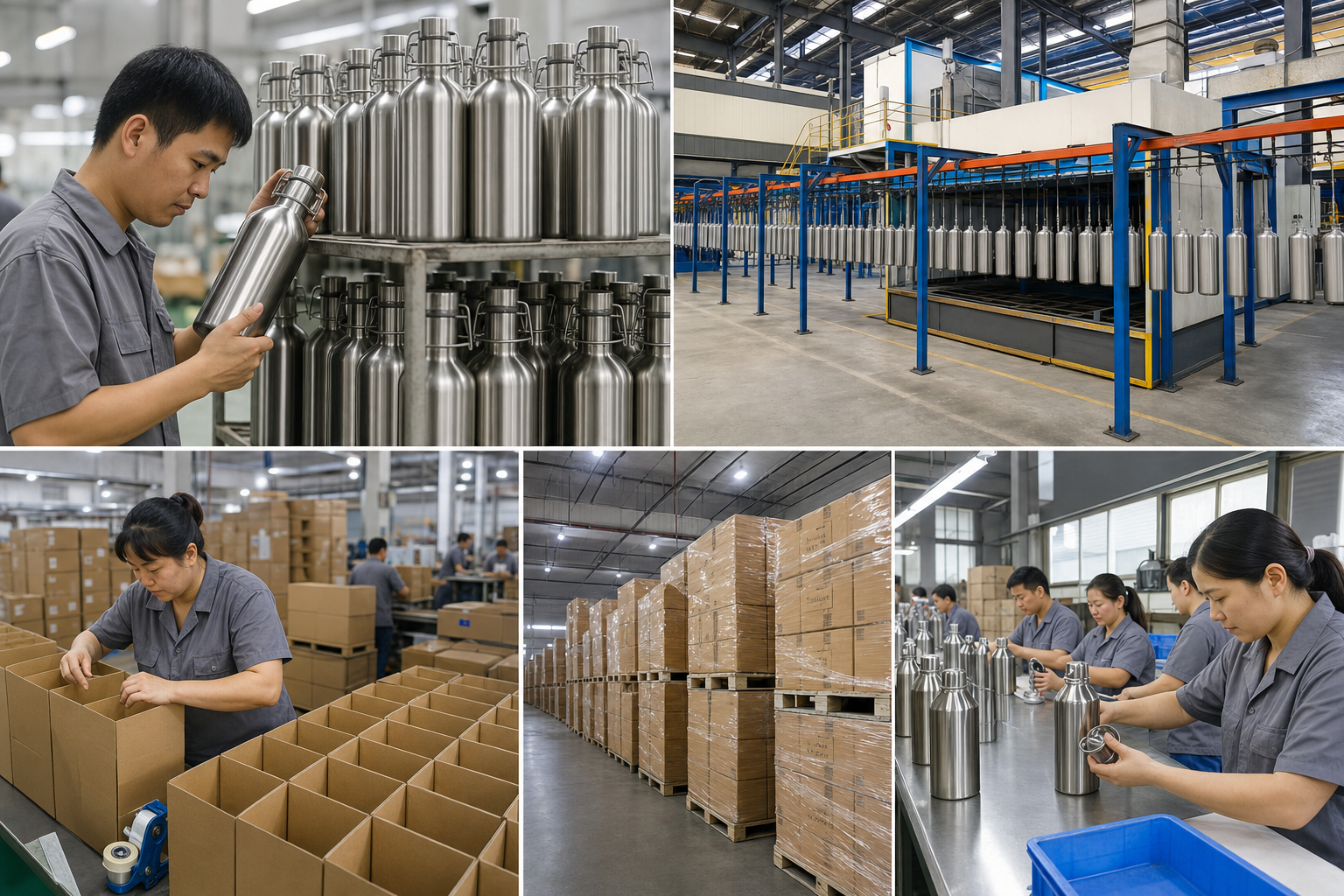
Key Takeaways
- Typical beer growler custom MOQ is 500-1,000 pcs, with 35-45 days lead time after sample approval.
- 304 stainless steel with 0.5-0.6 mm wall thickness is the safer choice for retail and brewery programs.
- FOB China unit prices often sit at USD 2.80-6.50 depending on size, finish, and lid complexity.
- Ask for REACH, LFGB, and AQL 2.5 inspection data before you approve a canteen manufacturer or growler supplier.
If you are sourcing beer growler custom for retail, brewery merch, or distributor programs, the hard part is not finding a supplier. The hard part is getting a growler that ships without bent rims, prints cleanly on the line, and keeps its seal after 50 openings. In Zhejiang and across China, plenty of factories will offer a “custom growler,” but the real differences sit in steel grade, coating thickness, lid structure, and how the shop holds a 0.3 mm to 0.5 mm tolerance on the neck and shoulder.
For B2B buyers, a growler is not just another piece of custom drinkware. It is where branding meets field failure. We have seen a 201 stainless shell or a loose hinge cap turn a low-price promo item into a return pile, and the math does not work. If you are comparing canteen custom options, canteen customizable models, or a more specific beer growler custom run, ask for MOQ, lead time, wall thickness, and test data, not vague promises. That is the wrong question to ask if the sample already dents at QC after one drop test.
What a beer growler must do
A beer growler looks simple. The buyer spec is not. You need a container that holds carbonation, survives repeated washing, and still leaves a clean imprint panel for the logo. For brewery and distributor programs, 32 oz, 64 oz, and sometimes 1 liter are the sizes we run. In North America, 64 oz is still the one buyers recognize first. In Europe, smaller packs move better because freight and shelf space eat the margin. One customer pushed for 750 ml, and the math worked once we compared carton loadings.
Do not treat a growler like generic custom drinkware. The closure system matters more than the body decoration. A swing-top lid with a food-grade silicone gasket works for low- to medium-volume programs, but the factory has to show leakage data, not just say “safe.” We ask for a 24-hour inverted leak test and a drop test from 80 cm on packed samples. QC pulled the sample on one run and found a weak gasket seat at 2.1 mm. If the supplier cannot explain the test setup, this is the wrong question to ask at the price stage.
For branding, a powder-coated body with laser engraving or silk screen is cleaner than a soft paint layer that looks fine on a screen and chips in transit. For a premium custom growler, ask for 0.8-1.2 mm coating thickness and check the cure temperature on the oven sheet. We shipped one lot where the buyer flagged a PO typo on the coating color code, and the mismatch showed up only after QC checked the carton label. Cheap coating saves pennies and costs claims. That is why serious canteen distributors ask for test data before artwork approval.
Choose the right material grade
The material choice decides whether your beer growler custom program protects margin or turns into a pile of returns. For beer and cold drinks, 304 stainless steel is the standard we ship. It holds up against corrosion better than 201, and you see the gap after 50 wash cycles and a week of acidic beer residue. For most retail and hospitality orders, 304 with a 0.5 mm shell clears the spec, but 0.6 mm gives a better hand feel and cuts dent claims. We had one buyer flag a PO typo on the wall thickness, and the line caught it before sampling, because 0.1 mm matters on a growler.
Some canteen manufacturers will pitch 201 stainless to chase a lower FOB price. You can use it for non-food promo jobs, but I would not put it on a brewery SKU that needs repeat orders. The math does not work. A canteen factory in Zhejiang that exports should know the difference between “looks similar” and “passes 12 months of use.” Ask for material certificates, not just a sales promise. If the factory also runs canteen promotional items, custom canteen bottles, and customizable drinkware, make sure they keep food-contact stock separate from display-grade stock. QC pulled the sample on one mixed line last month because the magnet test did not match the declared grade.
Practical spec to request:
- Body: 304 stainless steel
- Wall thickness: 0.5-0.6 mm
- Lid gasket: food-grade silicone
- Finish: powder coat, brushed steel, or matte paint
- Inner surface: electropolished or food-safe passivated
That spec is not overkill. It is the floor if you want a custom drinkware item that does not come back as a complaint. We have seen this go sideways when a buyer tried to save 0.08 USD per piece and ended up with rust spots after the first dishwasher run.
Printing and branding that hold up
For a beer growler custom order, choose branding by abrasion, not artwork sharpness. On the line, we check whether the mark survives a 1 kg rub block after 50 cycles, because a pretty logo that scuffs in a carton test becomes a buyer complaint fast. Silk screen fits one-color brewery marks and keeps setup low. Laser engraving is cleaner for premium retail and looks right on brushed stainless. UV print carries gradients and full-color art, but it needs a stable coating system and tighter QC. For distributor programs, laser plus one accent color is usually the safer call; it holds up better than soft paint when cases get dragged across a pallet.
We see buyers order a canteen customized finish, then QC pulled the sample and the logo had already started to haze after three wash cycles. The problem is simple: the ink system was chosen for appearance, not adhesion. A serious canteen vendor in China should show rub test data and dishwasher guidance, not just a render in WeChat. A basic silk screen should survive 50-100 dry-cloth rub cycles; laser-marked stainless is effectively permanent. If your market wants premium retail, the extra USD 0.20-0.60 for better branding is usually money well spent.
If you are comparing canteen custom and custom growler orders in one program, use one decoration standard across the line. We ship mixed pallets all the time, and a 2 mm print-height difference is enough to slow picking at the packing table. One spec cuts setup waste, keeps reorders clean, and avoids the buyer flagging a PO typo because half the order says matte black print and the other half says brushed silver. The math does not work if every SKU needs its own screen and proof.
MOQ, pricing, and lead time
This is the part buyers need first. For a standard beer growler custom order from a canteen manufacturer in China, MOQ usually starts at 500 pcs for a simple one-color print and moves to 1,000 pcs for mixed finishes or special lids. We have also done 300 pcs in Zhejiang when the body mold and lid tooling were already on the shelf, but that is stock-based customization, not full custom. QC pulled the sample before packing, and that saved us from a bad first run.
FOB pricing depends on material, capacity, and decoration. A basic 32 oz 304 stainless growler with a simple cap may land around USD 2.80-3.80. A 64 oz powder-coated swing-top model is more often USD 4.20-6.50. Add laser engraving, custom packaging, or a premium hinge, and the price can move another USD 0.30-1.20. If a supplier quotes far below that, ask what is being cut. The math does not work if the steel is 201, the wall is too thin, or the coating is not export-grade; we have seen that go sideways on a 1.2 mm body.
Lead time is usually 35-45 days after sample signoff, with 7-10 days for pre-production sample and artwork confirmation. If the factory is in Zhejiang and the line is stable, monthly output can reach 80,000-120,000 units across different custom drinkware SKUs. That matters when you ship repeat orders for distributors or a brewery campaign with a hard launch date. Ask for a real production calendar, not a sales promise. We once caught a PO typo on a lid spec, and that one line would have cost 12 days.
Testing, compliance, and packing
Export buyers should treat compliance as part of the product, not a paperwork add-on. For North America and Europe, ask whether the beer growler custom run can pass REACH, LFGB, FDA food-contact declarations, and, if needed, Proposition 65 review on coatings or accessories. On stainless drinkware, the gasket and lid finish create more risk than the 304 stainless body. We had a buyer flag a soft TPE seal on day one, and QC pulled the sample for a wipe test.
Quality control should start with AQL sampling, usually AQL 2.5 for critical defects and 4.0 for minor defects. Critical defects are leaks, broken lids, wrong capacity, and contaminated interiors. Minor defects are cosmetic issues like print shift under 1 mm or small scuffs. A factory that ships export orders will show the inspection sheet, not just say “checked.” If the supplier also acts as a canteen distributor or distributor drinkware wholesaler, ask for the factory report, not a trade-company summary. The math does not work any other way.
Packing needs its own check. For retail and e-commerce, one unit in a polybag plus inner box is standard. For Amazon-style fulfillment, you may need master carton labeling, FNSKU placement, and carton drop resistance. A heavier customized growler should go with dividers so the finish does not rub on metal. We run this on the line with a 60 cm drop test, and the carton tells the truth fast. Ask for carton size and gross weight before you confirm shipping; a bad packing plan can add 8-15% to freight cost in one move.
How to brief the factory clearly
The fastest way to blow up a custom canteen or beer growler order is a vague brief. Do not send “make it premium” and expect the line to read your mind. Give the factory a technical sheet with capacity, steel grade, wall thickness, lid type, decoration area, coating color code, packing method, and target market. If you also source canteen customizable bottles, canteen customized sets, or a customized drinkware line, split each SKU with its own drawing and carton spec. We have seen a buyer send one file for three products, and the carton height was off by 18 mm on the first trial.
A solid brief for a beer growler custom order looks like this:
- Capacity: 32 oz or 64 oz
- Material: 304 stainless steel
- Body thickness: 0.5-0.6 mm
- Finish: matte powder coat, brushed steel, or color paint
- Logo method: laser, silk screen, or UV print
- Lid: swing-top, screw cap, or custom stopper
- Packing: individual box with divider
If you work with a canteen vendor, ask for a pre-production sample made with the real production tooling, not a hand-made mock-up. Hand samples can look clean and still miss the actual stamping line, and that is where the trouble starts. QC pulled the sample on one run because the lid thread felt fine by hand but skipped after 200 open-close cycles. The best canteen suppliers in Zhejiang will tell you this straight, because they know sample beauty and export consistency are not the same thing.
Send your growler spec, get a real quote
Share capacity, material, logo method, and target market. We will price your beer growler custom order with MOQ, lead time, and packing details.
Frequently asked questions
What is the usual MOQ for beer growler custom orders?
For a standard beer growler custom project, MOQ is usually 500 pcs for simple decoration and 1,000 pcs for mixed finishes or premium lids. Some Zhejiang canteen manufacturers can start at 300 pcs if they use existing molds and standard tooling. If you want fully customized artwork, lid shape, or packaging, plan for a higher MOQ because setup waste and QC time rise quickly. For distributor drinkware programs, 1,000-3,000 pcs is often the most efficient first run.
How much does a custom growler cost FOB China?
A basic 32 oz custom growler in 304 stainless usually starts around USD 2.80-3.80 FOB China. A 64 oz powder-coated version with a swing-top lid is commonly USD 4.20-6.50. Add laser engraving, special packaging, or a premium gasket system, and the price can rise by USD 0.30-1.20 per unit. If a canteen supplier quotes well below those ranges, check the steel grade, wall thickness, and whether the finish is export-safe.
Which material is better, 201 or 304 stainless steel?
For beer growler custom orders, 304 stainless steel is the better choice for retail and hospitality. It resists corrosion better, handles repeated washing better, and gives you fewer complaints over time. 201 is cheaper, but it is more suited to low-risk promotional use where the product life is shorter. If you want a customized growler that feels solid and supports repeat orders, use 304 with 0.5-0.6 mm thickness and a food-grade silicone gasket.
What quality checks should I request from a canteen factory?
Ask for AQL 2.5 inspection on critical defects and 4.0 for minor defects. Critical issues include leaks, loose lids, contamination, and wrong capacity. Also request a 24-hour leak test, a drop test from 80 cm, and coating adhesion or rub test data if the body is painted. A serious Zhejiang canteen factory should be able to provide REACH, LFGB, or FDA-related food-contact documentation depending on your market.
Can I use the same supplier for canteen custom and growler orders?
Yes, if the supplier actually has export experience with customizable drinkware and not just one product line. Many canteen manufacturers in China can handle both custom canteen orders and beer growler custom projects because the core processes are similar: stainless forming, lid assembly, coating, printing, and packing. The difference is in leak control and beverage-specific testing. If you are building a broader canteen promotional or distributor canteen program, keeping one factory in Zhejiang can simplify reorders and color matching.