Key Takeaways
- A practical beer growler customizable order usually starts at 1,000–3,000 pcs MOQ, with 25–35 days lead time after sample approval.
- For beer use, 18/8 stainless steel with 0.5–0.8 mm wall thickness is safer than thin decorative bodies.
- Laser engraving holds up best for long-term branding; screen print is cheaper at USD 0.15–0.40 per color.
- A serious canteen factory in Zhejiang should offer AQL inspection, REACH-compliant materials, and FOB pricing from China.
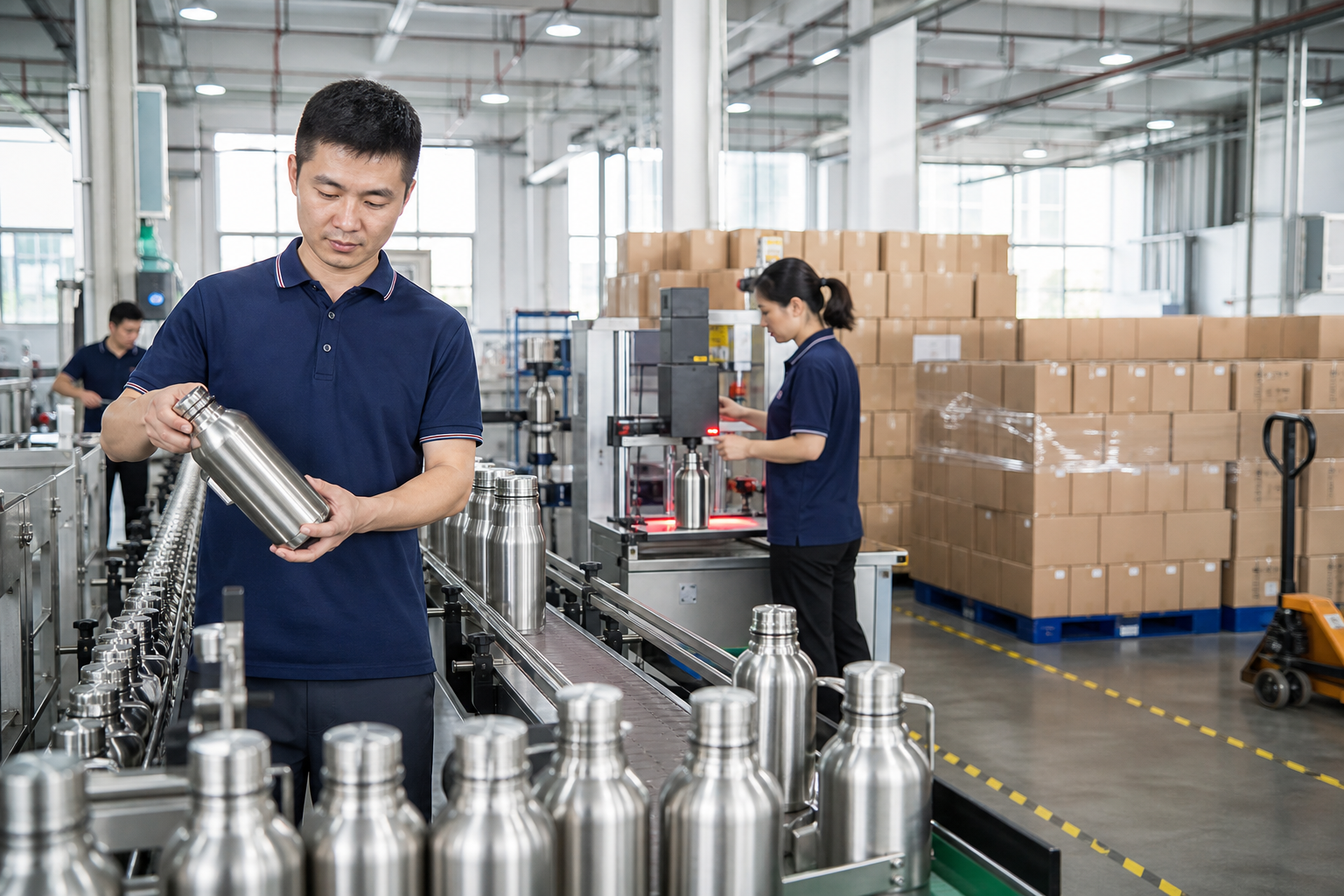
If you are sourcing a beer growler customizable for retail, hospitality, or promotions, the hard part is not finding a bottle. The hard part is buying one that survives transit, prints cleanly, and still leaves margin after freight, cartons, and rework. On our line in Zhejiang, a growler can look fine in photos and still fail at 1.2 mm wall thickness or leak at the lid gasket. QC pulled the sample, filled it, and the seam held. That is the sort of check that matters.
Think of a growler as a packaging system, not a container. Body material, mouth finish, cap style, logo process, carton strength, and test standards all move the result. A supplier in Zhejiang should quote FOB, give you the MOQ in plain numbers, and tell you whether your artwork works for screen print, laser engraving, or a full-color wrap. We run into buyers who send a polished mockup and miss the cap thread spec by 0.5 mm. The math does not work. If a factory cannot answer those points without hand-waving, you are not buying custom drinkware; you are buying a return rate.
What buyers really mean by customizable
When buyers ask for a beer growler customizable product, they usually mean three things at once: a landed price that still leaves room for margin, a logo that survives shipping, and packaging the warehouse can move without babysitting. That is the real brief. A 64 oz stainless growler with powder coat and a two-color logo looks clean on the quote sheet, but if the wall is only 0.6 mm or the cap starts weeping after a 1-meter drop test, the math does not work.
For B2B sourcing, define the product before you ask for quotes. Start with capacity, usually 32 oz, 64 oz, or 750 ml. Then lock the material: 304 stainless for general beverage use, 316 if corrosion risk is part of the brief, or glass if the buyer wants shelf visibility. A solid custom growler spec covers neck finish, handle style, lid type, surface finish, and whether the print must survive dishwasher cycles. If you are buying from a canteen manufacturer or canteen supplier in China, ask for the drawing first. On our line in Zhejiang, we check the neck tolerance at 0.2 mm before we even talk decoration, because that is where bad fits start.
Do not let the word “customizable” distract you from the commercial side. A customizable growler that is hard to pack, hard to test, or hard to reorder is not useful for a distributor. You want repeatability. That means one exact color code, one confirmed logo area, and a carton spec that protects the finish when the pallet gets moved twice. The buyer flagged a typo on the PO once, and the whole carton mark had to be reworked. We ship more than a shape. The base body should stay the same, and only the branding layer should change. That is how experienced canteen distributors and distributor drinkware teams keep margin under control.
Material choice decides failure rate
Most beer growler buyers spend too much time on capacity and too little on material. That is the wrong question. Material drives dent resistance, taste neutrality, seal stability, and how many complaints your retailer sees after the first weekend. For a beer growler customizable program, 18/8 stainless steel is the safest baseline. We usually ask for 0.5 mm to 0.8 mm wall thickness on standard retail models. Below 0.4 mm, the bottle starts to feel flimsy and dents in transit. Above 0.8 mm, the unit cost climbs and the finished piece feels heavy in hand. On our line, QC pulled a 0.38 mm sample once, and it was dead on arrival for export packing.
Glass still has a place for shelf display and beer taproom merchandising, but it gives you less room for error. You need stronger carton design, internal partitions, and a breakage allowance in the quote. If you are sourcing from a canteen factory that usually runs insulated bottles, ask whether they can switch the polishing station and cap assembly without slowing output. We ship from Zhejiang plants that can handle both jobs when the molds, conveyors, and inspection table are set right. One buyer flagged a carton spec with 6 mm dividers after a drop test; without that, the math does not work.
For buyers who want a custom canteen style offer beyond beer, the same logic applies to vacuum flasks and camping bottles. A canteen custom project should use the same test plan: confirm the inner coating if there is one, ask for salt spray or corrosion tests on any metal contact parts, and request the compliance papers before mass production. One PO typo can waste a week; we once saw “3040 stainless” on a purchase order and had to stop the line. You are buying a repeatable spec, not a sample photo. That is why serious canteen manufacturers and canteen suppliers talk in material grades, not marketing words.
Recommended sourcing numbers:
- 304 stainless steel for mainstream beer growlers
- 0.5–0.8 mm wall thickness for retail durability
- 500–1,000 cycle dishwasher durability target if the decoration process allows it
- Target weight tolerance within ±5% on production runs
Decoration methods change your margin
Logo choice changes landed cost and the reprint risk. On a customized growler or customizable drinkware run, we quote screen printing and laser engraving first because those two decide the math. Screen print is cheap and fast. A one-color job on our line adds USD 0.15–0.30 per piece at volume; two or three colors usually land at USD 0.25–0.40 once you count screens and UV curing. Laser engraving sits around USD 0.20–0.60 per piece, but the mark stays put and does not chip when the carton gets knocked around.
If you sell to distributors, laser engraving is usually the safer call because distributor growler orders pass through more hands before they hit shelf. I have seen a PO come in with the logo 2 mm too close to the seam, and the buyer flagged it before we started the rotary laser. For promotional buyers, a canteen promotional spec can use pad print or UV print on a lower-cost body and still look sharp. This is the wrong question to ask: "Which decoration is best?" The real question is which channel is paying for the risk. A retail brand can justify a premium finish. A canteen distributor supplying a chain store usually needs lower unit cost and faster replenishment.
Ask the factory for printed samples after abrasion testing, not before. A proper supplier in Zhejiang should be able to run tape pull tests, hot water soak, and carton drop tests before mass production. On our side, QC pulled the sample after 50 tape pulls with 3M 610 tape and checked the edge under a 10x loupe. If a customized drinkware vendor cannot tell you which ink system they run, whether the exterior ink stays food-contact safe, and how the curing temp is controlled, walk away. The cheapest print gets expensive when it disappears after one wash cycle.
Practical rule: if the logo carries the brand, spend on decoration first and metal second. A bad print makes a good bottle look cheap. We have seen that go sideways on a 12,000-piece order when the buyer saved USD 0.18 and then ate the remake cost.
MOQ, lead time, and pricing reality
MOQ is the first hard question, and the math decides fast. For a standard beer growler customizable run from a Chinese factory, the real MOQ is usually 1,000 to 3,000 pcs per design and color. If you want two lid styles or mixed capacities, the line needs extra packing, extra cartons, and separate bin labels, so the MOQ climbs. We run this every week in Zhejiang. Sample lead time is usually 7–12 days, and production lead time sits around 25–35 days after sample confirmation. If a supplier says 10 days for a printed stainless growler at 5,000 pcs, the buyer should push back. That schedule does not hold.
FOB pricing comes down to body material, finish, and decoration. For a basic 64 oz stainless growler with one-color logo and a standard carton, factory price often lands at USD 3.20–6.50 per piece at medium volume. Powder coating, custom lid hardware, or gift boxing can move it up fast. We once had a PO typo change 3,000 pcs to 30,000 pcs, and the quote looked “cheap” until the buyer flagged the missing packaging line. That is the wrong question to ask if you only chase a low number. A canteen vendor quoting far under market usually leaves out testing, carton spec, or print durability.
When you compare quotes from custom canteen and drinkware factories, strip the offer down line by line. Ask whether the price includes:
- 1 logo setup fee or not
- Inner polybag and master carton
- Drop test or burst test records
- Export cartons with 5-layer or 7-layer board
- FOB Ningbo or FOB Shanghai terms
This is how experienced canteen distributors and distributor drinkware teams avoid fake savings. QC pulled the sample and found a 2 mm lid gap on one lot; that kind of miss shows up later as returns. The cheapest sample often becomes the most expensive PO. A reliable canteen supplier in China should be clear on all-in cost, not just piece price.
Compliance and testing you should request
If you buy into Europe or North America, compliance is not optional. A proper custom growler order should come with material declarations and test reports for the target market. For stainless steel bodies and closures, ask for REACH documentation, food-contact material declarations, and, where applicable, FDA alignment for U.S. market expectations. If the product includes coatings or inks, confirm whether the finish has been tested for heavy metals and overall migration. On our line, QC will pull a sample straight from the powder booth and check the batch card before anything leaves the packing table.
Do not skip the functional checks. A growler should pass leak testing at room temperature and after thermal cycling if it is insulated or capped with a gasketed lid. Ask for torque data on screw caps if the design uses threads. If you are buying a customized canteen or customizable canteen alongside the growler line, align the compliance documents so your procurement team is not chasing five test formats. This is the wrong question to ask if you think paperwork alone is enough; we have seen a 2 mm gasket change turn into a leak claim. One strong canteen factory catches that before mass production.
Also check packaging standards. If you ship pallets from China to Europe, a box that survives local courier handling may still fail container vibration or warehouse stacking. Request carton compression data, not just nice-looking outer cartons. The difference between a smooth launch and a chargeback often comes down to one dented cap ring or one cracked glass bottle. Good factories in Zhejiang know this because they export every week, not once a year. We run a drop test with a 10 kg master carton and the buyer flags the result fast when the corner crushes.
How to brief your factory correctly
The fastest way to get a usable quote is to give the factory a real brief. A vague email saying “need beer growler customizable, good quality” gets you a vague price. We see it on the line all the time. A solid brief gets you a sample that can move into production. Start with capacity, lid type, logo method, target color, carton count, and destination market. Then add the commercial terms: target FOB price, annual forecast, and whether you need one-off promotional stock or repeat replenishment. A canteen manufacturer can only make the right call if you say which trade-off matters most: cost, speed, or finish.
For a distributor launch, I suggest you share a simple spec sheet with the following points:
- Product size: 32 oz or 64 oz
- Material: 304 stainless steel or borosilicate glass
- Decoration: laser engraving, 1-color silk print, or full wrap label
- Packaging: individual box, 10 pcs/master carton, carton test requirement
- Approval standard: pre-production sample, golden sample, AQL inspection
This level of detail helps both canteen suppliers and canteen vendors move faster. It cuts sample loops, and that saves cash. If the buyer flagged a crooked logo on the first pull, we already know the brief was too loose. If you are comparing a customized drinkware offer against a canteen promotional program, promotional items can live with slightly looser tolerances, while retail growlers need tighter consistency. If you want one factory to handle both, ask whether they run above 200,000 units a month across bottle lines. That scale usually means cleaner process control. In Hangzhou and the wider Zhejiang base, scale plus export experience is what separates a nice quote from a shipment that actually lands.
Send your growler spec for a factory quote
We can quote FOB China, confirm MOQ, and match the logo process to your channel. If you need a Zhejiang export factory with repeatable output, start here.
Frequently asked questions
What MOQ should I expect for a beer growler customizable order?
For a normal export run, expect 1,000–3,000 pcs per design and color. If you need a special lid, custom carton, or multiple logos, MOQ can move to 5,000 pcs because tooling and packing efficiency change. A factory in Zhejiang with stable lines may accept 500 pcs for sampling, but that is not the same as a production MOQ. Always confirm whether the MOQ applies per SKU or per total order.
What is the best material for custom growler orders?
For most B2B buyers, 304 stainless steel is the best balance of cost and durability. Use 0.5–0.8 mm wall thickness for retail models. If corrosion resistance matters more, 316 is stronger but adds cost. Glass is fine for display-led retail, but shipping breakage is higher and packaging must be stronger. For a canteen customized or growler program, material choice should follow channel, not trend.
How much does custom decoration add to unit price?
A one-color screen print can add about USD 0.15–0.30 per piece at volume. Two or three colors often land around USD 0.25–0.40. Laser engraving usually adds USD 0.20–0.60 depending on area and batch size. If you want powder coating plus logo, expect a higher step-up. Ask the factory to quote decoration separately so you can see where margin is going.
What lead time should I budget from sample to shipment?
Sample lead time is usually 7–12 days if the spec is clear and no new tooling is needed. Production after sample approval is commonly 25–35 days for standard stainless growlers. If you add custom molds, special lids, or gift boxes, expect longer. A solid canteen factory in China should give you a realistic schedule and update you before delay becomes a problem.
What compliance documents do European and U.S. buyers ask for?
For Europe, ask for REACH-related declarations and food-contact material documentation. For the U.S. market, buyers often want FDA-aligned statements and testing on inks, coatings, and metal contact surfaces. You should also request AQL inspection records, carton drop testing, and if needed, heavy metal or migration results. The exact file set depends on whether you are shipping a custom drinkware retail line or a canteen promotional program.