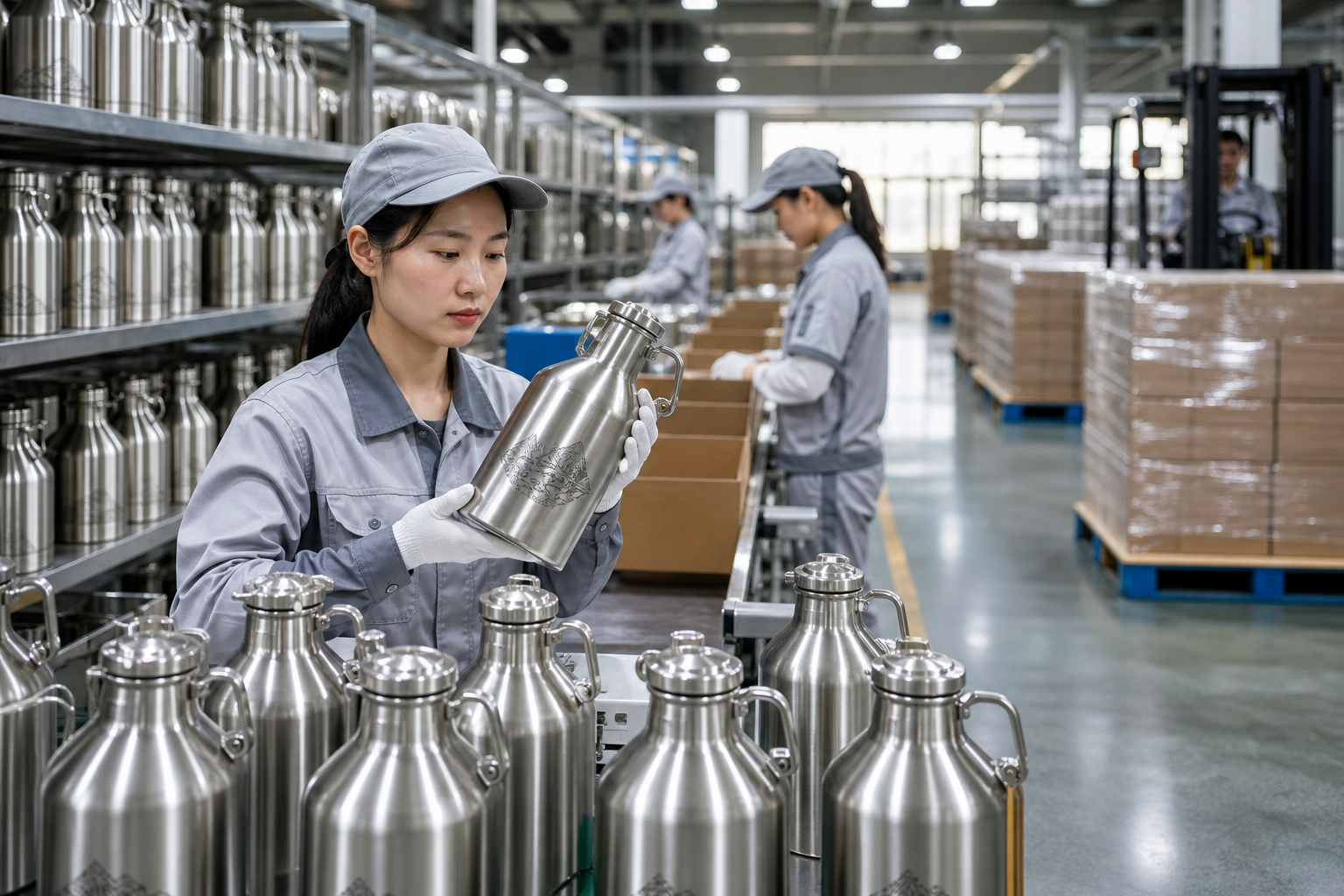
Key Takeaways
- Most beer growler customized projects start at 1,000 to 3,000 units, with FOB China pricing often in the USD 2.80 to 6.50 range depending on steel grade and decoration.
- For stainless custom growler orders, 0.4 mm to 0.6 mm wall thickness is common; 18/8 stainless is the practical baseline for export programs.
- REACH, food-contact tests, and carton-drop testing matter more than artwork if you sell through distributors or Amazon.
- A Zhejiang canteen factory with 100,000+ units/month output can usually hold 25 to 35 day production lead times after sample approval.
If you are buying beer growler customized for retail, taprooms, or distributor programs, the first question is not “can it be printed?” It is whether the bottle survives 200 wash cycles, clears compliance in your market, and still leaves margin after freight. A 64 oz growler can look fine on a sample shelf and still fail if the liner, weld seam, lid torque, or powder coat is off by 0.2 mm.
At BottleForge in Hangzhou, Zhejiang, we see the same misses every season: buyers lock onto logo placement and skip wall thickness, closure sealing, carton strength, and lead time. QC pulled a sample last month because the cap gasket sat 1.5 mm shallow, and the buyer flagged it before we shipped 3,000 pcs. If you buy from a canteen factory or canteen manufacturer in China, ask for straight numbers on MOQ, unit cost, and what is actually customizable. The math does not work any other way.
What buyers actually need
When buyers search for beer growler customized, they usually need more than a bottle with a logo. They need a product that fits a sales channel. A taproom wants a refill bottle that feels premium in the hand. A distributor drinkware program wants carton sizes that stay within spec, and defect rates that do not blow up on the line. A gift buyer wants decoration that looks sharp at 1 meter, not only in a close-up photo.
Start with the end use. For draft beer, the common sizes are 32 oz and 64 oz. The 64 oz format usually works better for retail and brewery merchandising because it gives more print space and a stronger shelf value. We have seen buyers push for the smaller size, then come back after the first PO because the artwork looked cramped. If you are sourcing a custom growler for export, ask whether the closure is a screw cap, swing-top, or threaded stainless cap. Each one changes sealing performance and landed cost. A swing-top can cost USD 0.20 to 0.45 more per unit than a basic screw cap, but it can also support a higher shelf price.
Do not treat this like generic custom drinkware. A growler holds carbonated or partially carbonated liquid, so dimensional stability matters. QC pulled the sample, checked the neck with a caliper, and rejected one lot because the mouth was 0.8 mm out. If your supplier cannot tell you neck finish, lid torque target, and leak-test method, you are not talking to a serious canteen supplier or canteen manufacturer, just a middleman.
Materials and structure
For export buyers, stainless steel is still the safest choice for a customized growler. The usual spec is 18/8 stainless, which means about 18% chromium and 8% nickel. That is 304 stainless in food-contact drinkware, and we run it every week on the line. It resists corrosion and leaves a clean inner surface. If a factory offers a lower grade without a clear reason on paper, stop there. The inside should be smooth, with no sharp weld line or rough bead, because residue builds up fast and the buyer will flag it on the first rinse test.
Wall thickness is not cosmetic. A 0.4 mm wall helps on promo orders where the target weight is tight, while 0.5 mm to 0.6 mm gives a better hand feel for retail. We had one buyer push back on a 0.4 mm sample because the bottle sounded thin when tapped, and he was right. Double-wall vacuum construction keeps temperature longer, but it adds cost and slows the cycle; on our line, that usually means one more forming step and a longer leak test. For a customizable growler in premium channels, vacuum insulation normally adds USD 0.80 to 2.20 per unit, depending on size and lid. Single-wall still works for cold-fill use only. That is the wrong question to ask if the target shelf price is too low for insulation.
In Zhejiang and other industrial centers in China, some canteen factory lines can reach 80,000 to 120,000 units per month across multiple drinkware categories, but capacity on paper does not tell you whether they can hold your spec. Ask for body drawing photos, neck forming, welding, and leak testing from the actual workshop. We have seen PO typos turn into trouble, like 600 ml written as 660 ml, and the whole carton mark had to be reworked. A canteen vendor that cannot explain the process, or shows only a finished sample with no QC pull sheet, is not ready for export.
- Recommended material: 304 stainless steel
- Typical wall thickness: 0.4 mm, 0.5 mm, or 0.6 mm
- Common surface finish: brushed, powder coated, or matte spray
- Food-contact requirement: test to FDA or LFGB depending on destination
Decoration choices that sell
Decoration is where a lot of custom drinkware orders go off the rails. A buyer signs off on a PDF, then QC pulled the sample and the logo sat 8 mm too low on the curved body. For a beer growler customized order, we usually quote silkscreen, laser engraving, UV print, and powder coat with one-color logo. The right call depends on order size, artwork detail, and the retail price you need to hit.
Silkscreen is the low-cost choice for simple logos and high volume. Laser engraving looks clean on stainless and will not peel, but it works best for one-color branding. UV printing handles multi-color artwork and short runs, yet the surface can scuff if the buyer wants loose carton packing. If you want a customized drinkware SKU for brewery shops, a laser logo or laser over powder coat usually gives the best long-run result. We had a buyer flag a 3-color crest once, and the math did not work for laser.
There is a real gap between canteen customizable and customized canteen programs that scale. A promo piece can live with a softer finish, but a retail growler should clear a 50-cycle rub test and carton-drop test before it leaves the line. We tell buyers to ask for AQL 2.5 on major defects and AQL 4.0 on minor cosmetic issues. That is a working baseline. One PO typo can turn “matte black” into “matt black,” and the wrong finish ends up on the line.
Good decoration does not rescue a weak body. It only makes the weak body more expensive.
MOQ, price, and lead time
Most serious beer growler customized orders from China start at 1,000 units. If you want mixed colors, two logo positions, or special lids, 3,000 units is the number that actually holds. A smaller trial order is possible from some canteen suppliers, but the unit price jumps fast because the setup cost gets spread over too few pieces. On a 64 oz stainless growler, FOB China usually lands at USD 3.20 to 5.80. Add USD 0.30 to 1.50 for better decoration, and more if you want vacuum insulation. QC pulled a sample last week and checked the lid gasket at 1.2 mm. That is the sort of detail that keeps a run from turning messy.
Lead time is usually 25 to 35 days after sample approval for standard custom work. New tooling, a unique neck profile, or imported packaging can add 10 to 15 days. If you are buying from a canteen distributor instead of a factory, ask where the stock sits and who signs off on quality checks. We have seen the buyer flag a PO that said 5,000 pcs but listed the wrong lid color, and the line still had to stop. A canteen manufacturer in Zhejiang with steady lines can move faster than a trading layer, but only if your art files and specs are complete.
Here is the practical math: if your landed cost must stay under USD 7.50, keep decoration to one method, use plain packaging, and skip custom molds. If you need a customizable canteen style body with a special handle or cap, tooling charges usually run from USD 500 to 3,000 depending on complexity. That is normal in China. The wrong question is whether we can shave USD 0.12 off the unit price; the math does not work if the spec is still moving. A clean drawing on day one saves a week on the line and keeps the sample from getting kicked back.
Compliance and quality checks
For North America and Europe, compliance is not optional. A real custom growler supplier knows when the market needs FDA food-contact papers, REACH declarations, LFGB test reports, or carton compliance files. If your growler has painted surfaces or silicone seals, those parts must be checked too. Buyers skip the gasket. We see it all the time. On one 64 oz line, QC pulled the sample and the seal gave a faint odor after 24 hours in water. That kind of miss kills repeat orders.
Ask for a test plan that names each step: dimensional check, leak test, lid torque test, adhesion test for print, and drop test for packed cartons. For export orders, AQL inspection is standard. We run AQL 2.5 for critical and major defects, then AQL 4.0 for minor defects, unless the buyer pushes for a stricter limit. If you are buying customized growler units for retail, get a retained golden sample and a signed spec sheet before the line starts. A glossy catalog does not hold up in a claim meeting.
In Zhejiang, a good factory does not hide this stuff. If a vendor dodges test reports, that is your answer. We shipped one lot where the PO said “304 satainless,” and the typo exposed a bigger problem: the buyer had never locked the spec, so the math did not work when the claim came in. A serious customizable drinkware program depends on repeatability, not improvisation. Whether you sell to a brewery shop, a distributor canteen program, or a private label importer, the risk is the same: one bad container can trigger returns, chargebacks, or account loss.
- Request FDA, LFGB, and REACH documents where relevant
- Confirm AQL levels before production starts
- Keep one signed master sample for color and logo reference
- Require leak testing on 100% of finished units for sealed drinkware
How to brief your supplier
Keep the spec sheet short. Keep it complete. For a beer growler customized project, write down capacity, material, wall thickness, cap type, color, finish, logo method, carton spec, and target market. If you are also launching a custom canteen line, use the same format. A canteen customizable SKU with a loose brief turns into email ping-pong, and we have seen that add 10 to 14 days fast.
Good suppliers in Hangzhou and the rest of Zhejiang will push back with exact questions. That is a green flag. If they say yes to every line item, slow down. A real canteen manufacturer will ask whether the bottle is for cold beer, room-temperature water, or retail gifting. They will also ask about freight terms. FOB works for buyers who already know their lane. If you want sample control, ask for EXW on the first round, then move to FOB for bulk. QC pulled one sample last month and found a 1.2 mm cap mismatch, so this is not the place to guess.
Use this order structure:
- Confirm size, material, and closure
- Approve artwork on a curved-body mockup
- Check pre-production sample with logo placement
- Set AQL, packing, and carton drop standards
- Lock shipping window and reserve container space if needed
If you buy from a canteen vendor or customized canteen specialist, keep every approval in writing. A PO typo on carton count can stall a line for a full shift. That is the wrong question to ask after production starts. Put the agreement on paper, and your custom growler rollout stays on schedule.
Request a growler quote with real specs
Send your size, logo method, and target market. We will quote FOB China pricing, MOQ, and lead time without guessing.
Frequently asked questions
What is a normal MOQ for beer growler customized orders?
For most export orders, 1,000 units is the practical starting point for a standard beer growler customized project. If you need mixed colors, multiple print locations, or a special lid, 3,000 units is safer. Some China factories in Zhejiang can quote 500 units, but the unit price may rise 20% to 40% because setup cost is spread across fewer pieces. If you want retail-ready packaging or custom molds, add another 10 to 15 days and expect extra charges.
How much does a custom growler cost FOB China?
A standard stainless custom growler often lands around USD 3.20 to 5.80 FOB China for 64 oz, depending on steel grade, finish, and closure. Add USD 0.30 to 1.50 for decoration such as laser engraving, silkscreen, or UV print. Double-wall vacuum versions usually add USD 0.80 to 2.20. If you need custom tooling, budget USD 500 to 3,000 once, then use that mold over future orders.
Which material should I choose for a customized growler?
For most B2B programs, 304 stainless steel is the safest choice for a customized growler. It is durable, food-safe, and widely accepted for export. A wall thickness of 0.5 mm is a good middle ground between cost and feel. If the product is promotional only, 0.4 mm can work. If you want a premium retail item, 0.6 mm gives a heavier hand feel and better dent resistance.
What compliance documents should I ask for?
For Europe, ask for REACH and, when relevant, LFGB food-contact reports. For the US, request food-contact documentation aligned with FDA expectations. Also confirm silicone or gasket compliance if the lid uses seals. A good factory should provide a test report, a signed spec sheet, and a golden sample record. For ship-ready quality control, ask for AQL 2.5 on major defects and carton-drop testing before dispatch.
Can a canteen factory handle both growlers and other drinkware?
Yes, many canteen factory lines also produce custom drinkware such as tumblers, insulated bottles, and custom canteen programs. The important point is process control. A capable Zhejiang canteen manufacturer should be able to show separate lines or tooling for different body shapes, plus leak testing, coating inspection, and packing control. If you are a canteen distributor or distributor drinkware buyer, choose the factory based on documented capacity, not just catalog photos.