Key Takeaways
- For most beer growler distributor programs, 32 oz and 64 oz are the practical SKUs, with 1,000 units as a normal MOQ for a stock body and custom logo.
- 304 stainless at 0.5 to 0.7 mm is the common commercial spec; glass is cheaper on the unit but heavier, more fragile, and costlier in freight.
- A proper export quote should include EXW, FOB Ningbo, sample cost, tooling cost, carton spec, and a 25 to 35 day production window after approval.
- Ask for REACH, LFGB, FDA declarations, AQL 2.5 major defect limits, and 100% leak testing on caps and threads before you place the order.
If you are a beer growler distributor, the expensive mistakes are usually predictable: 0.8 mm wall on a sample that should have been 1.0 mm, a lid that starts weeping after 12 shakes, a logo that peels on the first wash, or a carton that looks fine until the pallet takes a 1.2 m drop. Buyers like to start with unit price. The math does not work. We have seen a $0.18 saving turn into a $4.60 replacement problem once chargebacks and rework land.
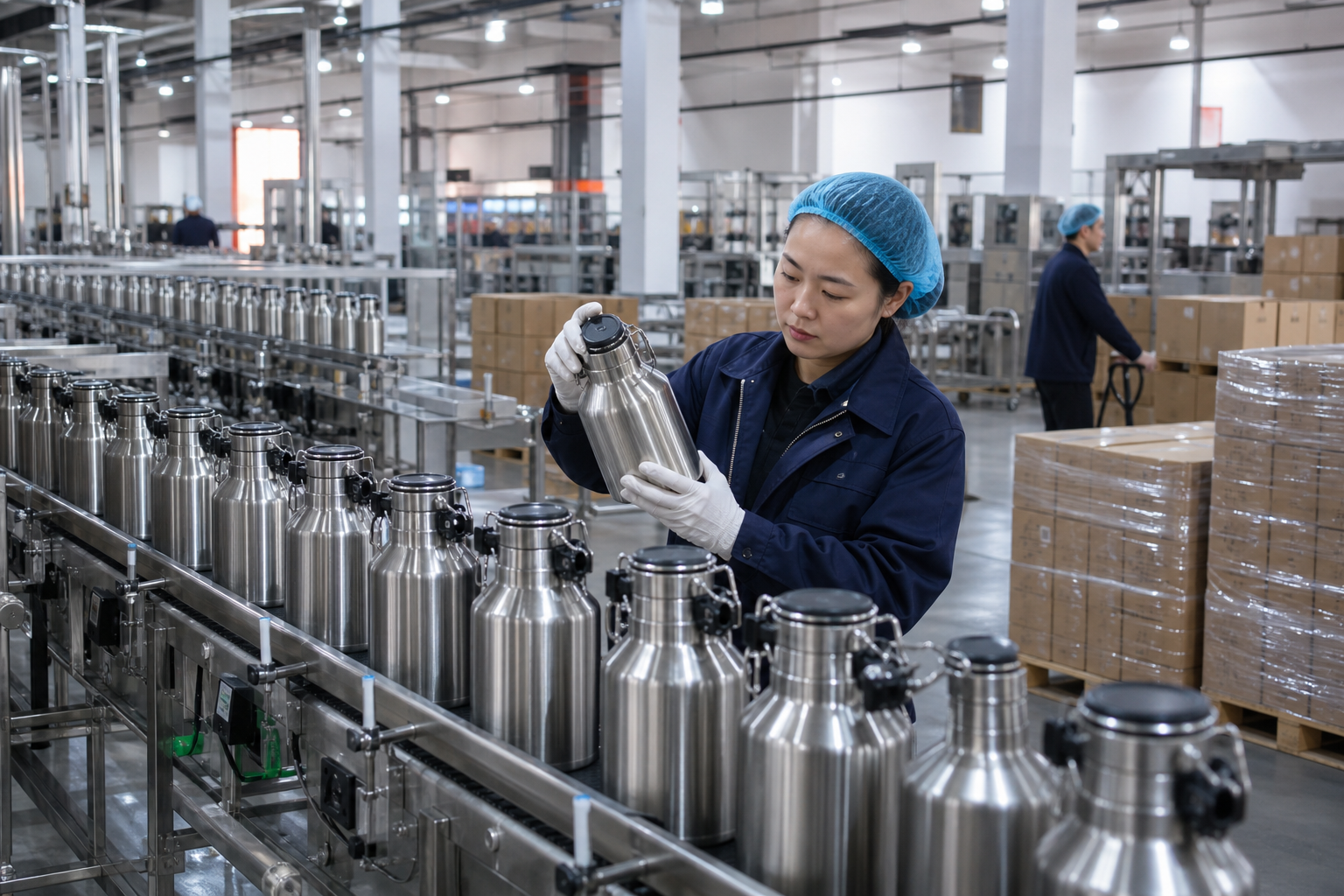
For a custom growler program, you need a supplier that holds tolerances, keeps test records, and runs the same spec on every order. On our line, QC pulled the sample against a caliper at 0.1 mm and checked the lid torque before release. A Zhejiang or China factory should quote exact capacity, material grade, closure type, decoration method, and packaging standard before you issue a PO. If you also source canteen custom or other custom drinkware, the same rule applies: define the use case first, then let the factory build to that spec. One PO typo on capacity or cap finish can slow a shipment by 7 days.
Start With The Channel
If you are a beer growler distributor, decoration is not the first question. The first question is where the unit sits: taproom counter, outdoor retail shelf, festival bundle, or gift box. A growler sold as distributor drinkware for a brewery hits different failure points than a promo item. We have seen the buyer flag a weak cap after 12 open-close cycles and the whole deal stalls. The closure has to survive repeated use, the body has to stay clean after washing, and the carton has to ride pallet movement without rubbing the logo.
Start by locking five specs: capacity, body material, closure, finish, and pack-out. For most B2B buyers, 32 oz and 64 oz are the numbers that work. A 64 oz custom growler gives better shelf presence; the 32 oz version ships easier and fits a gift pack without forcing a larger carton. If you are comparing custom drinkware lines, the same rule applies to a distributor canteen or another custom canteen program: define the use case first, then let the factory set the wall thickness and packaging. We run this check on the line before QC pulls the sample.
- Capacity: 32 oz, 64 oz, or metric equivalent
- Material: 304 stainless, 316 stainless, or glass
- Closure: swing-top, screw cap, or insulated lid
- Branding: one-color logo, laser mark, or wrap print
- Pack-out: individual box, master carton, or FNSKU-ready retail pack
Do this well and the quote reads clean. Do it badly and every supplier reply turns into noise. We once corrected a PO that said "64oz growler, 65 oz" and the math did not work.
Material Choices Decide Margin
For a custom growler, material choice sets freight, breakage, and the price story the buyer can defend. 304 stainless is the default for a reason: it stays stable, cleans up fast, and retail buyers know it. If the program is premium or the customer wants better corrosion resistance near salty docks, 316 stainless is the cleaner upgrade, but it adds cost and does nothing for a weak closure or sloppy carton fit. On the line, QC pulled a 0.6 mm sample after a 1.2 m drop test, and the dent pattern told the story fast.
Glass has a place, but the lane is narrow. A glass growler works for local pickup, bar fill, or display-heavy retail. It stops working when a distributor program runs long freight lanes, warehouse forklifts, or mixed pallets with cans and cartons. If you are buying for export, the shipping weight can wipe out the unit savings on its own. The buyer flagged this after comparing 12 days of inland trucking with 18 days of export handling, and the math did not work. That is why a lot of beer growler distributor programs move to insulated stainless: the bottle costs more, but the landed cost usually comes out better once claims start hitting the invoice.
Closures matter as much as the body. Swing-top lids are familiar and easy to sell, but the gasket has to hold up through repeated use. Screw caps are easier to automate and usually cheaper, but thread control has to be tight. The wrong question to ask is whether the cap looks solid in a photo. We test whether it survives torque and still seals. If it fails at the spec, it is not ready for wholesale, and we have seen a PO typo on cap size turn a clean run into a week of rework.
Decoration That Still Looks Right
A custom growler lives or dies on decoration. We saw a buyer send back 3,000 pcs because the logo flaked after 20 wash cycles, and the distributor ate the chargeback. For a customized growler, we run three safe routes: laser engraving, single-color silk screen, and powder-coat branding with a small debossed mark. Multi-color print only makes sense when the art really needs it; every extra color adds a screen, a setup step, and another place to miss the Pantone target.
On curved stainless bodies, one-color silk screen is still the lowest-cost route, but the ink system and curing temperature have to match the line. We check oven temp at 160°C and line speed before the first pull. Laser engraving costs more per unit, but it stays clean and holds up in the field. For a premium distributor growler, laser on matte powder coat is usually the safer call. The buyer flagged a glossy sample as “too retail,” and they were right—the math does not work if the finish fights the brand.
- Silk screen: best for simple logos and 5,000+ pcs
- Laser engraving: best for abrasion resistance and premium retail
- Pad print: useful for 15-25 mm artwork, weaker on heavy wear
- Powder coat: hides fingerprints and improves shelf appeal
Ask for a pre-production sample with the exact print position, Pantone reference, and curing method. A mockup is not a sample. QC pulled the sample, checked the logo offset at 2 mm, and caught a PO typo on the Pantone code before we shipped.
Compliance And Testing
For export drinkware, paperwork is what clears the door. Buyers hand it to customs, a marketplace team, or a retail compliance desk. For Europe, we ask for REACH and LFGB when the beer growler has food-contact parts. For the US, we ask for FDA food-contact declarations and migration data from an accredited lab. If a Zhejiang factory says the document is “available on request,” that is a red flag. A serious China supplier knows the standard before PO issue.
Quality control has to be in the PO. We run AQL 2.5 for major defects and 4.0 for minor defects, but sampling alone is not enough on leak-prone items. On our line, caps and threads get 100% leak testing, then finished cartons go through a drop test from 76 cm. QC pulled the sample last week and found a 1 mm thread offset; that would have turned into a buyer complaint after the first dispatch. If you ship FNSKU units to Amazon or another 3PL, put the carton label, polybag, and barcode spec on the order sheet. The buyer flagged a typo on a PO before, and we saved a full reprint.
- Documents: REACH, LFGB, FDA declaration, BSCI audit if needed
- Tests: leak test, coating adhesion, dishwasher cycle, drop test
- Packaging: carton spec, inner tray, FNSKU, case pack count
The right supplier does not argue about this. The weak one does. We have seen that go sideways on a 12,000-piece order.
What Good Pricing Looks Like
I’m rewriting the three paragraphs in place, keeping the HTML structure intact and tightening the language so it sounds like a factory-side sales answer instead of generic web copy.Price only matters next to capacity. A canteen factory or stainless line in Zhejiang that runs 80,000 units a month can usually hold a 25 to 35 day production window after sample sign-off. For a standard 32 oz custom growler with a one-color logo, we run a 1,000-unit MOQ. If you want custom colors, special lids, or a new mold, plan on 3,000 to 5,000 units and 45 to 60 days. QC pulled the sample for a lid torque check at 18 kgf-cm, and that is normal on our side.
Ask for the same quote structure every time: EXW, FOB Ningbo, sample cost, tooling cost, carton cost, and decoration surcharge. If one supplier gives you a headline price and another gives you a full landed-cost breakdown, the second quote is the one you can buy from. This is the wrong question to ask if you only compare unit price. We have seen a 0.18 USD savings disappear once the carton moved from 5-ply to 7-ply and the buyer flagged a print typo on the PO.
Ask for a price ladder at 1,000, 3,000, and 5,000 units. That tells you whether the factory is serious about scale, or just trying to win the first PO. We run that ladder off the same line, and when the 3,000-piece number barely moves from the 1,000-piece quote, the math does not work.
Build A Broader Range
Once the growler program is stable, the smart distributors do not sit on one SKU. They add adjacent custom drinkware, and the same rep can sell a brewery, a gift shop, and a corporate buyer in one call. If your canteen factory already runs custom canteen, canteen custom, canteen customizable, canteen customized, customizable canteen, customized canteen, and canteen promotional work, you know the drill: one decoration standard, one carton spec, one QC checklist, fewer shocks at shipment. We have seen a 2 mm logo shift turn into a claim. The line does not forgive that.
The same goes for a canteen manufacturer, canteen supplier, canteen vendors, and canteen distributors relationship. Ask if the partner can produce distributor canteen and distributor drinkware under the same audit trail as your distributor growler line. When one Zhejiang factory handles both custom growler and canteen promotional orders, sampling drops from 3 rounds to 2, and replenishment gets simpler. The buyer flagged a PO typo once—“grolwer” instead of “growler”—and QC still caught the carton mark mismatch before loading. That is the right kind of boring.
For buyers who want a broader assortment, we usually keep the core tight: growler, insulated bottle, travel tumbler, and one canteen shape. Four items. Enough to bundle, not enough to wreck your stock plan. If the MOQ is 500 pcs per SKU, the math works; if it jumps to 2,000, it does not. We have seen this go sideways when a distributor tried to carry seven shapes and ended up with slow movers on three of them.
Quote Your Growler Program With Real Specs
Send the capacity, lid type, logo method, and carton rules. We will quote MOQ, lead time, and export packing without guesswork.
Frequently asked questions
What MOQ should I expect for custom beer growlers?
For a standard beer growler distributor order, 1,000 units is the normal starting point if you are using a stock mold and one-color logo. If you want a new lid, special coating, or custom packaging, 3,000 to 5,000 units is more realistic. Samples usually take 7 to 10 days, and production is commonly 25 to 35 days after approval. A factory that runs 80,000 units per month can support that schedule; a smaller line may not. Ask for separate pricing at 1,000, 3,000, and 5,000 units so you can see the real breakpoints instead of guessing.
Should I choose stainless or glass for a distributor growler?
If you sell through retail, ecommerce, or mixed freight lanes, 304 stainless is usually the safer choice. A 0.5 to 0.7 mm wall gives acceptable strength, better dent resistance, and lower breakage risk than glass. Glass still works for local taproom fills or premium display programs, but it adds weight and shipping damage. In practical terms, a glass unit can look cheaper on the quote and still cost more after carton damage, replacements, and returns. For most distributor drinkware programs, stainless wins on total landed cost.
Which logo method lasts longest on growlers?
Laser engraving is usually the most durable option because it does not depend on ink film staying intact. For simple branding, one-color silk screen also works well if the curing process is controlled and the artwork is not too busy. Pad print is useful for smaller logos but is less durable on surfaces that get heavy handling. If you want a premium look, combine matte powder coat with laser engraving. That combination tends to survive washing, shelf handling, and warehouse abrasion better than bright multi-color print on a curved body.
What compliance documents should I ask for from a China factory?
For Europe, ask for REACH and, if there are food-contact parts, LFGB test data. For the US, ask for FDA food-contact declarations and migration reports from an accredited lab. If the supplier claims BSCI, request the audit copy. For quality control, specify AQL 2.5 for major defects and 4.0 for minor defects, plus 100% leak testing on caps and threads. If you are shipping to Amazon or a 3PL, also confirm carton labels, FNSKU application, and case pack rules before production starts.
Can one factory handle growlers and canteen orders?
Yes, if the factory has a stable stainless line, proper tooling control, and separate QC rules for each product. The same canteen manufacturer or canteen supplier that handles custom canteen and canteen promotional orders can often support a distributor growler program, but only if they document process control and pack-out standards. The key is not the category name; it is whether they can repeat the same wall thickness, finish, lid fit, and decoration across reorders. If they cannot show that discipline, split the order and keep the risk contained.