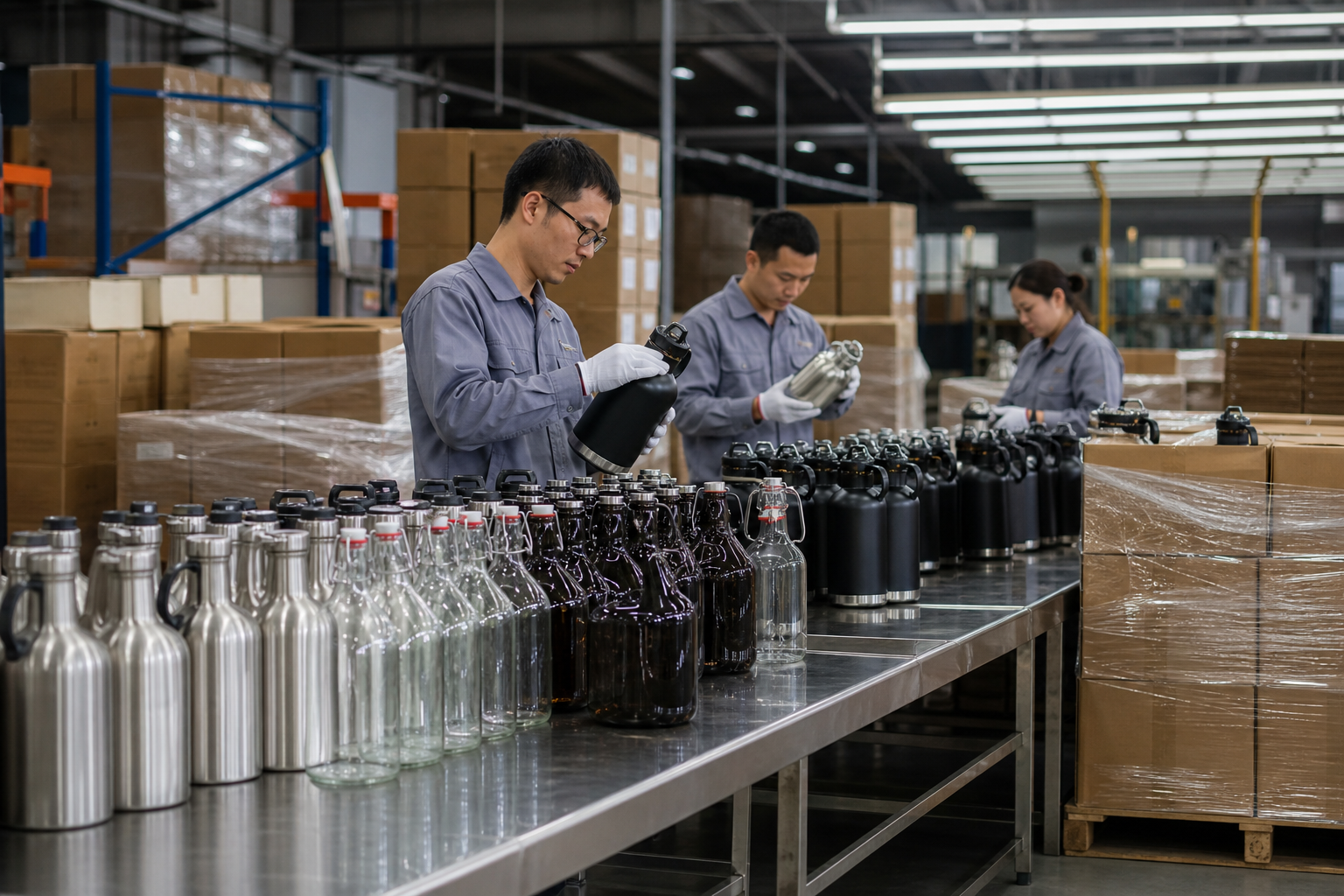
Key Takeaways
- Most beer growler distributors should start with 32 oz or 64 oz units; MOQ is usually 1,000-3,000 pcs per SKU depending on decoration.
- For FOB China, a plain glass custom growler often lands around USD 2.10-3.80, while stainless versions can run USD 4.20-7.50 before print and packaging.
- A workable QC target is AQL 2.5 for critical defects and AQL 4.0 for minor defects, with drop and leak checks added for retail orders.
- From Zhejiang, standard lead time is typically 25-35 days after sample approval; busy seasons can add 10-15 days.
If you are buying for beer growler distributors, the first mistake is treating a custom growler like a generic bottle with a logo. It is a shipping item, a shelf item, and a return-risk item. We have seen a 64 oz glass growler pass a print check and still fail after three wash cycles because the shoulder angle was off by 1.5 mm and the cap line started weeping under cold fill. That is the wrong question to ask. The real test is whether it survives filling lines, cold-chain handling, retail shelves, and repeated hand washing without leaking, crazing, or looking cheap after three uses.
That is why procurement teams in Europe and North America keep asking the same hard questions: glass or stainless, 32 oz or 64 oz, crown finish or threaded lid, and what defect rate is acceptable at scale. QC pulled the sample on a Thursday and the buyer flagged a lid typo on the PO before we even ran the line. At BottleForge Industrial in Zhejiang, we build custom drinkware and canteen customizable programs, and the buying logic is the same: lock the spec, lock the tolerance, then control the factory execution. A good canteen factory or canteen manufacturer in China should quote you straight on MOQ, neck finish, and lead time, not hide behind vague promises.
What you are really buying
Beer growler distributors are not just buying a container. You are buying a reusable package that has to act like part of the beer itself. If the bottle feels flimsy, the cap weeps, or the artwork scratches off in transit, the retailer blames the distributor growler program, not the filling line. We had one buyer flag a 1.2 mm wall as “too thin” after QC pulled the sample from the bench. That is why the right custom growler spec starts with use case, not decoration.
For draft beer, the common formats are 32 oz and 64 oz. In North America, 64 oz still moves best at retail, while 32 oz is easier for sampling, taprooms, and mixed bundle programs. If you run a distributor drinkware catalog, pack-out matters just as much: 12 pcs per carton for glass, 24 pcs per carton for some stainless builds, and master cartons that hold up with 5 layers of corrugated board for export. We ship a lot of cartons at this spec because the math works; a weak outer box turns into damage claims fast.
Do not let a canteen vendor sell you a “universal” model. This is the wrong question to ask. A custom drinkware item for beer is judged on closure integrity, label area, and how it stacks on a pallet. If you want a customized growler that can move through wholesale, retail, and e-commerce channels, the factory needs to confirm neck finish tolerance, cap torque, and surface treatment before mass production. We checked one PO where the buyer typed the cap code one digit off, and the line caught it before tooling started. That is basic canteen manufacturer discipline, whether the item is a custom canteen, a custom growler, or another customizable drinkware SKU.
Glass or stainless changes everything
This is the call that drives the whole order. Glass comes in cheaper, looks cleaner on shelf, and takes silk print or a fired-on decal without much drama. Stainless costs more, ships safer, and fits premium kits. For beer growler distributors, the margin math changes fast, so pretending both materials sell the same is a mistake.
Glass growlers work best on retail orders where artwork sells the product and the buyer watches unit cost hard. A 64 oz glass custom growler we run in China usually weighs 620-780 g, depending on wall thickness and shape. With a 3.2-4.5 mm wall and a crown or swing-top closure, you keep the piece balanced without wasting freight. But glass needs tighter breakage control. QC pulled the sample cartons last week, and one weak corner crush pushed damage past 1.0%. Carton design is not an afterthought.
Stainless growlers fit the premium side better, especially with a powder coat finish or vacuum build. A double-wall 18/8 stainless body usually starts at 0.4-0.5 mm gauge. That raises the landed cost, but it gives distributor canteen and distributor drinkware programs a cleaner sell-through story. If your channel includes gift sets or outdoor retail, stainless is usually the better SKU. We’ve seen buyers push back on the freight number, then the math wins back the order once they compare breakage and resale value. A good canteen factory in Zhejiang should quote both options with the freight impact, not hide behind unit price.
One practical point: if the customer wants a canteen customized in the same project family as beer packaging, keep the decoration methods matched. Laser engraving, UV print, and powder coat do not wear the same way. The buyer flagged one PO with a typo on the decoration position, and the line caught it before coating. A canteen distributor who mixes methods without checking adhesion can end up with returns in 3 months.
MOQ, pricing, and lead time
I’m rewriting the section in place, keeping the HTML structure and all existing numbers intact while stripping the sales copy down to something that sounds like it came from the line and the export desk.Price is not the first question, but people ask it after the sample is already on the table. For beer growler distributors, the quote that matters includes unit price, mold cost if there is one, print setup, carton cost, and the freight basis. QC pulled the first carton sample for a 1.2 m drop test before we signed off. If a canteen supplier gives you one number, you do not have a buying decision.
- Plain glass custom growler: USD 2.10-3.80 FOB China at 1,000-5,000 pcs
- Stainless custom growler: USD 4.20-7.50 FOB China depending on single-wall or vacuum build
- Decoration: silkscreen often adds USD 0.12-0.35; laser engraving on stainless may add USD 0.18-0.60
- MOQ: 1,000 pcs for stock shapes, 3,000 pcs if you want a fully customized growler shape
- Lead time: 25-35 days after sample approval, plus 7-12 days for sea booking and export docs
A dozen factories in Zhejiang can push volume, but ask for monthly capacity in writing. At BottleForge Industrial, the rotary screen printer and vacuum seamer run about 180,000 units per month across multiple categories, so you can tell whether a re-order fits before peak season hits. The buyer flagged a stale capacity sheet once, and the line missed the ship date by 8 days. If a canteen vendor will not commit on paper, your launch calendar is a guess.
For North American distribution, ask for FOB Ningbo or FOB Shanghai, then do the landed math yourself. In Europe, check whether the outer carton can handle palletization at 1.2 m stacking height. We have seen a carton crush on the fork tines because the buyer skipped that check, and the math does not work after that. A customized drinkware program fails fast when the carton is weak.
Decoration and branding choices
Your branding method should follow the channel, not personal taste. Sounds obvious. Still, this is where a lot of growler promo programs go sideways. If the growler sells in a gift shop or brewery taproom, the artwork can be louder. If it goes through wholesale, it needs to stay readable at 1 meter and survive cartons, stacking, and a few rough hands on the line.
For glass, the common choices are one-color silkscreen, multi-color silk print, ceramic decal, and a frosted acid-style finish. For stainless, we run powder coating, UV print, and laser engraving. A custom drinkware order for beer growler distributors usually works best with one strong brand hit and one small technical mark, such as volume, recycled content, or care instructions. Covering every inch with ink is the wrong question to ask. On a 64 oz growler, the buyer wants the logo to hold up after 12 washes, not a busy mockup that only looks good on screen.
If you are sourcing canteen custom programs from the same canteen factory, keep the artwork spec the same. Pantone matching, logo clear space, and finish selection need to go into the approval sheet. A canteen customizable project gets expensive fast when the buyer assumes the vendor will figure it out. We have seen that go sideways with a PO typo on the Pantone code and a whole run of 3,000 pcs that missed the target shade. A real canteen manufacturer will ask for AI or vector files, Pantone references, and print tolerance. Good. That is how you avoid a bad batch.
“If your artwork depends on a perfect press photo, it is probably too fragile for wholesale.”
For customized growler and customized drinkware programs, I recommend a hard proof, then a pre-production sample, then a shipment sample after packing review. QC pulled the sample at 30 mm off-center once, and the buyer flagged it before we shipped. Three checkpoints are enough. More than that usually slows the line without fixing the real problem.
Quality checks that protect margin
Most bad growler programs fail in the same few spots: weak closures, neck dimensions that wander by 0.3 mm, coating that flakes, and packing that crushes corners. The fix is boring. That is why people skip it. If you sell to beer growler distributors, boring keeps the margin in the black.
Start with the inspection standard. AQL 2.5 for major defects and AQL 4.0 for minor defects is common for drinkware exports, but for breakage-sensitive glass orders we tighten it. Ask for leak testing, torque testing, drop testing, and dishwasher resistance where the buyer will actually wash the item. For a stainless custom growler, we run coating adhesion and vacuum retention checks on double-wall items, and QC pulled one sample that lost 8% retention after 24 hours.
For glass, ask the canteen supplier to confirm annealing quality and neck finish tolerances. For stainless, require material verification for 18/8 stainless, usually 304 grade. If a canteen vendor cannot provide material certs, the math does not work. We had a buyer flag a PO typo on 18/0 versus 18/8, and that one line would have turned into a scrap pile. In China, good factories keep incoming QC, in-process QC, and final random inspection separate. Ask how many inspectors they put on each line, not whether they “have QC.”
Packaging matters more than a lot of buyers think. Inserts, dividers, and carton drop tests should sit on the PO. A distributor growler order can lose money even if the bottles leave the factory perfect. If the master carton fails a 60 cm drop test on corners, transit claims will eat the margin fast. We ship a 12-pack with 5 mm EPE dividers and a 7-layer master carton, because a carton spec is part of the product, not an afterthought.
How to source from Zhejiang
If you source from Zhejiang, you get a real leg up: the closure suppliers are close by, the packaging mills answer faster, and export paperwork is usually handled by people who have shipped before. That still does not make every canteen factory worth your time. The good ones stand out fast. The weak ones do too, once you ask about the 38 mm cap line and the last container booking date.
For beer growler distributors, I push for three samples every time: product sample, decoration sample, and packed sample. A buyer once approved a bare bottle, then the buyer flagged the carton size after 8,000 units were already in motion. That is the wrong question to ask. QC pulled the sample, and the carton insert was 2 mm off, which is how you end up paying for rework you should have caught at the bench.
Ask for these documents before deposit:
- Business license and export registration
- REACH statement for materials and coatings where applicable
- BSCI or equivalent social compliance if your retailer requires it
- ISO 9001 if available, plus internal QC SOP
- Photos or video of filling, decoration, and packing lines
In practical terms, a serious China supplier should tell you how many units per shift get packed, who applies the labels, and how they keep mixed-SKU cartons from getting crossed on the line. We usually ask for the packing log from the last 3 orders and a photo of the pallet mark. If they cannot explain that in plain words, they are improvising, and we've seen that go sideways on a 20-foot shipment.
My view is simple: buy from Zhejiang when you want price, speed, and control in the same order. The math does not work with a random middleman. We shipped one PO with a typo on the outer carton mark once, and the buyer caught it before loading. That is the difference. You see it in the first sample, and you feel it in the first complaint report.
Request a growler quote with real specs
Send your target capacity, closure type, artwork, and annual volume. We will quote a custom drinkware program you can actually buy, not a guess.
Frequently asked questions
What MOQ should I expect for custom growlers?
For stock shapes, many Zhejiang factories can start at 1,000 pcs per SKU. If you want a truly customized growler body, custom mold work usually pushes MOQ to 3,000-5,000 pcs. Decoration-only projects are easier. A one-color silkscreen order on a standard glass growler is the lowest-risk route. If you need mixed colors or retail gift packaging, build in another 10-15% overrun allowance. For beer growler distributors, the best practice is to lock one core SKU first, then expand after sell-through data.
Should I choose glass or stainless for retail distribution?
Choose glass if you need lower unit cost and the main selling point is branding. Choose stainless if your channel values durability, premium feel, or thermal performance. A 64 oz glass custom growler often saves USD 1.50-3.00 versus stainless at the factory level, but stainless can lower breakage claims and improve perceived value. For distributor drinkware programs, I usually recommend glass for volume and stainless for higher-margin bundles. If you are uncertain, sample both and test them in your own carton spec.
What QC standard should I use for a beer growler order?
Use AQL 2.5 for major defects and AQL 4.0 for minor defects as a baseline, then tighten the leak or breakage criteria depending on material. For glass, add neck finish checks, leak tests, and drop tests from 60 cm. For stainless, verify 18/8 material, coating adhesion, and vacuum retention if double-wall. A good canteen manufacturer in China should accept a written QC checklist and sign off before production. Do not rely on factory verbal assurances.
How much does FOB China pricing usually run?
A plain glass custom growler commonly lands at USD 2.10-3.80 FOB China, depending on size, shape, and decoration. Stainless versions are usually USD 4.20-7.50 FOB China before freight and duties. Printing may add USD 0.12-0.35 for simple silkscreen and more for laser engraving or multi-step finishes. If someone quotes much lower than that, check whether the carton, lid, or secondary packing is missing from the number. Beer growler distributors need apples-to-apples quoting or margin planning gets messy fast.
What lead time should I plan for a reorder?
A normal reorder from Zhejiang is 25-35 days after sample approval, with another 7-12 days for export booking, sailing, and documentation. Busy seasons can add 10-15 days. If your order includes a new mold, artwork development, or special packaging, plan longer. For canteen distributors managing seasonal sell-ins, I recommend placing a reorder when you hit 60% of forecast consumption, not when stock is already below safety levels. That gives you room for inspection and shipping delays.