Key Takeaways
- A realistic MOQ for beer growler factory direct orders is usually 300 to 1,000 pcs per SKU, depending on finish and packaging.
- For export growlers, ask for 304 stainless, 0.5 to 0.7 mm shell thickness, 100% leak testing, and AQL 2.5 inspection on critical points.
- Typical lead time from a China factory is 7 to 10 days for samples and 25 to 45 days for production after deposit and artwork approval.
- REACH, FDA food-contact declarations, BSCI, and carton drop-test records matter more than a low FOB price when you buy for Europe or North America.
Buying beer growler factory direct is not just about cutting out trader margin. It is about controlling the details that decide whether the order lands cleanly: 0.8 mm wall thickness, weld quality, cap fit, print wear after 50 wash cycles, carton crush strength, and how the factory handles sampling. If you also source custom drinkware or canteen customized programs, you already know the quote is one line; the PO and the sample are the parts that get judged.
The better move is to treat the supplier like a manufacturing partner in China, not a catalog vendor. A Zhejiang factory that ships 300,000 units per month can turn samples in 5 days instead of 12, and we run the line faster on corrections when the buyer flags a typo on the artwork or asks for a 64 mm cap instead of 62 mm. That is why a custom growler, a customizable growler, or a mixed program with canteen promotional items usually works better direct from the factory than through a middleman.
What Factory Direct Really Changes
Factory direct changes control first, price second. You can lock in body thickness, weld finish, lid tolerance, print position, and carton structure before the first bulk run starts. That matters because beer growlers usually fail in the same spots: dented shoulders, leaking closures, rough coating edges, and labels that lift after 3 to 5 wash cycles. If you buy for a canteen distributor, distributor drinkware program, or distributor growler account, those problems become claims fast. We’ve seen a 0.8 mm wall spec save a shipment. We’ve also seen a PO typo on lid color create a headache nobody wanted.
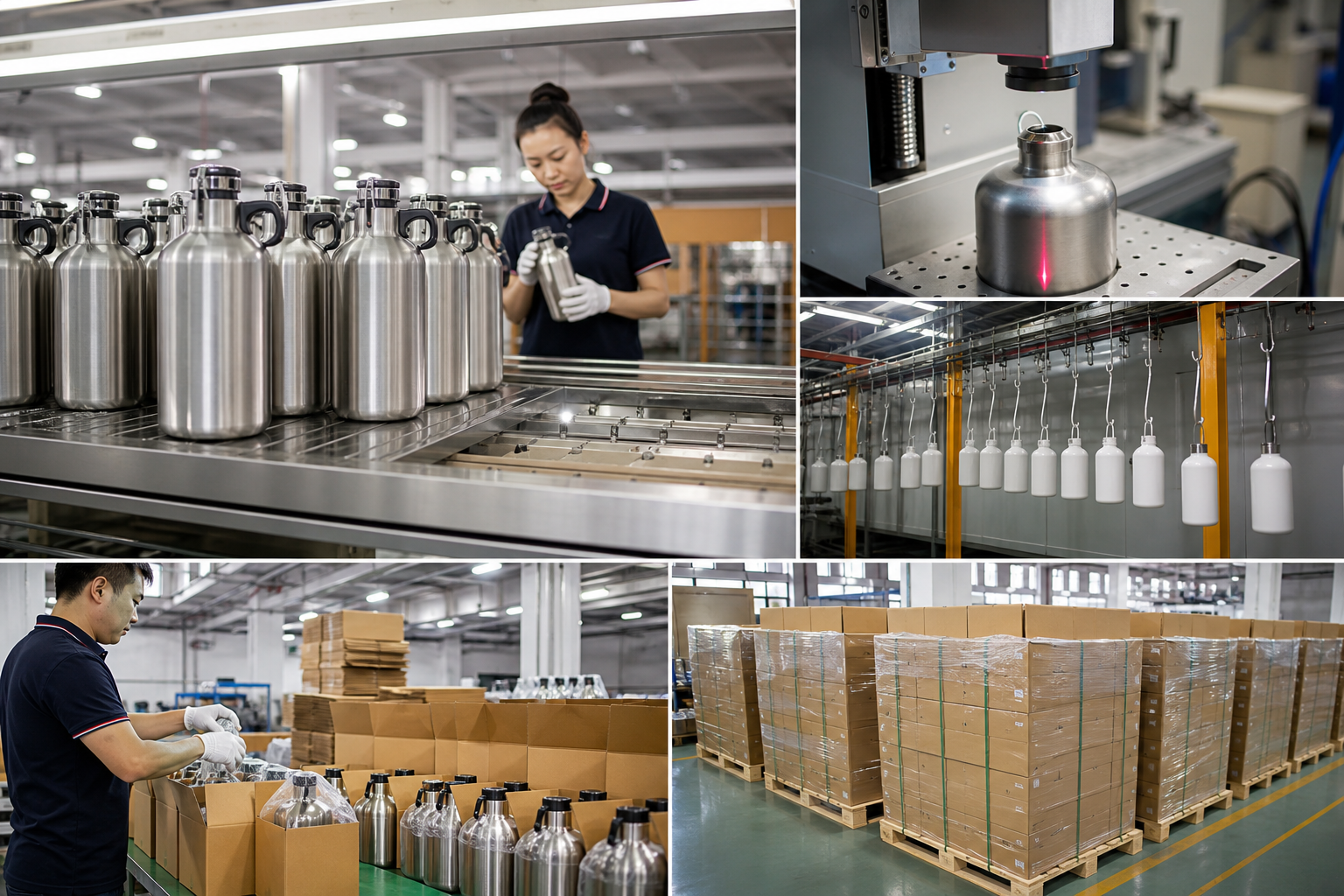
A Zhejiang factory with the line under one roof has more timing control than a reseller. Welding, polishing, coating, and packing all run in the same plant, so we can move one drawing through sample, approval, and carton test without waiting on three middlemen. That matters if your order includes custom canteen, customizable canteen, or customized drinkware items. The math does not work any other way. One approved sample. One spec sheet. One carton standard. A factory can scale; a trader just forwards messages and hopes QC does not flag the print alignment at the last minute.
- Ask who owns the tooling and die set, not just who replies to email.
- Ask for sample lead time in days; 12 days means something, “soon” means nothing.
- Ask for monthly output by SKU, not a pretty factory profile or a vague brochure.
Specs That Decide Performance
For a custom growler, the technical sheet matters more than the marketing copy. A 64 oz or 128 oz beer growler needs a tight capacity tolerance, a neck finish that stays stable on the capping line, and a closure that fits how your customers actually use it. On single-wall stainless jobs, 0.5 to 0.7 mm body thickness is the range we run most often; go thinner and dent resistance falls fast. If you want a premium feel, check the handle welds, base ring flatness, and the inside seam finish. QC pulled a sample with a rough seam last month, and that unit would have been a pain to clean after a few beer fills.
Many buyers also source the same line as custom drinkware, so they compare a customizable growler with a customizable canteen or a customized canteen program. That is the wrong question to ask if the drawing is different. The math does not work if you only compare print area and ignore the fit risk. We have seen this go sideways when a buyer flagged a PO that called for the wrong neck spec. Look for:
- Capacity tolerance within +/-3 percent.
- Leak test on every unit or every batch, not a random promise from the sales desk.
- Closure torque or fit test documented on the QC report.
- Surface finish that survives 20 wash cycles without visible peeling.
If you want a canteen custom program to match the growler line, ask the factory to keep the same measurement template and carton drop standard so the buyer does not have to manage two QC systems. We run the same 80 cm drop test on both lines when the carton spec is shared, and that saves days when the shipment is already booked.
Materials And Finish Choices
Material choice drives beer performance and export risk. For most beer growlers factory direct orders, 304 stainless is the safe default because it keeps cost, corrosion resistance, and food-contact acceptance in one package. Use 316 only when the spec truly needs it, such as harsh wash cycles or a premium program with salt spray on the coast. On the line, we check the mill cert first; if the buyer asks for 316 just because it sounds better, the math does not work.
For painted or coated bodies, ask for coating thickness in microns and adhesion data. A 60 to 80 micron powder coat is common, and the ASTM D3359 cross-hatch test gives a real answer, not a glossy sample tray photo. We had one buyer flag a PO typo that said 8 micron instead of 80 micron, and QC pulled the sample before packing because that kind of mistake goes straight into complaints.
For Europe, ask for REACH and, where needed, LFGB support. For North America, ask for FDA food-contact declarations and migration test data. If the factory says the finish is approved but cannot produce a test report, treat it as a red flag. The same rule applies to a custom canteen, customized growler, or customized drinkware range. A canteen manufacturer in Zhejiang should know exactly which finish is embossed, powder-coated, or laser marked, and which one survives 12 months of repeated handling better than the rest.
Good finish work is not decoration. It protects the shipment, the shelf life, and the next 200 uses in one layer.
Branding That Ships Cleanly
Decoration looks simple until the sample turns into 5,000 pieces. On growlers, laser engraving usually gives the cleanest result for factory direct orders. It holds up against abrasion, does not bleed, and stays sharp on brushed stainless. Silk screen is the right call when the buyer wants a stronger color hit, but the artwork has to be clean and the curing window has to stay tight on the line. We run 18 mm logo bands and 0.3 mm line checks before setup. If the artwork scale is off, the rework bill shows up fast.
This is where a lot of canteen suppliers and canteen vendors lose the order. They approve a logo from a PDF, then QC pulled the sample and the thin stroke disappeared under production lighting. A serious canteen supplier or canteen vendor asks for vector files, PMS references, print size, and a signed proof before mass production. Same story for a canteen promotional item, same story for a custom growler. If you are building a mixed program for canteen distributors, distributor canteen accounts, or distributor drinkware buyers, set the branding standard first and keep it locked across every SKU. The buyer flagged it when the logo shifted 2 mm from bottle to bottle.
For a deeper look at process choice, compare decoration methods before you confirm the PO: silkscreen vs laser engraving for growlers.
MOQ, Price, And Lead Time
Factory direct buyers ask for numbers, so here is the working range. For a plain stainless beer growler with laser logo, MOQ sits at 300 to 500 pcs per SKU. Once you add custom color coating, mixed print, or special packaging, 1,000 pcs is the safer floor. Sample lead time is 7 to 10 days after artwork sign-off. Production lead time from a China factory runs 25 to 45 days, depending on tooling load, coating queue, and carton spec. If someone offers 10 days on a complex run, they are guessing. QC pulled the sample on a 0.3 mm logo edge last week, and that told us more than the sales pitch.
FOB price for a standard custom growler usually lands at USD 4.20 to USD 8.80 per unit, driven by size, coating, lid type, and box spec. The wrong question is "what is the cheapest unit price?"; the math does not work that way. Yield decides the landed cost. A line with steady welding and polishing keeps reject rate down and protects your margin. We saw a batch lose 6% to pinhole welds before the buyer flagged it, and that turned a cheap quote into an expensive problem. Serious buyers ask for monthly output, inspection points, and spare-part coverage in one shot.
For a distributor growler program or a canteen account, lock case packs early. Twelve pcs per master carton is common, but confirm the drop test and pallet count before ship date. We run this check because a 48 x 36 inch pallet plan can break if the carton height is off by 12 mm, and then the warehouse starts calling. A typo on the PO, like 12 pcs written as 21 pcs, can slow the line fast.
How To Qualify The Factory
Qualify the factory like an engineer, not a tourist. We run this check every week on growler projects out of Zhejiang. A solid partner will answer with numbers: line capacity, sample lead time, leakage rate, AQL level, and audit status. Ask for BSCI or ISO 9001 if you need a documented system. Ask for 100 percent leak testing on closures and a written corrective-action flow if a batch misses spec. If the supplier cannot explain how they handle nonconforming goods, they are not ready for export volume.
This is where the canteen side matters too. Same discipline, same questions. It does not matter whether the factory calls itself a canteen factory, canteen manufacturer, canteen manufacturers, canteen supplier, canteen suppliers, canteen vendor, or canteen vendors. Titles do not ship goods. Process does. A custom drinkware buyer, canteen distributor, or distributor drinkware manager should ask for the same pack of evidence: production photos from the line, QC records, packaging specs, and a sample approval trail. QC pulled the sample on a 2,000 pcs order last month and found a 1.2 mm lid gap; the buyer flagged it before PO release, which saved a headache. A real China factory will show you the work, not hide behind vague language.
Ask for the data that would protect your PO if customs opens the carton at destination. That is the right test.
Source your growler program from the factory
Send your spec, logo file, and target MOQ. We will quote the build, confirm compliance, and map the fastest China production route.
Frequently asked questions
What MOQ should I expect for a custom beer growler?
For a beer growler factory direct order, a normal MOQ is 300 to 500 pcs for a simple laser logo and standard box. If you want custom color coating, special handle parts, or printed retail packaging, plan for 1,000 pcs per SKU. Some Zhejiang factories will split MOQ across colorways, but you should confirm that in writing. If you are building a distributor drinkware program, keep the MOQ tied to one spec sheet so the factory does not mix revisions. A clean MOQ is better than a low quote with hidden rework later.
Can I get REACH and FDA compliance documents?
Yes, but only if the factory already works on export drinkware. For Europe, ask for REACH support and any relevant migration data. For North America, ask for FDA food-contact declarations and the test basis behind them. If the growler has powder coating or printed decoration, request coating data and ink safety documents as well. A serious China factory should be able to send these before the PO. If the answer is vague, treat it as a supply risk. Compliance is not a marketing line; it is a file set.
How long does production take from deposit to shipment?
Typical timing is 7 to 10 days for a pre-production sample and 25 to 45 days for bulk production after deposit and final artwork approval. A simple stainless growler with laser engraving sits near the shorter end. A coated or printed program, or one that includes custom packaging, usually takes longer. If your order includes canteen customizable items in the same container, ask the factory to separate lead times by SKU. China factories can move quickly, but only when the drawing, proof, and carton spec are frozen before the line starts.
How do you test beer growlers for quality before shipping?
Start with a 100 percent leak test on every growler, then use AQL 2.5 for critical defects and AQL 4.0 for minor cosmetic issues, if that matches your buying standard. Check the closure fit, coating adhesion, print alignment, and carton compression. A good factory will also keep a spare gasket or lid sample from the approved batch. For export orders, request photo records from the inspection point and confirm how failed units are segregated. Quality control is cheaper than a chargeback, especially for distributor growler and custom drinkware programs.
Can the factory pack for retail or Amazon FBA?
Yes, if you specify it early. Many buyers ask for individual boxes, barcode labels, and carton markings that support Amazon FBA or distributor case packs. If you need FNSKU labels, confirm the label size and placement before printing. A common setup is 6 or 12 pieces per master carton, with a 5-ply export carton and drop-test confirmation. If the same shipment includes canteen promotional items, keep the carton style consistent so warehouse receiving is simple. The factory should quote packaging separately, not hide it inside the unit price.