Key Takeaways
- MOQ for a standard 64 oz stainless beer growler is usually 500 units; custom color often starts at 1,000 units.
- A 0.5 mm 304 stainless body is a safer commercial spec than 0.4 mm for beer growler bulk orders.
- Typical ex-works pricing for simple single-wall growlers in China can start around USD 2.80-4.20 per unit at 1,000 pcs.
- For export, ask for REACH, LFGB where needed, and an AQL 2.5 inspection plan before you approve production.
If you are buying beer growler in bulk, the hard part is not finding a supplier. The hard part is separating a production spec that runs from a pretty sample that fails in transit, leaks after the first wash, or misses your margin by $0.60 a unit. We see that every week on the line. A 0.4 mm wall, an 18/8 stainless body, a powder coat, or a vacuum build all change cost, lead time, and the real service life of the program.
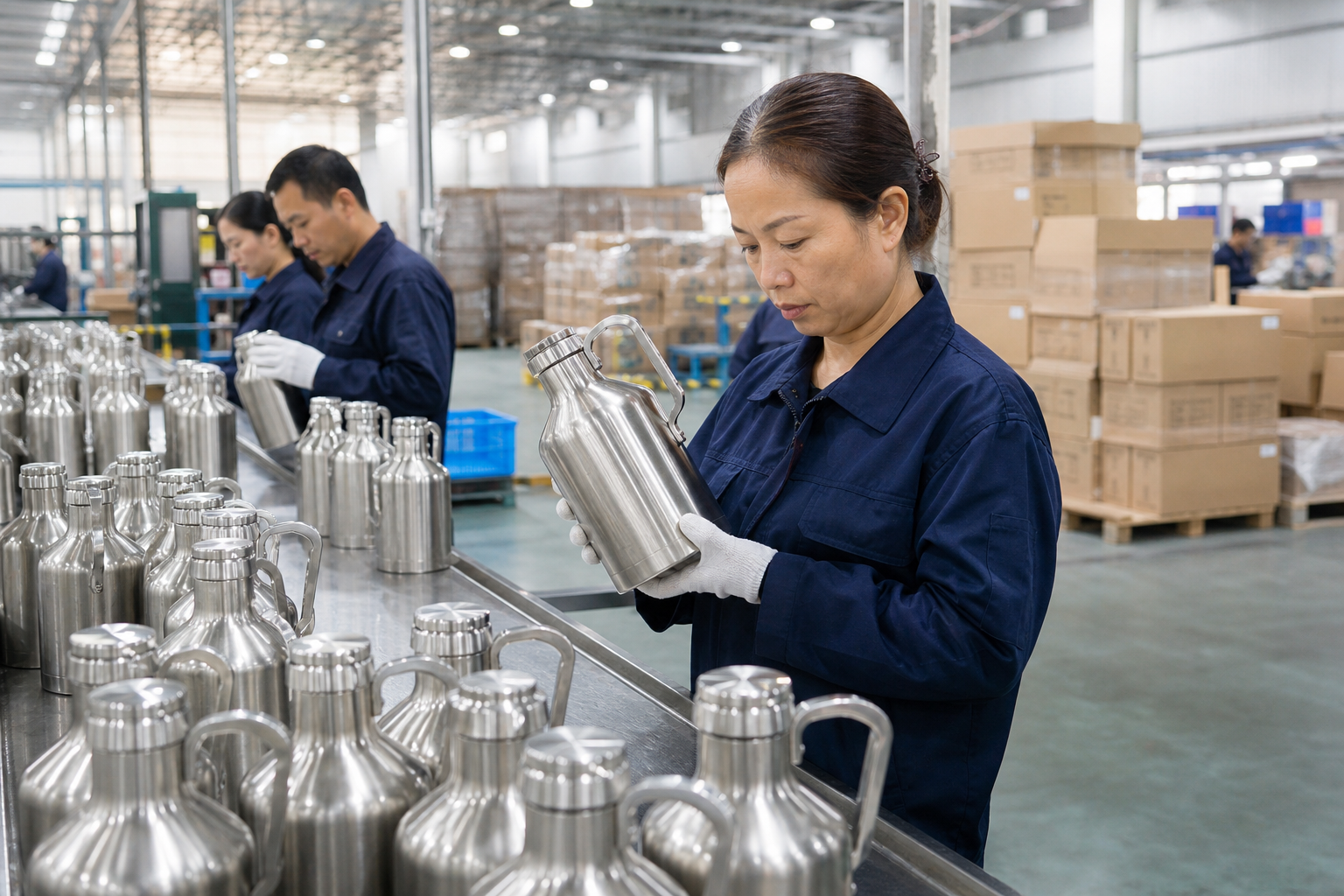
We build drinkware in Hangzhou, Zhejiang, and most buyers want the same thing: a bulk growler program that ships on time, passes basic compliance, and does not create headaches for Amazon, retail, or bar-channel distribution. QC pulled the sample, filled it with 60°C water, and checked the cap torque before it left the room. If you are sourcing beer growler wholesale or beer growler wholesale bulk, start with the use case, then lock the structure, finish, packaging, and test standard. The wrong question is whether the factory can make one nice piece. The real question is whether we can hold the spec across 5,000 units without the buyer flagging a leak report on day 12.
Start with the drinking scenario
Before you ask for a quotation, pin down how the growler will be used. A bar takeout program needs a different bottle from a promo gift set, and a homebrewer refill bottle is not the same thing as a retail shelf item. For beer growler in bulk, we usually see 32 oz, 64 oz, and 128 oz. The 64 oz size moves fastest. It packs cleanly at 12 or 24 pieces per master carton, and buyers like that it fits standard shelf pricing without forcing a weird carton count.
For procurement, the use case decides the material stack. If the buyer wants cold retention for 6-12 hours, a double-wall vacuum body is the right call. If the target is lower landed cost for beer growler wholesale, single-wall 304 stainless is often the better commercial choice. We’ve seen this go sideways when a buyer asked for “premium” but chased a razor-thin margin; the math doesn’t work. A bulk drinkware program should stay simple unless the order size and margin support the extra tooling. On our line, the fastest quote comes when the buyer states capacity, finish, lid type, carton spec, and target market. Skip that, and you get a vague “best wholesale drink bottle” reply that nobody can place.
Ask for these details up front:
- Capacity: 32 oz, 64 oz, or 128 oz
- Material: 304, 201, or glass liner if applicable
- Wall structure: single-wall or vacuum
- Lid: screw cap, swing top, or carry handle
- Market: retail, promo, bar, or e-commerce
Choose the right material stack
The material choice sets the tone for durability, compliance, and landed cost. For most export orders, 304 stainless steel is the safest default for a wholesale growler or wholesale drinkware program. We run a quick salt-spray check on the line, and 304 still gives us fewer rust complaints after repeated wash cycles. 201 looks cheap on paper. This is the wrong question to ask if the bottle will hold beer, sit wet in a warehouse, and travel across three ports.
Wall thickness matters more than a lot of buyers expect. A 0.4 mm shell is common on entry-level items, but 0.5 mm gives better dent resistance and feels more solid in hand; we saw that on a 2,000 pcs test run where the buyer flagged a dented carton after drop testing. For vacuum insulated bodies, 0.4 mm outer and inner walls are normal, while the neck and weld area need tight control. Ask for stainless grade certificates and keep the mill test report if the order is large. On one PO, the buyer typed 3043 by mistake, and QC pulled the sample before production started. A Zhejiang supplier shipping to North America or Europe should already know REACH and basic food-contact declarations. If they do not, the math does not work.
Practical buying note: if you want a beer tumbler bulk program alongside the growler, keep the same coating family and print method. We ship fewer touch-up issues that way, and the color stays closer from lot to lot. One spec family is easier to run than three mixed lines.
Price structure and MOQ reality
Let’s talk numbers, because this is where most buyers lose time. For a standard 64 oz single-wall 304 stainless growler, a realistic MOQ is often 500 units for stock color and 1,000 units for custom Pantone powder coating. On the line, QC pulled the sample and checked the seam at 0.2 mm before we signed off. A vacuum insulated version may start at 1,000 units because the tooling and assembly line loading are more demanding. In Hangzhou and across Zhejiang, factories can quote fast, but the quote only means something if you know what is included.
At 1,000 pieces, a simple single-wall beer growler bulk item may land around USD 2.80-4.20 EXW depending on lid, finish, and packaging. Add vacuum insulation, laser logo, and retail box, and you can move into USD 5.80-8.50 EXW without much drama. We run this comparison every week, and the math does not work if you ignore the sample fee, plate charge, carton upgrade, and inspection. A price that is USD 0.35 lower can turn into USD 0.60 higher once you add packaging and freight-ready packing. We have seen that go sideways more than once.
For canteen bulk or canteen wholesale style procurement, the same logic applies. The cheapest quote is often the one that leaves out decoration and cartons. A buyer once flagged a PO typo that said 24 pcs/carton on one line and 20 pcs on another, and production stopped until we fixed it. Ask for one quote with the same spec, same packaging, and same Incoterm. Then compare like for like. That is the right question.
Testing that protects your margin
Good sourcing is not a sample photo with clean lighting. You need tests that match the abuse the product will see on the line and in transit. For beer growler wholesale bulk shipments, we run leak tests, dishwasher cycles if the finish claims it, drop tests for retail packs, and coating adhesion checks with tape pull. If the lid uses a silicone gasket, ask for compression and odor checks after 20 hot-water cycles at 60°C. If the buyer wants alcohol flask wholesale bulk style marketing claims, keep the structure honest and check for metallic taste transfer after cleaning.
Use an AQL plan, not a vague “we check quality” promise. For a commercial order, AQL 2.5 for major defects and 4.0 for minor defects is a practical starting point. If the order is 20,000 pcs or the retail channel is unforgiving, tighten it. We once had a buyer flag a PO typo on the carton mark, and QC pulled the sample before it became a shipment problem. Ask for pre-production samples, inline inspection photos, and a final random inspection before shipment. A serious factory in China should have a documented QC process and a clear nonconformance report format. In Zhejiang, the better plants do this as routine because export buyers ask for it every week.
“If the supplier cannot state the test method, the pass/fail limit, and the sampling plan, you do not have a quality system. You have optimism.”
That is especially true if you are buying bulk growler units for private label retail or chain account distribution. We ship against that standard, or the math does not work.
Decoration and branding choices
Decoration changes perceived value and factory work. Screen print is cheap and fast for a plain utility piece. For a retail line, laser engraving, UV print, or a full powder-coated body with a one-color logo gives a cleaner look without crowding the panel. If you are building a beer growler wholesale range and a matching beer tumbler wholesale bulk line, standardize logo placement. We usually keep one logo height across the range; it saves artwork sign-off and cuts carton mix-ups. Last month QC pulled two cartons with the logo 8 mm too low, and the buyer flagged it before ship.
Laser engraving is the toughest option on stainless surfaces, especially when the growler gets washed every day. Silk screen works for high-volume promo orders, though it wears faster on wet hands and dish cycles. Powder coat gives better shelf presence and hides small body marks from forming. For buyers who also need alcohol flask in bulk or alcohol flask wholesale items, the same print method does not behave the same on a curved wall or a narrow neck. That is the wrong question to ask if you expect one decoration spec to fit every shape.
Do not approve decoration from a mockup alone. Ask for a decorated pre-production sample and check it under indoor light, daylight, and camera flash. If your sales channel is Amazon or retail, the product has to look clean at 1 meter, not just on a render. We have seen a PO typo turn “matte black” into “matte blue” on 3,000 pcs, and that kind of mistake burns time fast.
Shipping, cartons, and compliance
Export problems usually show up after the line is packed and the cartons are sealed. Packaging belongs in the spec, not in the last email. For a 64 oz growler, a master carton usually holds 12 or 24 units, depending on body size and lid type. If you are shipping for e-commerce or FBA, ask for drop-tested inner boxes and barcode placement that still leaves room for the FNSKU label. QC pulled one carton after a 760 mm corner drop and the buyer flagged it right away. A carton that saves 10 grams but crushes in transit is not a saving.
For Europe, ask for food-contact declarations and REACH-related material statements. For North America, keep the compliance pack tight: product specification, material declaration, test reports, and carton data. This is the wrong question to ask if someone wants a dozen separate files from three factories. We run one format across wholesale drinkware SKUs, including bulk canteen, canteen wholesale, and beer growler in bulk, so your team does not waste time fixing a PO typo or chasing a missing stamp on page 3.
Lead time is usually 25-35 days for standard items after sample approval, and 35-50 days for custom color or complex vacuum builds. In our Hangzhou operation, monthly capacity is 200,000 units across mixed stainless drinkware, so we can keep replenishment steady if the artwork and carton spec are locked early. We have seen this go sideways when a buyer changed the lid color after sample sign-off; the line stopped, and the schedule slipped 12 days. If you need a reliable best wholesale drinkware program, consistency beats rush orders every time.
Request a growler quote with real specs
Send capacity, material, lid, finish, and target market. We will quote the right beer growler in bulk spec, not a guess.
Frequently asked questions
What MOQ should I expect for beer growler in bulk?
For standard single-wall 304 stainless growlers, MOQ is usually 500 units for stock finishes and 1,000 units for custom color or special packaging. Vacuum insulated versions often start at 1,000 units because assembly and yield control are tighter. If you want mixed SKUs such as growler wholesale plus beer tumbler bulk in one shipment, the factory may allow a combined order value of USD 3,000-8,000 instead of a strict per-SKU MOQ. Always ask whether the MOQ includes logo setup, carton printing, and sample charges.
Is 304 stainless necessary, or can I use 201?
For beer contact and repeated washing, 304 stainless is the safer choice. 201 can reduce the unit price by roughly 8-15%, but it is more prone to corrosion if the bottle is left wet or exposed to acidic residue. If you are selling into North America or Europe, 304 also makes compliance conversations easier. For a premium wholesale growler program, 0.5 mm 304 body thickness is a practical commercial spec. It feels better in hand and holds up better in retail handling than thinner stock.
What is a realistic EXW price for a 64 oz growler?
At 1,000 pieces, a simple single-wall 304 stainless growler from China can be around USD 2.80-4.20 EXW depending on lid, finish, and carton. A vacuum insulated version with laser logo and retail box may land around USD 5.80-8.50 EXW. If a quote is far below that, check what is missing: coating thickness, gasket quality, packaging, or testing. In Zhejiang, you will find very competitive pricing, but the real cost shows up after you add decoration and export-ready packing.
What tests should I ask for before shipment?
At minimum, request leak testing, coating adhesion, and carton drop testing. For vacuum products, add insulation retention checks and weld inspection. A practical inspection plan is AQL 2.5 for major defects and 4.0 for minor defects, with final random inspection before loading. If the product is going to retail or Amazon, ask for barcode verification, carton dimension confirmation, and a decorated pre-production sample. This is the difference between bulk growler sourcing and gambling on a photo sample.
Can I source growlers together with other drinkware items?
Yes, and it often improves your purchasing efficiency. If you already buy canteen bulk, canteen wholesale, or beer tumbler wholesale bulk items, keeping the same supplier family can reduce artwork work, freight coordination, and compliance admin. The trick is not to force every SKU into one spec. A growler, a canteen, and an alcohol flask wholesale bulk item may share materials, but their lids, packaging, and test needs are different. Group them operationally, not blindly by price.